The Odal rune (Othala): meaning, history and heritage jewellery
Introduction: a sign of roots and inherited land
A friend in rural Devon inherited her grandmother's small farm. The land had been in the family for five generations. When she moved into the old farmhouse, her grandfather pulled out a small box, opened it, and gave her a silver pendant. The pendant was shaped like an angular diamond standing on two short legs, the Odal rune from the Elder Futhark. The grandfather said: "Wear it. This is your land now, but also your ancestors' land. The rune holds both meanings."
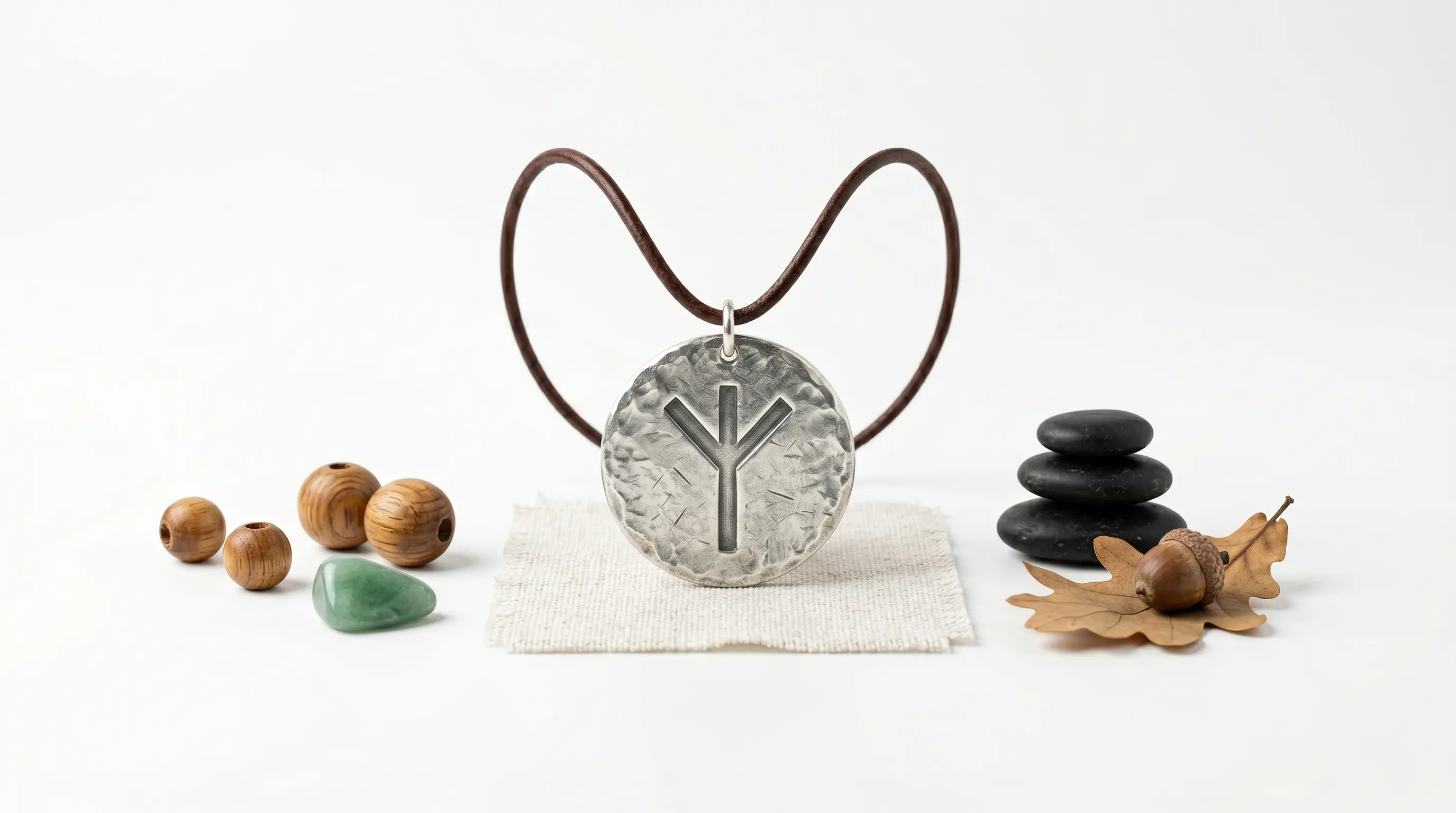
The Odal rune (also called Othala or Othilia) is one of the most layered and historically significant runes of the Elder Futhark. Its core meaning is heritage, ancestral land, home, the roots that connect a person to their lineage and place. The graphic form is a diamond standing on two diverging legs, resembling the outline of a homestead and its fields.
This guide gives the full history of Odal: from its origin in the Elder Futhark, through use among ancient Germanic peoples and Vikings, to medieval allodial law, to modern jewellery. It also addresses the difficult twentieth-century context with sensitivity: the rune was misappropriated by certain ideological movements, and modern wearers should know that history. The focus throughout is on the rune's authentic historical and personal meaning of family, home and belonging.
If you want to read about other runes, see the Valknut meaning guide and the Mjolnir guide. For the Algiz rune, see the Algiz rune guide (article 22000).
What the Odal rune is
The Odal rune is the 24th and final letter of the Elder Futhark, the oldest known Germanic alphabet. Its shape is a vertical diamond on two short diverging legs, like an outline of a household with its fields stretching outward. Of all the runes in the Futhark, Odal is one of the most graphically distinctive: it draws a closed figure, whereas most runes are open constructions of lines that do not meet. This closed shape is symbolically meaningful. A property is a bounded space, separated from the rest of the world. The rune literally draws an enclosed piece of land.
Place in the Elder Futhark
The Elder Futhark consists of 24 runes divided into three "aetts" (sets of eight). Odal is the last rune of the third aett (Tyr's aett) and the last of the entire alphabet. Its position is symbolic: the closing rune of the cycle, the final point. Runologists note that the placement of a rune in the sequence is never arbitrary. Fehu, the first rune, means cattle, portable wealth, the kind of riches that can be acquired and lost. Odal, the last, means the opposite: immovable wealth, land, the patrimony that cannot be taken away. The alphabet opens with wealth that circulates and closes with wealth that endures. This symmetry reflects a worldview in which the ultimate value is not what you earn, but what you transmit.
Family within the third aett
Odal belongs to the third aett, the aett of Tyr, which groups runes relating to the human and social world. This aett gathers Tiwaz (justice, sacrifice), Berkana (the birch tree, birth, motherhood), Ehwaz (the horse, partnership), Mannaz (humanity, community), Laguz (water, the flow of life), Ingwaz (fertility, rest), Dagaz (daylight, awakening) and Odal. All these runes speak of social life: family, partnership, community, law, home. Odal is their logical culmination, because it unites the family across time, through the generations, where the other runes describe a single life within one generation.
Phonetic value
Odal represents the sound "o" (long). In Proto-Germanic the word "*othalan" meant inherited land, ancestral property.
Function
In writing, Odal functioned as a regular letter for short inscriptions on weapons, tools, jewellery, gravestones. In divinatory and amuletic practice it bore the meaning of heritage, home, and roots. As a concept it appeared in rune poems, the mnemonic texts in which each rune was described by a strophe. The Old English rune poem, dated to the tenth century, gives Odal a verse that translates roughly: "The home is dear to every man, if he can there enjoy what is right and fitting, in prosperity, in due season." This ancient definition says it all: Odal is the house lived in with justice and continuity.
Younger Futhark
In the later Younger Futhark of the Viking age (after 800 AD), Odal disappears: the alphabet was reduced from 24 to 16 runes. But the meaning survived in Norse culture through the word "odal" itself, designating allodial land, and through the legal institutions built around it.
Origin of the name and pronunciation
A few linguistic notes.
Proto-Germanic name
In Proto-Germanic the rune was called *othalan or *othilan. The exact pronunciation is debated but close to "OH-thuh-lahn" or "OH-thee-lahn." The name designated "hereditary property," "allodial land," "family estate." The word is related to the Proto-Germanic adjective *athal-, meaning "noble." Nobility in ancient Germanic thought was not a title granted by a king; it was the condition of possessing land that no one could take from you because it came from your ancestors. Nobility was rootedness.
Modern names
In modern literature the rune appears under several names:
- Odal (the most common modern English form, pronounced "OH-dal")
- Othala (a transliteration of the Old English form, more common in English-language scholarship)
- Othilia (a Latinised variant, rare)
- Othel (Old English version of the name, which also appears as "Ethel")
In Old English
In Old English (Anglo-Saxon) the rune was called "Othel" or "Ethel" and survived in the Anglo-Saxon Futhorc (a derivative of the Elder Futhark) longer than in continental Germanic traditions. The same root gave English words: "atheling" (a prince of noble birth), "Ethel" as a personal name, and the concept of allodial inheritance. The word "noble" in English comes from Latin roots, but the equivalent Germanic concept survived in these Anglo-Saxon forms.
In Scandinavian languages
In Old Norse the related word "odal" survived as a legal term for inherited family land. "Odelsmann" was the owner of allodial land in medieval Norway. The Norwegian word "Adel" (nobility) and the German "Adel" both derive from the same Proto-Germanic root, making the connection between the rune's meaning and the concept of hereditary nobility entirely transparent. The name Otto and hundreds of Germanic place names also carry the same root, showing how deeply the concept of hereditary land structured the societies that used these languages.
The shape of the rune
A closer look at the graphic form and what it communicates.
Classic shape
A vertical diamond (a square turned on its corner) on two short diverging legs. Like a stylised outline of a homestead or a fenced field. The diamond above: the family house, the enclosed property. The two legs: the foundations, the roots, what anchors the house to the ground and prevents it from drifting away.
Why a closed figure
Most Elder Futhark runes are open constructions, built from strokes that do not meet, because ancient carvers avoided horizontal lines that would follow the wood grain and be hard to read. Odal breaks this pattern: the diamond is fully closed. This reflects the meaning directly. An enclosed property is defined by its boundary. The rune draws that boundary.
Symbolic reading of the shape
Some commentators see in Odal's form a kinship with the rune Ingwaz (a simple diamond without legs), which symbolises the seed, the potential for fertility. Odal would then be Ingwaz "that has taken root": the seed become an estate, the potential become heritage. This reading is consistent with the two runes' proximity in the third aett, where Ingwaz comes just before Odal.
Variants
In Anglo-Saxon runes the form may vary slightly: the legs longer, the diamond smaller. Some inscriptions show widely diverging legs, others nearly parallel legs. These variations do not change the rune's meaning; they reflect regional and individual carving habits, just as handwriting varies without becoming illegible.
In jewellery
In jewellery, Odal appears as flat cut-out pendants, engravings on round or oval medallions, and intaglios on ring faces. Its closed geometric shape is particularly well suited to cut work: an ajoure diamond lets light and skin show through, giving the piece a lively quality. The shape also suits minimalist contemporary jewellery, where clean, readable forms at small scale are valued. An Odal pendant of two centimetres remains perfectly recognisable, which is not true of more complex runes. This graphic efficiency partly explains why Odal is among the most requested runes from workshops specialising in Nordic symbolism.
Customer reviews
Zevira is a real jewellery shop. Genuine payments, deliveries and customer thank-yous.
🥰🥰🥰 gracias
Ok, ¡gracias! 🙂
Among ancient Germanic peoples
The first context for the rune.
Approximate period
The Elder Futhark was used between roughly 150 BC and 700 AD across territories of modern Germany, Scandinavia, the Netherlands, parts of Britain.
Early inscriptions
Silver, gold, engagement rings, symbolic jewellery, paired sets.
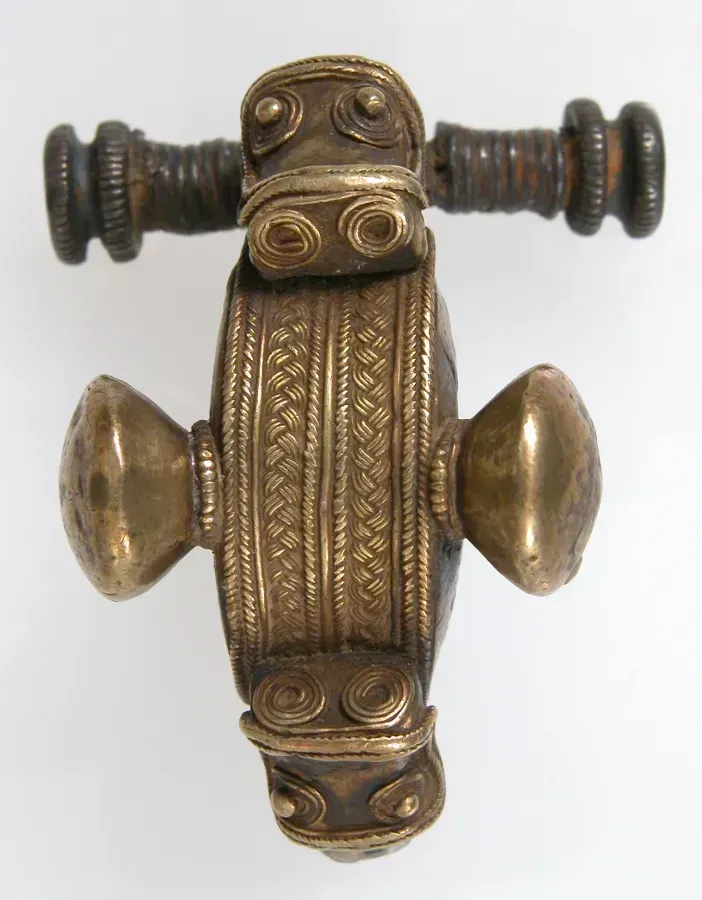
Inscriptions with the Odal rune have been found on stelae, weapons, jewellery and gravestones from the third century AD onward. The regions covered include Scandinavia, northern Germany, the Jutland peninsula, the Netherlands, and parts of Britain where Angles and Saxons settled. Among the most notable objects are bracteates: stamped gold medallions worn as pendants, made chiefly in the fifth and sixth centuries. Many bracteates carry runic inscriptions. The bracteate from Seim (Zealand, Denmark), dated to the sixth century, shows a rider and the Odal rune, interpreted as the mark of a hereditary lord. Other significant finds include the Tjurkö bracteate (Norway) with an inscription including Odal, and the Eggjum stone (Norway, seventh century) with one of the longest Elder Futhark inscriptions known.
Magical and amuletic use
Beyond regular writing, the runes were considered to carry power. The Odal rune was carved on house door-posts as a stabilising and protective symbol: a request for safety for the home and family. A rune worn at the neck was not a neutral decoration; it was a charged object, expected to draw toward the wearer what it signified. Carrying Odal meant carrying the idea of home, lineage, rootedness. For a people who could spend months away from home on trading or raiding expeditions, the reminder of the ancestral land had a particular force. The rune was a symbolic anchor for men whose profession was to depart.
Three functions
The Germanic peoples used runes in three main ways. As writing: short inscriptions (often one to three words, typically the owner's name) on durable objects. As magic: runes carved on amulets, weapons, and building timbers to invoke specific forces. And as divination: Tacitus in his Germania of 98 AD describes Germanic priests casting carved branch-pieces on white cloth and reading the signs that fell face up, though he does not use the word "rune." This early mention of Germanic divination is the kind of practice that later rune traditions adapted and formalised.
Odal among Vikings and in Scandinavia
The second great chapter.
After the alphabet reform
When the Younger Futhark (16 runes) replaced the Elder Futhark, the Odal sign disappeared as a letter. But the concept of "odal land" survived through Old Norse culture and law with full force.
Viking social structure
The family farm, the odal, stood at the centre of Viking social organisation. Scandinavian society of the era consisted principally of bóndi, free peasant farmers who owned their land. The bóndi was neither noble nor serf: he was a free man who drew his status, his right to speak at the assembly, and his honour from the land inherited from his fathers. Possessing an odal gave the right to sit at the thing, the assembly of free men that delivered justice and made collective decisions. Without hereditary land a man remained at the margin of the social body. The farm was not merely a means of survival; it was the family's identity, often designated by the name of the estate rather than a family name. A man was "So-and-so of such-and-such odal." The land made the man, and the man owed himself to the land.
Allodial law
In medieval Scandinavia (Norway, Iceland, Sweden) "odal" was a legal term: family land owned by hereditary right, free from feudal obligations to a lord. The central rule was clear: family land could not be freely sold to a stranger outside the clan. If sold, the heirs of the lineage retained a priority right to buy it back for a fixed number of generations. Norwegian law codes (the Gulating and Frostating, from the twelfth and thirteenth centuries) codify these rules in detail: the waiting periods, the order of priority among heirs, the conditions for exercising the right. This was not folklore but applied law, argued before assemblies. The goal was to prevent the dispersal of family patrimony, to ensure that land worked by the ancestors remained in the hands of their descendants.
The Odelsguts
A family that owned odal land had high social status. The land was a sign of independence from feudal lords and royal power. Its loss was a dishonour; its recovery, a restoration. Even today in Norway "odelsrett" (the right of allodial inheritance) is a part of property law.
Symbolic value in Norse culture
The concept of "odal" reached far beyond legal terminology. It was a sign of belonging to the family, the soil, the people. A man without odal land was a lesser man in all the ways that mattered: legally, socially, and in terms of personal honour. The Icelandic sagas, written in the thirteenth and fourteenth centuries about events from the ninth to eleventh, turn constantly on questions of hereditary land: who possesses it, who has a right to it, who seeks to recover it. Family disputes, lawsuits, arranged marriages, and vengeances all revolve around the odal. The sagas are in a sense a long literary meditation on what the Odal rune condenses into three lines.
Connection to the Old Norse worldview
In the Norse pagan worldview, soil and ancestors were sacred. The connection between a living person and the line of ancestors ran through the land where the family had lived for generations. Losing that land was to lose the thread connecting the living to the dead. The mythology reinforces this: Frigg, Odin's wife, goddess of home and marriage, embodies the domestic centre. Freya, goddess of love and earth, governs what makes a family grow and persist. The god Freyr, associated with the rune Ingwaz whose shape is close to Odal's, is the god of agricultural peace and good harvests: the nourishing land transmitted from father to son.
Wear the symbol, don't just read about it. These are in stock:
The meaning of Odal: heritage and ancestral land
The core symbolic meaning, in its full range.
Material heritage
At the most concrete level, Odal designates land, house, and transmitted goods. What one receives physically from parents and grandparents: a farm, an estate, a piece of jewellery, a family business. In the ancient Germanic world this material sense was primary, because survival depended on it. Today the material meaning of Odal is not limited to agricultural land. It can describe a family house passed through three generations, a workshop, a business, a piece of jewellery inherited, a collection of tools, any object that moves from hand to hand within a lineage and carries that lineage's memory.
Immaterial heritage
Alongside the material, Odal designates everything transmitted without physical weight: family values, traditions, stories told across generations, skills, trades, language, cuisine, ways of doing things. What the family contributes to a person beyond goods. For many contemporary wearers, this immaterial meaning is primary. One does not always inherit land, but one always inherits something: a way of speaking, a craft, a recipe, a moral standard, the memory of a grandparent. Odal honours this invisible transmission, which is often the most durable.
Wider symbolic layer
Roots. Where I come from, who my ancestors are, what culture and tradition I grew up in.
Home. A building, yes, and also the place where I belong. The concept of an anchor, a place that is mine and where I am expected.
Family. Continuity of generations, the responsibility to keep what was inherited and pass on more.
Identity. A sense of being someone tied to specific roots, not a rootless person.
Transmission as responsibility. The wearer of Odal is an heir and at the same time a link in the chain. They have received, and they will pass on. The rune says: the heritage is not a passive possession but an active charge. One keeps, maintains, enriches, and then transmits in turn.
Freedom through rootedness. In the ancient Germanic world, freedom was inseparable from owning odal land. A person without that foundation was dependent on others. Odal represents the kind of belonging that gives inner anchor and independence.
In divination
In rune divination Odal is interpreted as:
- A question of family, home, inheritance
- Continuity with the past
- Tradition in relation to innovation
- Connection to ancestors
The inverted Odal (legs pointing up, diamond below) indicates in most contemporary rune reading systems:
- Loss of home or family disruption
- Disconnection from roots
- The need to leave the family environment for personal growth
- An unresolved inheritance matter
In meditative practice
Some modern practitioners of Northern traditions use Odal in meditation as a symbol of connection with their roots: visualisation, recall of family history, reflection on what they have inherited and what they wish to transmit. The practice is worth understanding as a psychological and cultural tool rather than a magical one: it works by focusing attention and framing questions about lineage, not by producing direct effects.
Odal in modern jewellery
A separate chapter.
Why people wear Odal
Most often as a symbol of:
- Belonging to a family and connection to its history
- Honour for one's homeland or geographical origin
- A personal commitment to keep family traditions
- An interest in Norse and Germanic heritage broadly
- A marker of a significant family transition: inheritance, marriage, birth of a child, death of a parent
Who wears it
The first audience for Odal includes people who value generational transmission and ancestral memory, for whom family extends past the immediate circle of the living into a chain reaching back to grandparents and great-grandparents. Some have Scandinavian, German, English, or Dutch ancestry and choose Odal for its direct connection to that heritage. But the majority of contemporary wearers have no particular Scandinavian ancestry: they are people who value family transmission in general and find in Odal a strong graphic expression of that value. The rune is worn by people in life transitions, young parents, recent heirs, people far from their family who want to keep a symbolic link. It has no gender anchor: pieces exist for all styles.
Communities that wear it
- Asatru and other Northern pagan communities, for whom the rune is part of active religious practice
- Historical reconstruction enthusiasts (Viking, Anglo-Saxon, Germanic) wearing it as part of authentic kit
- People with Scandinavian or Germanic heritage honouring family origin
- Genealogists who have traced and value their lineage
- Those rebuilding family connections after displacement, emigration, or interruption
Sensitive context
It is essential to mention this honestly: in the twentieth century the Odal rune (along with several other Germanic symbols) was misappropriated by certain ideological movements, especially in 1930s and 40s Germany. The rune itself predates this misuse by over a thousand years, and its continuous historical meaning is family and ancestral land. But it is worth being prepared for occasional questions and able to explain the genuine context.
Types of Odal jewellery
The most common forms.
Pendant
The most popular form. The Odal rune as a flat pendant on a chain, either cut through in an openwork diamond (letting light and skin show through) or engraved in relief on a disc. Sizes from 1.5 to 4 cm. Worn on a fine chain for a contemporary minimal effect, or on a leather cord for a more authentic Nordic feel. The pendant is the most visible format and the one that expresses the rune's meaning most directly.
Ring
A signet ring with the engraved or carved Odal rune on the face. Often in silver or bronze. The signet ring echoes medieval rune rings found in Scandinavian and Anglo-Saxon archaeological contexts. More discreet than a pendant, suited to someone who wants the symbol present but unobtrusive.
Medallion
A round or oval disc with the rune engraved, sometimes surrounded by Norse ornament. The reverse face is well suited to personalised engraving: a name, a date, a dedication. The medallion is a natural format for a transmission piece, because its two faces can tell a story.
Bracelet
A bracelet with an engraved plaque showing the Odal rune, or a leather strap with a metal Odal plate. Some multilayer bracelets include Odal as one of several runic elements, allowing a composed message. The leather-strap version gives a robust, active quality; the silver chain version is more refined.
Earrings
Small Odal rune earrings, often in pairs as studs. The geometric shape suits miniaturisation well. When wearing Odal in earrings, the usual practice is to keep the same orientation on both sides, to avoid an unintentional inverted rune on one ear.
Brooch
For traditional clothing at reconstruction events. A round or oval brooch with the engraved Odal rune.
Custom and personalised pieces
Individual pieces: a ring with Odal as part of a matched wedding pair, a pendant with both partners' family runes, a memorial piece in honour of an ancestor. Bind-runes incorporating Odal as the central element, with other runes added for a personal message. Some workshops offer pieces where the visible face bears Odal and the inner face carries family names, dates, or a lineage motto.
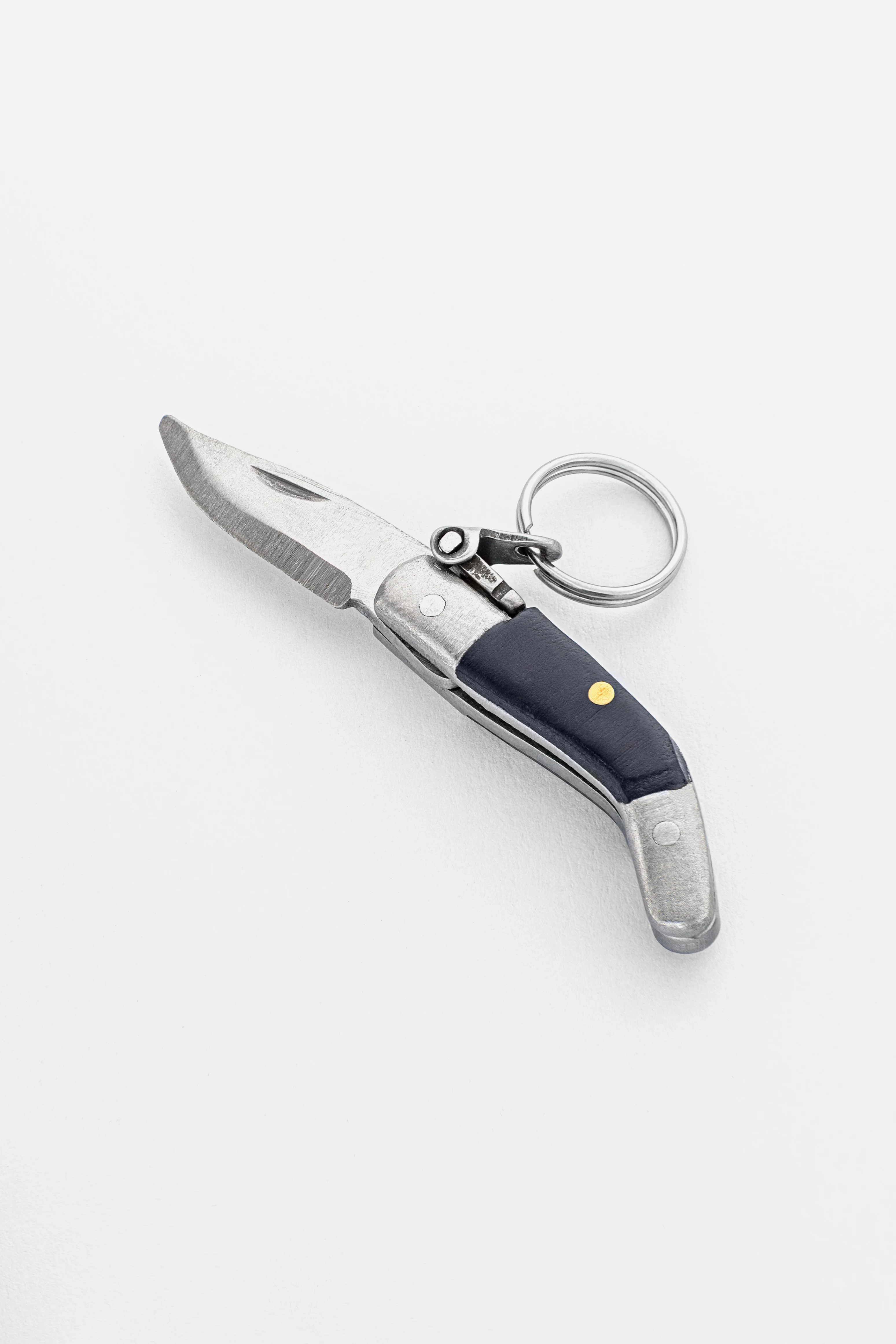
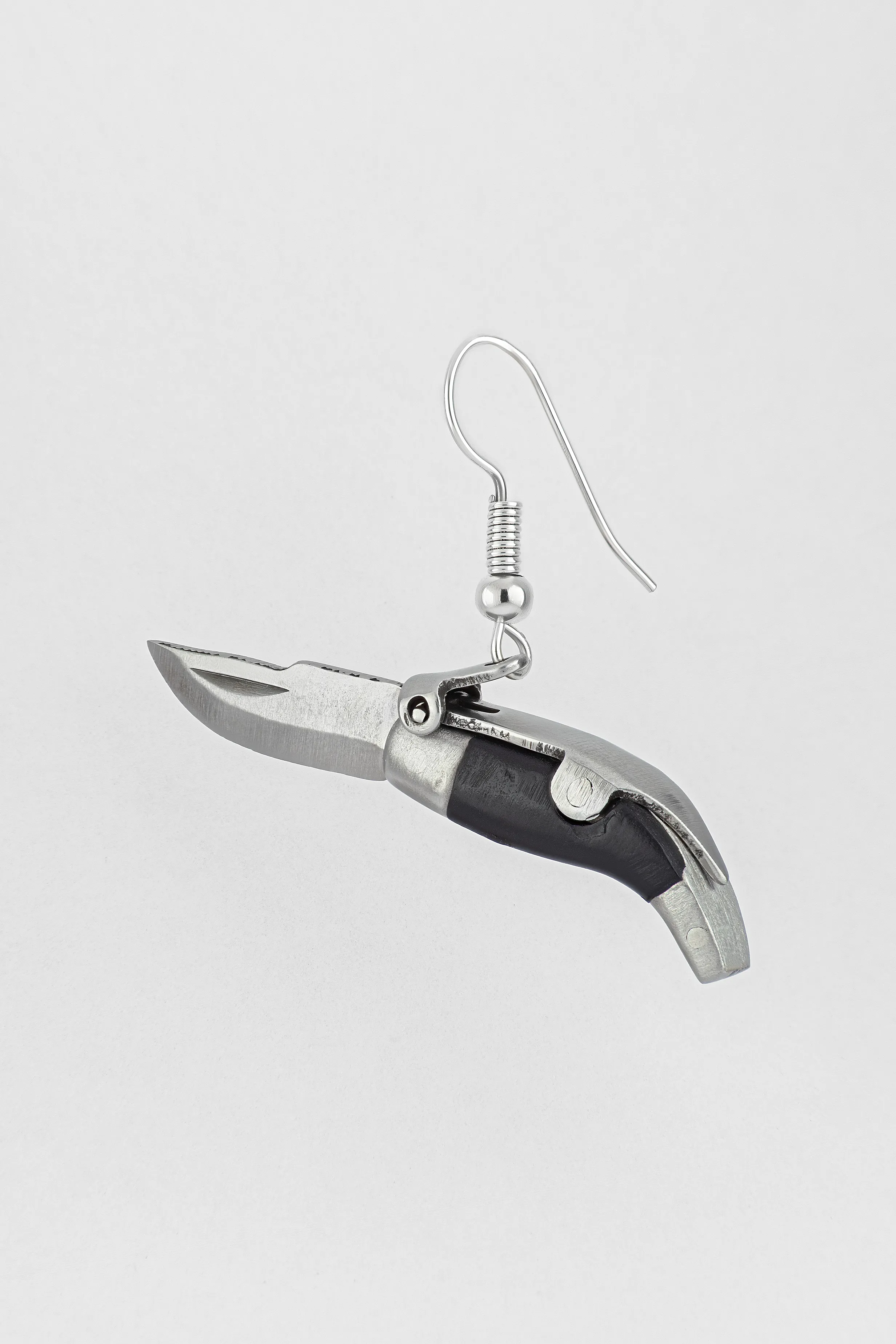
Artisan-crafted CAPAORA navaja pendant
A 40 mm stainless-steel navaja with a real folding mechanism and Palanquilla lock. An affordable gift to remember.
A code for blog readers:
10% off your first order
Authentic · Maker's guarantee · Ships from Spain
Materials for Odal pieces
The most common choices.
Silver
The most popular material and the most historically authentic for Nordic runic jewellery. The archaeological finds at Viking sites (Birka in Sweden, Hedeby in Denmark, Gotland) were predominantly in silver. Silver 925 accepts oxidised patina well, which gives pieces the sought-after appearance of an archaeological find. Silver is also symbolically rich in Northern culture: associated with the moon, with lineage, with what passes from generation to generation. It is the most coherent choice for an Odal piece of transmission. It does require periodic cleaning, as it tarnishes through contact with air and skin.
Bronze
A historically accurate material. Bronze rune jewellery has been found at many Northern archaeological sites. Modern bronze pieces offer a warm reddish look and develop a distinctive greenish patina over time. Bronze requires regular care to limit oxidation. It suits the wearer who values archaeological fidelity.
Gold
Less common for runic jewellery, since gold was reserved for elites in the Viking world. Today it suits family pieces of high value designed to be transmitted as genuine heirlooms. Gold does not tarnish, does not oxidise, crosses generations without heavy maintenance. For an Odal piece conceived as a lineage object, to pass from grandparent to grandchild, yellow gold embodies materially the durability that the rune signifies.
Iron
Authentic but practically rare due to corrosion. Some enthusiasts of authenticity choose forged iron.
Wood
Historical material, especially for amulets. Modern wooden runes are often handmade, carved from oak, ash (symbol of Yggdrasil), walnut, or yew. They require careful handling: no water exposure, no steam, no extremes of temperature.
Combinations
Silver pendant with bronze or iron inserts, or two different metals in one pendant. The contrast of materials can convey the idea of continuity (old and new, received and created).
Who the Odal rune suits
Some practical orientation.
People with strong family bonds
Those who feel a deep tie to family, parents, grandparents, ancestral homes. The rune resonates as a daily reminder of these connections.
People in life transitions
Marriage creates a new family branch. The birth of a child makes one a transmitter. The death of a parent places on one's shoulders the memory of who is gone. These transitions reorganise a person's position in the chain of generations. The rune can mark this change of position clearly.
People who have inherited something
Receiving a house, a piece of land, a business, or even a piece of jewellery places the recipient in exactly the situation Odal describes. The rune can symbolise the inheritance received and the responsibility that comes with it.
People rebuilding family heritage
Those whose family history was interrupted (by displacement, emigration, war) and who are deliberately reconnecting with their roots. The rune marks the rebuilding.
People with Scandinavian or Germanic roots
A personal connection to the historical context. The rune carries authentic genealogical meaning for those tracing ancestry to the regions where the Elder Futhark was used.
Lovers of Norse traditions
People interested in Asatru, the Old Norse worldview, Viking culture without necessarily having direct ancestry.
People honouring a deceased loved one
The rune as a memorial of a parent or grandparent who built the family home or maintained traditions. For those who have recently lost someone who held the family together, Odal can mark the taking up of that role.
Historical reconstructors
People who recreate Viking, Anglo-Saxon or Germanic life as a hobby. The rune is an authentic element of historical kit.
Who it does not suit
The Odal rune is not the right choice if you only know it visually without understanding its history. The rune carries weight; ignorance of the meaning makes the wear feel hollow and risks awkward questions.
Odal wants oxidised silver and a closed collar. A gold rune on a bare chest belongs on holiday, not on you.
How to wear the Odal rune
I style Odal as a quiet sign, not as jewellery shouting for attention. The shape is spare, so it slots into a wardrobe easily, and the work happens in the details: the metal, the collar, the chain length. Here is how I break it down by occasion.
What do I wear Odal with day to day? For everyday I recommend a small pendant, one and a half to two centimetres, on a fine chain, under a plain tee or a single-colour knit. A dark or light top with a closed neckline acts as the backdrop: oxidised silver reads sharper against dark, softer against light. One sign, nothing around it, that is where the rune looks most honest.
Can the rune work at the office? It can, as long as you keep it restrained. I suggest the same miniature piece, tucked under a shirt or a collared blouse, so the sign stays with you rather than on show. Oxidised silver is calmer here than a bright polish and does not pull focus in a formal setting.
How do I bring Odal out for the evening? For evening the logic reverses: the sign moves to the front. Under a deep V-neck or an open neckline I choose a larger pendant, two and a half to three centimetres, on a short chain or a choker, so the rune sits in the collarbone zone. Against a black dress or a dark suit I recommend silver with a patina; against beige and warm fabrics, bronze or gold settles in more softly.
What do I add for a special occasion? For a wedding or a family celebration I add a garnet or amber set into the piece. Northern stones support the theme of lineage without turning fussy, and the look reads as considered rather than accidental. If you are building layers, keep the metals in one family: silver with silver and steel, gold with gold and bronze.
Who does Odal suit, and how do I pick the length? It suits people who value restraint and meaning behind a spare form: Scandinavian minimalism, a calm base, a wardrobe without noise. On length I advise this: for a heavy men's piece a 55 to 60 cm chain brings the pendant onto the chest, for a miniature one 40 to 45 cm holds the rune at the collarbone. And the rule of measure: one expressive Odal works harder than a handful of symbols at once.
Turn on your camera, pick earrings, a pendant or a ring, and see the piece on yourself in real time.
Switch items in one tap.
Everything runs in your browser: no photo or video is ever uploaded.
Leave your email, we'll send your discount code. No spam, unsubscribe anytime.
The code arrives by email, valid on your first order.
Combinations with other runes and symbols
A few common pairings.
Odal plus Berkana
Berkana is the rune of birth, the birch tree, femininity, motherhood. Together with Odal they form a pairing of continuity: the family origin (Odal) and the next generation (Berkana). For a new mother in a family that values its lineage, this combination has particular resonance.
Odal plus Mannaz
Mannaz is the rune of humanity and social bonds. Combined with Odal: the family (Odal) within wider human community (Mannaz). The role of one person inside a tradition and a society.
Odal plus Algiz
Algiz is the rune of protection. Together: protection of the home and family (Odal) by a larger force (Algiz). A natural pairing for people who want to express both heritage and watchfulness, or for a gift to new parents.
Odal plus Fehu
Fehu is the first rune of the Futhark: portable wealth, livestock, material goods. Together with Odal it assembles both forms of wealth: what circulates and what endures, what one earns and what one preserves. A pairing for people managing a family business or inheriting an estate.
Odal plus Vegvisir
Vegvisir is the Icelandic stave of wayfinding. Together: the family's roots (Odal) and direction in life (Vegvisir). For those going through uncertainty who want to remember where they come from while moving forward.
Bind-runes with Odal
Odal can enter a bind-rune: a composite symbol where multiple signs are superimposed or intertwined in one figure. Odal typically serves as the base, with other runes added for a personal message. A bind-rune composed to order by an artisan who understands each element produces a unique sign condensing an individual story. This is the domain of bespoke jewellery.
For more on runes generally, see the Mjolnir guide and the Valknut guide.
Odal and its historical context
Honest discussion that every wearer needs to know.
Historical reality
The Odal rune is over 2000 years old. It existed as an authentic Germanic and Norse cultural element long before the twentieth century. Its primary historical meaning is family, heritage and ancestral land. This is documented by runic inscriptions, by the Old English rune poem, by Scandinavian legal codes, and by the everyday language of Germanic peoples for whom the word "odal" described their most important social institution.
Twentieth-century misappropriation
In the 1930s and 1940s certain ideological movements in Germany used the Odal rune within their iconography. This was a misappropriation: the rune was not created by these movements, but it became associated in part of the public mind with them. Knowing this fact is not a weakness in a wearer's position; it is a necessity. An informed wearer knows what they carry and can place it correctly in history.
Current status
Today the Odal rune is once again widely used as an authentic cultural symbol by Scandinavian and Germanic heritage communities, modern pagan religious movements (Asatru, Forn Sed, Theodism), genealogists and family-history practitioners, historical reconstructors, and jewellers and tattoo artists working in the Nordic heritage tradition. Scandinavian museums (Historiska Museet Stockholm, Nationalmuseet Copenhagen, Vikingskipshuset Oslo) present the rune as part of normal cultural heritage. In Scandinavian countries the rune is perceived as a historical national symbol without political charge.
How to wear Odal in clarity
A few practical principles:
- Choose a piece that expresses the dignity of the symbol: quality metal, careful craftsmanship, clean forms, a piece from a workshop that presents the rune for its cultural and historical value
- Pair Odal with other Northern symbols of similarly positive meaning (Vegvisir, Algiz, Mjolnir, other runes) to make the context clear
- Know the full history and the authentic meaning well enough to explain it briefly and calmly if someone asks
- Buy from reputable Northern heritage jewellers, not from sources with troubling associations
This knowledge is itself a form of transmission. Knowing where the rune comes from, what it meant for the Germanic and Norse peoples, is to wear the symbol with the depth it deserves.
Odal in modern fashion
How the rune is used today.
Minimalist jewellery
Nordic minimalism favours clean lines, smooth surfaces, and the absence of superfluous ornament. In this current Odal appears as fine silver or gold pendants, delicate rings, small pieces that remain perfectly legible at small scale. The rune's closed geometric form suits this aesthetic ideally: three strokes suffice. The minimalist approach suits the urban wearer who wants a discreet sign compatible with office dress or an understated daily look.
Vintage and historical reconstruction
At the opposite pole from minimalism, the historical reconstruction current seeks archaeological fidelity. It produces pieces in bronze or oxidised silver with rough textures, deliberate patinas, and forms inspired by actual excavated objects. Odal is worked as an ancient carver would have done: irregular strokes, aged metal, an air of excavation. This approach suits history enthusiasts and reenactors.
Designer and bespoke pieces
Between these two poles, designers specialising in Nordic symbols produce unique pieces. They work with the rune freely: personal compositions, bind-runes to order, Odal combined with other signs, stone inclusions. A bespoke piece costs more but is individual, made by someone who understands the meaning of each element.
Asatru and Northern paganism
Members of these modern religious movements wear the Odal rune as a sign of faith and connection to Northern traditions. It is a normal part of community identity.
Wedding tradition
Some couples of Northern heritage exchange Odal-themed rings as part of their wedding, alongside or instead of traditional rings. A sign of forming a new family unit and committing to continue a lineage.
Memorial tradition
Wearing Odal in memory of a deceased parent or grandparent who held the family together. A personal memorial piece that marks the taking-up of what the loved one left behind.
Trends for 2026
What is current.
Minimal silver pendants
Small (1.5 to 2.5 cm), thin chains, modest design. Suitable for daily wear, fits with minimalist and urban wardrobes.
Pieces with engraving
The Odal rune plus engraved family names, dates, places of origin on the reverse face. Personalised transmission pieces.
Family sets
Matching Odal pieces for parent and child, with personalised variations. A contemporary way to mark family continuity through jewellery. The grandfather's piece and the grandchild's piece, related in form but individual in detail.
Pieces in dark metal
Black-finished silver, oxidised, antiqued. Contemporary look with a Northern feel.
Stone insertions
A small stone (amber, garnet, moonstone, or other Northern-associated material) inserted into the rune composition. Amber, in particular, carries Baltic and Scandinavian provenance and adds both warmth and cultural depth.
Mixed metal compositions
Odal in silver set in a bronze frame, or two metals in one pendant. The contrast conveys the idea of continuity across time: old and new, received and made.
Slow jewellery approach
The slow jewellery movement values unique, handmade pieces purchased with consideration rather than impulse. Odal fits naturally: it is a rune that asks to be understood before it is worn, and it suits careful atelier work. Buying an Odal pendant from a specialist craftsperson, after understanding what the rune means, is exactly the approach the slow jewellery ethos promotes.
Archaeological replicas
Producers above the mass-market level are making exact copies of specific historical finds: the Tjurkö bracteate, the Seim bracteate, the Uppåkra fibula. The buyer receives not "a rune pendant" but a historically specific object.
Odal in the context of other Northern cultures
Wider context.
Norse mythology
No deity is directly associated with Odal, unlike runes tied to a specific god (Tiwaz for Tyr, Ansuz for Odin). But the concept the rune carries runs through the entire mythology. Frigg, Odin's wife, goddess of the home, marriage and motherhood, embodies the domestic centre. Freya, goddess of love, fertility and the earth, governs what makes a family grow and endure. The spirit of the family farm also lives in Norse folklore: the tomte or nisse, the small guardian spirit of the farmstead in Swedish and Norwegian tradition, who watches over the household and livestock as long as he is respected. The trolls, boundary spirits, and household guardians of Scandinavian folklore all say the same thing as Odal: the family home is not a simple building but a charged place, inhabited by memory, that one inhabits, maintains, and transmits.
Sami tradition
The Sami people of northern Scandinavia have their own runic-style symbols (not the Elder Futhark itself but a distinct tradition). The Odal rune is not a Sami symbol but exists in Norway and Sweden alongside Sami cultural material.
Finnish tradition
Finland is not strictly Germanic and the Odal rune is not part of its native tradition. Finnish people of Norse descent may wear it; traditional Finnish heritage uses different symbols (Kalevala motifs, the Sampo).
Icelandic stave tradition
Iceland has its own magical stave tradition (the Galdrastafir) including the Vegvisir and the Aegishjalmur. These are a separate tradition from the Elder Futhark, though related by cultural context. They can be combined with Odal or worn separately.
Anglo-Saxon and Frisian connection
The Anglo-Saxon Futhorc preserved Odal/Ethel almost unchanged. The Old English rune poem's verse on Ethel describes the rune as "the beloved home of every man, where he can enjoy what is right and fitting." This tradition carried the rune into early medieval Britain and the etymological roots of English words for nobility and inheritance.
For the Aegishjalmur, see the Aegishjalmur guide.
Celtic tradition
The Celtic world has its own knot and symbol tradition (the triskele, the Claddagh, Celtic knots). Odal is not Celtic, but people with mixed Northern European heritage may wear both.
For Celtic symbols, see the Celtic knot guide and the Triskele guide.
Send a friend a discount code, they save on their first order.
Odal in personal symbolic practice
A considered use of the rune.
As a daily reminder
The wearer touches the pendant or ring during the day as a brief reminder of the connection to home and family. A small meditative habit that works cognitively rather than magically: it focuses attention on what the person values.
In transitions
When making important life decisions (a move, a marriage, a career switch), reflecting on what to keep from family heritage and what to set aside. The rune acts as a focus for that reflection.
In family conflicts
Family disputes are part of any extended family. Holding the symbol of family roots can help to remember that beyond the present disagreement the longer continuity matters. Not as a magical intervention but as a reminder of what the relationship is for.
In grief
After a parent's or grandparent's death, the rune can become a way to maintain a felt connection and to mark the taking-up of the role of memory-keeper. Many people wear the deceased's symbol as a continuing bond and a sign of commitment to carry the lineage forward.
In genealogy
For those tracing family history, the Odal rune can be a sign of completed research. Some genealogists give themselves an Odal piece after finishing a major project (a generations-back tree, a homecoming visit to the ancestral village). The piece marks the moment of connection.
In tattooing
Odal is frequently chosen as a tattoo, most often on the arm, forearm, or chest. Tattooing is a more permanent commitment than jewellery: the rune is inscribed on the skin for life. It is worth being fully informed about the rune's meaning and prepared to explain it before making this choice. Many people test the rune in jewellery form first, living with it for a time, before committing to a tattoo.
Odal and modern allodial law
A separate angle that shows the concept's extraordinary durability.
Norway
Norway preserves allodial law (odelsrett) in its land code. A descendant of a family that has owned a farm for generations has priority right to inherit and purchase it. The law is called Odelslova. It concerns agricultural and forest properties of a certain size. A member of the lineage has a legally enforceable priority right to buy back land if it is sold outside the family, within fixed time limits. This is not a tradition or a custom; it is enacted law applied by Norwegian courts. It is one of the very rare cases where a medieval Germanic legal institution has crossed the centuries into the positive law of a modern European state.
Iceland
Modern Iceland inherits the broader Norse tradition of family farming. Family farms going back many generations are still a significant part of Icelandic cultural identity, and the Landnámabók (the twelfth-century record of Iceland's settlement) itself reads as a national register of original odal holdings.
Other countries
Most European countries replaced traditional allodial law with modern property law in the eighteenth and nineteenth centuries. But the underlying value of family land continuity survives in many rural areas of Britain, France, Germany, and Spain. The Odal rune captures a value broader than any specific law: the connection between a person, their family, and the land. This value continues to matter even where the legal form has changed.
A general principle
The rune Odal and the Norwegian odelsrett share literally the same word and the same idea. In a globalised economy where land has become a commodity like any other, one country has maintained a legal device that protects the bond between a family and its soil. The allodial right resists the logic of the pure market. It says that land worked by the ancestors is not a wholly ordinary good, that it carries a part of a lineage's identity deserving of legal protection. Wearing Odal as a piece of jewellery today refers back to an idea that has not stayed merely historical or symbolic. It is still a reality of living law.
Frequently asked questions
What does the Odal rune mean?
Heritage, ancestral land, home, family roots, continuity of generations. Both the material inheritance (land, house, estate) and the immaterial one (values, traditions, memory, skills).
Is Odal a Viking rune?
It originates in the Elder Futhark, the oldest Germanic alphabet (before the Viking period). But the concept of "odal" (allodial family land) was central in the Viking era, even though the rune itself dropped out of the Younger Futhark alphabet used by Vikings.
Can I wear the Odal rune if I am not Scandinavian?
Yes, especially if you connect with the meaning of family, home and roots. The rune belongs to a broad European cultural heritage. Knowing the history shows respect for the symbol.
Is the rune associated with anything negative?
In the twentieth century the rune was misused by certain ideological movements. But the rune's primary meaning has been family and heritage for over two thousand years. The brief misuse does not erase the deeper history. Wearing it today as a heritage symbol is normal, and the Scandinavian academic and cultural community presents it as such.
On which finger or where to wear Odal?
Most often as a pendant on a chain. Ring (signet style), bracelet, and earrings also work. The pendant is the most visible format and the most directly expressive of the rune's meaning.
What is the difference between Odal and Othala?
The same rune. Odal is the modern English form commonly used in rune practice. Othala is a transliteration closer to the Old English name.
Why is Odal the last rune in the Elder Futhark?
It closes the third aett (Tyr's aett). The closing position is symbolically significant: the final rune of the cycle, the point of completion and transmission. The alphabet opens with portable wealth (Fehu) and closes with fixed, immovable heritage (Odal).
What does the inverted Odal mean?
In rune divination an inverted Odal usually suggests loss of home, family disruption, disconnection from roots, or the need to step away from one's inherited environment before being able to receive it fully.
Can I combine Odal with other runes?
Yes. Combinations with Berkana (family, birth), Mannaz (humanity, community), Algiz (protection), and Fehu (portable wealth) are all common and coherent.
Is Odal a Wiccan or Asatru symbol?
It is most often used in Asatru (Norse pagan tradition) and related Northern pagan movements. Wicca uses different symbols (the pentacle, the moon, the triple goddess). Asatru explicitly incorporates runes from the Elder Futhark.
What material is best?
Silver is the most historically authentic choice and the one with the strongest symbolic resonance for Nordic heritage. Bronze is also used and is archaeologically accurate. Gold suits a piece intended as a lasting family heirloom. Steel is practical for daily active wear.
Can I wear Odal at work?
A small, discreet piece (1.5 to 2.5 cm) is appropriate for most workplaces. Larger pieces draw attention. A pendant inside the collar avoids any need for explanation in formal environments.
Will people misread the symbol?
Some viewers familiar with the twentieth-century misuse may have associations. Most viewers will simply see a runic pendant. Being able to explain the historical meaning briefly and without defensiveness is useful preparation.
Should I make my own Odal piece or buy?
Either works. Handmade carries personal meaning. Bought pieces from reputable Northern heritage jewellers are also entirely appropriate. Avoid sources that present the rune in a politically charged context.
Where does the rune appear in literature?
In the Old English rune poem the verse on Ethel describes the rune as the beloved home where a man can live by right and custom. In Beowulf and other Old English texts the concept of the family estate and its continuity runs throughout. Modern fantasy literature inspired by Norse culture (Tolkien was a scholar of Old English) works with related concepts extensively.
Can the Odal rune be a family heirloom?
This is arguably its most natural use. A piece of silver or gold commissioned with Odal and passed from grandparent to grandchild, or from parent to child at a milestone, directly enacts the meaning the rune carries. Many families use it this way.
Conclusion
The Odal rune captures a deep value: the connection between a person, their family, and the place they come from. For over two thousand years it has been a sign of inherited land, home and continuity of generations. Today it serves as personal jewellery for those who value their roots, their family, their heritage, and for those in the specific life moments when questions of lineage and transmission become vivid.
Three main principles. First: know the rune's history. The two-thousand-year-old meaning is family and heritage; the misuse in the twentieth century was a brief episode that does not erase the deeper history, but does make it important to understand and be able to explain that history. Second: pick a piece that fits your style, in silver or bronze, of modest size for daily wear, in a quality that matches the weight of the symbol. Third: be ready to explain the meaning if asked. Owning the history makes wearing the rune meaningful.
What else to read. On the Algiz rune, the Algiz rune guide. On Mjolnir, the Mjolnir guide. On the Valknut, the Valknut guide. On the Aegishjalmur, the Aegishjalmur guide. On Celtic symbols, the Celtic knot guide and the Triskele guide.
About Zevira
Zevira makes jewellery by hand in Albacete, Spain. The themes of heritage and family memory sit close to what we do: a piece becomes the carrier of a personal story, something that moves from hand to hand and ties the generations together.
What you can find with us around runic and Norse symbolism:
- Pendants and charms with Elder Futhark runes and Northern motifs
- Rings and signets that can be engraved with a runic or family sign
- Bind-runes and individual marks designed around the story of a particular lineage
- Sterling silver 925 with blackening and patina for the look of an unearthed artefact
- Matching "father and son" or "mother and daughter" pieces for passing on a family symbol
- Engraving of dates, ancestors' names or a family motto on the inner side
Every piece is made by hand by a craftsperson, with the option of personal engraving. Sterling silver 925 and 14-18K gold.