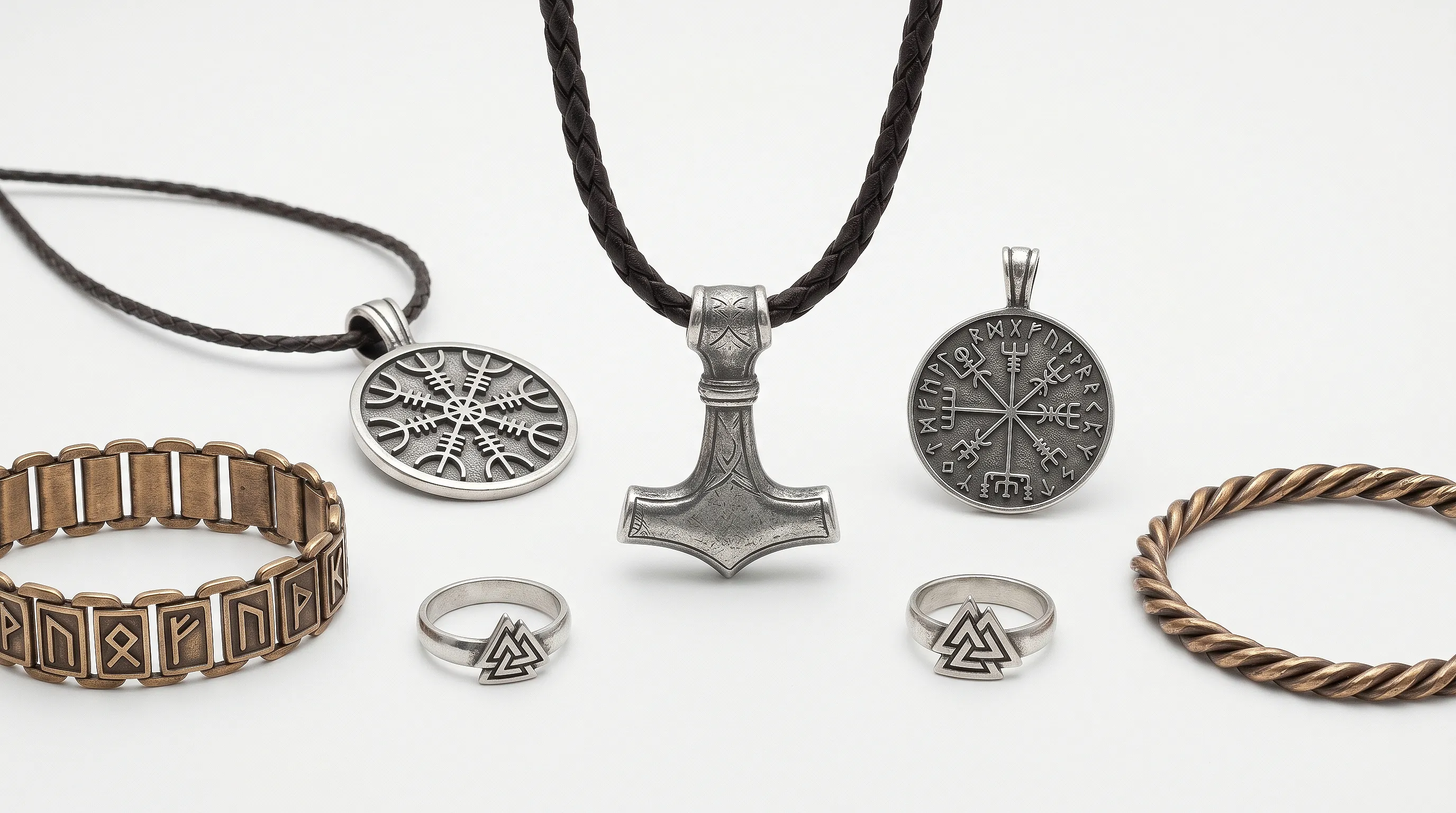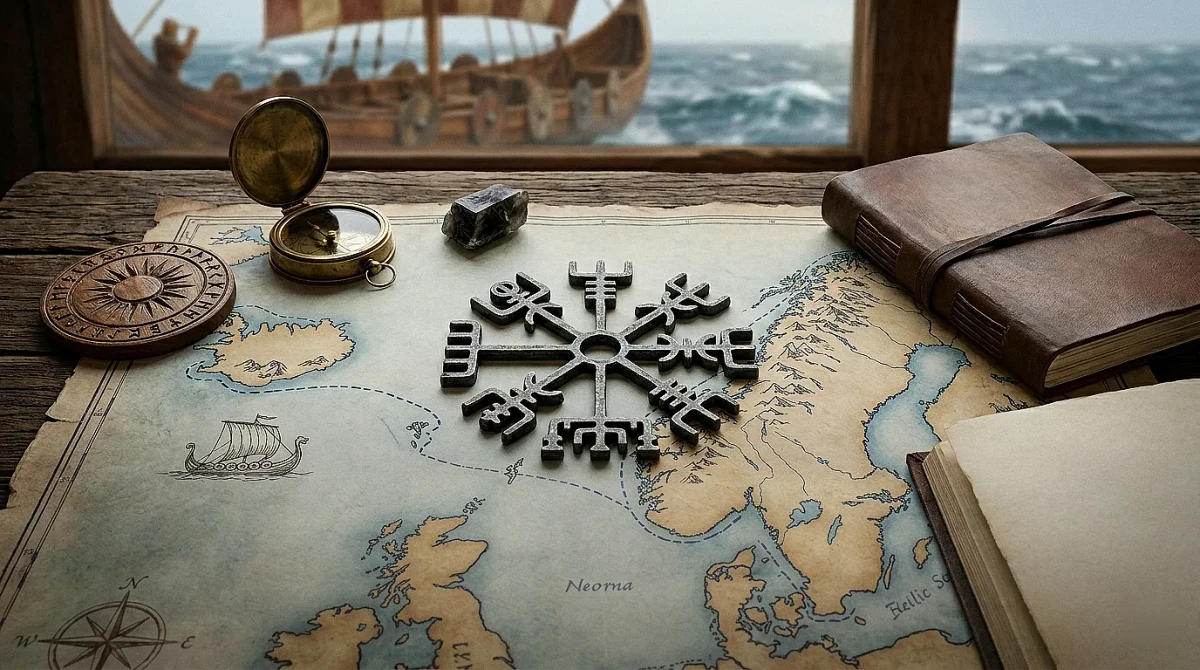
Vegvisir Meaning: The Viking Compass Symbol Explained
Vegvisir (from Old Icelandic vegur meaning "way" and vísir meaning "guide") is an eight-armed magical stave from the Icelandic Galdrastafir tradition, designed to help the bearer find their way through storms and unknown paths. Often called the "Viking compass," it does not actually point north and almost certainly post-dates the Viking Age. The earliest documented description is from the Huld Manuscript, compiled in Iceland in 1860. The symbol survives today as one of the most popular Norse-inspired motifs in tattoo and jewellery design.
The most popular Viking symbol has a problem
There's an eight-pointed symbol that shows up on roughly one in every five Viking-themed tattoos. You've seen it on pendants, rings, t-shirts, and album covers. It looks ancient. It looks Norse. It looks like something Ragnar Lothbrok would have carved into the prow of his longship before crossing the North Atlantic.
It's called the Vegvisir, and its story is more complicated than almost anyone who wears it knows.
Here's the problem, stated plainly: the Vegvisir probably isn't Viking. The only manuscript that describes it was written in 1860, roughly 800 years after the Viking Age ended. There's no archaeological evidence of it from the Viking period. No runestone carvings. No saga references. No amulets dug out of Norse burial sites.
Does that make it meaningless? No. It makes it interesting. Because the Vegvisir comes from a genuine tradition of Icelandic magic that evolved from Norse culture over centuries. It's not a fake. It's just not what most people think it is. And its real story, the one that involves Icelandic grimoires, magical staves, and the survival of pagan practice inside a Christian society, is honestly more fascinating than the simplified "Viking compass" version.
This article tells that real story. Where the symbol actually comes from, what it was actually used for, how Vikings actually navigated (spoiler: not with magical symbols), and why wearing a Vegvisir in 2026 carries meaning regardless of its contested origins.
Vegvisir Meaning: A Way-Finder in Icelandic Magic
The Vegvisir (pronounced "VEGH-vee-seer," from Icelandic "vegur" meaning road/path and "visir" meaning guide) is a magical stave, a type of Icelandic sigil designed to be drawn or carved for a specific purpose. Its purpose, according to the only source we have, is to help the bearer find their way through rough weather and unknown paths.
What it looks like: Eight staves radiating from a central point, each with a different symbol at its end. It resembles a compass rose, which is likely why people started calling it "the Viking compass." But unlike a compass, the eight arms are all different. Each one terminates in a unique set of lines, hooks, or branching patterns.
What it is not:
- It is not a rune. Runes are letters in the Elder Futhark or Younger Futhark alphabets. The Vegvisir uses no runic characters.
- It is not a compass. It doesn't point north. It doesn't indicate direction.
- It is not confirmed to be from the Viking Age (793-1066 CE). The earliest known description dates to 1860.
- It is not mentioned in any Edda, saga, or other medieval Norse text.
What it is: A magical stave from the Icelandic Galdrastafir tradition, recorded in a 19th-century manuscript, believed by some scholars to draw on older (possibly medieval) magical practices. Its function is protective and navigational in a magical rather than literal sense.
That's a lot of caveats. But understanding them makes the symbol more meaningful, not less, because you stop wearing a fantasy and start wearing something with a real, complicated history.
The Huld Manuscript: The Only Source
Geir Vigfusson and the 1860 collection
Everything we know about the Vegvisir as a named, described symbol comes from a single document: the Huld Manuscript (Huld means "secrecy" or "hidden"), compiled by Geir Vigfusson in 1860.
Vigfusson was an Icelandic collector of folk magic who gathered symbols, spells, and staves from various sources into a single volume. The Huld Manuscript contains dozens of galdrastafir (magical staves), each with a description of its purpose and instructions for use.
The manuscript is held in the Icelandic National Library in Reykjavik. It's a real document, properly catalogued, studied by scholars. It's not a mystery text or a controversial discovery. It's just very late.
What the manuscript actually says
The entry for the Vegvisir is brief. Translated from Icelandic, it reads approximately: "If this sign is carried, one will never lose one's way in storms or bad weather, even when the way is not known."
That's it. No elaborate mythology. No connection to Odin. No mention of Vikings. No ritual instructions beyond carrying the symbol. It's a practical magical tool: draw it, carry it, don't get lost.
The simplicity is notable. Many other staves in the same manuscript come with complex instructions involving specific materials, times of day, spoken words, or ritual preparations. The Vegvisir just needs to be carried. This suggests either that the instructions were simplified during collection, or that the stave was genuinely considered straightforward to use.
The dating problem
Here's where it gets controversial. 1860 is 800 years after the Viking Age. Can we assume the Vegvisir is older than the manuscript?
Arguments for older origins:
- Vigfusson was collecting existing folk traditions, not inventing them. The staves in the Huld Manuscript likely predate the manuscript itself.
- Icelandic magical stave tradition has documented roots in the 1500s-1600s (the Galdrabok, for example, dates to around 1600). Some scholars believe the practices extend further back into the medieval period.
- Iceland preserved Norse cultural elements longer than mainland Scandinavia due to geographical isolation. Practices that disappeared in Norway and Denmark in the 13th century could have survived in Iceland until the 17th or 18th century.
Arguments against Viking-era origins:
- No archaeological evidence of the Vegvisir or anything visually similar from the Viking Age. No carvings, no amulets, no manuscript illustrations.
- The design doesn't resemble known Viking-era art styles, which favoured animal interlace, knotwork, and runic inscriptions.
- Some of the symbols in Icelandic magic staves show influence from continental European grimoire traditions (medieval Christian magic), which arrived in Iceland after the Viking Age.
The honest answer: we don't know how old the Vegvisir is. It could be medieval. It could be early modern. It almost certainly draws on older ideas even if the specific form is relatively recent. The symbol exists in a grey zone between ancient tradition and later compilation, and anyone who tells you they know its exact age is either speculating or lying.
Icelandic Magic Staves: The Tradition Behind the Symbol
Galdrastafir: what they are
The Vegvisir belongs to a category of Icelandic magical symbols called galdrastafir (singular: galdrastafur). "Galdr" means magic or incantation. "Stafur" means stave or staff. These are drawn or carved sigils, each designed for a specific purpose.
The Icelandic stave tradition is unique in European magic because of its visual complexity and systematic organisation. Each stave is a geometric composition, typically built from intersecting lines radiating from a central point, with various hooks, branches, and terminal marks. They look like nothing else in European folk magic.
Known staves number in the hundreds. Some examples:
- Aegishjalmur (Helm of Awe): for invincibility and to inspire fear in enemies
- Vegvisir: for finding your way
- Draumstafir: to dream what you desire
- Lukkustafir: for luck
- Gapaldur and Ginfaxi: for success in Icelandic wrestling (glima)
The Galdrabok and other grimoires
The most important Icelandic magical text is the Galdrabok (Book of Magic), dating to approximately 1600 CE. Unlike the Huld Manuscript, the Galdrabok is clearly older and contains spells that mix Norse pagan elements with Christian invocations, showing the transition period when Iceland was officially Christian but folk magic retained pagan roots.
The Galdrabok contains staves, but notably does NOT contain the Vegvisir. The Aegishjalmur appears, but in a simpler form than the version popular today. This suggests that either the Vegvisir was a later development, or it existed in an oral/practical tradition that didn't make it into this particular text.
Other Icelandic grimoires include the Lbs 2917 4to manuscript, the Lbs 764 8vo, and various fragments held in collections in Reykjavik and Copenhagen. Scholars like Stephen Flowers (Edred Thorsson) and Justin Foster have catalogued hundreds of staves from these sources.
How the staves were used
Icelandic magical staves were typically:
- Carved into wood and carried as amulets
- Drawn on paper or parchment and kept in a pocket or shoe
- Scratched into objects (tools, doors, ships)
- Drawn with specific materials (blood, charcoal, specific inks)
- Accompanied by spoken words (galdr, incantations)
The practice was taken seriously enough that people were executed for it. In the Icelandic witch trials of the 17th century, at least 20 people were burned for practicing galdur (magic), and magical staves were presented as evidence in trials. The Vegvisir and its cousins weren't quaint folk symbols. They were dangerous enough to kill for.
Wear the symbol, don't just read about it. These are in stock:
How Vikings Actually Navigated
Sun compasses and sunstones
Since the Vegvisir probably isn't a Viking navigation tool, how did Vikings actually find their way across open ocean?
The answer is: extraordinarily well, using a combination of technology, observation, and accumulated knowledge that modern researchers are still working to fully understand.
Sun compasses. In 1948, a fragment of a wooden disc was found at the Norse settlement at Uunartoq in Greenland. It appears to be half of a bearing dial, a device that tracks the sun's position to determine direction. If the reconstruction is correct, Vikings had functioning sun compasses that worked by casting a shadow on a graduated dial.
Sunstones. The sagas mention a "solarsteinn" (sunstone) that could locate the sun on overcast days. For decades, this was considered mythological. Then researchers discovered that crystals of Iceland spar (calcite) can detect polarised light, effectively revealing the sun's position through clouds. Experiments have confirmed that the technique works. Vikings may have been using a navigation tool based on the physics of light polarisation a thousand years before scientists understood the principle.
Stars, waves, and whales
Beyond instruments, Viking navigators used:
- Star positions: the North Star (Polaris) was known and used
- Wave patterns: experienced sailors could read ocean swell patterns to determine proximity and direction to land
- Bird behaviour: certain seabirds indicate proximity to land. Floki Vilgerdarson famously released ravens to find Iceland
- Whale migration routes: whales follow predictable paths that indicate currents and proximity to feeding grounds
- Water colour and temperature: changes in water colour indicate depth, currents, and distance from shore
- Fog and cloud patterns: land creates distinctive cloud formations visible from far out at sea
The sagas and wayfinding
Norse sagas contain practical navigational instructions. The Landnamabok (Book of Settlements) describes the route from Norway to Greenland in terms that amount to sailing directions: sail west from a specific point, keep a certain island to the south, watch for specific landmarks.
This is important for the Vegvisir story because it shows that Vikings had practical, effective navigation methods. They didn't need a magical compass because they had real ones (probably) and deep environmental knowledge (definitely). The Vegvisir, whatever its age, was never a substitute for skill. It was insurance, a backup for when skill and instruments weren't enough, and the weather was too bad to use any of them.
Vegvisir vs Aegishjalmur: The Helm of Awe
These two symbols get confused constantly, so let's clarify.
Aegishjalmur (Helm of Awe / Helm of Terror):
- Eight identical arms radiating from centre, each ending in the same trident-like fork
- Mentioned in the Eddas and sagas (much older attestation than the Vegvisir)
- Purpose: to make the wearer invincible and terrifying to enemies
- Warriors painted it on their foreheads before battle
- The dragon Fafnir claims to wear it in the Volsunga Saga
Vegvisir:
- Eight DIFFERENT arms radiating from centre, each with a unique terminal
- Not mentioned in Eddas or sagas
- Purpose: to help the bearer find their way
- Carried rather than worn on the forehead
- No mythological association
The visual similarity is obvious: both are eight-armed radial designs. But they serve completely different functions. The Aegishjalmur is about power and intimidation. The Vegvisir is about guidance and safety. One is a weapon. The other is a map.
In jewellery, both are popular, but they attract different people. Aegishjalmur wearers tend to gravitate toward strength and warrior imagery. Vegvisir wearers tend to gravitate toward journey and exploration imagery. Knowing which one you actually connect with saves you from wearing the wrong symbol.
Customer reviews
Zevira is a real jewellery shop. Genuine payments, deliveries and customer thank-yous.
🥰🥰🥰 gracias
Ok, ¡gracias! 🙂
The Modern Viking Revival
Bjork and the Icelandic moment
Icelandic culture had a global moment in the late 1990s and 2000s, driven largely by Bjork, Sigur Ros, and a general fascination with Iceland as a place of otherworldly beauty and cultural uniqueness. Bjork has worn the Vegvisir publicly and has it as a tattoo, which did more for the symbol's visibility than any academic paper ever could.
Iceland's tourism boom (which went from 300,000 visitors in 2000 to over 2 million by 2018) brought people face to face with runic and stave imagery in Reykjavik's shops, museums, and street art. The Vegvisir became an Icelandic souvenir, which is ironic given the debate about whether it's genuinely ancient.
Vikings (the show) and the explosion
The History Channel series "Vikings" (2013-2020) triggered a massive global interest in Norse culture. The show's characters were tattooed with various Norse and pseudo-Norse symbols, and the Vegvisir appeared frequently. When millions of viewers see a symbol on a show they love, that symbol enters mainstream consciousness almost overnight.
The show was followed by "The Last Kingdom," "Norsemen," "Vikings: Valhalla," and the God of War games (2018, 2022), all of which featured Norse symbolism prominently. The Vegvisir rode this wave from niche Icelandic folk symbol to global mainstream.
Tattoo culture and the Vegvisir boom
The Vegvisir is now one of the most requested tattoo designs worldwide. Its geometric complexity makes it visually striking at any scale. It works as a chest piece, an arm tattoo, a back piece, or even a small wrist design. Tattoo artists love it because the eight different arms offer creative opportunities for customisation.
The tattoo boom created a feedback loop: more tattoos meant more visibility, which meant more people googling "what does the Viking compass mean," which meant more tattoos. The symbol became self-promoting.
For jewellery, the tattoo connection is relevant because many people who get a Vegvisir tattoo also want a pendant or ring to match. And people who want the symbolism but don't want the permanence of a tattoo choose jewellery as the alternative.
The Vegvisir wants an open neck. Buttoned to the throat? Do not even start.
How to wear the Vegvisir
Over years of styling I have put this stave through everything from a plain tee to a jacket and tie. One rule holds above all: the symbol needs an open neckline, or the eight arms drown in the folds of the fabric. Here is what actually works, sorted by occasion.
What do I wear it with every day? For daily wear I recommend a medium pendant in oxidised silver or matte steel over a plain top, a V-neck or a round neck of medium depth in grey, navy or black. On a chain of medium length it rests on the sternum and reads from across the room. Under a polo or a light knit I suggest keeping it as a quiet accent that does not shout but still catches the eye.
Is it right for the office? Yes, if you keep it minimal. I recommend silver with an oxidised finish or matte steel under a neutral shirt, the chain tucked under the collar so only the pendant shows. A signet ring with the Vegvisir on a flat face wins here: it reads as a detail of character, not a piece worn for show, and it holds up even under a strict dress code.
How do I build an evening look? For evening I suggest a contrast: a dark turtleneck or a plain shirt with the top button open, a larger piece and a slightly heavier chain. Under a leather jacket and a rough texture the stave sits especially well, because the nod to the road and the north comes through on its own.
How do I layer it? I work by the one-hero principle. Keep the Vegvisir in the centre and everything else quieter: a thin chain with a small element above it, a heavier line below. I recommend holding the metals in one tone, silver to silver, gold to gold; mix them only when it is a deliberate choice, not an accident.
Who does it suit, and what length? It suits anyone who likes restrained symbolism with a story, values travel and a quiet strength without flash. On length: for men I recommend a working chain of 50 to 60 cm, for women shorter, 40 to 45 cm, so the pendant sits higher and reads on an open neck.

Turn on your camera, pick earrings, a pendant or a ring, and see the piece on yourself in real time.
Switch items in one tap.
Everything runs in your browser: no photo or video is ever uploaded.
Wearing the Vegvisir: What It Says About You
Who wears it and why
Travellers and adventurers. The symbol's core meaning, finding your way in bad weather, resonates with anyone who values exploration, whether literal (backpackers, sailors, frequent travellers) or metaphorical (career changers, people navigating uncertainty).
Norse culture enthusiasts. People who are genuinely interested in Viking history, Icelandic culture, or Norse mythology. The fact that the Vegvisir's history is complicated doesn't diminish it for this crowd. If anything, knowing the real story makes the symbol more interesting than the simplified version.
People going through transitions. Divorce, career change, relocation, recovery. The Vegvisir says "I will find my way" without specifying where. It's about trust in your own ability to navigate, not about knowing the destination.
The aesthetically drawn. Eight-armed radial symmetry is just visually compelling. Some people wear it because it's beautiful and carries an aura of depth, without needing to know every detail of its history.
How to style it
The Vegvisir's geometric nature makes it versatile. It works in:
- Metal pendant on chain: the classic approach. The complexity of the design rewards a medium to large pendant size where the details are visible
- Ring: often engraved or cast, with the symbol on a flat face. Works as a signet-style piece
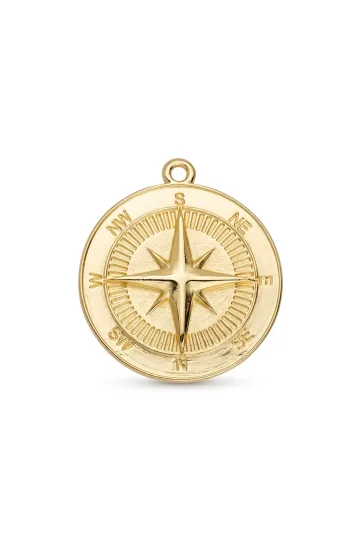
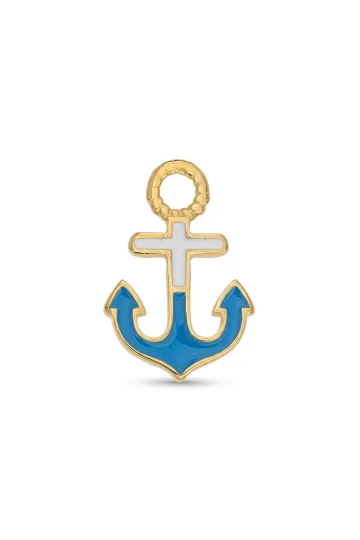
- Combined with other Norse elements: anchor pendants, compass roses, rune-inscribed pieces
- Layered with other symbolic jewellery: the Vegvisir pairs naturally with meaningful men's jewellery and exploration-themed pieces
The gift guide
For someone about to travel. The original purpose, a wayfinding charm, makes this an ideal travel gift. "Find your way and come back safe" is a powerful message.
For someone navigating life changes. New job, new city, new chapter. The Vegvisir says "you don't need to know where you're going. You just need to trust that you'll get there."
For a Norse mythology fan. Knowing the real history (Icelandic staves, the Huld manuscript, the debate about age) makes the gift more meaningful, not less. Include a note about what the symbol actually is.
For someone who got the tattoo. A pendant or ring to match. The symbol in wearable form, for days when the tattoo is covered.
Frequently Asked Questions
What is a Vegvisir? A Vegvisir is an eight-armed magical stave from the Icelandic Galdrastafir tradition, described in the 1860 Huld Manuscript as a charm to help the bearer find their way through storms and unknown paths. Each of its eight arms terminates in a unique geometric figure. Despite its common nickname, "the Viking compass," it is not actually a compass: it does not point north or indicate direction. It is a magical wayfinding symbol, and the modern interpretation treats it as a personal guide through both literal and metaphorical journeys.
How do you use a Vegvisir? According to the Huld Manuscript, you simply carry it. There are no required rituals, spoken words, or material specifications. The brief instruction reads: "If this sign is carried, one will never lose one's way in storms or bad weather, even when the way is not known." Modern wearers usually carry the symbol as a pendant, ring, bracelet, or tattoo. There is no traditional rule about whether the symbol should face outward or toward the wearer, though most jewellery designs show it facing outward.
What material works best for a Vegvisir pendant? The eight-armed geometric design needs space to be readable. Materials that hold fine detail work best: cast sterling silver, brass, stainless steel, or solid gold. Stamped pieces in soft metal tend to lose their crispness over time. A Vegvisir pendant smaller than 20 mm in diameter often compresses the eight different arm endings into an indistinct shape, so 25 to 35 mm is the recommended size range for everyday wear. The line work needs to be clear enough that each arm reads as distinct.
Is the Vegvisir a Viking symbol? This is debated. The only known description comes from an 1860 Icelandic manuscript, roughly 800 years after the Viking Age. There's no archaeological evidence from the Viking period. However, it comes from Icelandic magical stave tradition, which has roots in Norse culture. Most scholars describe it as "post-Viking Icelandic" rather than "Viking."
What does Vegvisir mean in Icelandic? "Vegur" means road or path. "Visir" means guide or pointer. Literally: "path-finder" or "way-guide."
Is the Vegvisir a compass? Not in any functional sense. It doesn't point north or indicate direction. It's a magical stave believed to help the bearer find their way through rough conditions. Calling it a "compass" is a modern simplification.
What's the difference between Vegvisir and Aegishjalmur? Aegishjalmur (Helm of Awe) has eight identical arms and is about power/protection in battle. Vegvisir has eight different arms and is about guidance/wayfinding. They look similar but serve different purposes and have different histories. The Aegishjalmur has older attestation.
Is it disrespectful to wear a Vegvisir if I'm not Icelandic or Norse? The Icelandic stave tradition is not a closed practice. Iceland doesn't have an indigenous cultural protection framework around these symbols the way Maori culture does around ta moko, for example. The symbol is widely sold in Iceland to tourists. That said, knowing its real history rather than the simplified version shows respect for the tradition.
Can women wear the Vegvisir? Absolutely. Icelandic magical stave practice was not gendered. Historical records show both men and women accused of practicing galdur. The symbol carries no masculine or feminine associations.
What's the best material for a Vegvisir pendant? The design's geometric complexity works best in materials that hold fine detail. Cast metal (steel, brass, silver-toned) preserves the intricate line work. Very small pieces may lose the arm-end details, so medium to large sizes tend to look better.
Should the Vegvisir face outward or toward the wearer? There's no traditional instruction about orientation. Most pendant designs face outward (visible to others). Some people prefer it facing inward (the guidance is for the wearer, not for display). Both are valid. Choose based on whether you see it as a public symbol or a private reminder.
Can I combine the Vegvisir with other Norse symbols? Yes. The Vegvisir pairs naturally with rune-inscribed bands, Thor's hammer pendants, and compass rose motifs. Layering a Vegvisir pendant with a simple rune ring creates a Norse-themed combination without overdoing it. The key is to keep each piece legible. Too many complex symbols at once becomes visual noise.
What size works best for a Vegvisir pendant? The eight different arm endings need space to be visible. Below 20mm diameter, the details compress into an indistinct blob. The sweet spot is 25-35mm for a pendant, where every arm ending is distinct and the geometric complexity reads clearly. Larger works for statement pieces. Smaller works only if the casting or engraving is exceptionally fine.
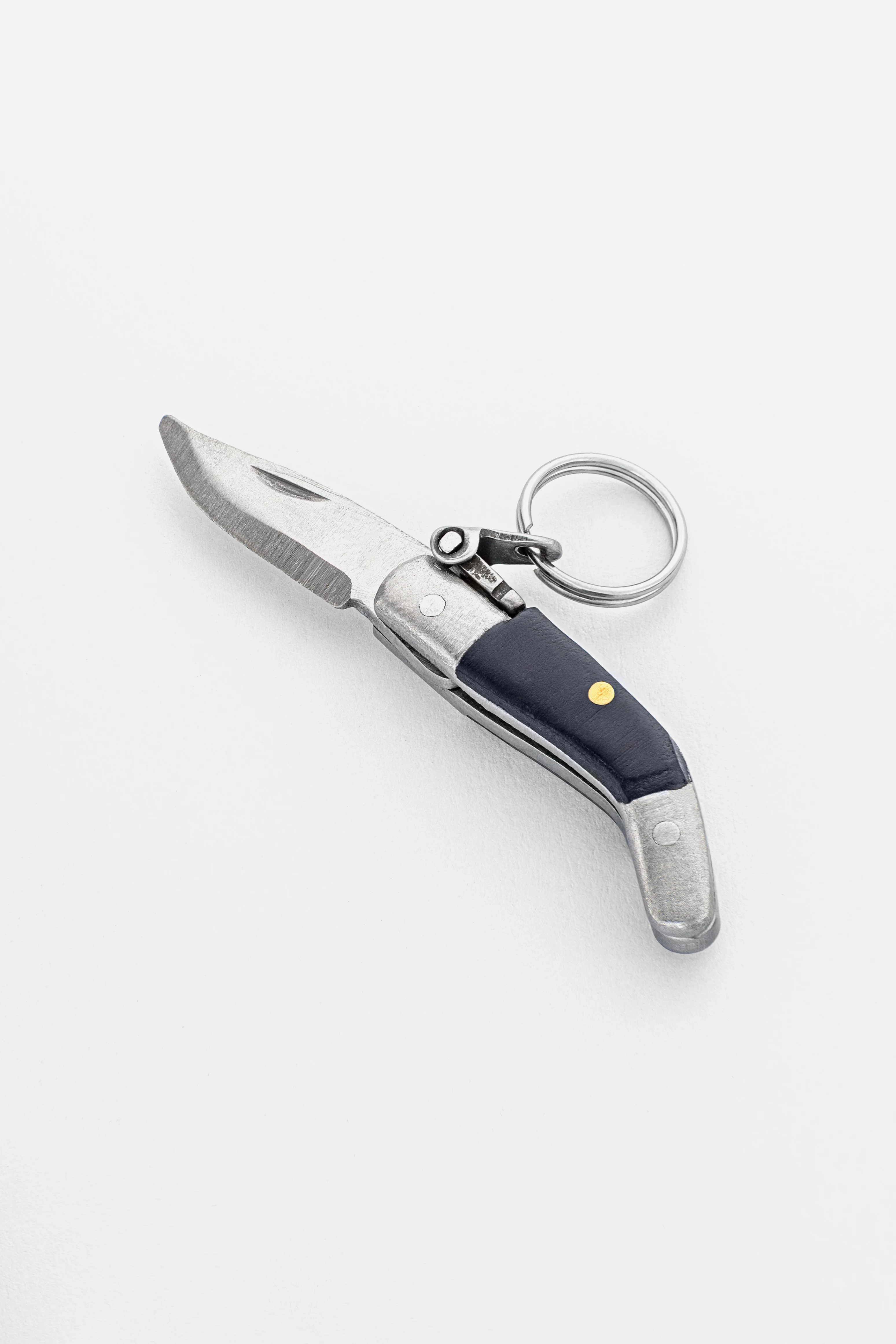
Artisan-crafted CAPAORA navaja pendant
A 40 mm stainless-steel navaja with a real folding mechanism and Palanquilla lock. An affordable gift to remember.
A code for blog readers:
10% off your first order
Authentic · Maker's guarantee · Ships from Spain
Vegvisir Symbolism in Norse Culture: More Than a Compass
Strip away the modern marketing and look at what the Vegvisir actually represents in the cultural context it grew out of, and you find something quite different from "Viking GPS." The symbol is a piece of Icelandic folk magic that operates within a worldview where weather, fate, and the spirit world are entangled in ways the modern mind has trouble grasping.
Iceland in the period when the Galdrastafir tradition flourished, roughly the 1500s through the 1800s, was a place where bad weather was a regular killer. Crossing the high mountain passes between settlements in winter was genuinely dangerous. Fishermen who went out in fog could disappear for good. Travellers who lost their bearings in a snowstorm sometimes did not come home. A symbol that promised to keep you from getting lost was not metaphorical entertainment. It was practical safety equipment.
But the Vegvisir reaches beyond a navigational tool in the literal sense. The Icelandic concept of "vegur" (way, path) extends far beyond physical roads. It encompasses life paths, moral paths, fate. When the Huld Manuscript promises that the carrier will not lose the "way," the way being referred to includes the way through a difficult life decision, the way through grief, the way through the year that lies ahead. This is why modern wearers connect to the symbol when going through transitions: divorce, career change, recovery, immigration. The Vegvisir speaks to that broader sense of pathfinding.
The symbol also carries weight in modern Icelandic national identity. Iceland is one of the most thoroughly Lutheran countries in the world by formal religion, but it also has one of the highest rates of belief in álfar (elves, hidden people) and other folk supernatural elements. Roughly half of all Icelanders, in repeated surveys, say they believe in the existence of elves or are open to the possibility. This is not because Iceland is unmodern. Iceland has one of the highest standards of living on earth, near-total literacy, advanced technology, and a thriving startup scene. It is because Icelandic culture has consciously preserved a relationship with its folk tradition that other Lutheran countries have abandoned.
The Vegvisir fits into this preserved tradition. It is a piece of folk magic that survived the Reformation, the witch trials, the modernisation of the 20th century, and the digital revolution. The fact that it became globally famous through Bjork and the show Vikings is just the latest stage in a long story of survival.
For Icelanders themselves, the symbol has slightly complicated meaning. On one hand, there is genuine cultural pride in the international fascination with Iceland's folk traditions. On the other, there is mild frustration with the simplified "Viking" labelling that erases the actual Icelandic medieval and early modern context. Many Icelandic craftspeople and jewellers now make a point of correcting the record when they sell Vegvisir pieces, gently noting that the symbol is post-Viking Icelandic and that the real story is more interesting than the simplified version.
How a Vegvisir Pendant Is Made: From Design to Finished Charm
Producing a Vegvisir pendant well requires solving a specific design problem: the eight different arms need to remain visually distinct at jewellery scale. This is harder than it sounds, and the best pieces involve several stages of careful work.
The process usually begins with a digital design, drafted in a CAD program by a jewellery designer. The eight arms are drawn precisely, each with its distinctive terminal: hooks, branches, dots, crosses. Spacing between the arms has to be calculated so that the design reads cleanly from a distance. If the arms are too close, the centre becomes a black blob. If they are too far apart, the geometric symmetry of the symbol disappears.
The next stage is producing a wax model using a 3D-printed pattern from the CAD file. Modern jewellery production has largely moved to this method because it allows fine detail to be preserved with great fidelity. The wax model is then attached to a wax "tree" with other models and embedded in plaster investment material. The whole assembly is fired in a kiln, melting out the wax (lost-wax casting) and creating a hollow plaster mould.
Molten metal is poured into the mould. For Vegvisir pendants, the most common materials are sterling silver, brass, stainless steel, and gold of various karats. Cast metal preserves the details of the original wax model with remarkable accuracy.
After casting, the pieces are broken out of the investment, cleaned, and finished. This stage is where the quality of a Vegvisir pendant is made or lost. The eight arms need to be cleaned of casting residue without rounding off their edges. The recesses between the arms need to be properly defined. Sharp tools and careful hands are required.
Many Vegvisir pendants use a darkening technique called oxidisation. The pendant is dipped in a chemical bath (often a sulphur solution) that creates a black patina across the surface. The high points are then polished back to bright silver, leaving the dark patina only in the recesses. This produces the classic "antique" Vegvisir look where the design lines stand out against a darkened background. The technique massively improves the readability of the symbol.
Hand-engraved Vegvisirs are the high-end option. A skilled engraver works on a cast or sheet-metal disc, cutting each line by hand under magnification. This produces variations and irregularities that cast pieces cannot achieve. A hand-engraved Vegvisir from a serious Icelandic workshop can cost as much as a luxury holiday, but it carries a craft history that mass-produced pieces simply do not have.
For modern wearers who want maximum durability, stainless steel Vegvisirs hold their detail indefinitely without tarnishing. The trade-off is that steel does not have the warm visual quality of silver or gold. Black steel and brushed stainless are popular finishes for everyday wear.
Tattoo versions skip the production process entirely, of course. The artist works directly with a printed reference, often customising the design for the specific placement on the body. Good Vegvisir tattoos require a tattoo artist with experience in geometric and Nordic styles, since the precision required is significant.
Leave your email, we'll send your discount code. No spam, unsubscribe anytime.
The code arrives by email, valid on your first order.
The Psychology of Wearing a Vegvisir
The Vegvisir is psychologically interesting because it operates through metaphor in a way that more direct protective symbols do not. The blue eye of a nazar reflects an envious gaze; the open hand of a hamsa blocks negative energy. These are immediate, intuitive functions. The Vegvisir, by contrast, does something more abstract: it guides.
This abstraction is part of why the symbol resonates with people going through life transitions. When you are in the middle of a divorce, a career change, or a move to a new country, the practical question is often not "how do I block this bad thing" but rather "how do I find my way through this." The Vegvisir's promise, that you will not lose your way even when the way is not known, speaks directly to this experience.
Psychologists who study symbolic behaviour note that humans use external objects to externalise internal states. A wedding ring externalises commitment. A medical alert bracelet externalises a health condition. A protective amulet externalises the feeling of needing protection. The Vegvisir externalises the experience of being on a path that is not yet clear, of moving forward without a map.
This externalisation has a personal effect that many people describe. Wearers often say that keeping a meaningful object close during periods of uncertainty helps them feel calmer and more in control. The objects themselves do not provide guidance in any literal sense. They function as anchors that the mind returns to when stress spikes. A Vegvisir touched during a difficult moment is a brief pause: the wearer feels the symbol, remembers what it represents, and is gently nudged back toward the conviction that they can find their way.
The symbol also benefits from what behavioural psychologists call "narrative coherence." Humans are storytelling animals, and we make sense of our lives by constructing narratives that link past, present, and future. The Vegvisir provides a ready-made narrative element: the story of someone who finds their way through difficulty even when the path is unclear. Wearers absorb this narrative and apply it to their own circumstances, often unconsciously. The result is a kind of self-reinforcing optimism that does not require any mystical belief to function.
For people who have been through a hard period, the Vegvisir can serve as a daily reminder that the wearer is still moving, still oriented toward a future, even when current circumstances feel disorienting. Some people choose to keep the symbol close during difficult chapters simply because the idea behind it speaks to them.
The deeper point is that the Vegvisir is one of the most psychologically sophisticated protective symbols ever produced by a folk tradition. It does not promise to remove difficulty. It promises help finding the way through difficulty. This is a much more realistic and ultimately more useful promise than blanket invulnerability, and it explains why the symbol has resonated so deeply with modern audiences.
Vegvisir in Norse-Inspired Cinema and TV
The Vegvisir entered mainstream global awareness primarily through screen media, and tracking its appearances across film and television tells you a lot about how the symbol travels.
Vikings (2013-2020). The History Channel series, created by Michael Hirst, is the single biggest driver of Vegvisir awareness outside Iceland. The show used the symbol throughout its six-season run, often as tattoos on lead characters or as background props in Viking settings. Floki, the boatbuilder character played by Gustaf Skarsgard, was particularly associated with the symbol. The show's set designers acknowledged that they used Vegvisir and other Galdrastafir partly for visual impact, knowing the symbols were historically post-Viking but choosing them anyway for their striking geometry.
Vikings: Valhalla (2022-). The Netflix spin-off continued the visual language of the original, with Vegvisirs appearing on character props, ship carvings, and tattoo designs. The show is set later in the Viking Age and the medieval period, which makes the symbol's appearance slightly more defensible historically, though still not strictly accurate.
The Last Kingdom (2015-2022). This BBC and Netflix adaptation of Bernard Cornwell's novels was generally more careful about historical accuracy than Vikings, but the Vegvisir still appeared occasionally as a visual marker of pagan Norse identity in contrast to the Christian Anglo-Saxon characters.
Norsemen (2016-2020). This Norwegian comedy series about life in a Viking village used the Vegvisir and other Norse symbols knowingly, often as visual gags playing on the modern audience's familiarity with the symbols.
The Northman (2022). Robert Eggers' film about a Viking prince seeking revenge was praised for its commitment to historical accuracy. Eggers consulted with academic experts on Viking culture, and the Vegvisir does not appear in the film, which is itself a meaningful choice. The film instead uses authentic Viking-era symbols like the valknut and the swastika sun-cross, demonstrating what an actually period-accurate Norse visual vocabulary looks like.
God of War Ragnarok (2022). The Sony PlayStation game features extensive Norse symbolism, including the Vegvisir on various character designs, weapons, and environmental elements. The game's design directors have spoken about their research into Norse mythology and folk magic, and the Vegvisir appears as part of a broader visual language that mixes authentic Viking-era and post-Viking Icelandic elements.
Norse-themed blockbusters. Big-budget fantasy films drawing on Norse mythology often include a range of Norse-inspired symbols in their production design, usually in stylised form rather than faithful reproduction. Vegvisir-like motifs sometimes turn up among them as part of the broader visual language.
Music videos. Bjork has used the symbol in her visual identity for decades, and her influence cannot be overstated. The Icelandic doom-folk band Heilung uses Vegvisir-inspired imagery on album covers and stage design. The Swedish folk band Wardruna incorporates similar visual language. These artists have brought the symbol to global audiences in ways that traditional academic publishing never could.
Documentaries. Several documentaries about Iceland, Norse culture, and Viking history have featured the Vegvisir, sometimes accurately representing its post-Viking origins and sometimes contributing to the confusion about whether it is Viking. National Geographic, History Channel, and BBC documentaries have all included the symbol with varying levels of accuracy.
Who Tends to Wear the Vegvisir
The Vegvisir has a smaller public footprint than symbols like the nazar or hamsa, but the kinds of people drawn to it are interesting and tend to cluster in a few areas.
The music world. Artists working within Icelandic and Nordic folk traditions have done a great deal to spread the symbol, often engaging with it thoughtfully because they are working inside their own cultural heritage. The Nordic neofolk scene in particular has embraced Vegvisir imagery on stage and in promotional photography, usually informed by careful study of Norse and Icelandic tradition.
The entertainment industry. Actors and crew connected to Norse-themed productions sometimes adopt the symbol, partly through their work on these projects. For many of them the symbol becomes a personal marker of journeys and career uncertainty.
Athletes. Combat-sport competitors, particularly those of Nordic or Northern European heritage, often gravitate to the symbol. Its association with finding one's way through difficulty makes it appealing to people who face frequent setbacks and recovery.
The pattern across these groups: most are connected to either Icelandic and Nordic culture, the entertainment world, or the broader Northern European cultural sphere. The symbol resonates particularly with people whose lives involve significant uncertainty and physical or emotional risk.
Vegvisir Tattoos: A Permanent Form of the Symbol
The Vegvisir is one of the most tattooed symbols in the world right now, and the design has its own well-developed tattoo subculture.
The most common placements include the upper back, the chest, the inside of the forearm, the back of the hand, the side of the calf, and the upper arm. Smaller versions work on the wrist or behind the ear. The geometric complexity of the design rewards medium to large placements where the eight different arms can be rendered with clarity.
Several tattoo styles work well for the Vegvisir.
Black and grey traditional. The classic approach: clean black lines, optional grey shading, no colour. Ages well, preserves detail over decades, and looks appropriately rune-like. This is the most common style and the one most experienced tattoo artists are comfortable with.
Dotwork and geometric. Some artists rework the Vegvisir into pure dotwork or strict geometric line art, emphasising the symbol's underlying mathematics. These pieces can be beautiful but they sometimes lose the specific terminal patterns that distinguish the Vegvisir from other eight-armed symbols.
Realistic with weathering effects. Tattoo artists working in a realistic style sometimes render the Vegvisir as if it were carved into wood, stone, or bone, complete with weathering, cracks, and ageing effects. These pieces are striking but require a highly skilled artist.
Combined with other Norse elements. The Vegvisir often appears alongside Yggdrasil (the world tree), runes, Thor's hammer, Odin's ravens, or the valknut. Combined tattoos can become quite elaborate, with the Vegvisir as the central element surrounded by supporting iconography.
Custom variations. Many wearers ask their tattoo artists to incorporate personal elements into the Vegvisir: dates, names, additional symbols, or elements from family heritage. The eight-armed structure of the symbol provides natural space for customisation at each terminal.
The cultural conversation around Vegvisir tattoos is mostly relaxed. Icelandic commentators have generally been welcoming of the symbol's international spread, with some mild requests that wearers learn the actual Icelandic origins rather than perpetuating the "Viking" myth. There are no specific cultural taboos around the symbol that would prevent its use by outsiders.
Practical considerations for a Vegvisir tattoo: the line work needs to be precise, since the symbol relies on geometric clarity. The eight different arms need to be readable as distinct elements. A blurry Vegvisir is a sad sight. Book with a tattoo artist who has either experience with Norse-style work or with detailed geometric tattoos. Look at their portfolio for examples before committing.
Touch-ups every five to ten years may be needed for finer detail work. Black ink generally ages well, but the precision of the arm terminals can soften over time as ink migrates slightly in the skin.
Vegvisir in Festivals and Rituals
Iceland has several festivals and cultural moments where the Vegvisir features prominently, and the symbol has also found a place in modern Norse-inspired festivals around the world.
Þorrablót. The Icelandic mid-winter festival, held in late January and February, celebrates traditional Icelandic culture with feasts of fermented shark, sheep's head, blood sausage, and other heritage foods. Vegvisir-decorated items, from wall hangings to commemorative jewellery, are common gifts during this festival.
Independence Day. Iceland's national day, 17 June, commemorates the country's full independence from Denmark in 1944. Vegvisir-themed merchandise, particularly jewellery and decorative items, is heavily marketed during this period.
Iceland Airwaves. The country's biggest international music festival, held annually in Reykjavik, has become a significant moment for the Vegvisir to be displayed in modern contexts. The symbol appears in festival merchandise, on attendee jewellery, and in the visual identity of many performing artists.
Tourist seasons. While not a traditional festival in any strict sense, the tourist seasons in Iceland (summer and winter) drive enormous interest in the Vegvisir. Reykjavik's Laugavegur shopping street and the design district around Skólavörðustígur are full of shops selling Vegvisir jewellery, prints, and decorations.
Up Helly Aa. The Shetland fire festival, held in late January, is one of the largest Viking-themed festivals in the world. Although Shetland's Norse heritage is distinct from Iceland's, the Vegvisir has been adopted by some participants as part of the broader Norse visual language of the festival.
Reenactment festivals. Across Europe and North America, Viking and medieval reenactment groups gather for festivals throughout the year. The largest, such as the Jorvik Viking Festival in York, the Wolin Viking Festival in Poland, and the Foteviken market in Sweden, draw thousands of participants. The Vegvisir's status at these events is complicated: serious reenactors with academic backgrounds often avoid the symbol because of its post-Viking origins, while newer participants and the broader public embrace it enthusiastically.
Pagan and heathen gatherings. Modern Asatru, Forn Sed, and other heathen religious groups have varying relationships with the Vegvisir. Some incorporate it into ritual practice, drawing on Icelandic folk tradition. Others reject it as historically inauthentic. The conversation within these communities is ongoing.
Personal rituals. Many wearers of the Vegvisir incorporate the symbol into personal rituals: meditation, journaling, journey-starting moments. Travellers sometimes hold the symbol in their hand before departing on a significant journey, as a personal version of the practice described in the Huld Manuscript. These individual practices are not formalised but they represent a living continuation of the symbol's original purpose.
Vegvisir Meaning in Different Regions
The Vegvisir is fundamentally an Icelandic symbol, but its modern global spread means it carries slightly different meanings in different cultural contexts.
Iceland. The home culture. Vegvisirs are sold widely as cultural artefacts and tourist items. Many Icelanders treat the symbol with affectionate pragmatism: they know its actual post-Viking origins, they appreciate its visual appeal, and they are pleased that the world has discovered Icelandic folk culture even if the labelling is imprecise.
Scandinavia (Norway, Sweden, Denmark). In mainland Scandinavia, the Vegvisir is less central than in Iceland, but it has become part of the broader Nordic visual identity. Norwegian, Swedish, and Danish jewellery designers have incorporated the symbol into their work, particularly in the contemporary Nordic minimalism movement.
Faroe Islands and Shetland. These small Norse-heritage communities have adopted the Vegvisir as part of their Viking and Norse cultural identity, alongside their own indigenous symbolic traditions.
Germany, Austria, Switzerland. The German-speaking world has a long fascination with Norse mythology, going back to the 19th-century Romantic period and Wagner's Ring Cycle. The Vegvisir fits naturally into this broader cultural interest in Germanic and Norse heritage. The symbol appears in German jewellery, tattoo culture, and reenactment scenes.
United Kingdom. Britain's complicated Norse heritage (the Viking raids, the Danelaw, the Anglo-Saxon and Norman invasions all involve Norse elements) gives the Vegvisir a particular resonance. The symbol appears widely in British tattoo and jewellery culture, especially in northern England and Scotland where Viking heritage is most visible.
United States. America's Norse-descended communities, particularly in Minnesota, Wisconsin, and the Pacific Northwest, have embraced the Vegvisir as a marker of ancestral heritage. The symbol also appears widely in American popular culture, driven by the television show Vikings and the broader American interest in Norse mythology.
Canada. Similar pattern to the United States, with concentrated Norse heritage in the Maritime provinces and in communities founded by Icelandic immigrants in Manitoba (Gimli, the largest Icelandic settlement outside Iceland).
Russia. Russia has its own complicated Norse history (the Varangian rulers who founded the Kievan Rus state were Scandinavians). The Vegvisir has become popular in Russian tattoo and jewellery culture, sometimes incorporated into broader Eurasian symbolic vocabularies.
Global tourist culture. Iceland's tourism boom of the 2010s brought millions of visitors face to face with the Vegvisir for the first time. The symbol now appears in tourist shops, airport gift stores, and souvenir markets worldwide as a marker of "having been to Iceland" or "interested in Norse culture."
The symbol's meaning in each region tracks the local relationship with Norse culture. The closer to Iceland and to authentic Norse heritage, the more nuanced and informed the engagement with the symbol tends to be. The further away, the more it functions as generic Norse-themed decoration. Both modes of engagement are valid.
Choosing the Right Vegvisir: A Buyer's Guide
If you are thinking of buying a Vegvisir for yourself or as a gift, here is what to consider before committing.
Material. For everyday durability, sterling silver and stainless steel are the workhorses. Sterling silver has a warmer visual character and traditional appeal, but it can tarnish and requires occasional cleaning. Stainless steel is essentially maintenance-free and holds detail indefinitely. Brass is the budget choice, with a warm bronze appearance that ages to a darker patina. Solid gold is the premium choice, more durable than silver and more permanent in symbolic terms. Pewter and antiqued tin are sometimes used for inexpensive pieces but they lack the durability of better metals.
Size. This is the most common mistake people make with Vegvisir pendants. The eight different arms need space to be visible. Below 20 mm in diameter, the design tends to compress into an indistinct geometric blob. The sweet spot for everyday wear is 25 to 35 mm, where every arm ending reads as distinct. Statement pieces can go larger (40 to 50 mm+). Smaller pieces work only if the casting or engraving is exceptionally fine.
Finish. Antiqued or oxidised finishes, where the recesses of the design are darkened, dramatically improve the readability of the Vegvisir. The high points are bright, the low points are dark, and the eight arms stand out clearly. Bright polished finishes look beautiful but the Vegvisir tends to disappear visually because the design becomes a uniform shiny surface. For maximum visual impact, choose antiqued.
Hand-engraved vs cast. Hand-engraved pieces have variation, slight imperfections, and the unmistakable character of human work. Cast pieces have perfect symmetry and identical reproduction across many pieces. Hand-engraved costs significantly more, often as much as a serious weekend away, but for collectors and connoisseurs the difference is worth it. For everyday wear and gift-giving, well-made cast pieces are perfectly satisfactory.
Style. Traditional designs reproduce the Huld Manuscript version faithfully, with all eight arms in their classic configuration. Contemporary designs simplify the form, use cleaner lines, or incorporate the Vegvisir into broader Nordic design vocabularies. Both are valid choices. Traditional fits with serious Norse interest. Contemporary fits more easily into minimalist wardrobes.
Combinations. Vegvisirs are often paired with other Norse elements: runes, Yggdrasil, Thor's hammer, ravens, valknut, compass rose. Layering a Vegvisir pendant with a thinner rune-inscribed chain or a simple compass piece works well. Avoid stacking too many complex symbols together: the visual noise becomes hard to read.
Where to buy. The most authentic Vegvisirs come from Icelandic workshops, particularly in Reykjavik's Skólavörðustígur district, where multiple jewellery studios produce hand-made and small-batch pieces. Outside Iceland, look for jewellery makers who specialise in Norse or Nordic design and who can speak credibly about the Icelandic origins of the symbol. Avoid generic gift shops where the provenance is unclear and the design quality is variable.
Hallmarks and quality. Sterling silver should be stamped "925" on the bail or back. Gold should be stamped with its karat. Stainless steel should be marked as 316L (surgical grade) for jewellery use. The maker's mark is also worth looking for: established makers stamp their pieces, and provenance adds value.
Gifting considerations. Vegvisir jewellery makes an excellent gift for travellers, people in transition, those starting new chapters, and anyone with Norse or Nordic heritage interest. The Huld Manuscript's promise (you will not lose your way even when the way is not known) is a powerful message for someone facing uncertainty. A pendant or ring with a small card explaining the actual Icelandic origins of the symbol turns the gift into a small cultural education as well.
Budget reality. A basic cast Vegvisir pendant in pewter or low-grade silver costs the same as a couple of takeaway coffees. A solid sterling silver piece with proper finishing costs about the price of a nice meal out. A hand-engraved or carefully hand-made piece in sterling silver can run to the cost of a serious weekend break. A gold version is in the territory of a significant jewellery investment. As with other protective amulets, the symbolic meaning does not scale with price. A budget piece worn with intention works as well as a museum piece worn casually.
The best Vegvisir for you is the one you will actually wear. A beautiful symbol that lives in a drawer does no work. Pick something that fits your life, your style, and the journey you are on, and the amulet will serve its purpose.
Send a friend a discount code, they save on their first order.
The Germanic Dimension: Why This Symbol Feels Familiar
The Icelandic stave tradition has roots that go deeper than Iceland itself. The Germanic magical tradition, from which the Norse tradition evolved, also encompassed the territories we now call Germany, Austria, and Switzerland.
The older runic inscriptions (Elder Futhark, 2nd-8th century) come from Scandinavia and from the wider Germanic-speaking region. The Nordendorf fibula in Bavaria, the runestones of Schleswig-Holstein, the bracteates from the Migration Period, all of these show that magical symbolism was widespread in the Germanic cultural sphere long before the Vikings plundered their first monastery.
Whether the Icelandic Galdrastafir are direct descendants of these older Germanic practices is debated among scholars. But that a cultural connection exists is undisputed. The Eddas, which form the foundation of Norse mythology, describe a worldview that also echoes in continental Germanic sources. Odin's rune magic in the Havamal ("I know that I hung on a windswept tree, nine long nights") speaks of a magic common to the Germanic peoples.
Wagner's "Ring of the Nibelung" reached back to exactly this shared heritage. The material of the Nibelungenlied connects Germanic and Norse tradition so tightly that the boundary between the two blurs. The Romantic period's rediscovery of Norse mythology was not about importing something foreign. It was about recovering something that had always been part of the broader cultural lineage.
Jacob Grimm himself travelled to Copenhagen to study Old Norse manuscripts, and his "German Mythology" (1835) was one of the first major works to systematically catalogue Germanic-Norse beliefs. The tradition stands in a research history that scholars across Northern Europe contributed to.
Haithabu and the Viking Heritage in Northern Europe
Schleswig-Holstein was for centuries a border area between the Germanic and Scandinavian worlds. Haithabu (Hedeby), now a UNESCO World Heritage site near Schleswig, was one of the most important trading cities of the Viking Age. It sits at a crossroads between the North Sea and the Baltic, and at its peak it was home to several thousand people from across the known world.
The Vikings at Haithabu were not invaders. They were neighbours. Trading partners. Sometimes relatives. The archaeological finds there, combs, brooches, glass beads, iron tools, show a cosmopolitan trading hub where Norse, Slavic, Frankish, and Anglo-Saxon goods changed hands.
For anyone interested in the real Viking Age, as opposed to the Hollywood version, the material culture from sites like Haithabu is essential. These were people who valued craft, understood trade, and decorated their tools and clothing with meaningful symbols. The Vegvisir may or may not have been among those symbols. But the impulse to carry a protective sign on a journey? That is older than any manuscript.
The Reenactment Scene and Historical Accuracy
The historical reenactment community takes accuracy seriously. At festivals and markets, you meet people who know the difference between a genuine Viking Age find and a stave from a 19th-century manuscript. Exactly the kind of differentiation the Vegvisir needs.
This matters because the Vegvisir exists in a space between documented history and living tradition. Wearing it with knowledge of its actual origins, the Huld manuscript, the Galdrastafir tradition, the dating debate, is different from wearing it as a generic "Viking symbol." The first is engagement with a complex cultural history. The second is cosplay.
Both are fine, honestly. Not everything has to be an academic exercise. But knowing the real story gives the symbol weight that the simplified version lacks. And weight is what makes the difference between jewellery that sits in a drawer after a month and jewellery you wear for years.
Silver and gold jewellery, wedding bands, symbolic pendants, paired sets.
Wear the symbol, don't just read about it. These are in stock:
Finding the way
The Vegvisir is a symbol that refuses to be simple. It's not cleanly Viking, but it's not fake either. It comes from a real magical tradition, recorded in a real manuscript, connected to a real culture that spent centuries preserving and evolving Norse ideas after the rest of Scandinavia moved on.
Its power as a wearable symbol doesn't depend on whether a Viking in 900 CE would have recognised it. It depends on what it means to you now: the idea that there's something you can carry that represents your ability to find your way. Not a GPS. Not a roadmap. Just a reminder that people have been navigating through uncertainty for a very long time, and that the act of deciding to keep going is itself a form of direction.
The Huld manuscript says: "If this sign is carried, one will never lose one's way in storms or bad weather, even when the way is not known."
Even when the way is not known. That's the part that stays with people. Not the promise of arrival. The courage of departure.
About Zevira
Zevira makes jewellery by hand in Albacete, Spain. The Vegvisir is close to what we care about. A symbol you carry as a personal point of reference sits naturally in a pendant or a ring built for one particular person.
Here is what you can find with us for Norse symbolism and charms for the road:
- Pendants with Norse and navigational motifs for everyday wear
- Signet rings, where the geometry reads cleanly on a flat face
- Sterling silver with an oxidised finish, where the design stands out against a dark background
- Paired sets to give to someone setting out on a journey or going through a change
- Medium-sized pieces, where the eight different arms stay distinct
- Options with personal engraving: a date, a name, the coordinates of a place that matters
Every piece is made by hand by a craftsperson, with the option of personal engraving. Sterling silver and 14 to 18K gold.