Fifth Wedding Anniversary Gift: Jewellery for the Wooden Anniversary
By year five, infatuation no longer carries a couple on momentum, yet routine has not curdled into boredom either. The fifth-anniversary gift works as a quiet stress test: if you both see the same thing in it, the road ahead exists. If your answers drift apart, you get an honest diagnosis before the gap has time to widen.
Wooden Anniversary: What Lies Behind the Name
In the traditional European system, the fifth wedding anniversary carries the name of the wooden anniversary. The custom took shape in the German and Austrian culture of the nineteenth century, where every marriage milestone received a material symbol, and English-speaking countries adopted it from there during the Victorian period. Wood for the fifth year was not picked at random, nor for any practical thought about how easy the material is to find. It is the most eloquent of all the early anniversary symbols, and the reason becomes visible the moment you start choosing a gift.
Why Wood, Specifically
A tree grows from its roots. This is the least obvious and most precise part of the metaphor. Above ground we see the trunk, the bark, the crown, and we assume the visible part is the tree. Underground, every mature tree has a root system whose volume rivals the part above the soil. In some species the roots run deeper than the tree stands tall. A marriage in its fifth year has exactly the same structure: above ground is what outsiders see, below ground is what holds. Anyone can see your clothes, your home, your photographs together online. Nobody but the two of you sees the work running beneath that visible layer. A wooden-anniversary gift lands well precisely when it carries the image of the roots as well as the crown.
Wood withstands weather. A young sapling planted in open ground lives on a thin edge in its first year. A hard wind, a late frost, a dry summer, hungry deer in winter, any one of these can kill it. By year five the tree already has bark thick enough, a root system deep enough, and the reserves of a good season to carry it through a bad one. Five years of marriage are built the same way. In the first year almost any household trifle knocks the couple off balance: a quarrel over unwashed dishes, jealousy over a partner's old friend, a clash with the in-laws at a holiday. By year five most trifles stop registering as a crisis, because a shared fabric has formed, and the blows pass through it and get absorbed.
Wood has a unique grain. Take two oaks grown in the same wood, on the same clearing, under identical conditions, cut through the trunk, and the growth rings will differ between them. One tree came through a dry summer losing three millimetres of annual growth, the other lost five because it sat in a slightly poorer patch of soil. The fibre structure of every trunk is unique, like a fingerprint: dendrochronologists identify boards in medieval buildings by that structure, tying them to a particular region and a particular decade. A marriage carries the same unique pattern. No two five-year marriages are alike. A gift that reflects this understanding reaches the core.
Wood bends but does not break. The most underrated property in the engineering description of timber is elasticity. Bone snaps cleanly along the fracture line, metal first deforms plastically and then tears, while wood bends, recovers, bends again, and only under truly extreme load does it crack. A young trunk in the wind bends almost to a right angle and springs back the moment the gust drops. Five years of life together build exactly this elasticity in a couple: the capacity to bend in a sharp moment and then return to working position rather than break.
Wood remembers. Growth rings record every year of the tree's life: dry or abundant, cold or warm, the year of a strong storm, the year of long rains, the year of a short summer. Together the rings form a history you can read if you know how to look. Dendrochronologists reconstruct century-long and millennium-long climate series from cross-sections. A piece of jewellery with a tree or root motif carries that image: every year lived leaves a mark, and together the marks build a history that belongs only to you.
Oak: Durability
Oak became a synonym for strength and longevity in European culture long before anyone counted wedding years. An oak barrel outlives several generations of winemakers. An oak beam in the floor of a Gothic cathedral stands six hundred years without replacement. Beneath Venice, wooden piles have held the city up for centuries. People built houses, ships and furniture from oak for the things meant to last longer than a human life. The Celts called oak the king of trees and linked it to the druids; by one reading, the word "druid" itself is kin to the word for oak in the Indo-European family. Among the Romans, the oak wreath, the corona civica, rewarded a citizen who had saved a comrade's life in battle.
For fifth-anniversary jewellery the oak image works on two fronts at once. First: the symbolism of durability and strength that a couple wants to affirm as a property of their relationship. Second: the image of slow but steady growth. An oak does not shoot up quickly, it rarely grows tall in a decade, its strength lies in centuries rather than first seasons. A strong marriage proves itself the same way, not in the early years but over the long distance.
In jewellery form the oak motif reads through the leaf (its deep, lobed shape), through the acorn (potential from which a vast tree grows) and through a branch with three or four acorns (family fruitfulness). A ring with a carved band of oak leaves, an acorn pendant in silver or gold, drop earrings shaped like an acorn on a thin stem, all of these formats exist in the European jewellery tradition and serve the fifth anniversary with particular accuracy.
Birch: Flexibility and Youth
If oak is the royal tree of European monarchies, birch is the bright, youthful counterpart. As a symbol it works more softly than oak. It is not the eternal, mighty trunk but the living young relative, with its own beauty and its own meaning. For the fifth anniversary the birch image suits couples who value the liveliness and mobility of their relationship rather than its monumental stillness. A birch grove breathes with the wind, rustles, and glows white-silver among the dark of the wood. There is a lot of air in that image.
In jewellery, birch is rendered through the motif of a slender branch (often with small leaves), through the texture of white bark with its distinctive black strokes (well imitated by combining polished and oxidised silver), and through elongated drop elements. A silver pendant with a birch twig on a chain, drop earrings shaped like a birch leaf, a thin ring with a bark texture on the outer band, all of these work as a lighter, airier reading of the wooden anniversary.
Olive: Peace and Long Memory
In Mediterranean culture the olive holds a place comparable to oak in the north. It is a tree that lives not hundreds but thousands of years. In a monastery garden on Mount Athos there still stand olives planted by monks in the eleventh century. In the Garden of Gethsemane in Jerusalem grow olives whose wood analysis dates them close to the events of the Gospels. The olive is in no hurry, it grows at a rate that adds a few centimetres of trunk diameter per century. In exchange it stands for a thousand years.
In symbolic language the olive means peace and reconciliation (the dove with the olive branch from the story of Noah's ark), wisdom (the attribute of Athena, her gift to the Athenians in her contest with Poseidon) and longevity (through the tree's biological property). For the fifth anniversary the olive branch is an image for the couple who came through difficult moments and reached reconciliation through them. Not a flawless, smooth five years, but five years with a history, with moments that demanded a conscious choice to make peace.
In jewellery the olive branch reads through fine curved forms with its characteristic narrow leaves. A wreath of olive branches as a ring motif, earrings shaped like a single olive twig, an enamelled medallion pendant with an olive branch, all of these work in the Mediterranean tradition (Italy, Greece, Spain) and in the broader European one.
Cedar: Biblical Strength
Cedar appears in the biblical text as the material from which the Temple of Solomon was built: Lebanese cedar was brought to Jerusalem as the most precious and durable timber known to the ancient world. Cedar wood does not rot, insects do not bore into it, it exudes a resin with antiseptic properties, and its fibres do not let moisture through. Cedar chests are still used to store woollens, because moths give them a wide berth. In Lebanon the cedar became a state symbol and sits on the country's flag.
The cedar image carries a duality: on one side biblical sacredness, on the other the practical property of preserving whatever is placed inside it. For the fifth anniversary this is an unusually interesting symbol. A cedar chest guards what was laid in it for centuries. A marriage that has reached five years becomes such a vault too: it keeps shared memories, common friends, a common past, the habit of one particular person.
Cedar appears in jewellery less often than oak or olive, which is exactly why a piece with a cedar motif or a stabilised cedar inlay stands apart in a jewellery box. A pendant with a cedar cone, a ring set with stabilised cedar, earrings with a miniature cedar sprig, all of these carry strong but unaggressive symbolism.
Concrete Jewellery Formats with Real Wood Inlays
Beyond tree motifs rendered in metal, there is a whole category of jewellery with real wood inlays. This is a distinct genre, and it suits the wooden anniversary especially well.
A tree-slice pendant with engraving on the bark. A cross-section of a branch is taken, stabilised with a special impregnation (more on this below), set into a metal frame and hung on a chain. The growth rings are visible on the slice and can be counted. Choose a branch with exactly five rings and you get a literal artefact of the five years: as many rings as years lived. Additional engraving can run along the bark (the outer rim of the slice) or across the slice itself in a fine laser stroke.
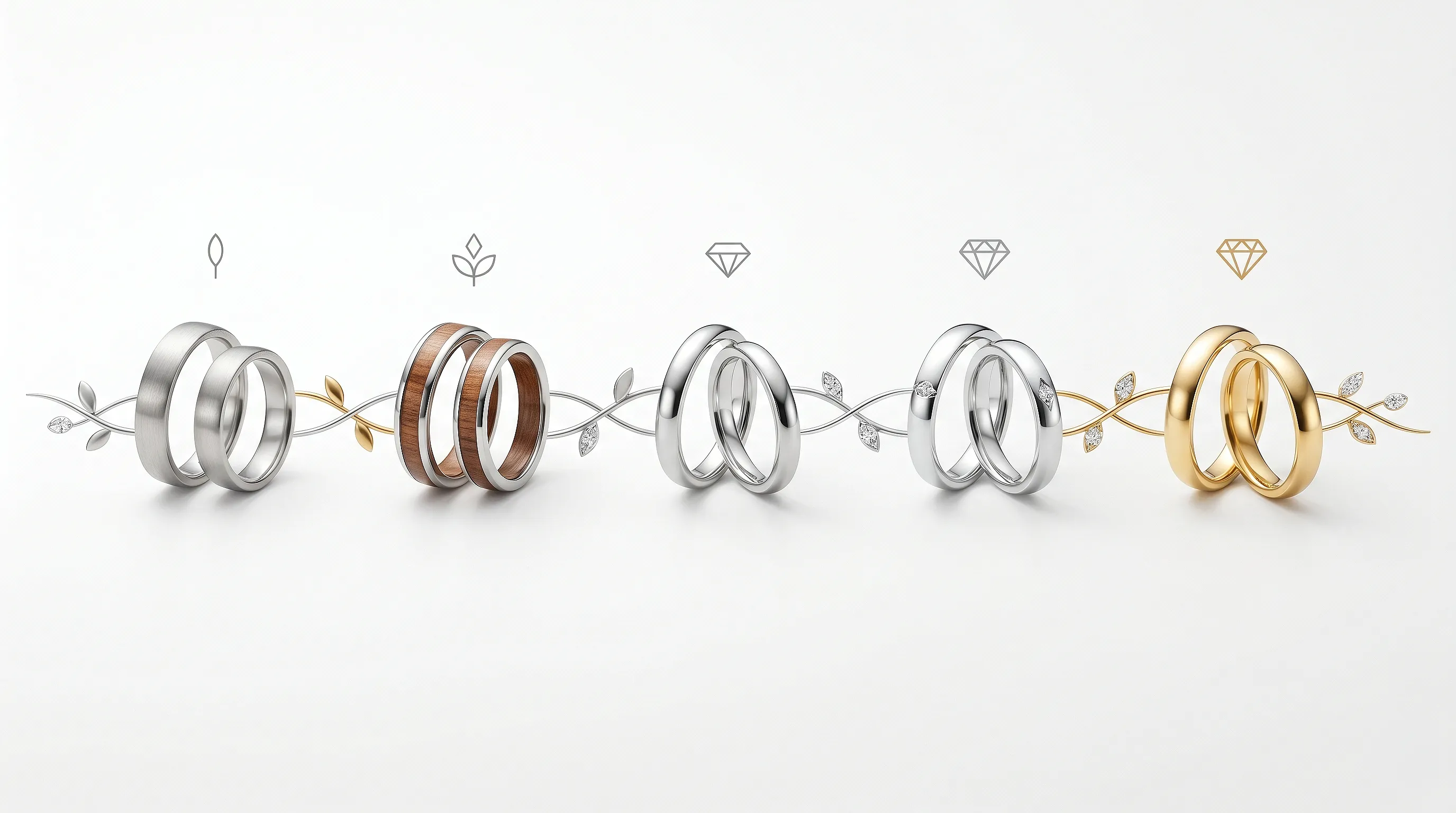
A ring with a stabilised oak inlay. The outer band is metal (silver or gold), while the inner or middle part is made from wood that has been through stabilisation (the process is covered in the FAQ). Such a ring can be washed, worn in the shower without long soaking, lasts for decades and keeps its visible wood texture.
A sandalwood bracelet. Sandalwood is a rare and costly timber with a natural scent that lasts for decades. A bracelet of sandalwood beads with a single engraved metal tag is jewellery you both see and smell: warmed by the wrist, the sandalwood gives off its distinctive spicy aroma. In India and South-East Asia sandalwood bracelets are traditionally worn as a protective charm. For the fifth anniversary such a bracelet carries the idea, "you have become part of the scent of my life."
Earrings with miniature wood elements. Small fragments of precious species (rosewood, ebony, cocobolo, olive) set in metal. Each species has its own colour and grain: ebony almost black, rosewood violet-brown, cocobolo bright orange with dark stripes. Drop earrings with such inlays look unusual and repeat no standard jewellery shape.
A pendant with a wood core and a metal frame. A more involved technique: inside the metal frame sits a thin layer of stabilised wood, and on it engraving or inlay. The result is a piece with three layers of material: outer metal, middle wood, surface engraving. Each layer carries its own information.
An intarsia signet. Intarsia is the technique of inlaying wood into wood of another species. A design (a star, a letter, a symbol) is cut from one species and set into a base of another. The result is a two-colour pattern with no paint, only the natural colours of different woods combined. Stabilisation afterwards makes the piece fit for everyday wear.
A reliquary with a chip of a particular tree. If a couple has a specific tree that holds personal meaning (a tree from a parent's garden, a tree under which the proposal happened, a tree planted for the wedding), a chip of it can be set into a metal reliquary capsule. This is no longer a serial piece but an artefact that means something only to the two of them.
The Wooden Anniversary Across Cultures
In the United Kingdom and the United States the fifth anniversary is the Wooden Anniversary precisely because, by the common feeling of the era, the couple had "weathered the first storms." Wood stood for the survivors, in the good sense: those who came through the difficulties and stayed together. In the United States it is an occasion for a party with guests; in Britain it is marked more quietly, with the accent on personalisation: an engraved bracelet, a pendant with initials, a ring with a date inside the band. In Scotland and Ireland a Celtic thread fits well: the Claddagh ring, a Celtic knot, the clan tartan.
In Germany and Austria the anniversary historically went by the name Hölzerne Hochzeit and came with a ritual recorded in ethnographic sources from the late eighteenth century onward: the husband chopped firewood for the home, demonstrating his readiness to provide for the family for many years more, while the wife laid out a meal from everything she had grown that year, and guests brought handmade wooden gifts. The modern German tradition keeps the same emphasis on handwork and concreteness, and planting a tree for the anniversary is considered a separate, beautiful gesture.
In France the fifth anniversary (noces de bois) is counted among the "minor" milestones and marked within the family, valuing restraint: a thin ring with a single stone, a pendant with one symbol, a short engraving ("Toujours", "Cinq ans"). In Italy (nozze di legno), by contrast, the gift may be large and conspicuous: eighteen-carat yellow gold, one big stone, sometimes a medallion with a religious motif even among secular couples. In Spain (bodas de madera) the gathering is loud, with extended family, and the gift acknowledges the couple's place in the larger clan: a family pendant, a ring with stones for each member, in Catalonia or the Basque Country with a regional symbol (the senyera, the lauburu).
In Japan the fifth anniversary has no special name with a wooden symbol, but the tradition of exchanging jewellery with natural motifs on important marriage milestones runs strong. A branch, a water motif or a tree in a piece reads there as respect for natural cycles and for family continuity.
The Number Five and Its Symbolism
Five is the number of a completed first cycle. In numerology the five stands for freedom, movement, change and adaptation. A couple who have lived five years together have already passed through several versions of themselves: people in love, newlyweds, people with a shared household, partners in difficulty. The fifth anniversary is the first milestone the couple genuinely has something to mark. Not "a month together," not "a year," but five years: the first stretch that demands respect.
In tree biology, five years is when a young tree crosses from the category of "sapling" into the category of "tree." It no longer needs daily care to survive. It can already get through a season without watering. It has already pushed out several seasons of leaves and returned each time. The metaphor is precise and unworn.
Regional Traditions of the Fifth Anniversary
How the fifth year is marked in different cultures matters not for trivia but for choosing a gift with a sense of context. If the couple is Anglo-German, the German tradition can be a second background frame of reference. If the first trip together was to Italy, the Italian tradition will suggest a form.
In the English-speaking system the fifth anniversary has two symbols: the traditional one (wood) and the modern one (sapphire), so it can be marked at once with a handmade wooden piece and with a sapphire piece. The choice between a loud party and a quiet, personalised gesture maps onto the difference between the American and British readings of the same milestone.
In Germany and Austria the milestone was historically called Hölzerne Hochzeit, with the rite described above. Planting a tree for the anniversary counts there as a separate, fine gesture, and the modern tradition holds the same accent on handwork and concreteness.
In France the fifth year belongs to the "minor" milestones, marked within the family, with a taste for the laconic. In Italy the gift can be bigger and more visible. In Spain the celebration is loud, with extended relatives, and the gift acknowledges the couple's place in the larger family, which is why family pendants and rings with a stone for each member appear so often there.
Across English-speaking practice the strongest fifth-anniversary gifts share one thing: they are worn, not displayed once. The piece travels with the person into ordinary days and into the celebration alike, which is exactly why a piece of jewellery tends to outperform most other gift categories for this milestone.
The Psychology of the Fifth Year
Five years is the first stretch where a conscious choice can be edged out by autopilot. By this point many couples notice that the sense of novelty has dulled, not because feeling has vanished but because the brain stops registering the familiar as significant. This is the work of the nervous system, not a crisis in the relationship. Understanding it helps you choose a gift that works against autopilot rather than feeding it.
What Has Usually Happened in Five Years
The picture of a couple at the fifth anniversary looks roughly the same across most of Europe and the English-speaking world. By year five a couple has often gone through some of the following.
Frequently they already have at least one child. That means the relationship has stopped being a relationship between two adults and become a system of "two adults plus a child." The distribution of attention, time and resources has changed radically: every interaction now happens against a backdrop of parental duties, lost sleep and the running concerns of a small person.
Some couples lose a parent in this period: a mother-in-law, a father-in-law. For people who married around thirty, this is a plausible event. The death of a parent is always a serious test for a couple: the family landscape shifts, a new load appears (often financial or organisational), and the second partner becomes the only support for the one who grieves.
Many move house at least once in these years. A move within the city, between cities, to a new country for emigrant families. Each move is a serious load on the relationship: the couple loses its familiar space, its familiar surroundings, its familiar rituals, and has to rebuild them from scratch.
A serious career crisis for one partner often occurs. Loss of a job, a long search for a new place, a professional dead end, burnout, a clash with a boss that forced a resignation. A career crisis for one partner is always a financial and emotional load on the other.
Some couples go through the serious illness of a partner or a close person. Hospitalisation, surgery, long treatment, a diagnosis with an unpredictable outlook.
This is not a portrait of an unhappy five years. It is the ordinary course of a couple's life over five years. Each couple passes through some subset of these events, and the fifth-anniversary gift acknowledges, directly or indirectly, the density of what has been lived.
Habituation and What to Do About It
The process is called habituation: what repeats predictably, the brain records less and less. A partner you see every day stops being perceived as a separate person with their own story. They become part of the familiar space, like an armchair or a coffee machine.
This is not betrayal and not cooling. It is biology. The same biology that makes us insensitive to the smell of our own home, to the background noise of the street, to the taste of tap water. The brain adapts and frees resources for new tasks.
The trouble begins when the autopilot is mistaken for the truth. When the absence of noticing a partner is read as the absence of feeling. When the habit of shared presence replaces deliberate attention.
A gift that interrupts this autopilot works as a reminder: this is the person you chose. Jewellery is especially precise here, because it is put on consciously, looked at in the mirror, and each time that moment asks for at least a second of attention. A glance at a pendant with the coordinates of your first shared address returns you in a second to what those numbers stand for.
What the Gift Should Anchor
A good fifth-anniversary gift works not as decoration for a perfect picture but as recognition of the real distance covered. That means the piece should carry traces of this couple's specific history rather than being a generic "anniversary gift."
If the couple lived through a move to a new city, the coordinates of that new city on a pendant or bracelet carry more than a generic "5 years" engraving. If the couple came through a serious illness, a symbol of recovery (the tree of life, a phoenix, a rising sun) reads especially sharply. If a child was born, the child's name or date of birth turns the piece into a family artefact.
A gift that anchors what has been lived works like a tether: each time the wearer puts it on, it returns them to what it means. Not to an abstract "five years together" but to a concrete "we came through this, and we are here." That is a completely different emotional charge.
The Ratio of Positive to Negative Interactions
People who have watched couples closely tend to notice the same thing: the difference between the content and the discontented rests not on the number of conflicts but on the ratio of positive to negative interactions. In stable couples the positive moments noticeably outnumber the negative. Where a couple drifts toward a split, the balance tips the other way, and there is more friction than warmth.
An anniversary gift is a concentrated positive moment. One good gesture does not solve everything, but it adds weight to the right side of the scale. If the gift is well thought through and lands on the partner's personal content, its "weight" in the couple's emotional economy can exceed that of a dozen small good moments.
The Fifth Year as the First Real Choice
At the start of a marriage partners hold together largely on the momentum of infatuation, on social expectation, on a household that has not yet settled. By year five the momentum runs out. Only those who chose to stay, consciously, remain. The fifth anniversary is the first time "we are together" means a choice rather than the continuation of something already begun. The gift for it should match that weight.
Gift Ideas for the Fifth Anniversary
The list is split into three parts: gifts for her, gifts for him, and shared or paired gifts. Each item is described briefly and concretely so you can use it as a checklist while choosing.
For Her (ten ideas)
1. A ring with a stabilised wood inlay. A band of silver or gold with a central inlay of stabilised oak, olive or walnut. The warm texture of wood against the cool shine of metal. The size and shape of the inlay are chosen to fit the finger.
2. A pendant with the coordinates of a first shared place. A silver or gold tag engraved with the coordinates of a first date or a proposal. The figures are known only to the two of you, and no outsider will decode them.
3. Paired pendants from one tree slice. A single branch slice is cut in two, each half set into a metal frame and hung on a chain. The halves are worn separately and fold into one object only when both partners are together.
4. A bracelet engraved with "tree" in several languages. A thin bracelet engraved with the same word in five to seven languages, separated by commas: arbol, albero, baum, arbre, tree. Each language is a layer of meaning.
5. Drop earrings with a miniature trunk. Pendants shaped like an elongated drop with bark texture across the surface. Oxidised silver, or a mix of silver and warm enamel for the effect of living wood.
6. A reliquary with a chip of a particular tree. A small metal capsule holding a fragment of wood with personal meaning: a tree from a parent's garden, the tree of a first confession, the tree planted for the wedding. Worn as a pendant on a chain.
7. A world map with a tree on the place you met. A medallion pendant with a tiny world map, a single tree marking where you met. The metaphor: among millions of places on the planet, there was one where it all began.
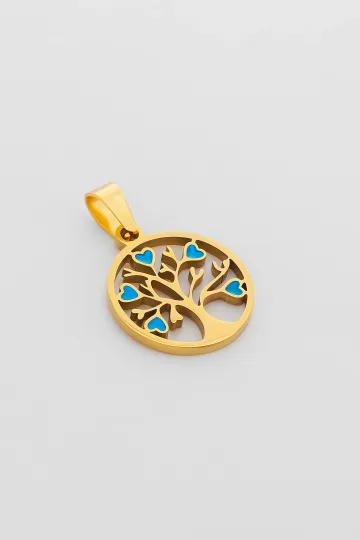
8. A tree-of-life pendant with five stones on its branches. The classic tree-of-life motif rendered with five small stones for the five years lived. Each stone is a year. At the tenth anniversary five more can be added. By the twenty-fifth the piece has its own history.
9. Cherry-blossom studs with five petals. Stud earrings shaped as a single cherry blossom with five petals. A metaphor of the fleeting beauty of the five years: cherish it because nothing is forever by default.
10. An eternity ring with sapphires. A thin ring with a continuous line of blue sapphires (the modern stone of the fifth anniversary in the Western tradition). Worn beside the wedding ring, not in place of it. Each sapphire is an affirmation of faithfulness.
For Him (ten ideas)
11. A signet with intarsia of two woods. A men's signet with a central intarsia element (wood set into wood): dark ebony in pale oak, forming a simple geometric figure or a letter. Stabilised inlay, a metal band.
12. A sandalwood bracelet with a silver tag. Beads of natural sandalwood with one engraved silver tag carrying a date or coordinates. The scent of sandalwood, the weight of wood on the wrist.
13. An anchor pendant with a wood core. A silver or steel anchor with a central inlay of dark wood (rosewood, ebony). The metaphor: I stand, I hold, and I am alive.
14. A ring with oak-bark texture. A men's ring with a relief surface imitating oak bark. Fully metal, no wood inlay, but a texture that gives the image of a tree. It sits well on a man with a larger hand.
15. Paired bracelets from an oak by a family home. If the couple's history holds a specific tree (an old oak by one partner's family home), a fragment of its wood can serve two bracelets: one for him, one for her. Stabilisation makes them fit for everyday wear.
16. A tree-slice fob for the keys. Not on the neck but on the car or house keys. A branch slice in a metal mount engraved with the wedding date. Seen every time he reaches for his keys.
17. Cufflinks with wood inlays. Double-sided cufflinks: one face metal with engraving, the other a wood slice. For double-cuff shirts. A good gift for a man who wears a suit now and then.
18. A signet with a family monogram and a wood motif. A signet ring engraved with both partners' initials framed by oak branches. A heraldic style that reads as "a family with history and roots."
19. A compass pendant with a Latin "fifth year." A silver or steel compass pendant engraved "Annus quintus" on the rim. A symbol of direction, the fifth year of the journey.
20. A bracelet with a chip of the wedding tree. If a tree was planted at the wedding, a fragment of its bark or branch can be sealed into a metal capsule inlay on a bracelet at the fifth anniversary. A relic tied to one specific day.
Shared and Paired Gifts (eight ideas)
21. Paired rings with the same wood inlay. Two rings with inlays from the same fragment of wood. Both rings show a piece of one grain cut in two.
22. A family tree pendant with the names of partners and children. A large pendant with a tree, the names of every family member engraved on its branches. The metaphor: here is our tree, and here is who grows on it.
23. Paired cord bracelets with five knots. Cord bracelets with the same number of knots as years lived. Five new knots are added at the tenth anniversary. By the twenty-fifth the bracelet becomes a history.
24. Paired rings with a soundwave. The phrase "I love you," spoken by each partner, is converted into a visual soundwave and engraved on the inside of the other's ring. On his ring her voice, on her ring his.
25. A box with two pieces inside. A handmade box of a precious wood, and inside two gifts: one for her, one for him. The box itself is a gift (handwork), plus its contents.
26. Paired pieces with one stone cut in two. Technically demanding but very precise: a single natural stone is cut into two halves (for different cuts), each half in its own setting. Neither piece is complete without the other.
27. A portrait with the jewellery in it. A commissioned portrait of the couple, each shown wearing the pieces they gave each other. Ten years on, a second portrait can be made. The series becomes a family chronicle.
28. Planting a tree together plus two pieces. An action plus an artefact. Plant a tree together for the fifth anniversary (in your own garden, in a community project, on land where planting is allowed), and each receives a piece holding a small fragment of that planting (soil, a chip of the sapling's bark, a miniature). The most material possible way to say "we are here."
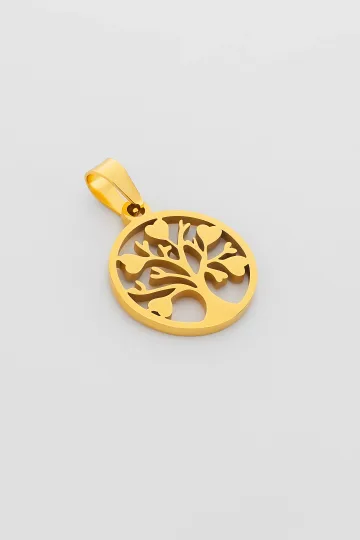
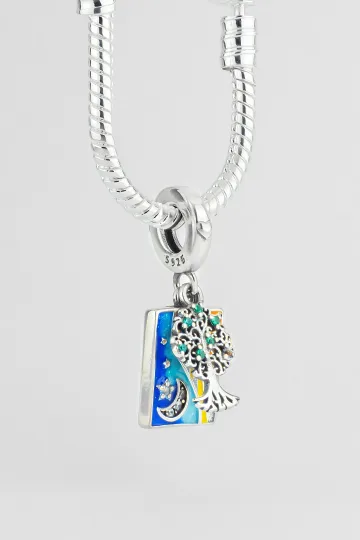
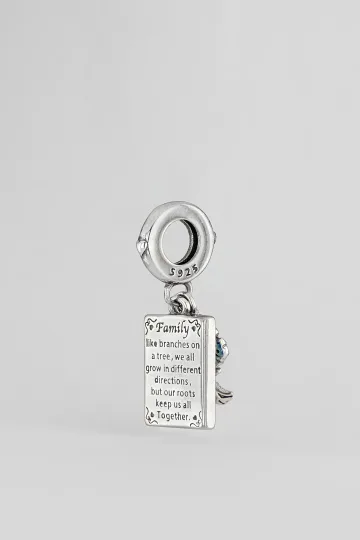
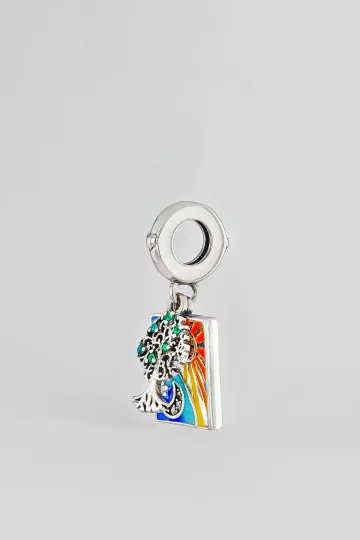
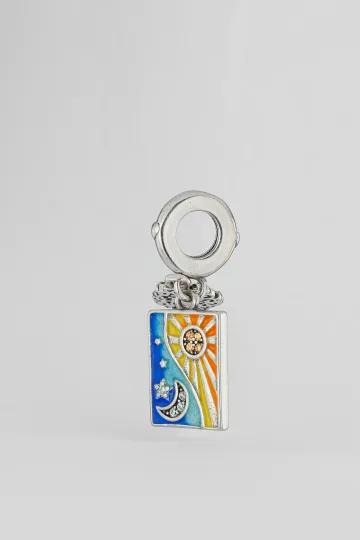
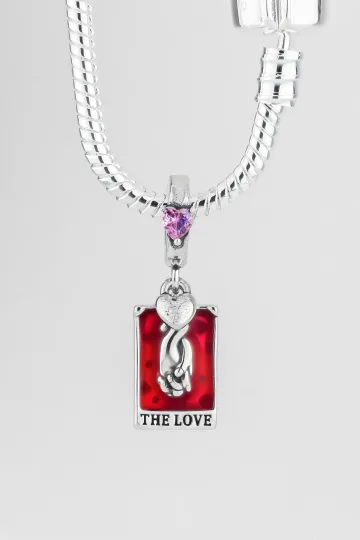
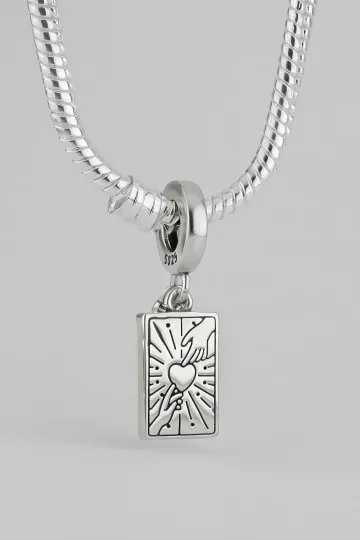
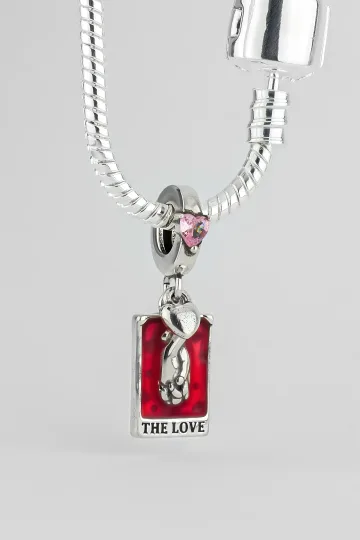
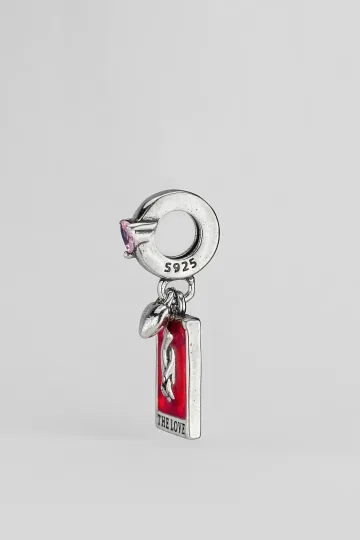
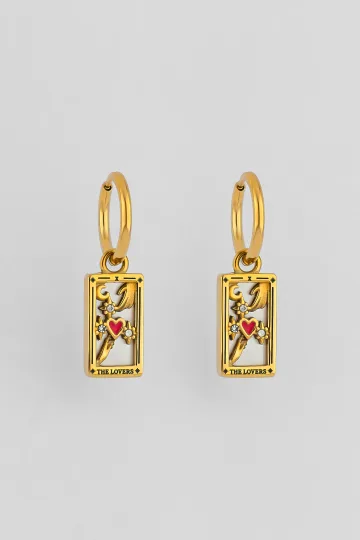
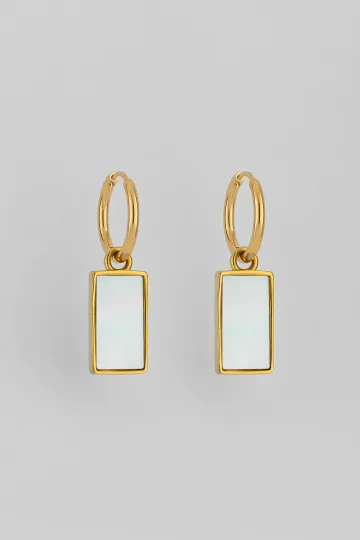
Wear the symbol, don't just read about it. These are in stock:
Five Detailed Case Studies
These cases are built from composite stories that recur in the practice of jewellery workshops handling anniversary commissions. Each shows how an abstract idea turns into a concrete artefact.
Case 1: A Couple Who Planted a Tree at Their Wedding
A young couple married five years ago in a small town in southern Spain. At the wedding the bride's parents gave the newlyweds an olive sapling, planted on the parents' plot on the day of the celebration. Over five years the olive grew into a small tree about two metres tall and bore its first small fruit.
For the fifth anniversary the husband commissioned a pendant with a slice of a branch from that tree from a local jeweller. The olive grows slowly, and a relative who farms donated a thin lower branch that needed pruning anyway. A cross-section of the branch, about two centimetres thick, was stabilised with a polymer impregnation, set into a round silver frame and hung on a chain.
On the back of the setting two dates were engraved: the wedding date (when the olive was planted) and the date of the fifth anniversary (when the branch was cut). Around the outer rim ran the words "Aceituna nuestra" (our olive).
The wife took the gift as a materialised metaphor of their marriage. "This tree grew with us," she would say, showing the pendant to her parents and friends with the same phrase each time. The gift entered her everyday set of jewellery and is worn almost daily.
The lesson: if a couple has a specific tree that holds personal meaning, a material fragment of it in a piece turns the abstract symbol of the anniversary into a real artefact.
Case 2: A Farmer's Son and Paired Oak Bracelets
The husband grew up on a family farm in the English countryside. In the yard of his parents' house grows an old oak, planted by his great-grandfather in the late nineteenth century. When he visits, he always remarks "look at the oak." For him the oak is not a tree but a family calendar.
For the fifth anniversary the wife decided to use the wood of that very oak for a paired gift. She arranged with the husband's father that one small branch, a lower drying one that needed pruning anyway, would be cut specifically for the project. The branch was taken to a workshop that specialises in jewellery with stabilised wood.
Two plates were turned from the branch, each about five millimetres thick and six centimetres long. The plates went through vacuum stabilisation (impregnation with polymer resin under pressure) and were mounted as the central elements of two silver bracelets, one for him, one for her. The bracelets share the same silver part and the same wood inlay, differing only in the wrist measurement.
On the inside of each bracelet a short phrase was engraved: on his, "Your home, my home," and on hers, "My home, your home." The mirror engraving points to the idea that one partner's home became the home of both.
At first the husband did not grasp the value of the gift: "an ordinary bracelet with wood." When the wife explained which tree the inlay came from, his reaction changed completely. He began wearing the bracelet every day, including to work, where he had never worn jewellery at all.
The lesson: for people with a deep connection to a specific place, a material tied to that place works several times harder than any generic symbol.
Case 3: An Urban Couple with No Tree to Speak Of
A couple married in London five years ago. Both city people, no country house, no attachment to any particular tree or landscape. Life runs between the office, home and the shops. The idea of "give a fragment of a special tree" simply did not work for them: there was no such tree in their biography.
The husband took a different path. He commissioned a small silver pendant engraved with the Latin "fifth year" (Annus quintus) and an inlay of a tiny oak leaf laid out from minute pieces of green mother-of-pearl. The leaf was about eight millimetres across, and each vein was a separate tiny inlay.
The idea he put this way: "We have no tree of our own, but the tree as a symbol suits us. So let there be one leaf, flawless, small, ours."
The wife took the gift as "honest." She explained to a friend: "We are not a country couple, we have no forest in our biography. What we do have is the precise understanding that we lived five years in the city, just the two of us. One leaf on silver is about us: small, neat, our own."
The pendant holds a place in her daily set and is worn with anything, including formal office wear.
The lesson: a "wooden anniversary" does not require a physical tree. The symbol of wood, executed neatly and with meaning, works for city couples with no forest in their past.
Case 4: A Biologist Wife and a Growth-Ring Pendant
The wife works as a biologist at a research institute, specialising in forest ecosystems. Her specific topic is the dendrochronology of mountain conifers: she reconstructs climate series from the growth rings of trees that grew at high altitude over the past three hundred years.
The husband knew about this scientific love and decided to make a gift that would both amuse and move her. He commissioned a silver pendant shaped like a conifer cross-section, not an abstract one but a realistic one: five growth rings arranged with the proper ratio of early to late wood, characteristic of a slow-growing alpine species.
The pendant was made from sterling silver 925 with very fine engraving of each ring. On the back was engraved a scientific caption: "Larix decidua, 5 yr, ad memoriam" (European larch, 5 years, in memory). The Latin phrase nods at once to her scientific practice (species are described with Latin names) and to their fifth anniversary.
At first the wife laughed when she saw the gift: "you made me a scientific artefact." Then she cried. The pendant took the place of her main piece, and she wears it to dendrochronology conferences, on fieldwork, at the institute and in ordinary city life.
The lesson: a gift that lands on the recipient's professional passion works several times harder than a generic one. The point is not to give what you like, but to give what lands in her world.
Case 5: After a Hard Year, Remelted Rings
The couple went through a hard fourth year of marriage: the husband was diagnosed with a serious illness that demanded long treatment, a long recovery and a temporary loss of work. By the fifth anniversary they had both come out of the crisis in good shape: health restored, work resumed, and between them the feeling of "we went through something real and did not break."
They decided to mark the fifth year with an unusual gesture: both removed their wedding rings, handed them to a jeweller and asked to remelt them into new rings, but with one new element added. The element was a small inlay of stabilised wood from an apple tree they had planted in their garden in the first year of marriage, which gave its first blossom in the year of his illness (the fourth year).
The new rings came out in the same metal as the wedding bands, but with the addition of a small round wood inlay. On the inside of each ring a single date was engraved: the date of his discharge from hospital. Not the wedding date, not the date of the fifth anniversary, but the very date that marked the end of the hard period.
The wife said of the gift: "I am not wearing a new ring. I am wearing the same ring I have worn for five years, with the thing we came through added to it."
The lesson: remelting existing wedding rings with the addition of a symbolic material is one of the strongest possible gestures for the fifth year. The ring is not replaced, it is augmented. The layers of history are literally fused into each other.
Anti-Patterns: How Not to Do It
A well-chosen gift is recognised both by what went into it and by what it avoided. A few typical failures that instantly collapse the whole effect of the fifth anniversary.
A Cheap Pine Object
Pine is a respectable timber, but in the category of "wooden anniversary gifts" it often becomes a refuge for cheap mass craft. A pine chopping board from a shop for the price of a takeaway lunch, a factory pine box, a pine photo frame with a stamped pattern. All of these technically fall into "a wooden gift," but they read unambiguously as "bought on the way home because I forgot it was the anniversary."
Pine itself is not at fault: properly worked (solid furniture, ship pine, northern pine for house building) it looks noble. The association is at fault: a factory pine object is a marker of low investment. The recipient reads not the material but the absence of effort.
If you do want a pine object, it should be either obviously handmade (with a maker's signature, with the story of the workshop) or further personalised (engraving, individual design). A plain pine object with no personalisation reads as a stopgap.
Over-Polished Wood with No Texture
Stabilised and heavily polished wood loses its main visual argument: the texture of the grain. If the surface of a wood inlay in a ring or pendant is polished to a mirror shine, you get a material that looks like plastic with the colour of wood. The unique grain pattern is hidden under lacquer, the wood stops being wood and becomes an imitation of a material.
Good jewellery with stabilised wood keeps the texture visible: the grain and the growth rings should be distinguishable under the fingers and to the eye. A light polish for smoothness is acceptable, a mirror polish kills all the symbolic and aesthetic value.
The rule: if you take a piece with stabilised wood and cannot see the grain from thirty centimetres away, the texture is dead and the material has turned into plastic.
A Faceless "Five Years Together"
The most common engraving on anniversary jewellery is an impersonal phrase like "5 years together," "forever," "my love" or their equivalents in other languages. Such engraving says nothing about the specific couple. Strip out the initials or the date and the pendant could go to any couple in the world marking five years.
A faceless inscription reads as the confession "I did not find the time to think of something of our own." The recipient values the piece less precisely because it is not tied to them personally. It is a piece about an abstract anniversary, not about their history.
A good engraving holds specifics: the coordinates of a place, the names of children, the date of an important event, a phrase from the couple's own vocabulary, a quote from a shared book, numbers that mean something only to the two of you. Any specificity beats any abstraction, even if the content seems odd or opaque to outsiders. The piece is made not for outsiders.
A Current Social-Media Quote
The temptation to engrave an inspiring line from a recent post is strong, especially if the phrase caught you at the right moment and seemed deep. Do not do it.
Such quotes age at the speed of the people who post them. In two or three years the author may be forgotten, the phrase compromised by a new context, the trend replaced. A piece into which you poured a five-year milestone risks becoming a marker of a passed internet era.
If you want a quote, it should be tested by time. A Latin maxim, a line from classical poetry, a phrase from a book that means something concrete to you personally. "Annus quintus" or "sic itur ad astra" will outlast any cultural movement of the recent decades and keep their dignity fifty years on. A current quote may cause an awkward wince in ten.
The "I Skimped on the Anniversary" Gesture
A gift into which visibly less was put than the giver could afford reads as a message. The message says: "this anniversary matters less to me than my other spending." No packaging and no rhetoric mask that impression.
This does not mean the gift must be expensive. It means the gift must show a considered proportion. On a tight budget it is better to choose one small but well-worked piece (a silver pendant with the right engraving) than a large and visibly cheap one. A small artefact with a story always outplays a big object with no soul.
The signal "I tried" reads at the level of details: the quality of the engraving, the neatness of the setting, the thought behind the symbol, the packaging, the moment of giving. All of these cost less money than attention. If the attention shows, the budget fades to the background.
A Gift with No Explanation
A meaningful piece the recipient does not understand works only at half power. A pendant with a slice of an olive branch from the parents' garden is a priceless artefact, but only if the recipient knows it is that olive. Without the explanation it is just a piece of wood in metal.
There is no need for a long speech. A card with one or two lines in the box is enough: "a fragment of the tree we planted at our wedding" or "the coordinates of the place where I proposed." Those words turn a beautiful object into a family story.
A Generic Piece "for Any Wife"
Any piece that suits "any woman in principle" does not suit this particular woman in particular. Generic pearls, a generic heart pendant, a generic single-stone ring, all of these work as a gift "for the occasion" but not as a gift "just for you."
A good fifth-anniversary gift holds something you could not give anyone else. Coordinates, you cannot. The names of children, you cannot. A fragment of a specific tree, you cannot. An engraving from your private vocabulary, you cannot. The more inalienable personalisation in the gift, the more precisely it reaches its addressee.
Customer reviews
Zevira is a real jewellery shop. Genuine payments, deliveries and customer thank-yous.
🥰🥰🥰 gracias
Ok, ¡gracias! 🙂
Engraving: Forms and Phrases
Engraving moves a piece from "a beautiful object" to "our story." On the fifth anniversary that shift matters most. A few engraving formats that work especially well for the wooden anniversary.
Quinquennium: Latin for "Five Years"
The word "quinquennium" in classical Latin means a period of five years. It was used for terms of office (the quinquennalia in the Roman magistracy), for terms of vows, for probation periods in monastic orders. The word is serious, not everyday, carrying the weight of administrative and cultural tradition.
Engraved "Quinquennium" on the back of a pendant or inside a ring band, it reads as a restrained, dignified mark of the time covered. No "5 years," no "five years together," just one Latin word naming exactly what happened. Brevity and force.
Latin capitals sit well in engraving: Roman monumental letters (capitalis monumentalis) with serifs work on silver, gold and steel. A letter height of two to three millimetres suits most pieces.
Annus Quintus: "Year the Fifth"
An alternative to "Quinquennium," more literary and less administrative. "Annus quintus" is "the fifth year" in Latin grammar (literally: year the fifth, the adjective after the noun). It sounds like a chapter or a book title: "Annus primus," "Annus quintus," "Annus decimus."
The engraving works especially well if the couple plans to continue the tradition: at the tenth anniversary a new piece with "Annus decimus," at the twenty-fifth "Annus vicesimus quintus." The result is a series with a shared grammatical structure but different content.
A Date as a Julian Day
The Julian day is a system of continuous day counting from a conventional starting date (1 January 4713 BC) to the present. Astronomers use it to mark events. Every calendar date corresponds to one Julian day, a five- or six-figure number.
If your wedding fell on, say, 15 June 2021, the Julian day of that date is 2459381. Engraved on a piece, that number looks like something entirely cryptic, unlike any standard date or code. Only someone who knows it is a Julian day, and how to convert it back, can decode it.
The Julian day as an engraving works especially well if the recipient has a connection to science or simply enjoys an intellectual cipher. A pendant with the number 2459381 on the back hides its meaning on three levels: the outsider does not know it is a Julian day, does not know how to convert it, and does not know what date it stands for or why it matters.
Coordinates of a Significant Place
Coordinates engraved in fine type are one of the strongest personalisations: many people know the wedding date, but usually only you know the precise coordinates. In an engraving the decimal format (51.5072, -0.1276) fits more compactly than the degree format and holds better on a small surface. Which place to choose and which formats exist are covered in the dedicated section on coordinate jewellery below.
A Quote from a Shared Favourite Book
If a couple has a book that means something to both of them (a favourite novel, shared poetry, a philosophical text opened in their teens), a short quote from it is a very personal engraving.
A few rules for choosing the quote. First: it should be short, no more than five or six words, so it fits the engraving without losing legibility. Second: it should be tested by time, classical or at least having survived fifty to a hundred years (nineteenth-century poetry qualifies, a social-media post does not). Third: it should be in the original language where possible, or in a tested translation.
Examples of suitable quotes: "Si vis amari ama" (if you wish to be loved, love) from Seneca, "Omnia vincit amor" (love conquers all) from Virgil. Any line from classical poetry or prose that holds personal meaning for you and is brief enough for engraving will work.
Children's Names with Dates of Birth
If by year five the family has one or more children, an engraving with their names and dates of birth turns the piece into a family artefact. A small pendant usually holds two names with dates, a large one holds three or four. A bracelet lets you set the names in a row.
The format: a child's name plus a date of birth, separated by a comma. Names are usually engraved on the back of the piece, with a symbol (tree, infinity, heart) on the front. The result has two faces: the front for the outside world, the back for the wearer alone.
A Soundwave
A voice recording converted into a visual soundwave and engraved on the surface is a technology of the past decade, now available at many jewellers. You can record a short phrase ("I love you," "forever," "our family," a child's name), convert it into a wave, and engrave it.
The soundwave looks like an abstract graphic pattern that conveys nothing to an outsider. The wearer knows what it is: scanned with a phone app, it plays the spoken phrase again. A piece with a hidden audio layer, one of the most unusual engraving formats available for the fifth year.
The Size and Font of the Engraving
A few practical notes on engraving technique that often get missed.
Font size depends on the type of piece and the place of engraving. For the inside of a ring, 1.5 to 2 millimetres are optimal. For the back of a pendant, 2 to 3 millimetres. For the front of a pendant or bracelet, 3 to 4 millimetres. Too small an engraving reads poorly and loses clarity over years of wear (it rubs away). Too large looks crude.
Choose a restrained font: Roman capitals with serifs for Latin inscriptions, a clean sans serif for modern ones, a handwritten script for romantic ones. Gothic faces and decorative fonts with shadows and complex elements usually fail in jewellery engraving: they read poorly and date quickly.
The engraving method is either laser or hand (mechanical). Laser is more precise and cheaper, good for fonts and figures. Hand engraving gives a more alive, slightly uneven stroke that looks more authentic, preferable for premium pieces and for inscriptions to which you want a human trace added.
Paired Jewellery for Five Years
Paired jewellery for the fifth year says the same thing to two people at once, every time both wear it. A quiet, continuous dialogue. There are several formats, and for a full breakdown it is worth following the couples guide; here, briefly, are the ones that fit the fifth year especially well.
Split pendants: one symbol divided in two (a heart, a tree of life, a key and a lock, halves of a tree slice whose rings are whole only when joined). Worn apart, the meaning appears only together. Bracelets with one shared engraving: a date, coordinates, a word in the language of the country where you met, or a Latin phrase like "Quinquennium" across two wrists. Paired fifth-year rings: thin, not in place of the wedding bands but beside them, as another layer of history that becomes a whole narrative by the tenth anniversary.
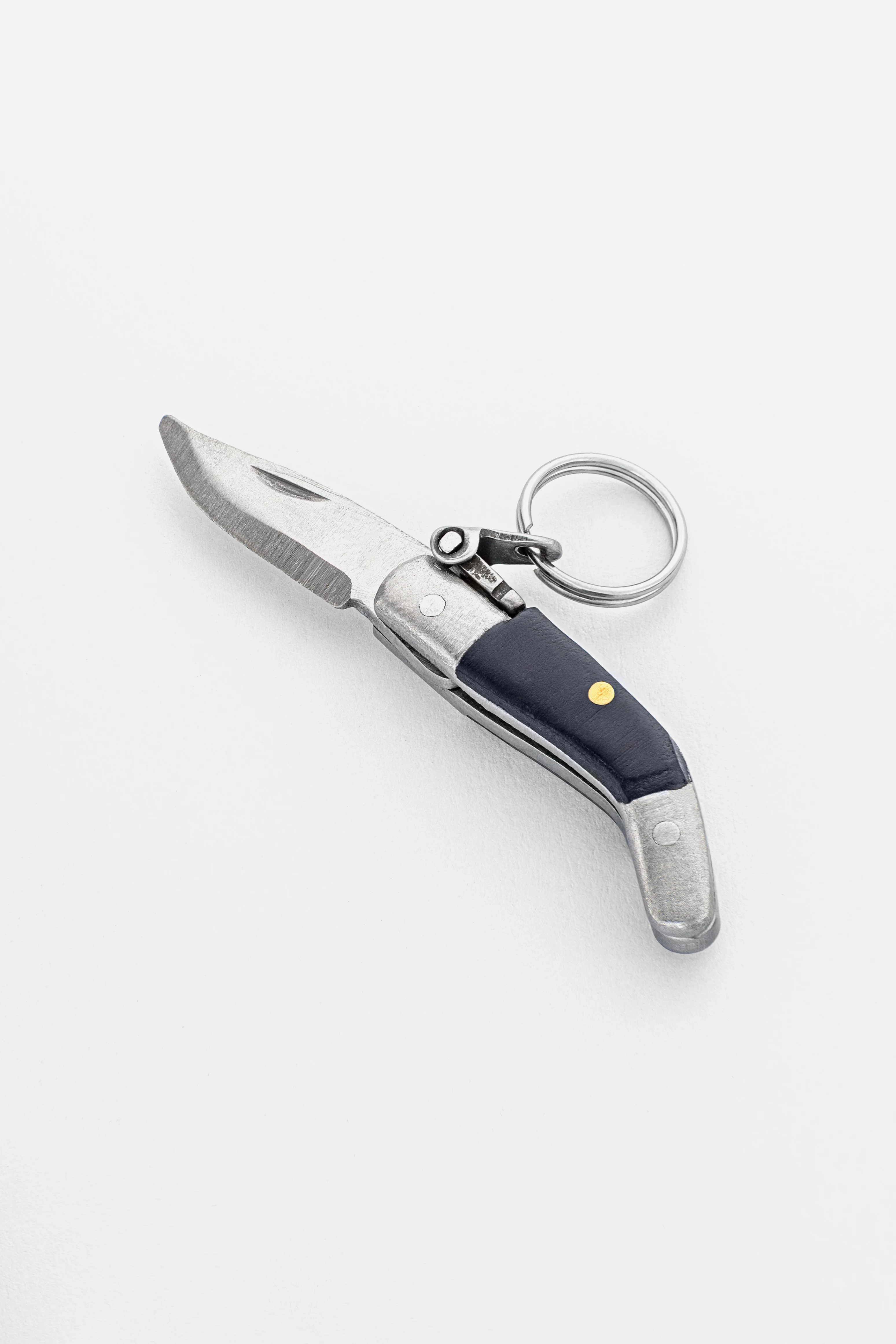
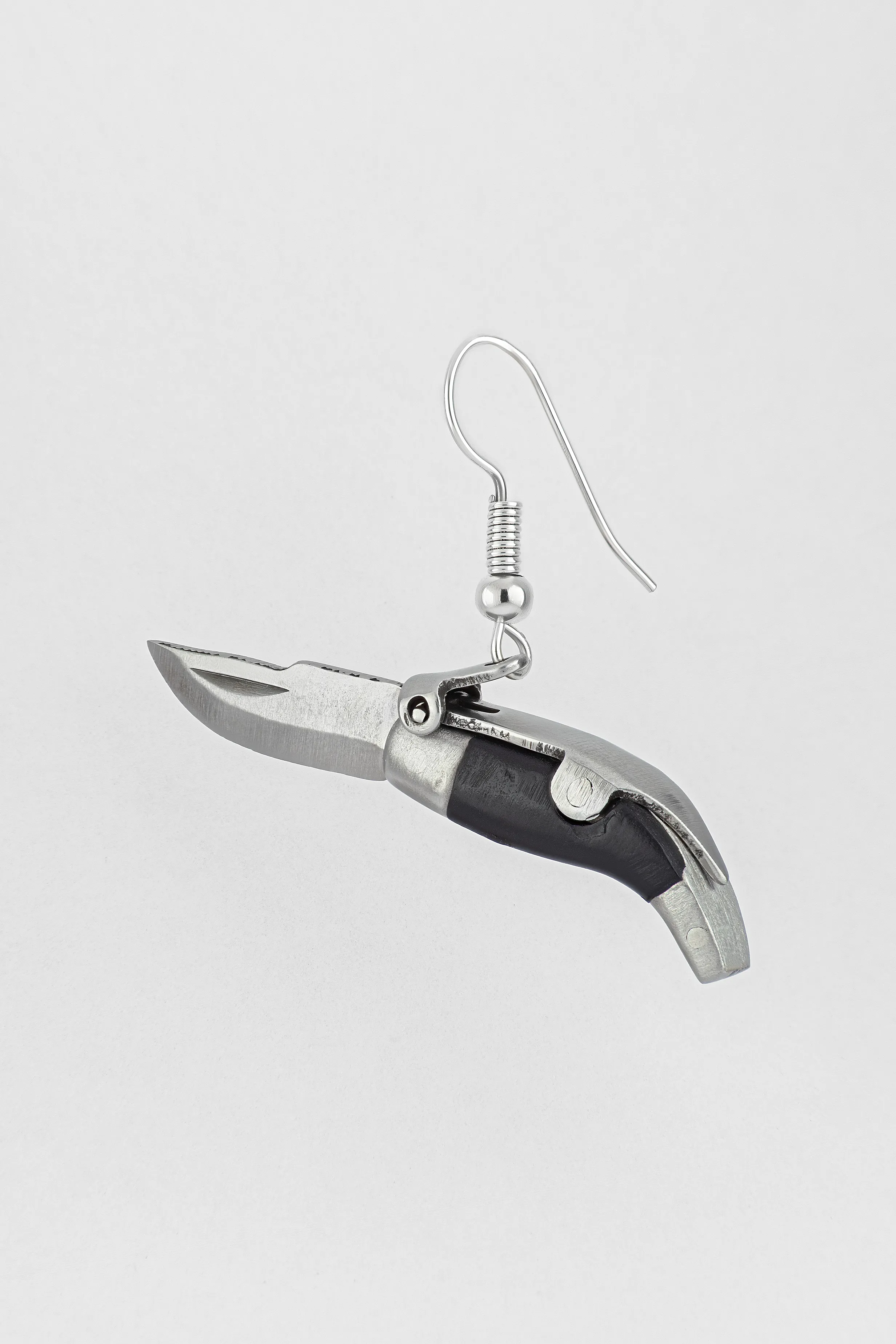
Artisan-crafted CAPAORA navaja pendant
A 40 mm stainless-steel navaja with a real folding mechanism and Palanquilla lock. An affordable gift to remember.
A code for blog readers:
10% off your first order
Authentic · Maker's guarantee · Ships from Spain
Symbols: What to Choose and Why
The fifth anniversary offers a wide choice of symbols, each working on several levels.
The Tree of Life
A tree-of-life pendant is the most direct symbolic answer to the wooden anniversary. The tree of life appears in dozens of cultures: in the Celtic tradition as a link between worlds, in the Norse one as Yggdrasil (the world tree joining nine realms), in Hinduism as the axis of the world, in Christianity as a symbol of eternal life, in the Kabbalah as a diagram of creation.
For the fifth year the structural part of the symbol matters most: roots hold, the trunk carries, the branches grow. It is the image of a working marriage, not a perfect one but a living one.
The tree of life works in jewellery precisely because it can be worn every day without explanation. It does not shout about the anniversary, but the person wearing it knows what it means. Onlookers see a beautiful pendant. The wearer sees the image of their marriage.
In jewellery the tree of life takes several forms: a flat silhouette with thin branches (minimal), a dimensional tree with detailed roots (more ceremonial), a round form with branches filling a sphere (a popular variant). Each reads a little differently.
The Claddagh Ring or Pendant
The Claddagh ring is the Irish symbol of love, friendship and loyalty. Two hands hold a crowned heart. For a paired fifth-anniversary gift it is one of the most meaningful choices. Its three elements name the three components of a strong marriage more precisely than most greeting cards.
The two hands are partnership: two people holding something together. The heart is the love between them, the love they sustain. The crown is loyalty and mutual respect, the honour they both pay to the relationship.
The Claddagh is worn in a particular way: on the right hand, heart pointing outward, when seeking; pointing inward, when in a relationship. On the left hand, heart inward, in marriage. The shift between positions is itself a story. To give a Claddagh ring for the fifth year and put it on the left hand, heart inward, is a fine gesture with a concrete meaning.
The Infinity Symbol
A piece with the infinity symbol reads simply and precisely at five years: it continues. Not "was," not "is," but "continues." The horizontal eight, one unbroken contour with no beginning and no end, is a symbol the mathematicians invented and romance took over.
Mathematically the Mobius strip is a surface with no inside and no outside, one continuous plane. It is a metaphor for a relationship with no hierarchy, no "head": two people on one surface that does not end.
In paired jewellery the infinity sign works especially well: two separate rings that form a figure-eight, or a pendant with names written inside the eight, a visual metaphor of two people who do not merge but are inseparably linked.
The Sacred Heart
The sacred heart is a symbol that carries the idea of love that is not free of pain and difficulty. A heart with thorns and flame is the image of a living, real relationship. For a fifth year truly lived, with hardships and victories, it is an honest symbol.
It is not for everyone. It asks for an understanding of the image and an acceptance of its complexity. But for a couple who know they came through something real, the sacred heart tells the truth. It is not the flawless love of a postcard. It is love that passed through fire and stayed itself.
The Family Pendant
If by year five there are children, a pendant with family silhouettes (adult figures and small figures) turns the piece into a portrait. It is worn every day, and each time the wearer sees their own people. This is a piece about the make-up of what is called home rather than about the anniversary first.
The number of figures matches the number of family members. A new child means a new figure. It is a piece that grows with the family.
Coordinate Jewellery
Coordinate jewellery long ago stopped being a rarity in personalised work. For the fifth anniversary it is a particularly precise gesture.
Why Coordinates Work
Coordinates are a language that describes a place more precisely than any other. Not "our yard," not "that café on the corner," not "the square where we walked," but concrete figures pointing to a spot on the globe with an accuracy of a few metres. Twenty years on, in another city or country, those figures will still point to that place. The place will not vanish.
A coordinate piece differs from a date piece in that everyone has a date, while only you have the coordinates. A coincidence with another place's coordinates is impossible within a hundred metres. That makes a coordinate piece absolutely unique by definition.
Which Coordinates to Choose
The place of the wedding. The most direct choice. The coordinates of the register office, the church, the beach or the restaurant where the wedding happened are the starting point of the story in the most literal sense. That is where it became official.
The place you met. Sometimes this matters more than the wedding place. A doorway, a café, an office, a train carriage, that is where it all began long before the official rituals. For couples whose beginning runs longer than their marriage, this is an especially precise choice.
The place that became home. The address of the first shared flat or the current home. Five years ago that place did not exist as "your home." Now it does. It became home because you both returned to it countless times.
The place a child was born. If the family grew by year five, the coordinates of the maternity hospital or birthplace carry a special weight. That is where the thing that changed everything happened: you became a family in the full sense.
The place of a first trip together. Where you went together for the first time. That moment is often remembered more sharply than many others: the first trip as a couple is when you learn whether you are compatible in unfamiliar surroundings.
Formats of Coordinate Jewellery
Coordinates are engraved on rings (inside the band or on the face), on pendants (back or front), on bracelets (along the length), on earrings (on the back, for yourself, not for show).
The format is standard (40°42'46"N 74°00'21"W), decimal (40.7128, -74.0060) or symbolic (figures only, no letters or symbols). The last is the most personal: an outsider will not understand what it is. Only the one who knows.
Myths About Fifth-Anniversary Gifts
How to Choose Metal and Stone
The wooden anniversary does not prescribe a specific metal, unlike the golden one (gold) or the silver one (silver). It is a freedom of choice based on taste and meaning.
Sterling Silver 925
Silver for the fifth year is the choice of those who value the natural and the practical. Sterling silver 925 is a touch duller than gold, with less ceremony and more daily life in it. A piece worn every day as well as on special occasions.
Oxidised silver (with a deliberate dark patina) suits pieces with natural motifs especially well: bark texture, the silhouette of branches, the outline of leaves in dark silver, all of these look realistic and expressive. The dark recesses between the details create a depth that polished metal loses.
Gold 14K or 18K
Gold for the fifth year is the choice of those who want to underline the weight of the moment. Yellow gold is warm, ceremonial, and does not lose its shine over time. White gold is closer to silver in tone but denser and heavier. Rose gold is soft, romantic, and very popular in paired jewellery in recent years.
For pieces with natural motifs (tree of life, leaves, branches) gold adds a sense of permanence: a golden tree does not rot or wither. A golden tree of life is a deliberately incorruptible image.
Sapphire and Other Stones
The traditional stone for the fifth anniversary in the Western tradition is the sapphire. The blue sapphire symbolises faithfulness and wisdom, steadiness and depth. It suits any format: ring, pendant, earrings.
Other options that work by meaning:
Green stones, jade, malachite, peridot, emerald. They strengthen the natural, forest, "wooden" symbolism. Jade is traditionally linked to wisdom and longevity in Eastern cultures. Malachite is growth and nature.
Blue and violet, sapphire, lapis lazuli, aquamarine, amethyst. Depth, faithfulness, intuition.
White and iridescent, moonstone, opal, white topaz, pearl. Tenderness, intuition, natural cycles.
Warm, citrine, amber, tiger's eye, carnelian. They rhyme with the warmth of wood and with sunlight. Amber is literally tied to trees: it is hardened resin that has carried millions of years of history within it.
The Wooden Symbol in Jewellery Design
The motif of tree, branch, root and leaf in jewellery is as old as jewellery itself. It is not a trend that appeared recently, but one of the durable languages of human culture, translated into metal and stone.
The Tree of Life from Sumer to Today
The image of the world tree or tree of life appears in the mythologies of nearly every culture anthropology has studied. The Sumerian god Enki stood by a sacred tree in a garden. The Egyptian sycamore joined the world of the living with the afterlife. The Norse Yggdrasil (an ash) ran through nine worlds from root to crown. The Hindu Ashvattha (the sacred fig) was an image of the universe itself. The Celtic Bile was the tree around which a cosmology was built.
In the Christian tradition the tree of the knowledge of good and evil from Genesis and the tree of life are two different images in one text. One brought mortality, the other promised immortality. The tree there carries both poles: the risk and the hope.
This near-universal symbol passed into jewellery directly. Tree-of-life pieces were made in ancient Egypt, in Mesopotamia, in Celtic Ireland, in medieval Europe. Each era added its own interpretation, but the base stayed: roots below, branches above, the trunk between.
Natural Motifs in Jewellery Across Eras
Art Nouveau (late nineteenth, early twentieth century). This style made natural motifs central to jewellery. Ivy leaves, tree branches, flowers, all of it became the language of the jeweller's art. Makers of the era created pieces where a branch could be the setting and the leaves the pendant. The natural form was not imitated but embodied as precisely as possible.
Art Deco (1920s to 1940s). Nature was geometrised. The tree became an angular silhouette, the leaves strict rhombuses. But the natural motif did not vanish, it only changed its language.
Organic jewellery of the 1970s. A return to natural forms, to the irregular beauty of a branch or a root. Pieces with emphatically natural texture, with deliberate asymmetry.
Modern biophilic jewellery. Today's pull toward natural motifs is tied to a broader cultural movement: people living in cities look for a link to nature in the objects around them. A leaf pendant on an office desk is a small reminder that something living and growing exists. For a wooden-anniversary piece this is especially apt: the symbolism and the moment coincide.
Bark, Slice, Rings: Wood Textures in Metal
Three main wood textures that work in jewellery.
Bark. Rough, alive, different every time. A piece with bark texture (usually achieved through a special metalworking technique) carries the image of a protective layer accumulated over years. Bark is what is on the outside, what all external blows pass through. A bracelet or ring with bark texture for a man on the fifth anniversary is a precise metaphor for what has been built together.
The trunk slice. Growth rings on a cross-section are one of the most readable natural images. Each ring is a year. A piece with a slice motif literally visualises history: five rings for five years. For the fifth anniversary it is hard to find a more accurate motif.
The branch. Living, with a direction of growth. A branch always grows toward the light. A piece with a branch motif carries that direction: not back, but forward. For the fifth year it is the image of growth that continues.
Leave your email, we'll send your discount code. No spam, unsubscribe anytime.
The code arrives by email, valid on your first order.
Connection to Neighbouring Anniversaries
The fifth year does not exist in a vacuum. It stands between the first anniversary (the paper one) and the tenth (the tin one). Understanding this context helps you build a series of gifts.
Connection to the First Anniversary
The first-anniversary gift usually relates to the theme of the "paper wedding": gifts of paper, handwritten texts, books, documents. Light, ephemeral things that reflect the still fragile, still forming fabric of the marriage.
If the first anniversary brought, say, a handwritten text or a hand-bound book, the fifth can make a conceptual sequel: a piece in which that handwritten text is converted into engraving. The result is a line of continuity: the paper of the first year became the metal of the fifth, with the same content.
If the first anniversary brought a young sapling (it happens), by the fifth year that tree has grown enough to become material for a piece. A branch slice or a fragment of bark from it in a pendant closes a four-year biological cycle.
Connection to the Tenth Anniversary
The tenth-anniversary gift is traditionally tied to the theme of tin or aluminium in the Western system. Five years after the wooden wedding the couple moves to a new level of material: from living nature to a tougher, worked substance. It is a symbolic movement, from the natural and growing to the structured and engineered.
If the fifth year brought a pair of pendants from one tree slice, the tenth can continue the series: add a pair of pendants from one fragment of metal. The series becomes two-part: "the wood of the fifth plus the metal of the tenth."
Many couples deliberately build such a system of continuity: a new piece for each anniversary, with an engraving or symbol matching the traditional name. The first, paper, a piece with a page or handwritten text. The fifth, wooden, a piece with a tree or a branch. The tenth, tin, a piece with silver. The twenty-fifth, silver. The fiftieth, gold. Not an obligation but a possibility: the possibility of building a visible history in objects.
If the Fifth Is the First You Celebrate
Not every couple had the habit of marking the first anniversary with a piece. Sometimes the fifth is the first time a couple decides to give each other a meaningful artefact. This is normal and even logical: the first anniversary often passes by in the stream of a young couple's daily life, while the fifth is felt as the first "real" milestone.
If the fifth is the first in the series, there is no need to build a "complete" collection after the fact. Begin with what makes sense today. Five years is a sufficient starting point.
The anniversary ring sits next to the wedding band, not soloing on the other hand. Deck out every finger and you're wearing a pawnshop window, not five years. Don't argue.
How to Wear the Anniversary Piece
After years of anniversary commissions, one thing holds: a gift only lives when it gets worn, not fished out of a box twice a year. Here is what actually helps an anniversary piece settle into a wardrobe, sorted by occasion.
How do I wear a tree pendant or coordinates every day? For everyday I recommend a thin 45 to 50 cm chain: the pendant sits on the collarbones and works with a roll-neck, a shirt, a basic knit. Sterling silver 925 needs no occasion and gets along with jeans. Under a high neck I suggest 60 cm or more, so the pendant lies over the fabric instead of getting lost beneath it.
Does a wooden piece suit the office? It does, as long as you keep it restrained. I choose one clean accent: a small pendant, a thin sapphire ring, stud earrings. A large wood slice reads heavy under a strict suit, so I keep the inlay small. Cool silver and white gold sit quieter than yellow.
How do I build a look for the day itself? For the evening I suggest an open or V neckline and a pendant on a mid-length chain that fills the line of the neck. Warm yellow gold and one clear stone, a sapphire or amber, add ceremony. Drop earrings with a wood inlay balance hair worn up.
How do I wear paired pieces without it turning sugary? I recommend the logic of layers, not symmetry. I place the fifth-year ring beside the wedding band, and the paired pendant reveals itself only when both partners put on their halves. I keep metals at one temperature: gold to gold, silver to silver. Or I play deliberately on the contrast of cool silver and warm wood.
What should I match to skin tone and type? A piece with a natural motif suits those who love soft, living shapes and an earthy palette: beige, green, warm brown. For a strict geometric wardrobe I suggest a clean engraving on smooth metal, no branches. A warm undertone leans toward yellow gold, a cool one toward silver and white gold. And one rule that never fails: match the chain length to the usual neckline, not the other way round.
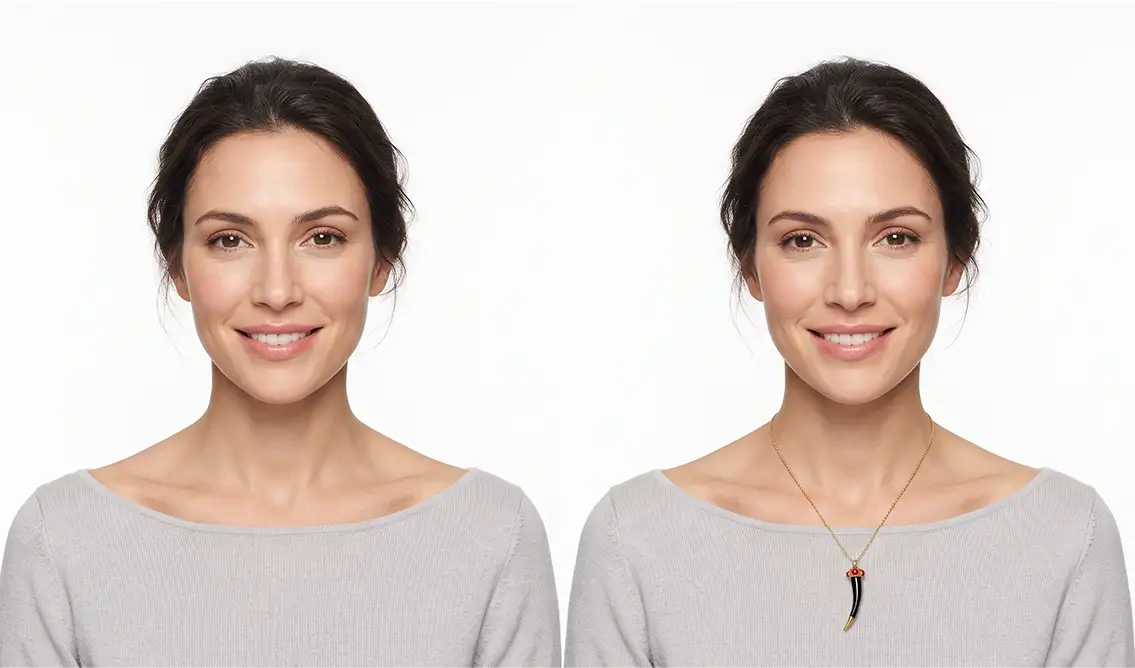
Turn on your camera, pick earrings, a pendant or a ring, and see the piece on yourself in real time.
Switch items in one tap.
Everything runs in your browser: no photo or video is ever uploaded.
How Not to Make a Mistake
A few practical rules that work regardless of budget.
Look at What the Partner Already Wears
The best gift is the one that enters the everyday set. Look at what the partner wears now: long chains or short, thin or bulky pendants, rings or none, what format of earrings. A piece that does not match the established style will most likely settle into a box.
Engraving Over Size
A small pendant with the right engraving works better than a large, beautiful one with no personal content. Engraving is what turns a piece into an artefact of your particular history. It adds little to the cost and a great deal to the meaning.
Fit the Lifestyle
An active life, work with the hands, small children, all of this affects the choice. A delicate thin pendant may be awkward for a parent with a small child. A bulky ring suits someone at a computer but not a builder or a cook. Practicality is part of respect.
Do Not Over-Explain
A meaningful piece needs no accompanying lecture. If anything, a short card with one or two lines is enough: "the coordinates of our yard" or "an engraving with the date of our first trip." Let the rest stay unspoken.
Order Ahead
A piece with engraving and special wood inlays takes time. The minimum for standard engraving is a few working days. For complex orders (paired pendants with stabilised wood, intarsia rings, non-standard engraving), two to three weeks. Order at least a month ahead.
Scenarios: Choosing for a Specific Couple
No universal list works for everyone. A few typical fifth-year scenarios with concrete recommendations based on the couple's age, the presence of children and their way of life.
A Couple of 28 to 32, No Children, Both in Offices
The most common profile of a young urban couple at the fifth year. Both in salaried jobs, living in a rented or mortgaged flat, no children yet by choice or circumstance. Mid-range budget. The lifestyle implies everyday wear, with the odd restaurant or work party.
The recommendation: paired pendants with the coordinates of the place they met, both in sterling silver 925 with fine engraving. A simple minimal design without excess decoration, because it has to be worn to work without distraction. If the budget allows, add a sapphire eternity ring (a thin band, nothing loud). Paired bracelets engraved "Annus quintus" as an alternative if neither wears a neck piece.
What to leave out: large wood inlays (they do not fit a strict office style), massive signets, bulky earrings. Anything that catches the eye is surplus for this couple.
A Couple of 35 to 40 with One Small Child
By the fifth year the couple has had a first child, now anywhere from six months to three years old. The wife is on leave or back at half-time. The husband works for two. There is almost no time for the couple's own life. The budget is mid-range or below because of the child's costs.
The recommendation: a family tree pendant with three names (parents and child). Sterling silver 925 or yellow gold 14K. Engraving with each one's date of birth. It is a piece that acknowledges the new situation: the couple became a family, and the gift reflects it. The wife will wear it on leave and after returning to work.
For the husband: a bracelet engraved with the child's name and date of birth. Leather or silver, minimal. Worn under a shirt cuff, drawing no attention at work, but always there.
What to leave out: thin fragile pieces (a child can grab and break them), long chains (they can catch while feeding or carrying), rings with complex settings (cosmetics and washing baby items get into the stone's seat).
A Couple of 30 to 35, Both in Creative Work
Designers, photographers, musicians, writers, artists. The lifestyle implies a flexible schedule, occasional travel, an active life online. Aesthetic demands on the gift are high: the piece must be "theirs," unlike anything standard.
The recommendation: a piece with stabilised wood of a rare species (rosewood, cocobolo, olive with a distinctive grain). Paired rings or paired pendants with intarsia of two woods. A bespoke design, made to order. The engraving laconic: one word or a short phrase, better in Latin or another "indirect" language.
An alternative: a reliquary with a chip of a particular tree tied to the couple's biography. If both travel often, they surely have a place of "their own" (a city, a café, friends' house), and a fragment of wood from there in a pendant works perfectly.
What to leave out: standard formats from the mass segment, faceless engraving, pieces with trite symbolism (a big heart, a stamped tree of life with no original detail). For this couple, singularity matters.
A Couple of 40 to 50, a Second Marriage for One or Both
If the fifth year is a second marriage for one or both, the context of the gift changes. Both want to underline that these five years differ fundamentally from the previous life, that this is a different life. The fifth-year artefact often becomes such a marker: "we built something new."
The recommendation: a piece using remelted old metal. If one partner has gold from a previous life (an inherited piece unconnected to the former partner, or their own thing), remelting it with a wood inlay or a new stone makes a strong gesture: old metal, new form, new history.
An alternative: paired bracelets with intricate bespoke work reflecting this couple's taste. The price is usually above average, which is normal for a 40-to-50 couple with settled finances.
What to leave out: universal symbols of eternal love (for a second couple they ring vulnerable), references to the years lived in imprecise terms, any engraving that stresses only "five years" (for partners with their own biographies it is a short stretch).
A Couple of 25 to 28, Married Very Young
The fifth year arrives for a young couple who married in their student years or right after university. Neither has hit a career peak, the budget is tight. Yet the emotional bond is often very strong: they came through the formation of adult life together.
The recommendation: a silver pendant with the coordinates of the university or hall of residence where they met. Small, thin, minimal. The engraving laconic: only the figures, no explanation. The price affordable, the emotional load very high.
An alternative: paired cord bracelets with a silver tag and one shared phrase. The most budget option, yet strong symbolically. Worn daily, never removed, they become "theirs" with time.
What to leave out: costly pieces with stones the young couple is not ready to wear for practical reasons (fear of losing, damaging, overspending). Better one simple piece with a story than a costly one without.
A Couple of 50+, a Late First Marriage
If both partners met late and married in their mature years, the fifth year is marked with particular weight. Each year lived in such a marriage carries more than in the marriage of twenty-year-olds.
The recommendation: classic high-carat gold (18K), pieces with weight and ceremony. A large tree-of-life pendant with one big sapphire. Paired gold rings with the same date engraved. The budget usually allows the upper segment.
An alternative: a piece with a fragment of a meaningful tree (if such a tree exists in the couple's biography). For a late couple any already-lived place with a history is especially precious.
What to leave out: recent trends that may date. For a late couple steadiness of aesthetic matters: a classic format, tested by time, will outlast the next twenty years without losing relevance.
A Couple After a Serious Crisis
If over five years the couple came through a serious crisis (infidelity, serious illness, the loss of a child, bankruptcy), the fifth-year gift carries a special load. It should acknowledge what was lived, neither pretending nothing happened nor turning into a mourning artefact.
The recommendation: remelting the wedding rings with a new element added (a wood inlay, a new stone, an engraving with the date the crisis ended). A strong gesture: the ring is the same (a symbol of the continuing marriage) but renewed (a symbol of the move into a new phase).
An alternative: a piece with a phoenix or a rising-sun symbol. Not the most direct symbol for the fifth year, but precise for a couple who "came back to life."
What to leave out: symbols of carefree, serene love that pretend the hard part never happened. For a couple after a crisis an honest artefact works better than a decorative one.
Two More Unusual Cases
To the five main cases, two more scenarios that show how a piece works beyond the classic scheme.
Case 6: A Couple with an Adopted Child
The wife could not have children biologically, and two years into the marriage the couple began the adoption process. By the fourth year they had a daughter, adopted at the age of two. By the fifth anniversary the daughter is three and fully part of the family.
The husband commissioned a family tree pendant with three names on the branches: his, hers, the daughter's. On the back, an engraving of three dates: the wedding date, the date of the daughter's adoption, the date of the fifth anniversary. Three points that made a family.
The wife took the gift as "honest." She explained: "We are not a couple whose child arrived biologically. We are a couple who chose a child. The pendant acknowledges that." For the family the adoption date equals or outweighs the wedding date.
The lesson: family pieces work regardless of how the family was made. The date of an adoption, the date of meeting a child from a former marriage, the date of another important family event can sit in the engraving alongside the traditional dates.
Case 7: A Couple of Professionals in One Field
Both partners are doctors, both work in the same hospital, both specialise in close fields (one in intensive care, the other in anaesthesia). Life implies shift work, night duties, professional talk at home about patients.
For the fifth anniversary the wife commissioned paired pendants with a medical symbol (the caduceus) and the Latin phrase "Primum non nocere" (first, do no harm). The pendants are identical, worn under the work uniform, seen only in private life.
Professional symbolism for the fifth year works especially strongly for a couple with a shared profession: the piece becomes both a family and a professional artefact.
The lesson: for couples with a shared profession the symbolism of the profession can matter as much as that of the family. Not instead, but together.
Send a friend a discount code, they save on their first order.
Sizes: So a Surprise Gift Lands Precisely
The main risk with a surprise piece is the ring size. The most reliable path is to quietly measure the inner diameter of one of the partner's rings (women's are usually 15 to 18 mm, men's 17 to 22). If that is not possible, choose a gift not tied to size: a pendant, earrings or a bracelet on an adjustable length, and leave the ring for later. In any case, order from a workshop that resizes within the first two weeks after delivery, so a miss is not fatal.
For a pendant chain the guide is simple: 45 to 50 cm is universal under most necklines, and under roll-necks and high necks take 60 cm or more. With earrings, mind the weight: heavy wood or stone drops are hard to wear for more than a couple of hours, so for an everyday piece choose light ones.
Family Heirlooms: When the Piece Passes to the Children
A piece given on the fifth anniversary may, twenty years on, become a family story. Not every piece becomes an heirloom, but those that carry a concrete history have the chance.
A pendant with the coordinates of the home where you lived with the children may, thirty years on, end up with a daughter as a memory of the place that was her first home. A ring with the children's names, as a memory of who her parents were in the early years of her life. A bracelet with the parents' wedding date, as a tangible point in the family chronology.
Pieces that carry concrete data (dates, names, coordinates) pass to the next generation with understandable content. Those that are merely beautiful lose their meaning in the handover.
If you want a piece to be able to become an heirloom: choose a material that holds its value (gold, silver 925, stones), add concrete data through engraving, and, where possible, keep a small note explaining what the piece means and what occasion it marked.
Stabilised wood, well made, lasts for decades and can pass to the next generation too. Especially if the wood is tied to family history: a branch from a tree planted for the wedding, a fragment from a parent's garden, a chip of wood that mattered to the couple. Twenty years on you can tell a daughter: "this piece is made of wood from the tree your father and mother planted in the year they married."
Zevira Pieces for the Wooden Anniversary
The Zevira collection holds several categories that work as a fifth-anniversary gift.
Paired jewellery for two, pendants, rings and bracelets made as a pair. Worn separately, the meaning appears together.
Tree of life, pendants and earrings with one of the main natural symbols. In sterling silver 925 and gold 14K, with engraving available on the back.
Infinity symbol, rings, pendants and bracelets with the horizontal eight. Simple. Precise. Wearable every day.
Claddagh ring, the Irish symbol of love, friendship and loyalty in silver and gold.
Sacred heart, an honest symbol for a marriage that came through something real.
All Zevira pieces are handmade in Albacete, Spain. Engraving is available on any piece in the catalogue. We work with English, Latin and numeric inscriptions.
Facts That Surprise
A few things about wood, marriage and the fifth year that tend to catch people off guard.
A mature tree's roots can rival or exceed the volume of everything visible above the soil, which is why "what holds is what you cannot see" is closer to botany than to poetry.
Dendrochronologists can date a single oak board in a medieval church to a particular decade and region by its rings alone, the way a fingerprint identifies a person.
The olives in the Garden of Gethsemane have wood that dates close to the events of the Gospels, meaning a living tree can outlast the entire history of a written tradition.
Cedar resin is naturally antiseptic, which is why cedar chests have guarded woollens from moths for centuries, and why "a marriage that keeps what is put in it" has a real material precedent.
In the English-speaking system the fifth year has two symbols at once, the traditional wood and the modern sapphire, so a single gift can honour both at the same time.
Amber is hardened tree resin, sometimes carrying insects tens of millions of years old, which makes it the only "stone" that is literally made of a tree.
A Julian day number turns a wedding date into a five-figure cipher that an outsider cannot read, hiding the meaning of an engraving on three separate levels.
The same biology that makes a couple stop noticing each other is the biology that lets you ignore the smell of your own home; habituation is a feature of the nervous system, not a verdict on a relationship.
FAQ
What should I give my husband for five years of marriage?
A men's fifth-year piece can be a ring with oak-bark texture, a signet with intarsia of two woods, an anchor pendant with a wood core, a sandalwood bracelet with a silver tag, or paired bracelets from an oak by a family home (if such a tree exists in the family history). The main rule: follow the style he already wears. If he wears no jewellery at all, start with a minimal ring engraved with the date inside, or a tree-slice key fob. If he does, look for a format that complements what he has rather than duplicating it.
Why wood, of all things?
Wood was chosen for the fifth year for several reasons at once. Biological: by five years a tree crosses from "sapling" to "tree," gaining its first growth rings, bark and branches. Historical: in the German and Austrian tradition of the eighteenth century the material symbols were arranged by rising durability (paper, cotton, leather, linen, wood), and wood came fifth as the first "real" material. Symbolic: a tree grows roots down and crown up, bends but does not break, remembers every year in its rings, all precise metaphors for a marriage at five years. Psychological: wood is the strongest of the living symbols you can place in a piece of jewellery.
Will jewellery with wood wear out over time?
Properly treated (stabilised with polymer resin), a wood inlay lasts for decades. Stabilised wood does not fear water, does not crack with temperature swings, does not react to sweat or cosmetics. A few wearing rules still hold. Do not keep the piece in water for long (a bath, washing in hot water with detergents). Avoid hard physical knocks, as with any jewellery. If aggressive chemistry reaches the wood (a silver cleaner, for instance), rinse it off at once with water. Follow these simple rules and a piece with stabilised wood looks fresh after ten and twenty years.
What is stabilised wood?
Stabilisation is a process in which wood is impregnated with a special polymer resin under vacuum. First the wood goes into a chamber and the air is pumped out, drawing the air from the wood's micropores too. Then liquid resin is fed in under pressure, filling the emptied pores. The resin sets inside the wood, making it strong, water-resistant and resistant to deformation. Afterwards the wood keeps its look (texture, colour, grain) but gains properties ordinary wood lacks: it can be washed, it does not react to moisture, it does not crack or fade in sunlight. Quality stabilisation is done in specialist workshops; home "stabilisation" (oil, lacquer, ordinary resin) does not give the same effect, so it is worth asking the maker which technology was used.
Can I give a wooden watch instead of jewellery?
A wooden watch has its merits: a visible object, worn daily, with a function and an aesthetic. But a few practical notes. First, a wooden watch is usually a wooden case around a standard movement and dial, so there is less "wood" in it than it seems. Second, not everyone wears a watch now; if the recipient does not, a watch will sit in a drawer whatever it is made of. Third, jewellery is easier to tie to a personal history through engraving or a slice of a specific tree, while a watch personalises poorly beyond an engraving on the back. If the recipient wears a watch every day and loves them, a good one with a case of a precious species can be a worthy gift. As a universal solution for the fifth year, though, jewellery works wider.
What if she does not like wooden jewellery?
The risk that a gift will miss exists in any category. To lower it: follow her current style; if she wears only classic gold, a silver piece with a wood inlay may fall out of her everyday set, so choose one with a minimal wood element (a "tree of life" engraving on a fully metal pendant) or a gold setting for the inlay. Check whether she wears natural motifs at all; if her collection is strictly geometric, a branch or a leaf may look foreign. As a fallback, choose a workshop that accepts returns or exchanges in the first two or three weeks. And remember that the symbolic content (wood as the image of the fifth year) can be rendered in any form: through one "Quinquennium" engraving inside a band, through coordinates on a pendant of any shape. The wooden anniversary is an idea, not a material.
Gold or silver for the fifth year?
Both work; the choice depends on the recipient's style and the couple's character. Sterling silver 925 is the more everyday, natural, soft material. It pairs well with wood inlays (the contrast of cool metal and warm wood) and suits paired pieces meant for daily wear. Gold is the more ceremonial, dense material that underlines the weight of the event. Yellow gold is traditional and universal, rose gold soft and romantic, white gold close to silver in tone but heavier. If the budget allows, gold is usually preferable for the fifth year as an expression of the moment's weight. If the budget is tight or the recipient wears mostly silver, sterling silver 925 is the right choice.
Can I give a sapphire on the fifth anniversary?
Yes. In the West the sapphire is called the modern stone of the fifth year, paired with the traditional wood. A sapphire pendant, ring or earrings are a good choice, especially if the blue suits the recipient's taste. The sapphire symbolises faithfulness and wisdom, both fitting for the fifth year. In the American system of anniversaries sapphire and wood are two equal symbols, so you can pick one or combine them: a sapphire ring with a wood inlay, or a pendant with one sapphire framed by stabilised wood.
What do people engrave for the fifth anniversary?
Most often: the wedding date (as dd.mm.yyyy or in Roman numerals), both partners' initials, the coordinates of a significant place (where you met, married, live now), children's names with dates of birth if any, a short phrase or a single word (Quinquennium, Annus quintus, a name in the partner's native language), a short quote from a favourite book (up to five or six words), or the Julian day of the wedding date as a cryptic code. Engraving on the back of a pendant or inside a ring is for yourselves, not for others. It is private, and that is exactly why it works.
How far ahead should I order?
It depends on the complexity. A standard catalogue piece with engraving takes a few working days to two weeks. Paired pieces with the same engraving, two to three weeks. Pieces with a stabilised wood inlay (especially if the customer supplies the wood), three to four weeks. Complex bespoke orders (remelting wedding rings, paired pendants with a slice of a specific tree, intarsia rings), up to two months. The universal recommendation: order at least a month before the date, which leaves room for changes to the engraving or design.
Conclusion
Five years of marriage is a real result that deserves real recognition. The wooden anniversary earned its name because by this point the tree is no longer a twig: it has a trunk, bark, first branches and the first few rings. A piece chosen with attention to that meaning says what often stays unspoken in the busyness of the fifth year.
You do not need to choose the perfect piece. You need to choose the one that will be worn, that will remind, and that carries something of your own. The coordinates of a place, the names of children on the back of a pendant, a date inside a ring, a slice of a twig from a family garden, these are not details, they are the content.
A tree does not grow because it is forced to. It grows because that is its nature. Five years lived together are the most convincing proof that this union has the right nature.
Silver, gold, symbolic jewellery, engraving, paired sets for couples.
About Zevira
Zevira is a jewellery workshop in Albacete, Spain. The pieces are handmade in sterling silver 925 and 14 to 18K gold.
For wedding-anniversary gifts the catalogue offers:
- Paired jewellery with symbols of love and loyalty
- Pendants with the tree of life, the infinity symbol, the Claddagh ring
- Bracelets and rings with engraving to order
- Coordinate jewellery
- Family pendants with the silhouettes of loved ones
- Pieces with a stabilised wood inlay (by individual order)
Engraving is available on any piece on request. We work with English, Latin and numeric inscriptions.
Guide to wedding anniversary gifts
First wedding anniversary gift