Diamond shapes: the complete guide to 10 cuts
Introduction: the same weight, ten different looks
Twenty-five years ago, a friend in London received an engagement ring with a round diamond. Standard mid-1990s style, just like all her classmates. Twenty years later her daughter chose her own engagement stone: oval, elongated, visually larger than her mother's at the same weight. When mother and daughter compared rings side by side, the difference read like an aesthetic argument between two eras. One stone, two different worlds.
The shape of a diamond determines roughly 80 percent of its visual impact. A round and an oval at the same weight (a carat, say) look completely different: the round is more compact and brighter, the oval is longer and slimmer, and the oval visually appears larger. Shape is not a technical detail. It is the main aesthetic decision when buying a stone-set ring.
This guide gathers the 10 main diamond shapes with their characteristics. How each differs, who suits each, which looks larger, which is cheaper at the same weight, which is on trend right now. Beyond descriptions, we cover how to pick a shape by finger type, by personality, by ring style. This matters for engagement rings, for large diamond studs, for pendants: the shape of the stone shapes the feel of the piece more than the metal.
If you want to start with diamond weight and pricing (the 4Cs), read what is a carat. For colour and clarity, see the diamond colour and clarity scale. For alternatives, see moissanite vs lab-grown diamond. This guide focuses on shape.
Cut vs shape: what's the difference
The two terms get confused, but they mean different things.
Shape
The geometric outline of the stone seen from above: circle, oval, pear, heart, square, and so on. It is what you see looking down at the diamond, how it sits on the finger or in a pendant.
The 10 main diamond shapes: round, oval, pear, marquise, emerald, cushion, asscher, radiant, heart, princess.
Cut
The quality of execution: facet placement, symmetry, proportions, polish. Cut determines how brilliantly the stone plays with light. Within one shape (round, for example) you can have different cut grades: Excellent, Very Good, Good, Fair, Poor.
The GIA (Gemological Institute of America) cut scale:
- Excellent: maximum light performance
- Very Good: close to ideal
- Good: solid
- Fair: average
- Poor: weak
What matters more
Shape sets the aesthetic. Cut sets the brilliance. A beautifully shaped stone with poor cut quality will look dull. An excellent cut even in a less-favoured shape will sparkle.
When buying, mind both. Ideally: a shape you love plus Excellent cut. Compromise: the shape you want with at least Very Good cut.
A grading detail worth knowing
There is an important asymmetry in how cut is graded. The GIA assigns a full cut grade on its scale only to round brilliant diamonds. For every fancy shape, from oval to emerald to pear, the certificate reports polish and symmetry but not an overall cut grade. This is because the optical performance of a fancy shape depends on too many subjective variables to reduce to one letter rating.
The practical consequence is significant. When you buy a round, the certificate does much of the cut judgement for you. When you buy any other shape, you must judge cut quality yourself, by looking at the stone or a high-quality video, by checking the length-to-width ratio against the flattering range for that shape, and by watching for shape-specific faults such as the bowtie in ovals and pears. This guide is about shapes, because that is the first visual decision, but a fancy-shape buyer should treat cut assessment as a personal task rather than something the paperwork settles.
What determines your shape choice
A few key factors.
Taste and aesthetics
The main and most subjective factor. Some prefer the classic round, others love elongated shapes (oval, pear, marquise), others geometry (emerald, asscher).
Ring style
Modern, vintage, art deco, romantic, minimalist. The stone shape needs to agree with the setting style and the piece overall.
Budget
At equal quality and weight, different shapes cost differently. The round cut is pricier than the rest at the same specs because of more complex cutting technique and more rough wasted.
Finger shape
Some shapes flatter some fingers more. Elongated shapes (oval, pear, marquise) visually lengthen the finger, good for shorter fingers. Round and cushion work on any finger.
Wearability
Some shapes (round, oval, cushion) are less prone to chipping. Sharp corners (pear, marquise, heart) are more vulnerable and need protective settings.
Era
Shape carries time associations. The asscher and emerald cut belong to the art deco 1920s and 1930s. The cushion and old mine cut belong to the eighteenth and nineteenth centuries. The round became the postwar default of the 1950s and 1960s. The princess defined the 1990s and 2000s. The oval has dominated the 2020s. Shape choice is therefore both an aesthetic decision and a cultural marker, and a buyer can use that deliberately: choosing a cushion signals a love of heritage, while choosing a radiant signals a preference for the contemporary.
Cut quality interaction
Shape and cut quality are linked in a way buyers often miss. Some shapes are forgiving of an average cut and some are not. A round with a weak cut still throws some light because the geometry is so efficient. A step cut such as emerald or asscher, by contrast, has nowhere to hide: poor symmetry ruins the hall-of-mirrors effect outright. Elongated brilliants such as oval, pear and marquise are the most cut-sensitive of all, because a careless cut produces the bowtie shadow. The lesson is to match your budget for cut quality to the shape: a step cut or elongated brilliant needs a careful purchase, while a round tolerates a modest compromise.
Round (round brilliant)
The most popular shape. About 75 percent of engagement rings worldwide use a round diamond.
Characteristics
Outline: a perfect circle.
Facets: 57 or 58 (Tolkowsky's classic brilliant cut, formulated in 1919). This scheme delivers maximum light play.
Light performance: the highest of any shape. The round reflects light most brightly, flashes all spectral colours.
Length-to-width ratio: 1.00 (a true circle).
Strengths
- Maximum fire
- Maximum sparkle
- Universally fits any era and style
- Suits any finger
- Highest resale liquidity
Weaknesses
- The priciest shape at equal weight and quality (20 to 30 percent above others)
- Looks smaller than other shapes at the same weight
- Less individual than rarer shapes
Who it suits
Universal, any finger, any style. The standard choice for classic engagement, for a wedding ring with a stone, for studs with a single larger diamond.
History
The modern 58-facet round cut was developed by Marcel Tolkowsky in 1919, when he published his doctoral work "Diamond Design" at the University of London. Tolkowsky came from a Belgian family of diamond cutters, so he combined practical workshop knowledge with formal mathematics. Before his calculations, round diamonds were cut by feel: the old European cut of the nineteenth century had a small table, a high crown and a chunky culet, which trapped light and looked dull by modern standards.
Tolkowsky's contribution was to treat the diamond as an optical instrument. He calculated the pavilion angle, crown angle and table size that would return the most light through the top of the stone rather than leaking it out the bottom. His recommended pavilion angle of about 40.75 degrees and crown angle of about 34.5 degrees are still close to what laboratories certify as an ideal cut today. A century of measuring instruments and computer modelling has refined the numbers only slightly, which is a remarkable testament to one calculation.
Round in practice today
The dominance of the round is partly self-reinforcing. Because it is the most traded shape, it has the deepest second-hand market and the most predictable pricing, which makes buyers and jewellers comfortable with it, which keeps it dominant. For a buyer who values resale liquidity, simplicity of comparison and a stone that will never look dated, the round remains the safest decision. It is the default choice for a classic solitaire engagement ring, for a pair of statement studs, and for a single-stone pendant where brightness is the whole point.
Oval
An elongated circle. The most fashionable alternative to the round in the 2020s.
Characteristics
Outline: a true oval, symmetrical along the long and short axes.
Facets: 57 to 58 (same as round but in an elongated outline).
Light performance: very close to round, only slightly less.
Length-to-width ratio: 1.30 to 1.50 (the sweet spot is around 1.40). The larger the ratio, the more elongated the oval.
Strengths
- Looks 5 to 10 percent larger than a round of the same weight (more surface area)
- Lengthens the finger
- Modern, on trend
- Light play almost equal to round
- 10 to 15 percent cheaper than round at equal weight and quality
Weaknesses
- The bowtie effect (a dark stripe through the centre) if proportions are off
- Less liquid on resale than round
- Possible darker corners with imperfect cutting
Who it suits
Especially good for:
- A short or medium finger (visually lengthens)
- Modern, minimalist rings
- Anyone wanting the "round effect" but visually bigger
- A younger and middle-aged audience
How to shop an oval
The oval rewards a careful buyer and punishes a careless one. The single most important thing to check is the bowtie, a dark area shaped like a bow tie that runs across the centre when light fails to bounce back evenly. Every oval has some bowtie; the question is severity. A faint shadow that fills with light as you tilt the stone is normal. A heavy black band that stays dark is a poorly cut stone. Because cut grading for fancy shapes is less strict than for round, you must judge the bowtie with your own eyes or from a clear video.
The length-to-width ratio is a matter of taste, but it has practical consequences. A ratio near 1.30 looks almost round and compact; a ratio near 1.50 looks distinctly slender and dramatic. Around 1.40 is the most popular balance. Buyers with shorter fingers often choose a higher ratio for the lengthening effect, while those who want the oval to read as a "soft round" choose a lower one.
History
The oval as a refined modern brilliant became a standard in the 1960s thanks to the cutter Lazare Kaplan, who patented his oval cut in 1957. Elongated diamond outlines existed for centuries before that, but Kaplan applied a proper brilliant facet arrangement to the shape, giving it sparkle close to a round. The oval spread widely in the 2010s and 2020s: a run of high-profile celebrity engagement rings featuring large ovals set the mass-market trend, and online retailers responded by stocking ovals in far greater depth than before. It is now the most requested non-round shape for engagement rings in the United States, the United Kingdom and Australia.
Pear (teardrop)
A romantic asymmetric shape.
Characteristics
Outline: a marriage of round and marquise. One end is rounded, the other pointed.
Facets: 58.
Light performance: strong, especially in the wider end.
Length-to-width ratio: 1.45 to 1.75.
Strengths
- A distinctive shape that stands out from the standard
- Visually lengthens the finger
- Works beautifully in pendants (point down)
- Light play at a good level
Weaknesses
- The sharp point is vulnerable to chipping and needs a V-prong setting
- Not suited to every style
- Harder to shop: harder to find good proportions
Who it suits
- Romantic style
- Long finger (the shape complements rather than shortens)
- Pendants and drop earrings (a classic choice)
Orientation on the ring
The pear is usually worn point toward the nail, which lengthens the finger and is the orientation most people find most flattering. Less commonly it is worn point toward the wrist for a different visual effect, sometimes chosen by people who find the nail-pointing version too sharp. Whichever way it sits, the point must always have a protective V-prong, a metal cap shaped like a V that wraps the tip and shields it from knocks.
How to shop a pear
Three things separate a beautiful pear from a mediocre one. First is symmetry: draw an imaginary line down the centre and the two halves should mirror each other exactly, with the point sitting dead centre rather than leaning to one side. A crooked point is the most common flaw and it is glaring once you notice it. Second is the bowtie, the same dark central band that affects ovals; tilt the stone and check that it fills with light. Third is the shoulders, the rounded upper sides, which should be neither too flat nor too high. Flat shoulders make a pear look like a triangle; over-rounded shoulders make it look like a lopsided egg. A length-to-width ratio around 1.55 to 1.65 gives the classic balanced teardrop most buyers picture.
Customer reviews
Zevira is a real jewellery shop. Genuine payments, deliveries and customer thank-yous.
🥰🥰🥰 gracias
Ok, ¡gracias! 🙂
Marquise
An elongated shape with two points.
Characteristics
Outline: an elongated figure with sharp points on both ends.
Facets: 58.
Light performance: good.
Length-to-width ratio: 1.75 to 2.25 (the classic ideal is around 2.00).
Strengths
- Maximally lengthens the finger
- Looks the largest of any shape at equal weight (biggest surface area)
- A unique elegant shape
- 25 to 30 percent cheaper than round
Weaknesses
- Two sharp points, both vulnerable
- Possible bowtie effect (like oval)
- Can look showy at large sizes
- Reads as old-fashioned to some tastes
Who it suits
- Long, slim finger
- Anyone wanting a visually large stone on a tighter budget
- Lovers of vintage and Victorian style
History
The marquise is named after Jeanne Antoinette Poisson, the Marquise de Pompadour, the influential mistress of Louis XV of France in the mid-eighteenth century. The traditional story is that the king asked his court jeweller to cut a diamond in the shape of the marquise's mouth. Whether or not that anecdote is literally true, the shape became a court favourite and a marker of aristocratic taste. It is sometimes also called a navette, from the French word for a small boat, because the pointed oval outline resembles a hull.
The shape carries a strong period association. It enjoyed a major revival in the 1970s and again in the 1980s, when large marquise solitaires were a status piece. That history is the source of its slightly retro reputation today. A younger buyer drawn to vintage character can use that to advantage; a buyer wanting a contemporary look may prefer an oval, which gives a similar elongating effect with fewer dated associations.
How to shop a marquise
The marquise needs a sharp eye for symmetry and the bowtie. Both points must align on the central axis and the two curved sides must mirror each other. The widest point should sit exactly halfway along the length. The classic length-to-width ratio is close to 2.00, which reads as the balanced traditional navette; ratios near 1.75 look fuller and rounder, while ratios above 2.10 look very thin and elongated. As with the pear, both points demand V-prong protection because they are the most chip-prone feature of any diamond shape.
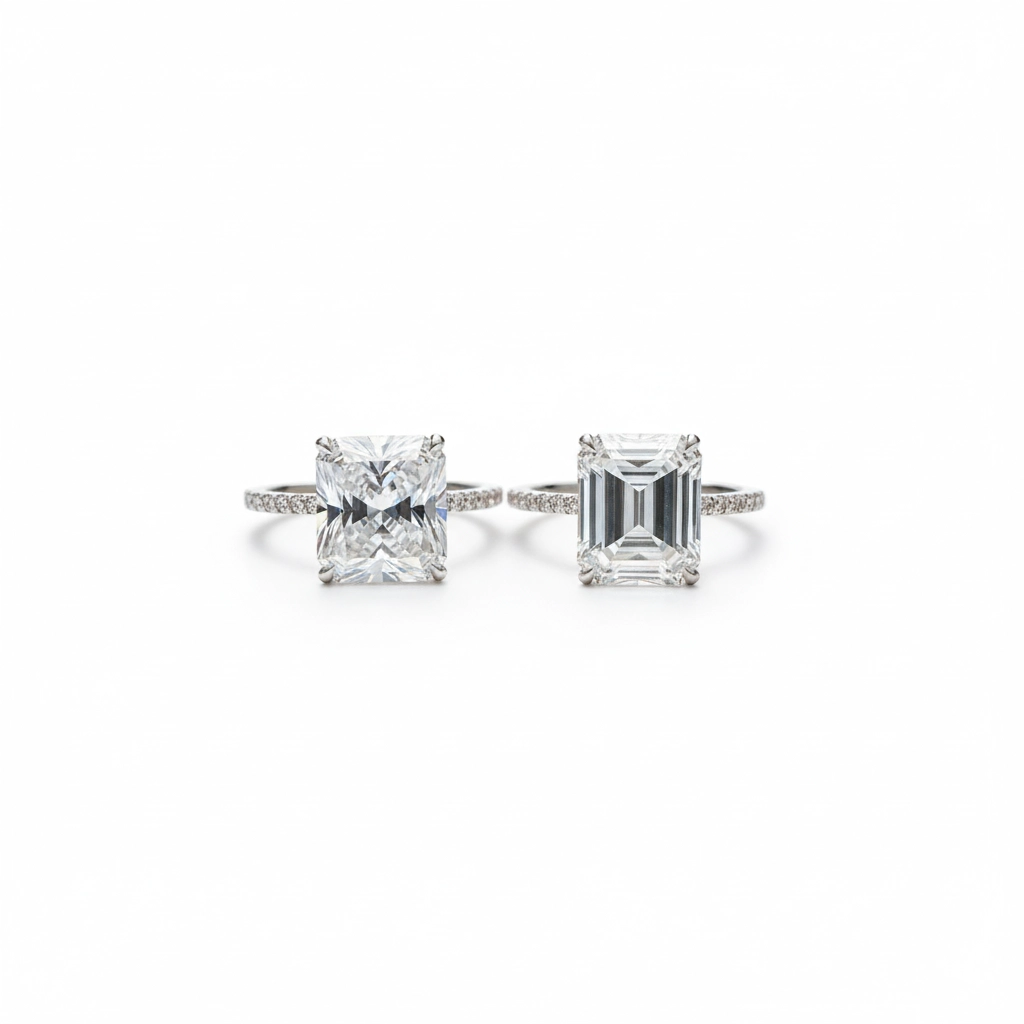
Emerald cut
A rectangular shape with cropped corners.
Characteristics
Outline: rectangular with cropped (truncated) corners.
Cut: step cut with long parallel facets. Not the brilliant cut of the round.
Light performance: mirror-like, less sparkle, more deep reflections (the "hall of mirrors" effect).
Length-to-width ratio: 1.30 to 1.50.
Strengths
- A very clean, modern look
- Highlights stone clarity (inclusions are visible, so only used in higher clarity diamonds)
- Looks bigger than a round of the same weight
- Ideal for art deco styling
- 20 to 25 percent cheaper than round
Weaknesses
- Less sparkle (reflects like a mirror rather than fires)
- Demands higher clarity (inclusions show)
- Not for every taste: some expect bright sparkle
Who it suits
- Lovers of clean, minimalist, elegant style
- Art deco aesthetics
- Mature, status looks
- Buyers choosing high clarity (VVS, VS)
History
The emerald cut was originally developed for emeralds themselves. Emerald is a relatively brittle gem with internal tension, and the long parallel facets and truncated corners of the step cut relieve stress and lower the risk of cracking during cutting and wear. Lapidaries had used variations of the step cut on coloured stones for centuries before it was formally applied to diamonds in the eighteenth century. The name was standardised in the 1920s, when the cut became one of the defining looks of the art deco movement.
Art deco design favoured clean lines, symmetry and architectural geometry, and the emerald cut suited that language perfectly. Long sautoir necklaces, geometric brooches and rectangular rings of the 1920s and 1930s used emerald-cut diamonds and coloured stones in abundance. That association still holds: choosing an emerald cut today reads as a deliberate nod to art deco elegance.
How to shop an emerald cut
Because the step cut acts like a window into the stone, clarity becomes the dominant concern. Inclusions that would hide inside a sparkly round are plainly visible through the broad open facets of an emerald cut, so most buyers choose a higher clarity grade, typically VS2 or better. Colour also shows more honestly, so any tint reads clearly across the large flat table. The length-to-width ratio runs from about 1.30 for a balanced classic rectangle to 1.50 or more for a long, slender modern look; a ratio near 1.40 is the most popular. Cut quality is judged by how evenly the parallel facets line up and how clean the corner truncations are, since any unevenness disturbs the hall-of-mirrors effect that is the whole appeal of the shape.
Cushion
A rectangular or square shape with rounded corners.
Characteristics
Outline: a square or rectangle with softly rounded corners. Like a pillow (hence the name).
Facets: 58 to 64.
Light performance: good, softer and warmer than round.
Length-to-width ratio: 1.00 to 1.20 (square cushion) or higher (rectangular).
Strengths
- A vintage, romantic look
- Light play at a good level
- Rounded corners are less vulnerable than sharp ones
- Versatile across styles
Weaknesses
- Looks 15 to 20 percent smaller than a round of the same weight
- Less sparkle than round
Who it suits
- Lovers of vintage style
- Victorian, Edwardian aesthetics
- Lovers of soft glow over sharp sparkle
History
The cushion is the direct descendant of the old mine cut, the dominant diamond shape of the eighteenth and nineteenth centuries. Before electric light and modern cutting wheels, diamonds were cut by candlelight and worked to suit the soft, warm light of a room rather than the hard light of a modern jewellery display. The old mine cut had a squarish cushiony outline, a small table, a high crown and a large open culet, all of which gave it a soft, glowing character. Most famous historical diamonds, from the Hope to the Koh-i-Noor, carry a cushion or old mine outline because they were cut in that era.
When Tolkowsky's round took over after 1919, the cushion fell out of fashion for decades. It returned strongly in the 2000s as part of a broad revival of antique aesthetics, helped by the popularity of halo settings, which frame a cushion beautifully.
How to shop a cushion
The cushion is really a family of shapes rather than one. The two main branches are the standard cushion brilliant, with larger facets and a bold flash, and the modified or crushed-ice cushion, with many small facets that create a sparkling, textured look like crushed ice. Buyers should view both before deciding, because they photograph and wear quite differently. Length-to-width ratio near 1.00 to 1.05 gives a true square cushion, while ratios of 1.10 and above give a rectangular cushion that elongates the finger. Cushions hide inclusions and colour reasonably well thanks to their sparkle, so they can be a value-conscious choice at slightly lower clarity and colour grades than an emerald cut would tolerate.
Asscher
A square shape with cropped corners.
Characteristics
Outline: a square with cropped corners. Similar to emerald cut but square instead of rectangular.
Cut: step cut, like emerald.
Light performance: "hall of mirrors", deep reflections, less sparkle.
Length-to-width ratio: 1.00 to 1.05 (almost a perfect square).
Strengths
- A precise geometric form
- A unique hall-of-mirrors effect
- Ideal for art deco styling
- 20 to 25 percent cheaper than round
Weaknesses
- Less sparkle (like emerald cut)
- Demands high clarity
- Can read as too formal
Who it suits
- Art deco aesthetics
- Geometric, graphic style
- Mature, elegant looks
History
The Asscher cut was created by Joseph Asscher in Amsterdam in 1902, the first diamond cut ever to be patented. The Asscher family firm was one of the most respected diamond houses in Europe, and in 1908 it was entrusted with cleaving and cutting the Cullinan, the largest gem diamond rough ever found. The original Asscher cut had a small table, a high crown and deep step facets, which gave it a distinctive deep "well" when viewed from above.
The cut became an icon of the art deco period in the 1920s and 1930s, alongside the emerald cut, because its strict octagonal geometry matched the design language of the era. Its popularity declined after the Second World War as tastes turned to brighter brilliant cuts. The 2000s brought a revival, helped by an updated "royal Asscher" version with extra facets, and by the broad return of art deco styling in engagement rings.
How to shop an Asscher
The Asscher shares the emerald cut's honesty: the step facets act as windows, so clarity and colour show clearly and most buyers choose higher grades. The defining quality marker is the "windmill", a pinwheel pattern of light and dark that radiates from the centre when the facets are cut with good symmetry. A well-cut Asscher shows a crisp, even windmill; a poorly cut one looks muddled. The length-to-width ratio should sit very close to 1.00, since the whole point of the shape is a precise square. Cropped corners should be even on all four sides. Because the Asscher is small in face-up area for its weight, buyers wanting visual size for their budget should weigh it against an elongated alternative.
Wear the symbol, don't just read about it. These are in stock:
Radiant
A rectangular shape with cropped corners but brilliant-cut facets.
Characteristics
Outline: a rectangle or square with cropped corners. Shape similar to emerald, but with different faceting.
Cut: brilliant cut (like round), not step.
Light performance: bright, sparkly, closer to round.
Length-to-width ratio: 1.00 to 1.50 (square to elongated).
Strengths
- Combines emerald geometry with round sparkle
- A very lively stone
- Cropped corners are less vulnerable
Weaknesses
- Less liquid on resale than round
- Not as formal as emerald cut
Who it suits
- Geometry lovers who also want sparkle
- Modern fashion
- A universal choice for those torn between emerald and round
History
The radiant cut was created by Henry Grossbard in 1977. Grossbard, a New York diamond cutter, set out to solve a specific problem: buyers loved the clean rectangular outline of the emerald cut but wanted the lively sparkle of a brilliant. By applying a brilliant-style facet arrangement to a rectangle with cropped corners, he produced a shape that delivered both. The radiant was one of the first new diamond shapes of the modern era to be developed and marketed as a named, branded cut, and it gained popularity quickly through the 1980s.
It remains a strong choice for buyers who feel torn between geometry and fire. It also pairs naturally with coloured diamonds, because its faceting concentrates and intensifies body colour, which is why many fancy yellow diamonds are cut as radiants.
How to shop a radiant
The radiant is forgiving compared with step-cut shapes. Its busy faceting hides inclusions and minor colour well, so it can be a value choice at slightly lower clarity and colour grades. The main decision is proportion: a length-to-width ratio near 1.00 to 1.05 gives a square radiant, while ratios of 1.20 to 1.50 give an elongated rectangle that flatters the finger. The cropped corners make the radiant durable, but the buyer should still check that the facets produce an even, lively pattern rather than dark patches. Because the radiant is less traded than the round, resale value is lower, so it suits a buyer choosing for love of the look rather than for liquidity.
Heart
A romantic symbolic shape.
Characteristics
Outline: a proper heart with a lobed top and a pointed bottom.
Facets: 56 to 58.
Light performance: good.
Length-to-width ratio: 0.90 to 1.10 (close to 1 to preserve the recognisable shape).
Strengths
- A unique symbolic form
- Emotional meaning (love, romance)
- Stands out from standard cuts
Weaknesses
- The point and the V at the top are vulnerable
- Demands a protective setting
- Not a classic choice: can read as too young or sentimental
- Loses shape at small sizes (minimum 0.5 carat for a recognisable heart)
Who it suits
- Romantic gifts
- Pendants (heart pointing down)
- Drop earrings
- Less a classic engagement ring, more a Valentine's Day gift
The heart works best for a wearer who wants the meaning to be obvious and does not mind a piece that reads as openly sentimental. It tends to suit younger recipients and pieces given for an explicitly romantic occasion. For a wearer who prefers understatement, or who wants a stone that will look at home in thirty years, a round or oval is the safer call.
History
Heart-shaped diamonds appear in the historical record from the sixteenth century, when the shape was already understood as a token of love. In 1562 Mary, Queen of Scots, is recorded sending a heart-shaped diamond ring to Elizabeth I of England as a diplomatic gesture. Cardinal Mazarin, the powerful chief minister of seventeenth-century France and an avid diamond collector, owned heart-shaped stones among his famous collection. Cutting a convincing heart by hand in that era was a serious technical feat, which made the shape a display of both wealth and craftsmanship.
Today the heart is a niche shape. It carries an unmistakable, literal message, which is its strength and its limitation. It works wonderfully for a gift whose meaning should be plain and emotional, and less well for a wearer who wants a discreet or classic look.
How to shop a heart
The heart is the most demanding shape to cut well, so symmetry is everything. The two lobes at the top must be equal in size and roundness, the cleft between them must sit dead centre, and the point at the bottom must align with that cleft on a straight axis. Any imbalance is immediately visible and makes the stone look amateurish. The shape also loses its identity at small sizes: below roughly half a carat a heart can read as a vague blob, so most jewellers recommend a minimum around 0.50 carat, and larger is safer. A length-to-width ratio near 1.00 keeps the heart looking plump and recognisable. The cleft and the point both need protective settings, since both are vulnerable.
Princess
A square shape with brilliant-cut facets.
Characteristics
Outline: a square or near-square with sharp corners.
Cut: brilliant cut with 49 to 58 facets.
Light performance: bright, sparkly, very close to round.
Length-to-width ratio: 1.00 to 1.05.
Strengths
- Combines square geometry with round-like sparkle
- 10 to 20 percent cheaper than round at equal weight
- Modern, crisp look
- Versatile across styles
Weaknesses
- The sharp corners are very vulnerable to chipping
- Demands corner protection in the setting
- Less liquid than round
Who it suits
- Anyone who wants a square with sparkle
- Modern, clean style
- A universal choice
History
The modern princess cut traces to the early 1960s and to work by cutters including Arpad Nagy in London, with the refined version most people recognise developed by Basil Watermeyer and Israel Itzkowitz in the 1970s and 1980s. It was originally devised partly for efficiency: a square princess can be cut from a rough crystal with much less waste than a round, which historically translated into a lower price for the same weight. The cut combined that economy with brilliant-style sparkle, and through the 1990s and 2000s it became the second most popular shape after round for engagement rings.
Its very popularity in that period now gives it a dated edge for some buyers, who associate the sharp square with the turn of the millennium. For others that is no drawback at all, and the crisp modern outline still appeals.
How to shop a princess
The defining vulnerability of the princess is its four sharp, uncovered corners, which carry most of the chip risk in the whole stone. A protective setting with V-prongs gripping each corner is essential, not optional. Within the setting, check that the corners are not already nicked. The princess hides inclusions and colour fairly well thanks to its busy faceting, so it can be a value choice at moderate grades. The length-to-width ratio should sit very close to 1.00 for a true square; some buyers prefer a slight rectangle near 1.05. Cut quality is harder to read than in a round because grading for fancy shapes is looser, so judge the stone by how evenly and brightly it returns light across the whole face.
For more on the princess, see the princess diamond cut guide.
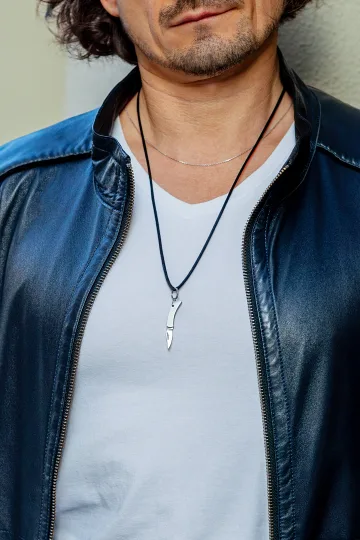
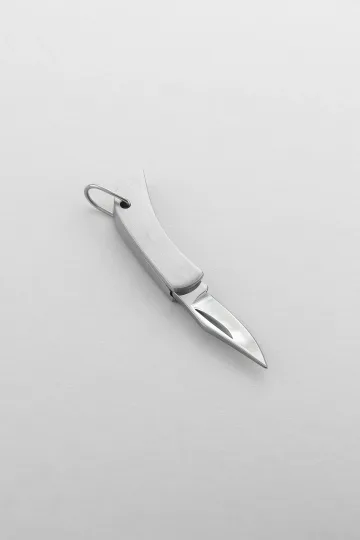
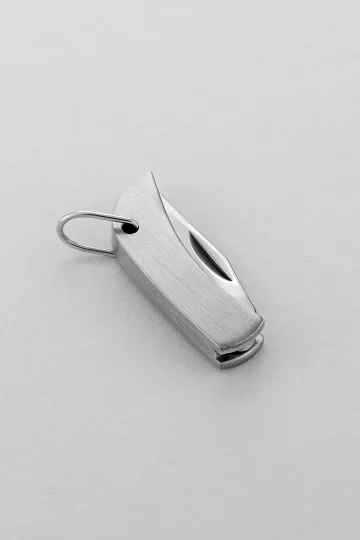
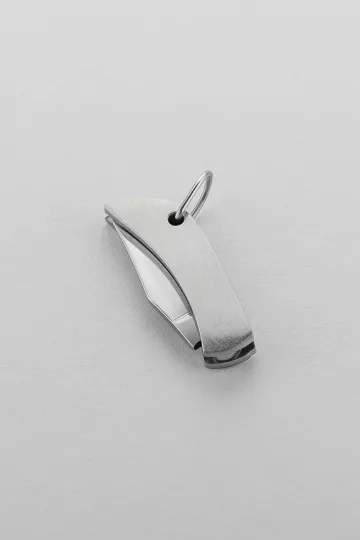
Artisan-crafted CAPAORA navaja pendant
A 40 mm stainless-steel navaja with a real folding mechanism and Palanquilla lock. An affordable gift to remember.
A code for blog readers:
10% off your first order
Authentic · Maker's guarantee · Ships from Spain
All 10 shapes compared
A quick summary for fast selection.
| Shape | Vs round price | Sparkle | Vulnerability |
|---|---|---|---|
| Round | baseline | Maximum | Minimal |
| Oval | -10 to -15% | High | Low |
| Pear | -15 to -20% | Good | Sharp end |
| Marquise | -25 to -30% | Good | Two points |
| Emerald | -20 to -25% | Low | Low |
| Cushion | -10 to -15% | Medium | Low |
| Asscher | -20 to -25% | Low | Low |
| Radiant | -15 to -20% | High | Low |
| Heart | -10 to -15% | Good | High |
| Princess | -10 to -15% | High | Corners |
Visual area calculation
At equal weight, different shapes show differently:
- Marquise is the longest, looks the largest
- Oval looks bigger than round
- Pear looks longer
- Emerald, asscher, princess look smaller than round
Cost and liquidity
Round is the priciest but the most liquid on resale (easiest to sell back). Alternative shapes are cheaper but may be less in demand for resale.
Which shape suits your finger
Finger shape affects how different cuts read.
Long, slender finger
Almost everything works. Particularly good: round (classic), emerald (highlights elegance), asscher.
Short or small finger
Elongated shapes lengthen: oval, pear, marquise, elongated emerald. Avoid very large square shapes (princess, asscher) which can visually shorten.
Wide finger
Larger stones look proportionate: princess, cushion, radiant. Very thin elongated shapes (marquise) can look too narrow for a wide finger.
Slim finger
Any light shape. Especially: small round, oval, elongated emerald. Avoid very large square shapes that pull the finger down.
Long nails
Round shapes (round, oval, cushion) pair well. Sharp shapes (marquise, pear) can compete with the nail for attention.
Short nails
Any shape. Sharp elongated ones can add visual length.
Arthritis or thicker knuckles
Rounded shapes (cushion, oval) read softer visually. Hard geometric ones (princess, asscher) can emphasise joint features.
Which shape looks largest at the same weight
One of the most common shopper questions.
Visually largest
- Marquise: looks about 30 percent larger than a round of the same weight
- Oval: 10 to 15 percent larger than round
- Pear: 10 to 15 percent larger than round
- Emerald: 5 to 10 percent larger than round
Baseline
- Round: the reference size
Smaller than round
- Princess: about equal to round or slightly smaller
- Cushion: 5 to 10 percent smaller than round
- Radiant: about the same as princess
- Heart: 10 to 15 percent smaller than round
- Asscher: 10 to 15 percent smaller than round
Why this happens
It comes down to surface area at equal weight. Elongated shapes (marquise, oval, pear) have more area on top and less depth. Compact shapes (princess, asscher) have less area on top and more depth.
What to choose on a tight budget
If you want a visually larger stone within a smaller budget, marquise or oval delivers the "carat-plus" effect. The same 1-carat stone in marquise reads closer to a 1.3-carat round.
Shape combinations in jewellery
Beyond single stones, in compositions.
Solitaire (one stone)
One shape, one stone. The cleanest and most universal choice, and the design that lets the shape itself do all the talking. Any shape works, but the solitaire is where shape character shows most plainly, because there are no surrounding stones to distract the eye. A round solitaire reads as pure tradition, an emerald-cut solitaire as architectural restraint, a marquise solitaire as confident drama. Buyers who chose their shape carefully often choose a solitaire setting precisely so the decision is not diluted.
Three stone
Three stones in a row. The arrangement carries a popular sentimental meaning, the past, present and future of a relationship, which is part of its appeal for engagement rings. Most commonly all three stones share one shape in graduated sizes, with a larger centre and two smaller flanking stones. More adventurous designs mix shapes: an oval centre with two half-moon or trapezoid side stones, or a round centre flanked by tapered baguettes. When mixing shapes, the side stones should complement rather than compete, and all three should be matched in colour and clarity so they read as one piece.
Halo (centre plus surround)
A central stone ringed by a continuous border of small diamonds. The halo has two practical effects: it makes the centre stone look noticeably larger, often by the equivalent of half a carat or more, and it adds sparkle around a centre stone that may be calmer in itself, such as an emerald or asscher cut. Any centre shape can take a halo, and the halo usually echoes the centre outline, an oval halo around an oval, a cushion halo around a cushion. A double halo, two concentric rings of small stones, pushes the enlarging effect further and suits buyers who want maximum visual size from a modest centre.
Pavé band
Small diamonds set into the band itself. The centre stone can be any shape.
Cluster
A grouping of small diamonds in varied shapes. A modern designer style.
Mismatched
Earrings or rings where different stones use different shapes. A modern non-standard approach.
Leave your email, we'll send your discount code. No spam, unsubscribe anytime.
The code arrives by email, valid on your first order.
Shapes for other gemstones
The same shapes apply to other gems.
Sapphires
Most often round, oval, pear, cushion. Emerald cut also works well for lighter sapphires. For more, see the sapphire colours guide.
Emeralds
The emerald cut (named for them) is classic. Also cushion and oval. Marquise and pear are rare because of brittleness.
Rubies
Oval, round, cushion, emerald. Heart is rare but emotionally striking.
Turquoise, opal, moonstone
Cabochon (no facets, smooth domed polish) for opaque or low-translucency stones. Sometimes flat cabochon in vintage-style rings.
Coloured quartz (amethyst, citrine)
Any cut. Quartz is plentiful and grows in large clean crystals, so cutters have a free hand. Emerald and other step cuts suit larger high-clarity amethyst and citrine because the long facets show off the even colour and the generous size. Round and oval brilliants suit everyday pieces where sparkle matters more than a window onto the colour. Quartz is also a popular material for fantasy and concave cuts, since its abundance makes experiment affordable.
Why shape choice differs for coloured stones
With a diamond the goal of cutting is to maximise return of white light, so the brilliant cut is king. With a coloured stone the goal is often to show colour at its best, which changes the maths. Step cuts deepen and concentrate colour, which is why emeralds and many sapphires are cut that way. A stone with pale colour may be cut deeper to intensify it, while a very dark stone may be cut shallower to let more light through. Hardness also matters: brittle stones avoid sharp points, so marquise and pear shapes are rare in emerald. The shape vocabulary is the same as for diamonds, but the reasons behind each choice shift toward colour and durability rather than pure brilliance.
A brief history of diamond shapes
Shape development tracks tool and technology development.
Before the fifteenth century
Diamonds were polished as simple point cuts (the natural crystal form with minor working). No complex geometric shapes.
Fifteenth and sixteenth centuries
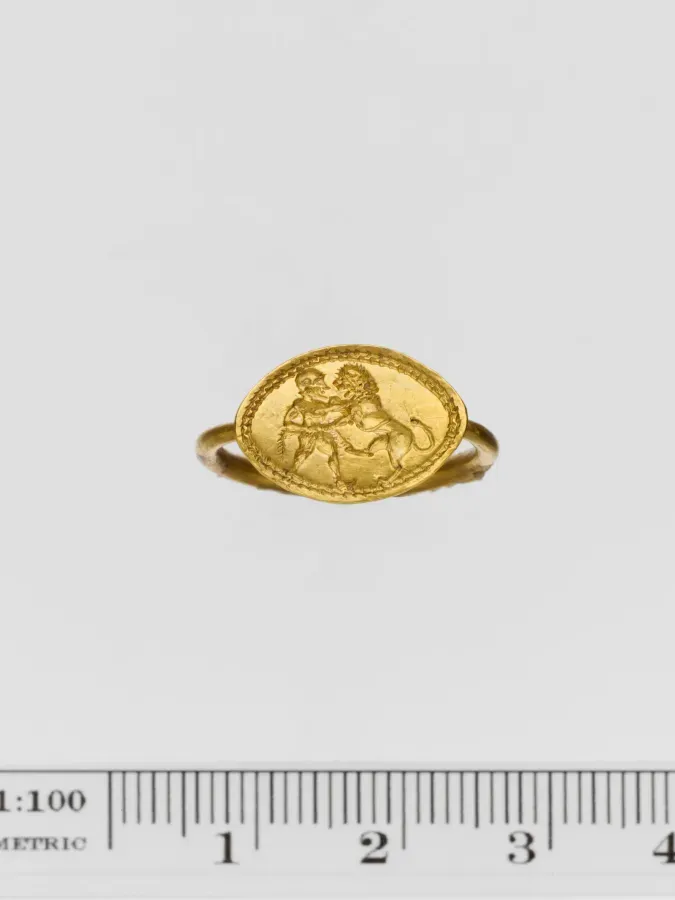
The table cut (flat top with facets at the edges). The first attempt to make a diamond more beautiful than its natural form.
Seventeenth century
The rose cut (like a rose, flat back with faceted domed top). Dominant up to the eighteenth century.
Eighteenth century
The old mine cut (precursor to the modern cushion). A squarish shape with rounded corners. Used for most large historical diamonds.
Nineteenth century
The old European cut (precursor to the modern round). A round shape with primitive brilliant cut.
1902: Asscher
The Asscher brothers developed the modern Asscher cut.
1919: the modern round
Marcel Tolkowsky mathematically calculated the modern brilliant cut. This was the turning point: after 1919 the round diamond became the benchmark.
Twentieth century
Other shapes also developed: marquise, emerald (adapted for diamonds), princess (1960s), radiant (1977), modern cushion.
Twenty-first century
The era of oval and elongated shapes. Modern public figures often choose oval, which has set the mass-market trend.
Famous engagement rings and their shapes
A handful of well-known engagement rings whose shapes drove fashion.
Grace Kelly (1956)
Prince Rainier III gave Grace Kelly an engagement ring with a 10.47-carat emerald-cut diamond in platinum, flanked by two baguette diamonds. The ring appeared in all her wedding photos with the Prince of Monaco in 1956 and set the fashion for emerald cut in postwar European high society.
Jackie Kennedy (1953)
John Kennedy's engagement ring used a 2.84-carat emerald-cut diamond with a baroque emerald-shape diamond beside it. A modern design for its time, it shaped American fashion in the 1950s and 60s.
Elizabeth Taylor and the Krupp Diamond (1968)
Richard Burton gave Elizabeth Taylor a ring with a 33.19-carat asscher cut diamond. One of the most famous asschers in history. Sold at auction after her death.
Princess Diana (1981, now worn by the Princess of Wales)
The famous sapphire and diamond ring with a 12-carat oval sapphire surrounded by 14 diamonds. Not a diamond as centre stone, but the oval form drove the trend toward ovals in modern engagement rings.
What they share
Famous historical rings tended toward larger stones (5 carats and up) with a distinctive central shape (emerald, asscher, oval). These are shapes that highlight the stone itself rather than burying it in detail.
The art of cutting: legendary masters
Cutting history knows a few key names.
Lodewyk van Berkem
A fifteenth-century Flemish jeweller. Credited with inventing the scaif (a wheel for cutting diamonds with diamond paste). This breakthrough allowed diamonds to be worked by diamond, which was previously thought impossible.
Louis de Berquen
Lodewyk's son, who advanced his father's methods. Received a commission to cut three large diamonds from Charles the Bold, Duke of Burgundy.
The Asscher brothers
Joseph and Abraham Asscher of Amsterdam. In 1902 they invented the Asscher cut, the icon of art deco. Their firm still exists and cuts major historical stones (Cullinan I, II, III for the British crown, for example).
Marcel Tolkowsky
Polish mathematician and engineer. In 1919 he published "Diamond Design" with the mathematical calculation of ideal proportions for the modern round brilliant. His scheme is still in use. Without Tolkowsky, the modern round diamond would not look the way we know it.
Lazare Kaplan
A Lithuanian-born jeweller who moved to the United States in 1919. Developed the modern oval brilliant cut in 1957. His firm Lazare Kaplan Diamonds is one of the leading diamond cutters in the United States.
Henry Grossbard
Inventor of the radiant cut in 1977. Combined emerald geometry with brilliant-cut sparkle.
What this means for the buyer
Knowing the history helps you see the modern diamond as the result of centuries of refinement. Most shapes have specific inventors and historical dates. They are not "just pretty stones" but engineering inventions with patents and authorship.
Shape and setting: how they work together
The shape of the diamond drives the setting type, and vice versa.
Round
Most universal for settings. Solitaire (4 or 6 prongs), halo, three-stone, pavé, channel. Any setting works.
Oval
Especially good in east-west orientation (length horizontal), which is becoming a trend. Also classic north-south (length along the finger). Halo works and emphasises the shape.
Pear
Point toward the nail (lengthens the finger): the classic orientation. V-prong protection for the point is essential. Looks beautiful in pendants.
Marquise
Points along the length of the finger. Both points need V-prong or closed setting protection. Often paired with vintage styling.
Emerald
Any setting works. Often bezel (full protection) or four corner prongs to emphasise geometry. Three-stone with two baguette side stones is a classic combination.
Cushion
Universal. Solitaire, halo (especially "old mine halo" for antique feel), three-stone.
Asscher
Rectangular geometric prong setting. Bezel is rarer because it would cover the geometry.
Radiant
Standard prong settings, no special needs. Universal.
Heart
V-prong on the heart point is essential. Often used in pendants (heart pointing down). Sometimes in a halo with small diamonds tracing the outline.
Princess
Corner prongs (V-prong on each of the four corners) are essential to protect the points. Channel setting is possible but the corner damage risk is higher.
For more on setting types, see the ring setting types guide.
Famous historical diamonds by shape
The best-known diamonds in the world and their shapes.
Cullinan I (Great Star of Africa)
Pear shape. Weight 530.2 carats, the largest cut diamond in the world from a natural rough. Cut by the Asscher brothers in 1908 from the 3106-carat Cullinan rough found in South Africa in 1905. Set in the British royal sceptre.
Cullinan II (Second Star of Africa)
Cushion cut. Weight 317.4 carats. The second-largest stone from the same Cullinan rough. In the British Imperial State Crown.
Hope Diamond
Cushion cut with antique "old mine" finish. Weight 45.52 carats. The famous blue diamond, said to be cursed (a legend). Owned by Louis XIV, Marie Antoinette, passed through many hands. Now at the Smithsonian in Washington.
Koh-i-Noor
Cushion cut. Weight 105.6 carats. One of the most famous in the world. Indian origin, passed through Mughal, Afghan, Sikh dynasties. Taken to London by the British in 1849 and added to the crown. Now at the Tower of London.
Tiffany Yellow Diamond
Cushion cut. Weight 128.54 carats. Yellow diamond found in South Africa in 1877. Cut with 90 facets (32 more than the standard cushion) to amplify the colour. Worn by only three women: Mary Whitehouse (1957), Audrey Hepburn (for a publicity shoot in 1961), and one further wearer in 2019.
Le Régent
Cushion cut. Weight 140.64 carats. Found in India in 1698. Owned by Philippe II of Orléans, Louis XV, Napoleon Bonaparte (Napoleon set it into the hilt of his sword). Now at the Louvre.
Orlov
Rose cut with dome. Weight 189.62 carats. Found in India. Owned by Count Orlov, who gave it to Catherine the Great. Now in the Russian imperial sceptre at the Kremlin Armoury.
Dresden Green
Pear shape. Weight 41 carats. The largest natural green diamond in the world. Found in India, bought by Augustus the Strong for the Saxon crown in 1742. Now in Dresden.
What legendary stones share
Most legendary historical diamonds use:
- Cushion (Koh-i-Noor, Hope, Tiffany Yellow, Cullinan II)
- Pear (Cullinan I)
- Rose cut (Orlov)
Modern shapes (oval, princess, radiant) do not appear on historical stones because they were invented in the twentieth century. Cushion and its variants dominate, which makes cushion the "royal" shape by association.
Diamond shapes by jewellery type
Shape behaves differently in different piece types.
Engagement rings
Universal: round, oval, cushion, princess.
Striking: marquise, pear, emerald.
Romantic: heart, pear.
Vintage: cushion, asscher, old mine.
Wedding bands
Usually plain or with small accent stones. If a central stone is present, the shape is chosen to coordinate with the engagement ring (worn together).
Stud earrings
Best: round, princess. These shapes hold light in a stud setting best.
Also good: oval, cushion.
Less ideal: marquise, pear (pointed shapes can catch).
Drop earrings
Ideal: pear (point down), marquise, oval. Elongated shapes hang beautifully.
Good: round in a drop format.
Pendants
Most popular: round, pear (point down or up), oval, heart.
Striking: marquise in a drop pendant, emerald cut for a strict look.
Tennis bracelets
Best: round (classic). Sometimes princess in modern variants.
Eternity and anniversary rings
Ideal: round, princess, baguette (rectangle without cropped corners). These shapes line up without gaps.
Brooches
Universal: round, marquise, pear. Brooches can mix shapes.
Send a friend a discount code, they save on their first order.
The psychology of choosing a shape
Each shape sets a mood.
Round
Safe, classic. No questions, agrees with any style. Reads as "reliability" and "tradition".
Oval
Modern, elegant. Lengthening the finger reads as gracefulness. Reads as "femininity with confidence".
Pear
Romantic, individual. The dual nature (round and pointed) creates depth. Reads as "femininity with character".
Marquise
Dramatic, attention-getting. Often chosen by mature women for a status effect. Reads as "confidence unafraid of attention".
Emerald cut
Refined, aristocratic. Minimalism without boredom. Reads as "restrained elegance, intelligence and calm".
Cushion
Warm, romantic, vintage. Reads as "connection to the past, continuity, softness".
Asscher
Geometric, graphic, formal. Reads as "order, precision, control".
Radiant
Modern, dynamic, free of classic associations. Reads as "independence, own style".
Heart
Young, emotional, direct. Not for everyone, more for teens or very open romantic gestures.
Princess
Crisp, modern, but slightly dated (linked to the 1990s and 2000s). Reads as "practicality without flourishes".
Certificates and independent grading
Diamond quality is verified through independent laboratory certificates.
GIA (Gemological Institute of America)
The most authoritative certificate in the world. Founded in 1931. Assesses the 4Cs (cut, colour, clarity, carat). A GIA report is the standard for quality diamonds.
IGI (International Gemological Institute)
Second most common. Especially popular in Europe and Asia. Grading is slightly softer than GIA on average.
HRD (Hoge Raad voor Diamant)
A Belgian institute with a strong reputation. Frequently used for diamonds moving through Antwerp (the world's biggest diamond trade centre).
AGS (American Gem Society)
An American institute. Good reputation, less known in Europe.
EGL (European Gemological Laboratory)
Lighter standards. An EGL grading may rate a stone one or two grades above GIA for the same diamond. Keep this in mind when comparing.
What a certificate should include
- Exact weight in carats (to 0.01)
- Colour (D to Z scale)
- Clarity (FL to I3)
- Cut grade
- Dimensions (length by width by depth)
- Ratio (for non-round shapes)
- Polish and symmetry
- Fluorescence
- An ID number
- Sometimes a laser inscription on the girdle
Where to look for shape on the certificate
The certificate states the shape. Standard abbreviations:
- RBC (Round Brilliant Cut)
- OVL (Oval)
- PER (Pear)
- MQR (Marquise)
- EMR (Emerald)
- CUS (Cushion)
- ASS (Asscher)
- RDT (Radiant)
- HRT (Heart)
- PRI (Princess)
Shape trends for 2026
What is popular right now.
Oval dominates
The oval continues to be the number one trend for engagement rings. A long finger, a visible size at moderate weight, a modern look.
Emerald cut returns
After a long round-dominated period, emerald is coming back through the aesthetics of "quiet luxury" and the art deco revival.
Pear in pendants and earrings
Pear is rare on engagement rings but active in pendants and drop earrings. Lengthening, romantic effect.
Cushion for vintage
Vintage fashion is back, and cushion with it. The "old mine cushion" is particularly popular among lovers of antique aesthetics.
Mixed metals and mixed shapes
Earrings and stacking rings mix shapes for designer compositions.
Step away from princess
Princess is gradually slipping, associated with the 1990s and 2000s. Today's younger buyers tend to choose oval or cushion instead.
How to choose a shape for an engagement ring
Silver, gold, engagement rings, symbolic jewellery, paired sets.
The main practical application of knowing shapes.
Step 1: Ask your partner (or not)
If planning a surprise proposal, you need to know preferences. Ways to find out:
- A direct conversation about "dream" jewellery
- Pinterest or social media (what they like)
- The style of their existing jewellery (classic, modern, vintage)
- Asking a close friend or their mother
If not a surprise, choose together.
Step 2: Budget vs shape
Set a budget and consider how shape affects perception:
- Want a visually larger stone within budget: oval, marquise
- Want maximum resale liquidity: round
- Want uniqueness: pear, heart, marquise
- Want vintage: cushion, emerald, asscher
Step 3: Partner's style
Classic style: round or princess.
Modern, trend-led: oval, emerald.
Vintage: cushion, asscher, old mine.
Romantic: heart, pear.
Minimalist: emerald, asscher.
Step 4: Partner's finger
Know rough finger proportions (short, long, slim, wide). Elongated shapes for short fingers, anything for long ones.
Step 5: Longevity
An engagement ring is worn for 30 to 50 years. Choose a shape that will not fall out of fashion within five years. The classic round or the timeless oval are safer than experimental shapes.
Step 6: Stone protection
If the partner is active (sport, manual work), avoid shapes with sharp corners (marquise, pear, princess without protection). Choose a closed setting or a cushion with rounded corners.
An emerald cut forgives nothing, not a cloudy stone nor a nervous hand. Faint of heart? Take a round, it hides the lot.
How to wear different diamond shapes
Hundreds of rings and earrings across all ten shapes have passed through my hands. The shape of the stone sets the mood of a look more than the metal of the setting, so I choose it for the occasion rather than the other way round. Here is what actually works.
Which shape works for every day? For daily wear I recommend the compact rounded cuts: round, oval, cushion. They do not snag on a sweater sleeve or a blouse, they sit flat on the finger, and they get along with plain rings on neighbouring fingers and thin bracelets. An oval or round stone layers easily and never fights everyday clothes.
What should you wear to the office? For a tailored look I suggest the calm step cuts, emerald and asscher. They read as quiet confidence, they do not pull attention with sharp glitter, and they sit beautifully with a shirt, a classic collar and solid deep-toned fabrics: grey, navy, wine. One stone and a pair of simple studs are plenty, with nothing piled on.
And for the evening or a special occasion? For evenings I choose the elongated, dramatic shapes. I recommend pear and marquise in drop earrings for an open neckline and a deep V: they stretch the line of the neck and work with smooth satin and silk. A pear or heart pendant I suggest wearing point-down on a mid-length chain, so the stone falls into the décolleté. Under evening light a bright cut (round, radiant, princess) comes alive more than the step cuts.
How do you match shape to metal and skin tone? Here I keep to a simple rule. Warm yellow and rose metal softens the geometry of emerald and square cuts and flatters a warm skin tone. Cool silver and white metal underline the icy sparkle of the round and suit a cool undertone. When I build a look I read the client's undertone first, then choose the shape and metal to follow it.
Which shape suits a short finger? For a short or small finger I suggest the elongated shapes: oval, pear, marquise. They visually slim and lengthen the hand. A long finger carries almost anything, including the strict geometry of emerald and asscher. Large square cuts on a short finger I would avoid, as they can shorten it.
Turn on your camera, pick earrings, a pendant or a ring, and see the piece on yourself in real time.
Switch items in one tap.
Everything runs in your browser: no photo or video is ever uploaded.
Frequently asked questions
What is the most popular shape?
Round takes about 75 percent of engagement rings worldwide. Oval is second, princess third.
Which shape is cheapest at equal weight?
Marquise is usually 25 to 30 percent cheaper than round at equal quality. Oval and pear are 15 to 20 percent cheaper. The others sit in between.
Which shape looks largest?
Marquise, oval and pear look larger than round at the same weight thanks to bigger surface area.
Which shape is sparkliest?
Round (the classic brilliant cut) gives maximum light play. Oval, princess and radiant come close.
Which shape needs special protection?
Anything with sharp corners or points: marquise, pear, heart, princess. Use settings with corner protection (V-prong, bezel).
What does "brilliant cut" mean?
A faceting type with triangular and kite-shaped facets that produce maximum sparkle. Used in round, oval, pear, marquise, princess, radiant and heart.
What does "step cut" mean?
A faceting type with long parallel facets that produce a hall-of-mirrors effect. Used in emerald cut and asscher.
Which shape is best for vintage style?
Cushion (especially the old mine), emerald cut, asscher. These shapes were used historically before the twentieth century.
Can you re-cut a diamond to change shape?
Technically yes, but it involves significant weight loss (20 to 40 percent). Rarely done.
Which cut is best for a lab-grown diamond?
All of them. A lab-grown diamond is cut the same way as a natural one in any shape.
Better one big stone or many small at the same total weight?
One big stone always costs more than several small stones of the same total weight (large stones are rare). Aesthetically depends on style.
Which shape for single-stone earrings?
Round (classic), princess, pear point down. These shapes look best in studs.
Which shape holds value best on resale?
Round has maximum liquidity. Alternative shapes can lose 10 to 20 percent of appraised value on resale.
What matters more: shape or quality (4Cs)?
Both critical. Ideal: a shape you love, Excellent cut, good clarity and colour. In practice compromises favour the shape (a shape you do not love cannot be saved by quality) and the cut (excellent cut makes a stone alive).
Can you mix shapes within one set (ring plus earrings plus pendant)?
Yes, with coordination. For example oval ring, round earrings, pear pendant. Or all the same shape. The main thing is that colour and quality stay on one level.
Conclusion
A diamond's shape is the most visible aesthetic decision in buying a stone. From the classic round to the elongated oval, from vintage cushion to dramatic marquise, every shape sets its own feel.
The three main rules. First: pick a shape for the style and the era the piece will live in for decades, not for last year's trend. Second: factor in finger shape and lifestyle (sharp shapes need protection). Third: at equal budget, elongated shapes (oval, marquise) give a visually bigger stone cheaper than round, but round remains the most liquid and universal.
What else to read. On weight and value, the carat guide. On the 4Cs scale, the colour and clarity guide. On the princess shape specifically, the princess cut guide. On alternatives, moissanite vs lab-grown. On engagement rings overall, the engagement ring guide.
About Zevira
Zevira makes jewellery by hand in Albacete, Spain. The shape of a stone sets the character of a piece, so our makers approach each setting individually: a round sits in one prong arrangement, a pear or a heart needs a protective V-prong, an emerald or square cut drops into a strict geometric mount.
What you can find with us around diamond shapes:
- Rings with round and oval stones for classic and contemporary looks
- Pieces with pear and teardrop stones for pendants and drop earrings
- Geometric art deco shapes: emerald and square cuts
- Protective settings with V-prongs and full bezels for stones with sharp corners and points
- Stud earrings with round and square stones for maximum light play
- Pendants with heart and pear stones on a silver or gold chain
Every piece is handmade by a single maker, with personal engraving available. Sterling silver 925 and 14 to 18K gold.