Jewellery for christening: what to give a baby
Introduction: a small box and a big responsibility
Sarah was about to become a godmother for the first time. A week before the christening she caught herself standing in front of the same jewellery shop window three evenings in a row in central Edinburgh, looking at the same pieces. A silver cross with enamel work, a small gold St Christopher medal, a fine chain with a tiny anchor. The woman behind the counter asked how old the baby was. "Three months", Sarah answered. The seller put the gold chain back. "The chain is better later, when the child grows. For now let the cross sit in a box, and we can give you a silk cord for the service."
That short exchange was worth more than any article. A christening is a child's entry into a family and spiritual tradition, not a one off purchase of a pretty piece. The cross given on that day will travel with him for life: as a baby on a cord, as a teenager on a silver chain, on a wedding day under a shirt or under a veil, in his grandchildren's box as family memory.
This guide is built as a practical cheat sheet for godparents, parents and relatives. No religious arguments, no moralising, only practice. What to buy, which metal, what chain length for an infant, what to engrave. And above all: how to make sure that the first piece of jewellery in this child's life is safe.
If you are preparing a christening gift for the first time, start with the basics: our jewellery gift guide by occasion lays out general gift logic. If symbolism matters to you, read our meaning of the cross necklace guide. For hallmarks see our 925, 585, 750 hallmark guide. And if the child has sensitive skin or you want to be safe, see our nickel allergy guide.
Why jewellery is given at a christening
A christening gift is an ancient tradition reaching back to the first centuries of Christianity. In Byzantium and early Rome godparents brought a gold or silver coin to the church to pay for the rite, and later that coin was often turned into a small cross for the godchild. Through the centuries the coin became the cross, but the tradition holds: the first piece of jewellery in a person's life is given at a christening, and it is given by people who answer for the child before God.
The meaning works at several levels. On the everyday level, it is a symbol of welcome into a family and a community: the child receives the first object that belongs only to him. On the spiritual level, it is a mark of protection: a cross worn from infancy marks the child's faith. On the psychological level, it is an identity anchor: a teenager who learns from his parents that "this cross was given to you by your godmother Anna when you were two months old" gains a sense of continuity.
So the choice matters. Cheap costume jewellery in unknown alloy will not do: the child will wear the cross for years, and the metal needs to be safe and durable. A flashy piece with big stones will not do either: a christening gift is not a worldly piece. It is a sacred one, and the form should match the meaning.
Who gives what: godfather, godmother, parents, relatives
The division of duties varies by country and parish, but there is a general pattern worth following.
The godfather in Catholic and Orthodox tradition traditionally buys the cross and contributes to the rite. This is his main material role on the day. The cross can be modest or rich, but it must be there. In Anglican tradition the godfather often gives a piece marked with a Bible passage or with the child's name.
The godmother in Orthodox tradition often gives the christening set: a baptismal gown, a bonnet, a christening cloth. This is the textile part of the rite and matters as much as the cross. If she also wants to give a piece of jewellery, a chain for the cross (for later wear once the child grows) or a small bracelet with the child's name engraving works well. In Catholic and Anglican tradition the godmother often gives a saint medal or a small pendant.
The parents usually do not give the cross, because that role belongs to the godparents. But parents often give something durable: stud earrings for a daughter (bought now, kept until age 5 to 7), a baby bracelet with a charm, a silver spoon. The silver spoon for the first tooth, an old British and continental European tradition, is not strictly jewellery but a traditional christening keepsake.
Grandparents, aunts, uncles can give anything additional: a home icon, a silver medallion, a saint pendant. There is no fixed rule, only the need to coordinate with the parents so that three identical crosses do not arrive on the day.
If you are a godparent and you are not sure who is buying what, the simple advice: ask the parents directly. One awkward conversation a month before is better than three crosses at the service.
Catholic tradition: cross and medal
The Catholic christening tradition is the most widespread in the US, UK, Ireland, France, Italy, Spain, Portugal, Latin America and the Philippines.
A baptismal medal (medaglia battesimale in Italy, médaille de baptême in France). A round medal of 1.5 to 2 cm with an image of the Virgin Mary, a guardian angel, or a saint. The date of christening is often engraved on the reverse. The medal is worn on a chain like the cross.
The patron saint. In Catholic tradition the saint is chosen by the child's name or by the date of christening. A child called Anthony receives a medal with Saint Anthony of Padua, a girl called Teresa receives one of Saint Therese. The medal becomes a spiritual anchor for life.
The cross in Catholic tradition is usually simple, no decorative excess. A Latin cross (four points) with a minimal crucifix or no crucifix at all. In Catholic countries the cross and the medal are often worn together on the same chain.
Pearls are traditional on a girl's baptismal medal in French and Italian tradition. A small pearl at the centre of the medal stands for the innocence of the infant.
Anglican and Protestant tradition
The Anglican tradition (Church of England, Episcopal Church in the US, Anglican Church of Canada, Australia, New Zealand) sits closer to Catholic in form but with simpler symbols.
A small silver cross is the most common gift. The Latin cross shape, with no crucifix figure. Often engraved with the child's name, the christening date, and sometimes a Bible verse reference.
The St Christopher medal is widely given in Anglican and broader Protestant culture, especially in the UK and US. St Christopher is the patron of travellers, and the medal stands for protection through life's journey.
A small Bible with a name plate is a frequent companion gift, alongside or instead of a piece of jewellery.
Protestant tradition (Lutheran, Methodist, Presbyterian) tends to be simpler still. A plain silver cross or a name pendant, without strong saint imagery. The emphasis is on the name and the date, not on a particular intercessor.
Bracelet with a name plate. A common Anglican and Protestant gift for the parents to keep until the child grows: a small silver bracelet with the name and date engraved on a flat plate. The piece sits in the keepsake box, sometimes alongside a lock of the baby's hair from the day.
Customer reviews
Zevira is a real jewellery shop. Genuine payments, deliveries and customer thank-yous.
🥰🥰🥰 gracias
Ok, ¡gracias! 🙂
Orthodox tradition: cross and chain
In Orthodox tradition (Greek, Russian, Serbian, Romanian, Bulgarian, Armenian Apostolic) the cross is the central object of the rite. It is blessed by the priest during the sacrament and put on the child as part of the service.
Orthodox cross has a recognisable form: four points, often with a crucifix or with the monogram IC XC NIKA (Jesus Christ Conquers). On the reverse the prayer "Lord, save and protect" or an image of the Mother of God. The eight pointed cross with upper and lower bars is traditional in Russian Orthodox practice.
Size of cross for an infant is usually 1.5 to 2 cm without the bail. A smaller cross is lighter, does not interfere with the child lying down, does not catch on clothes. Crosses 2.5 cm and up suit ages 3 to 5 onward.
Chain in Orthodox tradition is often replaced with a silk or linen cord for an infant. The cord is softer, does not scratch the skin, easy to wash, safer for the risk of catching. The chain comes later, at 1 to 3 years.
Blessing of the cross at the church is required. If you bought the cross in a jewellery shop, the priest blesses it before the rite. Many shops sell crosses that have been blessed in bulk, but a personal blessing during the christening is preferred.
A prayer engraving on the reverse is the Orthodox classic, on children's crosses usually in small letters because of the size, but almost always present.
Crosses: shapes and types
A cross seems like a simple shape, but the variants are wider than many people think. It is worth knowing them, because this is an aesthetic decision that lasts decades.
Latin cross. Four points with a longer lower arm. The standard for Catholic, Anglican and Protestant gifts. Slim, elegant, suits classic chains.
Four pointed Orthodox cross. Classic with a single crossbar. Simple, recognisable, lean. Suits infants and daily wear.
Eight pointed Orthodox cross with the upper INRI plaque and the lower diagonal bar. A more detailed form, often chosen by older generations. Can feel oversized for an infant.
Celtic cross. A Latin cross with a circle behind the intersection. Common in Irish and Scottish christening tradition. Often engraved with knotwork.
Glory rays cross with rays radiating from the centre. A decorative form, more common in Catholic women's pieces.
Armenian flowering cross. With widening arms and ornament. Worn in Armenian Apostolic tradition. Distinctive and instantly recognisable.
Cross with crucifix vs without. A delicate choice. For an infant, many priests advise a simple cross without a crucifix so the small form is not overloaded with detail. For older children, the crucifix works well.
Enamel crosses are beautiful but need more care. Enamel can chip on impact, and for an active child a plain metal cross is safer.
Chain for an infant: length and clasp
The chain is the most debated element of a christening gift. For a very young baby a chain is often not used at all: a cord is safer. But if parents plan to use a chain from age 1 to 2, it is worth choosing it well.
Length for a newborn. Not needed. Cord 25 to 30 cm.
Length for a one year old. 30 to 35 cm. The chain should sit high on the neck, not hang.
Length for ages 2 to 3. 35 to 38 cm.
Length for ages 4 to 6. 38 to 40 cm.
Length for ages 7 to 10. 40 to 42 cm.
Length for teenagers 12+. 42 to 45 cm.
Link type should be simple and strong. Anchor (cable), curb, Singapore are good. Very thin snake or Venetian links are less suitable for active children: they break easily on catch.
Thickness for a child's chain is 0.8 to 1.2 mm. Too thick looks odd with a small cross, too thin breaks.
Clasp should be lobster. A spring ring works too, but lobster is more secure. No screw clasps on a child's chain: a child may try to unscrew and swallow.
A slip chain with no clasp is dangerous for a small child: risk of asphyxia. The chain must have a clasp.
Chain length often surprises godparents. Buying a beautiful 50 cm chain "to grow into" gives you a piece that sits in a box for ten years. Better to buy a short chain now and replace it later, or order one with the option to shorten at a jeweller.
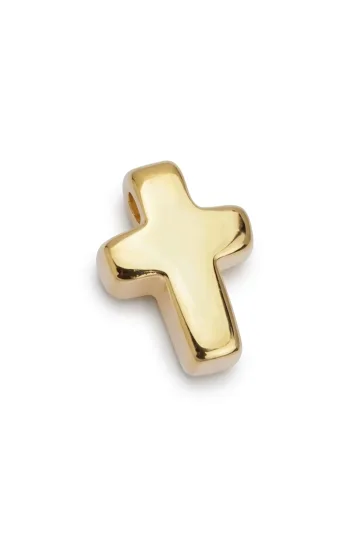
Wear the symbol, don't just read about it. These are in stock:
Saint medals and patron pendants
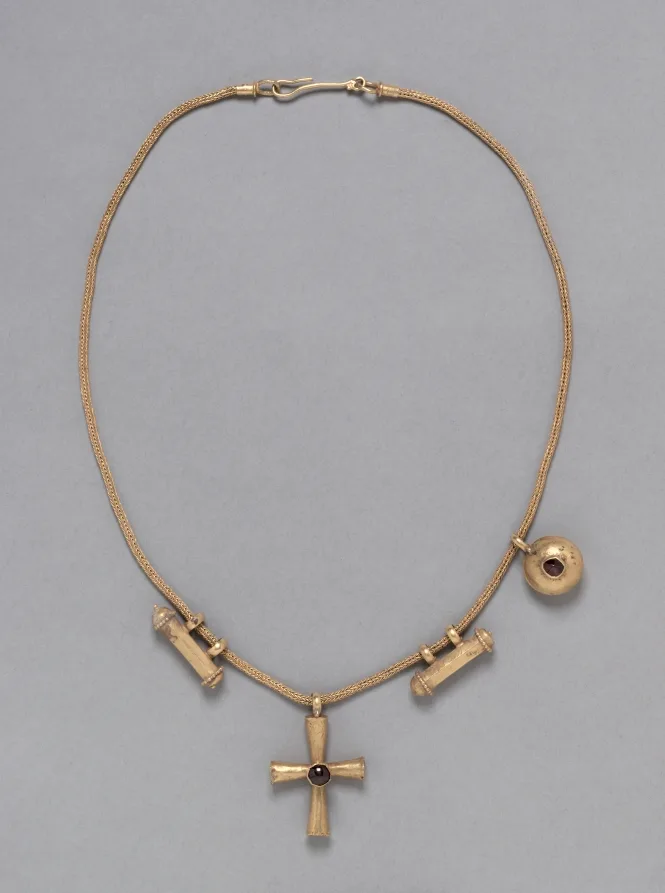
A saint medal (in Catholic tradition) or a personal patron pendant carries a child's spiritual companion for life.
Saint medal. Worn as a complement to the cross, never instead. Often on the same chain as the cross. Size 1.5 to 2.5 cm for an infant.
Pendant icon (Orthodox) or saint medal (Catholic). A flat medallion with an image of the saint or of the Mother of God. Size 1 to 1.5 cm. Engraved or enamelled. Patron saints particularly popular for children: Mother of God in Orthodox tradition; Saint Christopher (travellers, protection on the road) and Saint Anthony (children, lost things) in Catholic tradition; the guardian angel across all Christian traditions.
A patron medal works when there is already a cross from godparents and the godmother or another relative wants to add a personal piece. A medal with the child's namesake saint is a deeply personal gift that stays for life.
Silver Madonna pendant is a popular gift for a girl. The image of the Mother of God (Madonna with Child) carries warmth and protection.
Medals and pendants are usually made of sterling silver 925, sometimes 14 karat gold. Enamel medals are more beautiful but less durable for an active child.
Which metals are safe for an infant
This is the most important technical section, and it cannot be skipped. An infant's skin is several times thinner than an adult's, the barrier function is weaker, allergic reactions to metals show up faster and stronger.
Sterling silver 925 is the gold standard of children's jewellery. Pure silver with a minimal copper addition for strength. Hypoallergenic, safe, affordable. All children's crosses and chains from reputable shops are made of 925.
Pure silver 999 is soft but completely hypoallergenic. Used less often because it deforms easily (chains do not hold shape), but suits a cross pendant perfectly.
14 karat gold (585). Safe for an infant but contains alloy metals (copper, silver, sometimes nickel). When buying a gold cross for an infant, ask the seller: the alloy should be nickel free. In the EU and UK, nickel content in jewellery is restricted by REACH directive EN 1811, in the US by the Children's Product Safety Act, but still verify.
18 karat gold (750). Contains more pure gold and less alloy, so more hypoallergenic than 14 karat. More expensive but safer for sensitive skin.
Surgical steel 316L is used for piercing studs but is not classic for christening pieces. Hypoallergenic and very durable, but aesthetically secondary to silver and gold for a sacred object.
Medical titanium is similar to surgical steel: hypoallergenic, but not the classic look for a cross.
What to avoid. Mystery alloy costume jewellery, silver plated brass, nickel plated alloys. Even when a "pretty cross" sparkles and costs almost nothing, the risk of allergy and skin discolouration is too high. For a christening, buy only real precious metal with a hallmark.
Silver or gold: how to choose
The eternal question for godparents. There is no strict aesthetic rule: both silver and gold are traditional for christening across Catholic, Anglican and Orthodox traditions. But there are practical points.
In favour of silver. Affordable price, classic silvery tone goes with any infant outfit, silver tarnishing on a baby's neck has folkloric meaning in many cultures (folk wisdom says silver darkens when it "takes the bad" onto itself; scientifically it is oxidation with hydrogen sulphide), easy to refresh when dull.
In favour of gold. Does not tarnish (if nickel free), reads more formal on christening photos, a gold cross is passed down as a family heirloom, psychologically reads as a "more serious" gift.
Regional. In Eastern Europe and parts of the US silver is more common (especially from the godmother). Gold is the option from a wealthier family. In Italy, Greece, France and Spain gold is more traditional. Often combined: a silver cross with a gold chain, or vice versa.
Family continuity. If your family has a tradition of giving a gold cross to every newborn, follow it. If there is no tradition, choose by budget and personal preference.
Budget tip. A quality sterling silver 925 cross with a proper hallmark beats a cheap gold plated piece in mystery alloy. A gold imitation is not a christening gift.
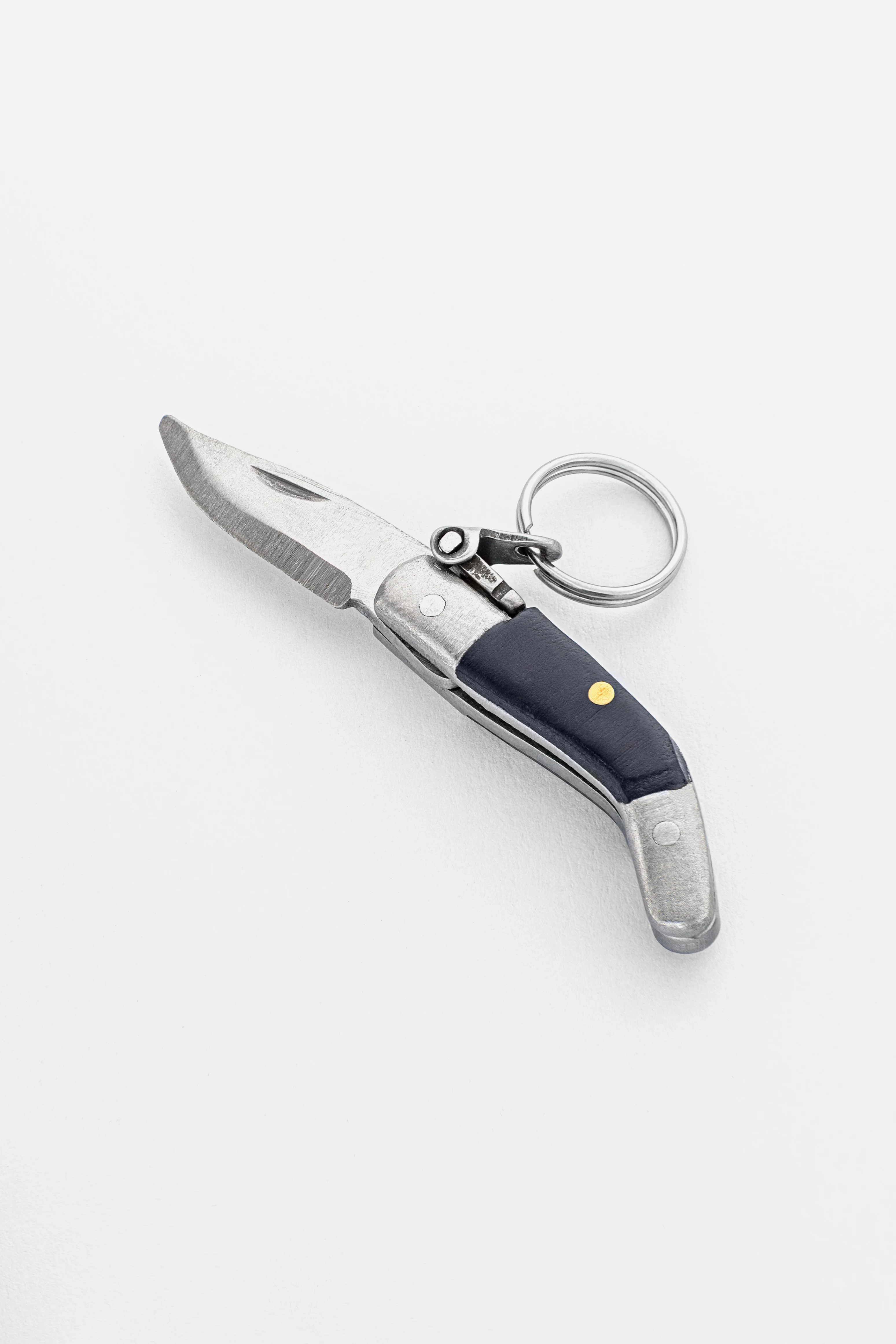
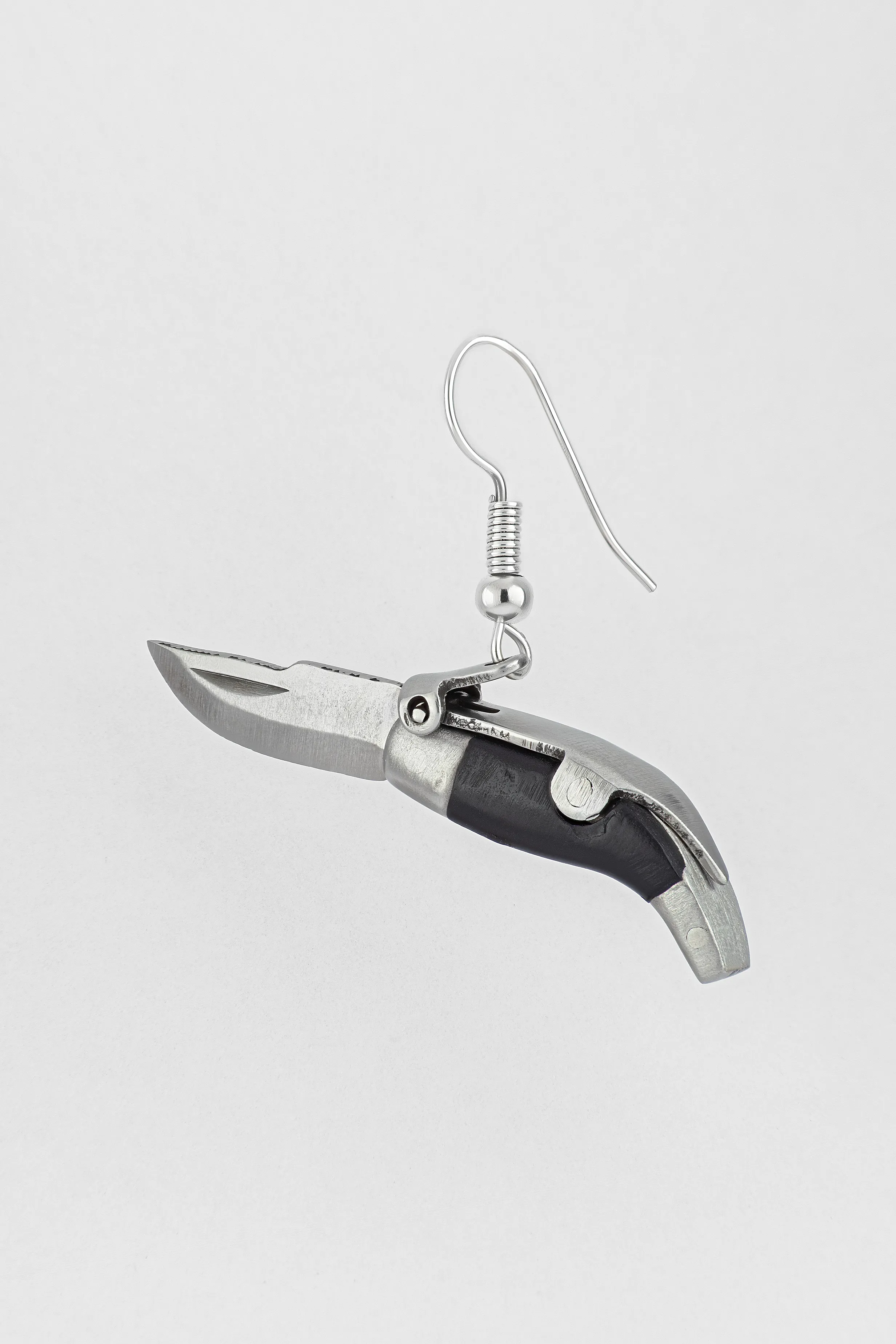
Artisan-crafted CAPAORA navaja pendant
A 40 mm stainless-steel navaja with a real folding mechanism and Palanquilla lock. An affordable gift to remember.
A code for blog readers:
10% off your first order
Authentic · Maker's guarantee · Ships from Spain
Enamel, stones, oxidation: what suits
Decoration on a christening cross is traditionally restrained, but options exist.
Oxidation (blackening) on a silver cross highlights the relief of a crucifix or an engraved prayer. The classic Orthodox finish, especially on men's pieces. Durable, safe, low maintenance.
Enamel on crosses comes in hot (cloisonné) and cold versions. Hot enamel is traditional in Russian work, especially the Faberge tradition. Enamel crosses are beautiful but need care: chips on impact. For an infant a plain metal cross is safer; enamel suits an older child better.
Stones on a child's cross are debated. A diamond, cubic zirconia or garnet as a centre stone shows up in Catholic tradition; in Orthodox tradition rarely. If you choose a cross with a stone, make sure it is securely set (closed setting) and will not fall out during active wear.
Pearl on a christening medal is traditional for a girl in French and Italian tradition. A small pearl at the centre of the medal stands for the infant's purity.
Turquoise is a traditional protective stone in Mediterranean tradition. A small turquoise cabochon at the centre of a cross is sometimes used.
The rule: the younger the child, the simpler the piece. A plain sterling silver 925 cross for a three month old is the ideal gift. Richly stoned crosses can wait until the child is 7 to 10 and wears jewellery by choice.
Age differences: newborn, infant, toddler, preschooler
The age at the christening shapes the choice more than anything else. Christenings happen at any age, from a few weeks old to several years.
Newborn (0 to 3 months). A cross only on a silk cord. A chain is dangerous (asphyxia risk). Cross size 1.5 to 2 cm, no stones, no enamel. Name and date engraving on the reverse is welcome. Stored in a box after the ceremony, worn only at major religious holidays.
Infant (3 to 12 months). Cross on a cord. A chain only in exceptional cases, under constant supervision (a formal photo). A small saint pendant 1 to 1.5 cm can be added.
Toddler (1 to 2 years). A fine chain 30 to 35 cm can begin. Cross at 2 cm. Companion gifts: a silver bracelet with a name charm, a silver "first tooth" spoon.
Preschooler (3 to 6 years). Chain 35 to 38 cm. Cross 2 to 2.5 cm. Enamel and small stones become possible. A coordinated gift (cross plus medal) works.
School age (7 to 10 years). Chain 38 to 42 cm. Cross 2.5 to 3 cm or more detailed. A proper piece with decorative elements. For a girl, stud earrings (if her ears are pierced); for a boy, an oxidised men's cross.
Safety: a checklist for parents
This section is worth saving or printing. When the baby is in your arms and 200 organisational tasks are on your mind, a checklist helps.
Before the ceremony.
- Ask the priest to bless the cross at the service if it has not been blessed at purchase.
- Check that the cross sits comfortably on the child's neck.
- Have a backup cord ready.
- No chain for an infant under 1 year.
During and after the ceremony.
- Do not leave a chain on a sleeping infant. Remove for sleep.
- Remove for bath time.
- Remove during massage, exercise, nappy change.
- Check the clasp or cord daily.
- Check the neck for redness or irritation weekly.
Warning signs (see a paediatrician).
- Redness under the cross that does not clear within a day of removal.
- Green stains on the skin (silver oxidation happens, but heavy reaction indicates contact allergy).
- Itching the child tries to scratch.
- Rash along the line of the chain.
Long term.
- Replace the cord every 3 to 4 months. Silk wears out.
- Replace the chain every 1 to 2 years as the child grows.
- Polish the cross with a soft cloth weekly.
Safety is not fear, it is awareness. Millions of children wear a cross from infancy with no issue, and yours will too if you follow basic rules.
Leave your email, we'll send your discount code. No spam, unsubscribe anytime.
The code arrives by email, valid on your first order.
Engraving: name, date, prayer
Engraving turns a mass produced cross into a unique personal object. It is one of the best ways to make a christening gift memorable.
The child's name on the reverse of the cross is the classic engraving. A small cross holds a short name or initials. A full name like "Alexander" sometimes does not fit; an abbreviation ("A.J." or "Alex") then works.
Date of christening is usually engraved alongside the name. Format: 19.05.2026 or 19 May 2026. For long term memory the full date with year is best, because thirty years on a grandson may not remember his christening day.
A prayer or motto. On Orthodox crosses the classic is "Lord, save and protect" (Spasi i Sokhrani). On Catholic pieces a short Latin phrase like "Ave Maria" or "In nomine Patris". Anglican and Protestant pieces often carry a Bible verse reference like "Psalm 23" or a short phrase like "Faith".
Patron saint's name in Catholic and Anglican tradition is often engraved on the medal next to the image. "Anthony" or "Teresa" under the corresponding saint.
Engraving time at a jeweller is usually 3 to 7 days. If the christening is in a week, order the cross in advance. If it is in two days, choose a shop that does same day laser engraving.
Cost of engraving is usually small compared to the cross itself. Do not skimp on this: it is the detail that turns a cross into an heirloom.
Packaging and presentation box
The packaging of a christening gift is a topic of its own. This is a sacred gift, and cartoon wrapping paper fits less well than a simple velvet box.
Velvet box. The classic packaging for a cross. Navy, burgundy, cream velvet. Satin lining inside. The box lasts decades, and the grown child reaches for the cross from this very box.
Silver or wooden box. A more premium option. The box outlasts the cross, and inside you can add other keepsakes: a christening photo, a lock of hair, a first milk tooth, a page from the calendar with the date.
Carved wooden icon or a small folding triptych suits a home display for the cross between wearings.
Engraved nameplate on the lid of the box, with the child's name and christening date, turns the box itself into a family heirloom. Sixty years later the grandchildren will see this box and instantly understand the story.
What to skip. Cartoon wrapping, balloons, flowery cards, paper gift bags. This is not a birthday, the tone is different.
If you buy online, check what box the piece arrives in. Many online shops use plain plastic blister packs, and for a christening such packaging will not do.
What else is appropriate besides a cross
If a cross has already been bought (by parents or another godparent) and you want to add your contribution, several traditional options exist.
Silver spoon for the first tooth. An old British and continental tradition. A small silver spoon with the child's name engraved, tapped against the first tooth for luck. By age 5 to 6 the spoon becomes the child's own.
Silver bracelet with a charm. A small child's bracelet with engraved name or zodiac charm. Size 12 to 14 cm for an infant, with the option to lengthen.
Stud earrings for a daughter if the family pierces ears early (common in Latino, southern European, and some Asian families). Small silver or gold studs with cubic zirconia. Kept until piercing age.
Home icon or wall cross. Small, for the corner of the child's room. Not for wearing, an interior piece. The Mother of God with Child, the guardian angel, a patron saint.
Engraved picture frame. Silver or wooden, with the christening date engraved. Not jewellery, but a traditional christening gift.
A cash gift in a beautiful envelope. A practical option. The cash goes to baby items, and the envelope is kept as a keepsake card. In some families the cash is put into a savings account opened on christening day and grown until adulthood.
A book with a personal bookplate. A children's Bible or a book of saints' stories with the godparent's signature on the flyleaf. Not jewellery, but a spiritual gift in the christening set.
Budget: from modest to heirloom
The budget for a christening gift sits across several tiers. Each tier fits its own situation.
Modest tier. A simple sterling silver 925 cross 1.5 to 2 cm, silk cord, plain packaging. Equivalent to a modest cafe lunch for two. Right when godparents are young and finances are tight. Nothing shameful in this: the key is real precious metal, not a fake.
Mid tier. A 925 silver cross 2 to 2.5 cm with engraving and enamel, a fine silver chain for later wear, a velvet box. Equivalent to a good restaurant dinner with the full menu. The standard for most families.
Premium tier. A 14 karat gold cross with engraving, a matching gold chain, a wooden or silver box with engraved nameplate. Equivalent to a short holiday. The grandparents' gift, or one from wealthier godparents.
Heirloom tier. 18 karat gold with diamonds or a hand made piece from a jeweller with a family crest engraving, plus a full set (cross, medal, chain, earrings for a girl, all in one design). Equivalent to a major family purchase. A rare and considered choice, usually for the first child in a family with a heirloom tradition.
Size of budget is not the main point. The match between the gift and the relationship and family status is. A modest silver cross from a young godparent is received warmly. A rich gold cross from someone barely acquainted with the family can be awkward. Think of the gift as a sign of relationship, not a display of wealth.
When the piece is worn and when it stays in the box
A subtle question: a cross and chain are not always worn constantly. Especially in modern urban families.
Worn constantly. If the family wears the cross from infancy as a religious sign. The cross goes on after the christening and comes off only for bath, sleep in the infant phase, gym class in adolescence.
Worn on holidays. For more secular families. The cross is kept in the box, worn at Christmas, Easter, the name day, birthdays, family celebrations. Not for daily wear.
Kept until the age of choice. Some parents decide that the child will start wearing the cross when she is old enough to choose. The christening gift sits in a box until age 7 to 10, then is handed over with the story: "Aunt Anna gave you this at your christening. It is yours now."
Handed over at key life moments. The cross given on the first day of school, on first communion, on confirmation, on the 16th birthday, on the wedding day under a veil.
Each scenario is valid. What matters is that the cross does not get lost, does not get forgotten in the back of a drawer. Twenty years on, the child should know where the christening cross is, and see it as a living object of his biography.
A christening cross lives under the collar, against the skin, never on show. Silver, small, quiet. A thick gold chain on a baby is the godparent's vanity, not faith, and I won't hear otherwise.
How to wear a christening cross
A christening cross is about belonging, not fashion, so I put this gift together differently from an evening piece. Here is what actually works, both when a child wears the cross and when it comes out for photos.
How should an infant wear the cross? I recommend a small cross on a soft silk cord, under the gown, against the skin. For a very young baby I suggest leaving the chain for later: a cord is safer and does not feel cold. The cross should sit high, at the base of the neck, rather than slip down, so I choose the length by age, never to grow into.
What should the child wear on the christening day? Under a christening gown or a linen dress I choose light, pastel tones: white, cream, ivory. Silver works with any of them, and warm gold I suggest against cream and beige, where it reads softer. For the formal photos I bring the cross out over the collar for a moment, then tuck it back under the fabric.
Can the cross be worn with other jewellery? The younger the child, the less they should wear, and that is a rule I keep. Beside the cross only a saint medal or a small reliquary on the same short chain belongs, and that is the only quiet stack a christening allows. A name bracelet I recommend on the wrist, separately, as its own detail.
Silver or gold within one set? I suggest keeping the metal consistent across the christening set: silver with silver, gold with gold. Mixing looks accidental, and this gift should read as one whole. If the cross is silver, I choose the chain and the medal in silver too.
How is the cross worn once the child grows up? For a teenager I recommend moving the same cross onto a longer silver chain and wearing it under a shirt or a sweater, close to the skin. It is never worn on show, and that is the whole point. When I put together a look for a graduation or another grown-up occasion, the christening cross stays a quiet personal detail under the fabric, not an accent.

Turn on your camera, pick earrings, a pendant or a ring, and see the piece on yourself in real time.
Switch items in one tap.
Everything runs in your browser: no photo or video is ever uploaded.
Care: how to clean baby silver
A child's silver tarnishes the same way adult silver does, sometimes faster because of skin moisture and contact with saliva when the baby starts putting everything in his mouth. Cleaning is fine and needed.
A soft polishing cloth (jewellery polishing cloth) is the safest method. Treated cloths are sold at jewellers, inexpensive. Wipe the cross and chain for 30 seconds and it shines.
Toothpaste and a soft brush. An old home method. A tiny amount of paste, a soft brush, gentle scrub, rinse with warm water, dry. Works on a plain cross without enamel or stones.
Baking soda and foil for heavy tarnishing. Put hot water with baking soda in a foil lined bowl, drop the cross in for 5 to 10 minutes. Works, but careful: not for enamel crosses.
Professional cleaning at a jeweller once a year is not excessive, especially for expensive gold crosses. Ultrasonic cleaning brings back the shine.
What not to do. No chlorine, no ammonia on enamel, no soaking silver in water, no scrubbing with a metal brush.
Storage between wearings in a velvet box, separately from other jewellery (so chains do not tangle), in a dry place. Not in a hot humid bathroom.
Send a friend a discount code, they save on their first order.
What not to give at a christening
This section helps avoid awkward moments.
Black pearls or black stones. Black is not part of christening symbolism. Pearl as a symbol of purity is only white or cream.
Rings with stones. A ring is not a christening gift. It carries different meanings (engagement, status) and gets worn later. Children's rings are inappropriate at all.
Oversized crosses. A cross 4 to 5 cm for an infant looks disproportionate and is unsafe (heavy, may injure on a fall).
Mystery alloy costume jewellery. Anything labelled "gold tone" or "silver tone" in unknown metal. Only real precious metal with a hallmark.
Religiously inappropriate symbols. Zodiac signs, runic pendants, occult symbols, flowers with pagan associations. The christening is a Christian sacrament; the symbolism must match.
A used piece without coordination. If you want to give a family cross (for example from your grandmother), ask the parents first. Many will agree, but the decision should be joint.
A too short chain (less than 25 cm). Will not fit.
A gift without a box. A christening gift with no packaging reads as unserious.
A cash gift without a card. If you give cash, include warm words mentioning the child's name.
If the christening has passed: a late gift
Sometimes you cannot attend the christening: a work trip, illness, distance. A late gift is also a tradition, and there are no strict rules.
Timing. Within 40 days of the christening (Orthodox custom) or any time before the child's first birthday. After that it becomes a gift for the name day or birthday.
What works. A cross or saint medal (if the child does not already have one), a silver bracelet, a silver spoon, a home icon.
How to present. In person if you can, with warm words to the parents and a story about the gift ("I chose this particular cross because the engraving is..."). If a personal visit is not possible, send by courier with a handwritten note.
Special case. If the child was christened long ago and you only now learned or only now grew close with the family, a late gift becomes a "name day gift" or a "I have wanted to for a long time" gift. No claim on christening status.
A late cash gift suits when you are far and cannot deliver a physical present. A bank transfer with a warm message "this goes to the child's account from me, congratulations on the christening" works fine.
Heirloom: passing down through generations
A christening cross is one of those pieces that gets inherited literally. It is a material thread linking four or five generations of a family.
Who passes it to whom. Most often a grandmother to a grandchild. Sometimes a godparent passes the cross he himself received as a child. Sometimes a mother passes her cross to her daughter on the wedding day.
When. At the christening of the next generation, at the 16th birthday, at the wedding, on first communion, when leaving for college in another city ("so it is with you").
Storage between generations. In a box with the story. If you have a photograph of the christening and written details (date, who christened, who was godparent), keep them in the box with the cross. Fifty years later a great grandchild will open it and see a biography, not a piece.
Restoring an old cross. If a great grandmother's cross has tarnished, scratched, bent, a jeweller can restore it. Restoring an old cross for a new godchild is a deeply warm gesture.
If the cross is lost. It is sad, not catastrophic. Family memory travels through objects and through stories. Tell the child about great grandmother's cross even if it did not survive. Spoken continuity also works.
When a new cross replaces the old. Sometimes the christening cross is consciously swapped for a more grown up one in adolescence. The old child's cross does not get thrown away: it goes into the family box of keepsakes, and one day passes to a grandchild.
Frequently asked questions
What does a godmother traditionally give?
In Orthodox tradition a christening set (gown, bonnet, christening cloth) is the godmother's main contribution. In Catholic and Anglican tradition a saint medal or a small pendant is common. If she wants to add a chain to go with the cross (for later wear), that works well.
What does a godfather traditionally give?
In Orthodox tradition the godfather buys the cross and contributes to the rite. In Catholic tradition the cross is also common from him. In Anglican tradition a name engraved silver cross or a St Christopher medal.
Can I give a gold cross to an infant?
Yes, if the gold is of certified quality and nickel free. 18 karat gold (750) is the safer choice because it contains more pure gold and less alloy. 14 karat (585) is also fine, but ask the seller about nickel in the alloy.
What chain length for an infant?
For an infant, a silk or linen cord 25 to 30 cm is safer than a chain. Chains start at age 1 to 2 with a length of 30 to 35 cm. Long chains carry a risk of asphyxia.
Can the baby bathe with the cross on?
Better not. Water speeds silver oxidation, soap residue builds up in the chain, the cord weakens. Take it off for the bath and put it back after.
What if there is redness on the skin under the cross?
Take it off for 1 to 2 days and watch the skin. If it clears, the metal is the culprit (likely nickel in the alloy): replace with verified sterling silver 925 or 18 karat gold. If it does not clear, see a paediatrician.
Can I pass a cross from one child to another?
Yes, but not instead of a fresh gift from the godparents. Generational continuity is valuable, but a new child needs his own gift too. Often the older cross is kept as a keepsake and a new one is bought for the new child.
The christening is in two days and I have no gift. What do I do?
Go to a reputable jewellery shop (not a street market, not an online flash sale), pick a sterling silver 925 cross with a factory engraved "save and protect" or a Latin cross, and ask for express name engraving. Many shops do laser engraving in an hour. Do not panic: the key is real precious metal.
Should I bless the cross at home or at church?
At church during the rite is the better option. If you bought the cross in advance, take it to the church a week before the christening and ask the priest to bless it. If the cross will be blessed during the rite, no prior blessing is needed.
The parents are not very religious. Do they need a cross at all?
If the family is having the christening, then yes: the cross is part of the rite. Even if the parents are secular and christen "for the grandmothers" or "for tradition", the piece survives as a cultural keepsake. If the family is non religious and there will be no christening, give a name bracelet or a name spoon instead.
Crucifix on the cross, or no crucifix?
Both are traditional. For an infant many priests advise a simple cross without crucifix on practical grounds: the small form with the crucifix is overloaded. For an older child either works.
What cross size for a three month old?
1.5 to 2 cm without the bail. Smaller is lighter and safer.
An expensive cross or beautiful packaging: which matters more?
Real precious metal in modest packaging beats a fake in a fancy box. Good sterling silver 925 in a simple velvet box is a real christening gift. A plated alloy in a rich box is not.
Can I give a decorative cross pendant that is not specifically for christening?
Better not. A christening cross carries religious imagery (crucifix, monogram, prayer on the reverse). A decorative cross without religious load does not fit the rite. Buy in a church goods shop or in the "crosses and medals" section of a jeweller.
What if the child tries to scratch the cross off?
Possible reasons: the chain is too tight (replace longer), the cross catches on clothes (replace the form), the skin reacts to the metal (remove and check material), or just play behaviour (normal at 4 to 8 months).
Conclusion
A christening gift is the first piece of jewellery in a child's life, and the choice deserves care. Three rules cover it. First: real precious metal with a hallmark, no costume jewellery. Second: safety for an infant (short cord instead of a long chain, small cross, no sharp parts). Third: engraving of name and date, turning a standard piece into a family heirloom.
If you have a few hours before the christening, go to a reputable jewellery shop and pick a sterling silver 925 cross 1.5 to 2 cm with a silk cord and ordered name engraving. That always works.
If you have a few weeks and a serious budget, plan a christening set: cross, saint medal, chain to grow into, a box with an engraved nameplate. The set will outlive several generations.
And finally. Thirty years on the child will not remember what the cross cost or which shop it came from. He will remember the photograph where his grandmother holds him and the godmother stands by with a small silk bundle. The gift is part of the story, not the story itself.
For further reading see our meaning of the cross necklace guide, our 925, 585, 750 hallmark guide, our nickel allergy guide, our protection rings guide, and our jewellery gift guide by occasion.
Silver, gold, engagement rings, symbolic jewellery, paired sets.
About Zevira
Zevira makes jewellery by hand in Albacete, Spain. A christening gift is the first piece of jewellery in a child's life, so we treat it as a future family heirloom: safe metal, a clean shape, and personal engraving that turns a cross into memory that lasts for decades.
Here is what you can find with us for a christening:
- Sterling silver 925 crosses in simple, recognisable shapes for infants and older children.
- Saint medals and pendant medallions with restrained imagery for a personal, named gift.
- Fine children's chains and grow into lengths with a secure lobster clasp.
- Nickel free, hypoallergenic metals that are safe for an infant's delicate skin.
- Personal engraving of the name, the christening date, and a short prayer on the reverse.
- Quiet, fitting gift packaging that suits handing a cross over at the sacrament.
Every piece is made by hand by a craftsperson, with the option of personal engraving. Sterling silver 925 and 14 to 18K gold.