Magnesite: White Magnesium Carbonate, Properties, History, and How to Spot a Fake
Magnesite is often mistaken for far costlier stones, and there is a reason for it. Porous and cheap, it takes dye easily and has been sold for decades under the guise of turquoise, lapis lazuli, or coral. On its own, though, it is an honest white mineral with clear chemistry and geology. Let us look at what magnesite really is, where it comes from, how to tell it from a dyed imitation, and how to care for it.
What Magnesite Is: Chemistry and Physics
Magnesite is magnesium carbonate, chemical formula MgCO3. By composition it is a close relative of calcite (calcium carbonate) and siderite (iron carbonate), all of them members of the same mineral family, the calcite group. In its pure form magnesite holds about 47 percent magnesium oxide and 52 percent carbon dioxide, which is driven off under strong heat.
Natural magnesite is rarely perfectly pure. The magnesium in its lattice is often partly replaced by iron, which produces a range of intermediate compositions running toward siderite. The amount of impurity also governs the colour: pure magnesite is white or colourless, while impurities lend a yellowish, greyish, or brownish cast.
Key physical characteristics:
- Crystal system: trigonal (rhombohedral), the same structural group as calcite.
- Mohs hardness: 3.5 to 4.5. This is a soft mineral; a steel knife scratches it, and it cannot scratch glass.
- Density: about 3.0 g/cm3 for pure magnesite, higher when iron is present.
- Lustre: vitreous on a fresh break, dull or waxy in dense porcelain-like varieties.
- Cleavage: perfect rhombohedral in crystalline varieties.
- Fracture: conchoidal in dense porcelain-like masses.
- Transparency: from transparent in crystals to opaque in dense aggregates.
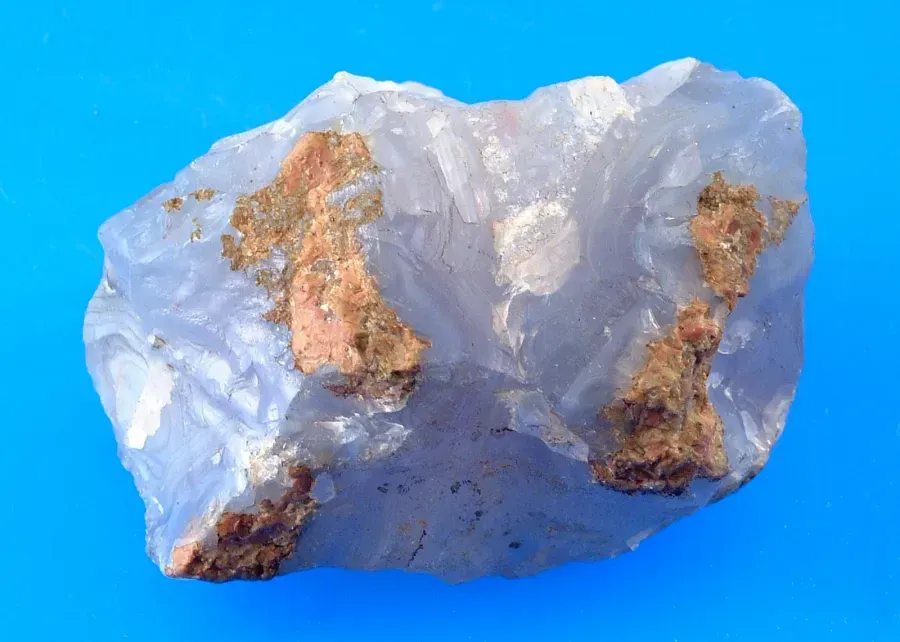
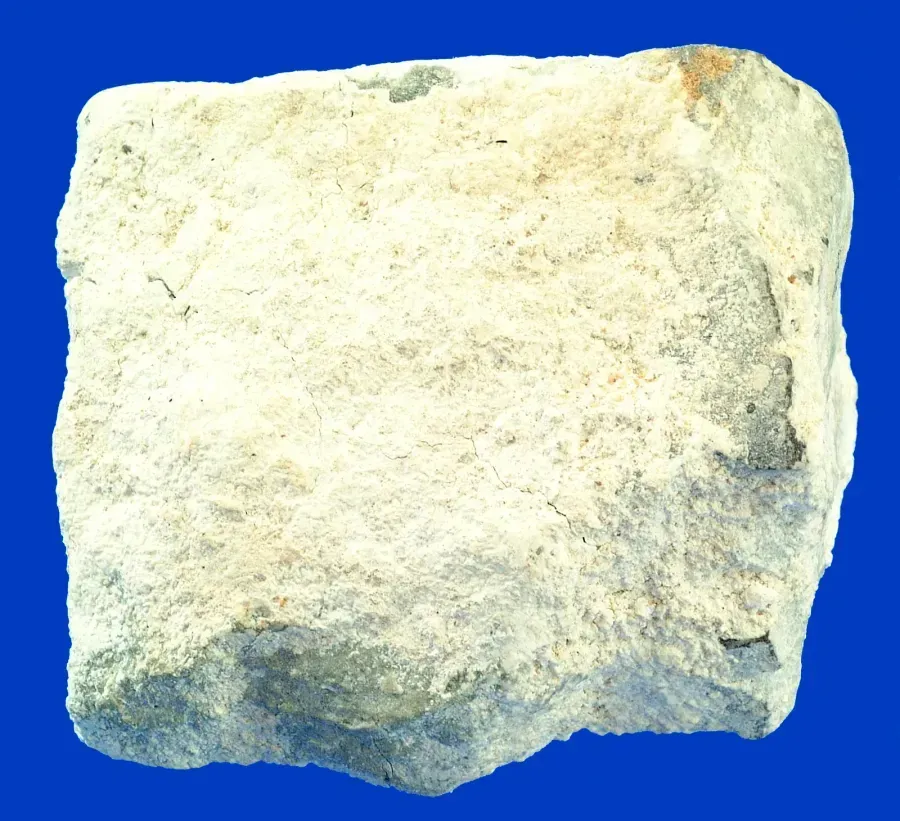
In appearance magnesite turns up in two very different guises. The first is coarsely crystalline, resembling white or greyish marble, with visible cleavage. The second is dense and porcelain-like, with no visible grains and a smooth conchoidal break, looking like unglazed porcelain or white bone. It is the porcelain-like magnesite that most often ends up in jewellery and cheap costume pieces, and it is the easiest to dye.
A simple diagnostic feature: magnesite reacts with hydrochloric acid but, unlike calcite, does not effervesce when cold. The bubbling release of carbon dioxide becomes obvious only in warmed acid. This is the classic way to separate magnesite from calcite and dolomite in the field.
Where Magnesite Comes From: Geology and Deposits
Magnesite forms in several ways, and geologists sort it into two main types.
Crystalline magnesite arises when dolomites and magnesium-rich carbonate rocks are altered by hot, magnesium-bearing solutions. The same heading covers magnesite produced by metasomatism, the replacement of one rock by another under circulating fluids. This kind of magnesite yields large granular deposits and is mined mainly for industry.
Amorphous, porcelain-like magnesite forms closer to the surface, during the weathering of ultramafic rocks such as serpentinites and peridotites. Rainwater charged with carbon dioxide leaches magnesium from these rocks, and it is redeposited in cracks as dense white veins and nodules. Hence the characteristic webbed texture with dark veining, so convenient for dyeing to look like turquoise.
Large magnesite deposits occur in several regions. China is today the leading producer by volume, above all the province of Liaoning, which supplies a large share of the world's crystalline magnesite. Austria, with its historic Styrian fields, was the early European centre and ran the first industrial calcining. Significant reserves also lie in Brazil, Turkey, Slovakia, Australia, North Korea, Greece, and the Ural region. Porcelain-like magnesite is typical of areas with serpentinite massifs.
The overwhelming majority of world magnesite output does not go into jewellery. Its main use is in refractories: when calcined, magnesite turns into periclase (magnesium oxide), which withstands temperatures above 2000 degrees. This lines the walls of metallurgical furnaces. Magnesite also serves as a raw material for producing magnesium metal and magnesia binders. Only a small share of the stone goes to jewellery and lapidary work, mostly the dense porcelain-like varieties with attractive texture.
How Magnesite Behaves When Heated
The behaviour of magnesite in fire is its main technical asset and at the same time a key to the chemistry of the stone. On heating to roughly 600 to 700 degrees, magnesium carbonate begins to break down: carbon dioxide escapes, and magnesium oxide is left behind. This process is called caustic calcining, and the product is caustic magnesia. Fire the stone harder, to 1500 degrees and above, and the magnesium oxide sinters into dense crystalline periclase, which is what works as a refractory. So one and the same handful of white powder can become either a soft binder or a material that holds the heat of a blast furnace; the firing temperature decides everything.
Sorel Magnesia Cement
Calcined magnesite is the basis of so-called Sorel cement, invented in the mid nineteenth century by the French chemist Stanislas Sorel. If caustic magnesia is gauged with a solution of magnesium chloride, the mass sets into a hard, pale material that takes polish and paint well. It was cast into seamless floors, stair treads, windowsills, even artificial stone for interiors. The old poured floors in public buildings of the early twentieth century are often exactly this magnesia composition. So a stone that someone wears as a white bead on the wrist, in another of its lives lies underfoot across whole railway stations.
The Main Mining Regions
The map of magnesite mining has shifted noticeably over the past century. The historic European centre is Austrian Styria, where deposits have been worked since the late nineteenth century and where industrial calcining was first put into routine production. Today the undisputed leader by volume is China, above all Liaoning province, which yields a large share of the world's crystalline magnesite. Major reserves are also held by Brazil, Turkey, Slovakia, Australia, North Korea, Greece, and the Urals. The lapidary porcelain-like varieties with handsome texture are mined only here and there, and their share of total output is small.
Magnesite in History and Culture
The name of the mineral is tied to the district of Magnesia in Greece, the same that gave its name to magnesium and to the magnet. The boundary here is not sharp: ancient authors used the word magnesia for several different white and dark stones, and the modern meaning of the term was settled only in the science of the modern era. As a distinct mineral species magnesite was described in the late eighteenth and early nineteenth century, once chemists had learned to separate magnesium compounds from those of calcium.
White carbonate stones have been used in jewellery and carving for a very long time, but magnesite as the material of mass-market beads and cabochons is mainly a phenomenon of the twentieth and twenty-first centuries. The reason is simple: the stone is soft, cheap, easy to cut, and it takes dye well. From it come beads, cabochons, small carvings, and prayer beads. In its natural form it is valued for a quiet milky-white tone and graphic dark veining.
With magnesite, as with most white stones, esoteric currents link ideas of calm, cleansing, and clarity of mind. It is worth saying plainly: this is cultural symbolism and a tradition of the new wave of interest in stones, and there is no proof of any physical or healing action of the mineral on a person. White does indeed read to many as purity and quiet, but that is about perception and aesthetics, not about the properties of magnesium carbonate. A similar quiet, light symbolism is given in modern stone literature to other cool minerals, for example celestine with its sky-blue tone.
Why White Stone Was So Prized
To understand magnesite's place in the history of jewellery, it helps to look wider, at the human love of white stone itself. A pure milky tone was linked in many cultures with clarity, calm, and beginnings. White stone marked happy days, white beads were woven into ceremonial dress, pale amulets were given at birth. Magnesite came into this old tradition late, already as a cheap material of the modern era, but it took a clear niche in it: anyone who wanted a quiet white tone without great cost got it in magnesite.
Magnesite and the Fashion for Ethnic Jewellery
The real rise of magnesite falls in the second half of the twentieth century, when large ethnic-style jewellery came into fashion: silver with turquoise in the spirit of the Native peoples of the American Southwest, heavy bead strands, handmade amulets. Demand for the turquoise colour sharply outran the supply of natural turquoise, and the market answered with dyed magnesite and howlite. So white magnesium carbonate became the quiet engine of a whole style: many of the recognisable blue-green strands of those years are not turquoise at all, but carefully tinted magnesite. That wave has not receded and still holds the main share of inexpensive turquoise-look costume jewellery.
Magnesite in the Hands of Carvers
For a carver magnesite is a rewarding material. The softness that makes the stone vulnerable in a ring becomes a virtue on the bench: porcelain-like magnesite cuts, turns, and drills easily and holds fine detail well. From it are turned beads of intricate shape, flat plaques for engraving, small figured carvings. The even white ground is also handy for dyeing, since the maker knows in advance how the colour will lie. It is the combination of cheapness, availability, and ease of working that made magnesite a workhorse of mass-market jewellery rather than a rarity for the few.
Wear the symbol, don't just read about it. These are in stock:


The Main Issue with Magnesite: Dyeing It to Look Like Other Stones
The most important thing a buyer needs to know about magnesite is not even its history, but its role as the leading imitation on the coloured-stone market. Because of its porosity, porcelain-like magnesite soaks up dye like a sponge, and that is exploited.
As turquoise. White magnesite with dark veins is dyed blue and blue-green, and the result is a cheap turquoise imitation. The veining of magnesite happens to mimic the natural matrix of real turquoise. Such stone is sold under names like "white turquoise" or "reconstituted turquoise", and sometimes simply as turquoise. A large part of the inexpensive turquoise beads on the market is exactly this dyed magnesite, or its close analogue howlite.
As lapis, coral, onyx. The same magnesite is dyed blue to pass for lapis lazuli, red-pink for coral, black for onyx. The dye gives an even, saturated tone that is almost never found in the natural stone.
Here it is worth mentioning howlite, another white mineral (calcium borate) that looks very much like porcelain-like magnesite and is used in exactly the same way, for dyeing. On the market the two stones are often confused and sold interchangeably. For a buyer the practical difference is small: both are soft, porous, white stones most often seen already dyed.
The dyeing itself is not deceit if the seller names the material honestly. The problem starts when dyed magnesite is passed off as expensive natural turquoise at the matching price.
Magnesite or Howlite: Telling the Two White Twins Apart
The section above says the difference matters little to a buyer, and that is true at a counter of dyed beads. But if it matters to you to know what you actually hold, the two can be told apart.
- Vein texture. In natural magnesite the veins are thinner, more graphic, and run as a net over the white ground. In howlite the pattern is larger, web-like, with broader dark veins and patches in places. This is the most workable everyday clue on an untreated stone.
- Acid reaction. Magnesite is a carbonate, howlite is a borate. A drop of warm hydrochloric (or strong household) acid on a hidden spot gives magnesite a weak bubbling reaction, while howlite shows none. Do not do this on dyed pieces; the test is for rough stone and cabochons.
- Heft in the hand. Magnesite is slightly heavier (density about 3.0 against roughly 2.5 for howlite), but by eye this difference is almost impossible to catch without a comparison specimen.
The main practical upshot: magnesite and howlite are equally soft, equally porous, and equally eager to take dye. So when you buy white or turquoise-look beads at costume prices, the question is not which of the two minerals you are holding, but whether it is dyed or not.
How to Recognise Dyed Magnesite
- Price. Jewellery-grade natural turquoise is expensive. Large, bright blue beads at costume prices are almost certainly dyed magnesite or howlite.
- Acetone or alcohol test. Run a cotton swab dipped in acetone or alcohol over an inconspicuous spot. If a blue trace stays on the swab, the stone is dyed. Solvent does not colour natural turquoise.
- Hidden areas. On dyed beads the dye often pools in cracks and around drill holes, giving an uneven, darker tone in the recesses.
- Hardness. Magnesite is soft and easily scratched. Natural turquoise is harder.
- Too even a colour. An unnaturally uniform, plasticky blue is a reason to be wary.
Varieties and Shades of Natural Magnesite
Natural magnesite has no flamboyant varieties of the kind agate or tourmaline offer, but neither is it monotonous. Its look depends heavily on how and where the stone formed.
Milky-White Porcelain-Like
The most common lapidary variety is dense white magnesite with no visible grains and a smooth conchoidal break, resembling unglazed porcelain. This is the one that goes into beads and cabochons, and this is the one that gets dyed. In its natural form its tone is quiet, a touch warm, with a fine dark net of veins from impurities and host rock.
Greyish and Brownish
When the composition holds more iron or impurities from the host rock, the stone shifts to grey, yellowish, or brownish. Such magnesite looks less dressy, so it reaches jewellery less often, but for those who value natural unevenness it has its own restrained beauty.
Transparent Crystals
Crystalline magnesite from deep deposits can yield transparent or translucent rhombohedra, sometimes honey-yellow from iron. These rarely go into jewellery because of their softness and perfect cleavage, along which the stone splits easily, but they are highly prized by collectors.
Customer reviews
Zevira is a real jewellery shop. Genuine payments, deliveries and customer thank-yous.
🥰🥰🥰 gracias
Ok, ¡gracias! 🙂
Magnesite and Health: A Sober View
The theme of sleep and calm draws many promises toward stones, so here it is worth setting honest limits.
Why "Magnesium Through the Skin" Does Not Work
The main argument of sellers of the "calm stone" is the magnesium in its make-up. Magnesium does matter for the nervous system, and a deficiency is linked with irritability and poor sleep. But the magnesium in magnesite is bound into a firm carbonate lattice and is not released by the warmth of skin or by sweat. A solid mineral does not pass the element into the body. Magnesium is replenished through diet or supplements prescribed by a doctor, not by wearing a bead.
Where the Honest Conversation Draws Its Line
To say "this white stone is traditionally associated with calm" is honest, because it is about culture and symbolism. To say "magnesite cures insomnia and anxiety" is dishonest, because that is a medical claim with no evidence. The difference matters to buyer and seller alike: a beautiful piece has every right to please the eye and to set a restful mood psychologically, but it should not be sold as a substitute for sleep, a routine, or professional help. For persistent sleep problems it is wiser to see a doctor and leave the stone in its role as a pleasant detail.
How to Buy Natural Undyed Magnesite
If you want white magnesite itself, not a turquoise imitation, watch a few simple things.
- The colour is uneven and not bright. Natural magnesite is milky-white, sometimes with a yellowish, greyish, or brownish cast from iron impurities. Its tone is alive and uneven. A perfectly even, plasticky whiteness across the whole bead is already a reason to ask whether the stone has been bleached.
- Veins vary in thickness. On a genuine stone the dark net runs at random, denser here, sparser there. A repeating identical pattern on every bead of a strand more often points to pressed crumb.
- What "reconstituted" and "stabilised" mean. Reconstituted magnesite is ground crumb pressed with a binder; its pattern is even and predictable. Stabilised magnesite is natural stone impregnated with resin for strength and colour stability. Neither is a fake if the seller names the goods that way, but it is not solid natural stone, and the price should match.
- Ask for photos in daylight. Shop lamps and a flash pull any white stone toward perfect whiteness. Daylight shows the true tone and the warm impurities.

Turn on your camera, pick earrings, a pendant or a ring, and see the piece on yourself in real time.
Switch items in one tap.
Everything runs in your browser: no photo or video is ever uploaded.
Magnesite in a Piece: Where It Lives Long, Where It Wears Fast
A hardness of 3.5 to 4.5 is below quartz (7) and below almost any stone in a standard jewellery box. From this follows directly which formats are wearable and which are not.
- Rings and magnesite go together poorly. Hands knock against desks, handles, and keyboards more than anything, and a ring stone takes the blow first. Soft magnesite in a ring soon abrades and chips. If you really want one, choose a cabochon in a closed high bezel and remove the ring for any hand work.
- Beads fear not water but friction on the thread. In a bracelet on elastic the bead holes wear from the inside over time as the soft carbonate rubs against the cord. Check the thread once a season and restring the beads before they break, especially with large, heavy beads.
- A pendant lasts longer than a bracelet. On the chest the stone takes almost no knocks or friction. A magnesite pendant or earrings wear far slower than a bracelet of the same stone, and this is the most sensible format for everyday wear.
- A silver bezel adds protection. A closed bezel covers the girdle and edges of the cabochon, the spots most prone to chipping. Open prong settings suit soft magnesite less well.
Caring for Magnesite Jewellery
Magnesite needs gentle handling precisely because of its softness and, in dyed versions, because of the instability of the dye.
- Guard against knocks and scratches. A hardness of 3.5 to 4.5 means the stone is easily scratched even against other jewellery. Store it separately in a soft pouch.
- Avoid acids and household chemicals. Magnesium carbonate reacts with acids. Vinegar, acidic cleaning products, even acidic sweat over long contact harm the surface.
- Do not soak it. Porous magnesite absorbs water and products. On dyed specimens water and soap can wash out the dye. Wipe with a slightly damp soft cloth and dry at once.
- Take it off before the shower, pool, and sport. Chlorine, seawater, cosmetics, perfume, and creams do the stone no good, and chlorine darkens a silver setting fast.
- Cosmetics last. Put the piece on after applying cream, perfume, and hairspray.
With such care both natural and dyed magnesite keep their look for a long time. Just remember that dye may fade over time in sunlight.
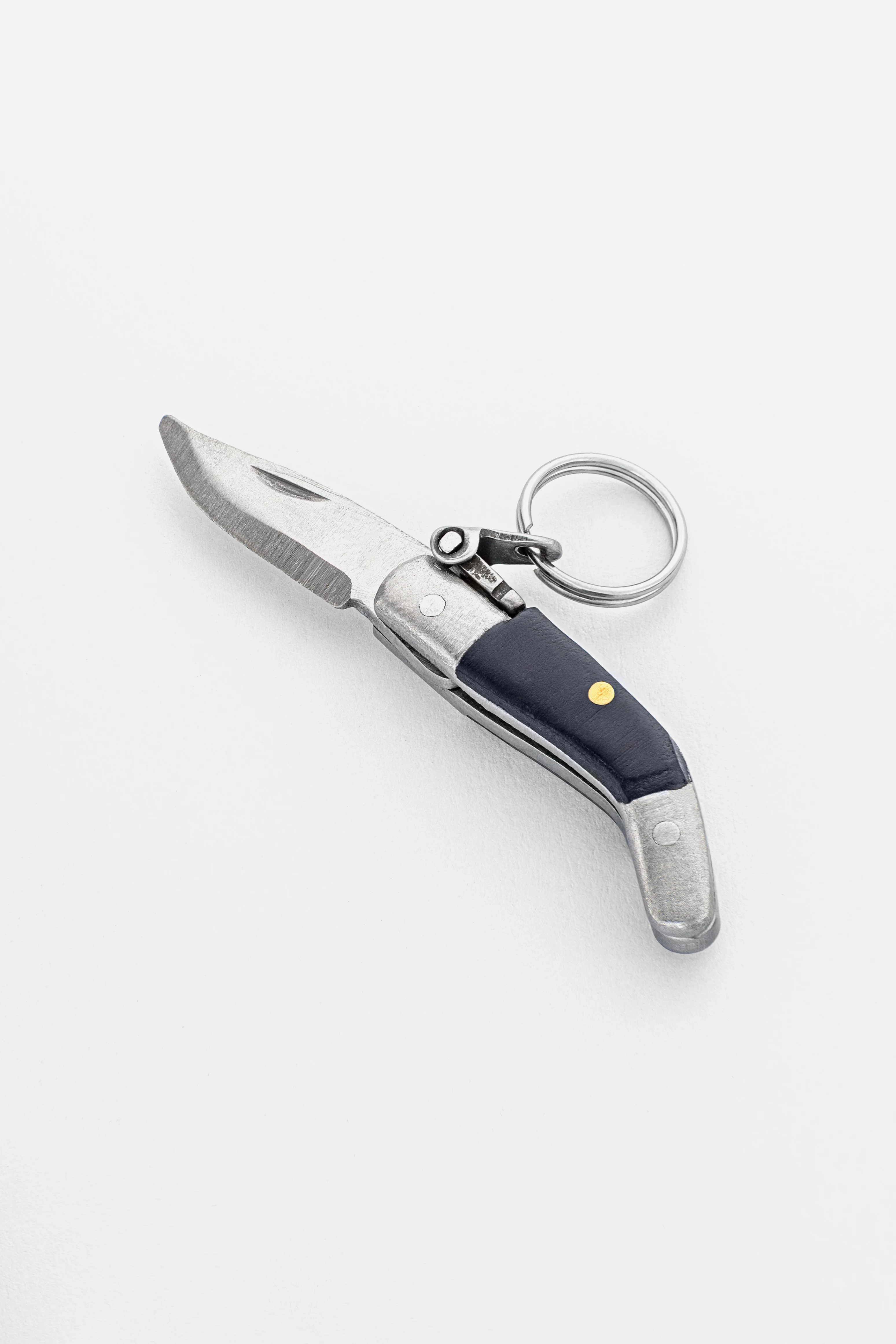
Artisan-crafted CAPAORA navaja pendant
A 40 mm stainless-steel navaja with a real folding mechanism and Palanquilla lock. An affordable gift to remember.
A code for blog readers:
10% off your first order
Authentic · Maker's guarantee · Ships from Spain
Magnesite Jewellery: Formats
Magnesite mostly goes into inexpensive pieces that look striking. The softness of the stone allows large forms to be turned from it without raising the cost.
Bead Strands and Bracelets
The most common format is beads, smooth or faceted, round and in rondelle shape. From them are assembled bracelets and long strands. Natural white magnesite with veining looks quiet and graphic; dyed gives a bright turquoise or coral tone. A bracelet on elastic or thread is a practical everyday thing, but bear in mind that the stone is soft and fears knocks against worktops and door handles.
Pendants and Cabochons
From dense magnesite cabochons are cut for pendants and inlays. In a setting of 925 silver the white stone looks restrained and clean. A plain setting without extra decoration emphasises the milky tone and the texture.
Prayer Beads and Large Beads
Light and cheap, magnesite is handy for prayer beads and large decorative beads: a big size makes the piece neither heavy nor expensive.
Leave your email, we'll send your discount code. No spam, unsubscribe anytime.
The code arrives by email, valid on your first order.
Magnesite Among Other White Stones
There are many white lapidary stones, and magnesite is easily confused with several of them, not only with howlite. Understanding its neighbours on the palette helps you avoid overpaying and choose more precisely.
Magnesite and White Opal (Cacholong)
Cacholong is a white milky opal, dense and opaque. In appearance it is close to porcelain-like magnesite, but harder (about 5.5 to 6.5) and unreactive to acid. Cacholong is valued for a deep porcelain whiteness without veins, whereas magnesite almost always shows a dark net. If a white stone is quite smooth, without veins, and is not scratched by a metal point, most likely it is not magnesite.
Magnesite and Selenite
Selenite is a translucent-white variety of gypsum with a silky fibrous lustre and a lengthwise cat's-eye sheen. It is even softer than magnesite (hardness about 2) and splits easily into fibres. Magnesite is dense, matte or waxy, without the silky glow. Selenite is almost never dyed to pass for turquoise; it is taken precisely for its light, so as imitations the two stones do not overlap.
Magnesite and White Agate
White agate is chalcedony, that is cryptocrystalline quartz with a hardness of about 7. It is much harder than magnesite, is not scratched by a knife, and does not react with acid. To the eye agate is denser, sometimes with fine banding, and noticeably colder to the touch. If a white bead confidently scratches glass, it is no longer magnesite.
Magnesite in a Mineral Collection
Crystalline magnesite is prized by collectors too. Clear transparent rhombohedra from Austrian Styria or Brazilian deposits look like icy cubes with bevelled faces and count as handsome specimens for a collection. Yellowish and honey-brown crystals, coloured by an admixture of iron, turn up from time to time. Such pieces are interesting not as jewellery but as a mineralogical object: on them the perfect rhombohedral cleavage and the very structure of the calcite group are clearly visible. For a collector magnesite is a vivid teaching example of a carbonate related to calcite and siderite, and at the same time a chance to practise identification by the reaction with warm acid.
What to Pair Magnesite With
Milky-white magnesite gets along with almost everything, and that is its strength: the stone does not argue with a wardrobe, it quietly supports it. By colour it is easy to gather into sets with other light, cool stones such as moonstone, selenite, rock crystal, and white agate. The cool palette stays whole. A neighbour close in mood is celestine, the sky-blue stone: its soft tone sets off the white.
Magnesite dyed to look like turquoise sits well with silver and with warm earthy tones in clothing, which is exploited in ethnic-style jewellery. This is a matter of aesthetics and colour pairing, not of any boost to properties.
Myths About Magnesite
A good deal of exaggeration has built up around magnesite, especially in texts about stones for sleep and calm. Let us sort out what is true and what is invention.
Send a friend a discount code, they save on their first order.
What to Wear Magnesite With
The milky whiteness of magnesite gets along with almost everything, and that is its strength: the stone does not argue with a wardrobe, it quietly supports it. For an everyday look take a thin bracelet and wear it under a loose shirt, a linen blouse, or soft knitwear in pastel tones. White with white, white with sand, white with grey-blue read especially quiet and come across as a considered rather than a chance choice.
For the office a pendant on a fine silver chain works over a plain roll-neck or a shirt with a shallow neckline. With a strict suit add only that, without extra detail: one light point on a neutral ground looks more expensive than a handful of pieces.
In the evening magnesite plays beautifully on bare skin. A V-neckline, a bare neck, a dark fabric (graphite, wine, deep blue) turn the milky stone into a drop of light. Here a longer chain is fitting, so the pendant settles toward the neckline. For a special occasion build a silver layer: a short chain plus a long one with magnesite, several thin bracelets on one wrist. Keep to a single metal, silver or white gold, so the cool range stays whole.
Magnesite dyed to look like turquoise behaves differently: it is now a colour accent. It is easier to wear with a plain neutral base and silver, in an ethnic or boho look. Two style notes. First: do not mix white magnesite with bright hot stones such as garnet or citrine in one set; white suits cool neighbours. Second: one striking piece is enough. If you wear an expressive pendant, keep the bracelet barely there, and the other way round.
Why People Choose Magnesite
Behind the demand for a quiet white stone lies a clear psychology, and it is more interesting to speak of it honestly than to credit the mineral with magic it does not have.
A Pull Toward the Neutral and the Calm
A milky-white tone reads as quiet, unconfrontational, clean. Someone drawn to magnesite is more often seeking not bright self-expression but the opposite, a background support: a piece that argues neither with clothes nor with mood. In that sense the white stone works like a neutral base in a wardrobe. It calms not by chemistry but by its very look, and for many that is enough.
A Ritual, Not a Medicine
When a person puts on the same bracelet before sleep or on a hard day, it is not the stone that works but the habit and the mood tied to it. Psychologists call this anchoring: the object becomes a signal that it is time to switch over. Magnesite is a convenient carrier of ritual precisely because it is quiet and unobtrusive. The only thing is not to confuse a pleasant habit with a healing action of the mineral, or it is easy to be disappointed and to overpay for a dyed bead.
Affordability Without the Feel of a Fake
Part of magnesite's appeal is that it is an honest cheap stone with a look of its own. Unlike plastic or glass, it stays a real natural mineral with clear geology, modest though it is. For many it matters to wear a stone rather than an imitation of one, and magnesite meets that wish for little money. The problem is not in the material but only in dishonest trade, when it is passed off as expensive turquoise.
Magnesite Facts That Surprise
A few things about this modest white mineral sound unexpected even to those who have long worn stone jewellery.
Most of the "Turquoise" in Cheap Beads Is It
If you take a counter of bright blue beads at costume prices, most likely there is no natural turquoise there at all. The overwhelming part of such goods is dyed magnesite or howlite. So a plain white stone dresses whole displays in the fashionable blue-green colour.
It Lies Underfoot in Old Buildings
Calcined magnesite was used for poured magnesia floors. So one and the same mineral can be both a bead on the neck and the flooring of a railway station or a school built in the last century.
It Withstands Blast-Furnace Heat
After calcining, magnesite turns into periclase, which holds more than 2000 degrees. A soft stone that a knife scratches, in another form lines the walls of metallurgical furnaces.
Its Name Is Kin to the Magnet
Magnesite, magnesium, and the magnet all took their names from one Greek district, Magnesia. Yet magnesite itself is not magnetic: all they share is a root in the name, not a property.
It Does Not Effervesce in Cold Acid, Unlike Its Relative
Calcite, the nearest relative of magnesite, fizzes vigorously from a drop of cold acid. Magnesite is almost quiet when cold and reacts noticeably only in warmed acid. This laziness is the simple field test that separates the two look-alike carbonates.
Its Magnesium Never Reaches the Body
Although the stone holds magnesium in its make-up, the solid mineral does not give it up. To wear magnesite "for the magnesium" is as pointless as licking a spoon to get iron: the element is there, but it is bound and unavailable.
Cheapness Made It the Star of a Whole Style
Without cheap dyed magnesite the boom in ethnic "turquoise" jewellery in the second half of the twentieth century simply would not have happened on that scale. The modest magnesium carbonate quietly powered a fashion wave while staying in the shadow of a louder name.
Frequently Asked Questions About Magnesite
Is it a precious stone?
No. Magnesite is an inexpensive lapidary stone. Its value lies in a handsome white tone, softness in working, and its role as a material for imitations. The overwhelming part of world output goes into industry, not jewellery at all.
Are magnesite and magnesium the same thing?
Magnesite is made of magnesium carbonate (MgCO3), so magnesium really is part of its composition. But the solid mineral does not give magnesium to the skin or the body. Wearing a piece does not replenish a magnesium deficiency and does not replace dietary sources. These are different things: a chemical element in a mineral's make-up and the absorbable magnesium of food.
Does magnesite help you sleep or calm down?
There is no evidence of a healing or physiological action. The link of magnesite with calm and sleep is the cultural symbolism of white stone, not a confirmed effect. A beautiful piece and a pleasant evening routine may set a restful mood psychologically, but this is not a cure for insomnia. For persistent sleep problems it is worth seeing a doctor.
Why is the white stone in a shop called turquoise?
Most likely it is dyed magnesite or howlite. A white porous stone is dyed blue to pass for turquoise, because it is cheap, and the dark veins of magnesite resemble the natural matrix of turquoise. If the "turquoise" costs as much as costume jewellery and is sold as large bright beads, it is almost certainly a dyed imitation.
How can I check whether my stone is dyed?
Run a cotton swab with acetone or alcohol over a hidden spot. A blue trace on the swab means the stone is dyed. Other signs: an unnaturally even colour, dye pooled in cracks and around bead holes, and a very low price.
How does magnesite differ from howlite?
These are two different minerals: magnesite is magnesium carbonate, howlite is calcium borate. In appearance porcelain-like magnesite and howlite are almost indistinguishable, both white, soft, and porous, and both are used for dyeing to look like turquoise. On the market they are often confused. For a buyer the practical difference is small.
Is magnesite hard? Will it scratch?
Magnesite is soft, hardness 3.5 to 4.5 on the Mohs scale. A steel knife scratches it, and so do harder stones kept in one box. That is why magnesite jewellery is stored separately and guarded from knocks.
Can magnesite get wet?
Better not. The stone is porous and absorbs water and products, and on dyed specimens water washes out the dye. Take the piece off before the shower, the pool, and the sea. Clean it with a slightly damp cloth and dry at once.
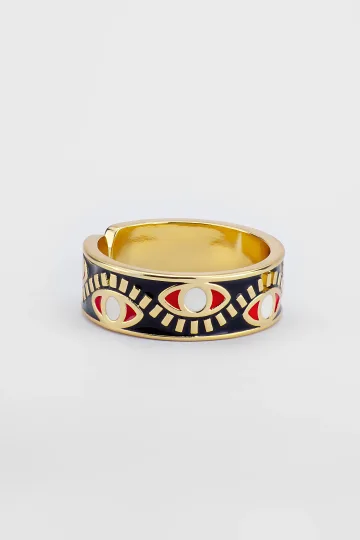
Wear the symbol, don't just read about it. These are in stock:
In Short
Magnesite is a soft white magnesium carbonate (MgCO3) of the calcite group, with a Mohs hardness of 3.5 to 4.5 and a trigonal crystal system. It forms when dolomites are altered by hot solutions and when serpentinites weather, and it is mined in China, Austria, Brazil, Turkey, the Urals, and a number of other places, but almost all of it goes not into jewellery but into the making of refractories and magnesium.
In jewellery the most important thing to know is one: porous porcelain-like magnesite is easily dyed and sold en masse as an imitation of turquoise, lapis lazuli, and coral. In itself it is an honest cheap stone with a pleasant milky tone; the deceit begins only when a dyed imitation is passed off as an expensive natural stone. Checking is simple, with acetone on a hidden spot. And the properties ascribed to it as a "stone of sleep and calm" are the cultural symbolism of the colour white, not a proven effect.
About Zevira
We make jewellery with natural stones and tell you honestly what you hold. Magnesite in our pieces is a quiet white stone in a setting of 925 silver: bracelets, pendants, bead strands. We do not promise that the stone cures sleep or anxiety, and we do not pass dyed imitations off as rarities. What you get instead is a beautiful piece with a clear composition and care.