Pentagram in Jewellery: Symbol Meaning and Why It Is Not Satanism
Introduction: The Star Everyone Drew at School
You probably drew a five-pointed star as a child, pencil never leaving the paper, one unbroken line. That is a pentagram. A geometric figure that first appeared on Sumerian clay tablets roughly 5,000 years ago and has never left human culture since.
The pentagram is also one of the most misunderstood symbols in the Western world. For many people it conjures horror films and dark associations. But that reading is remarkably recent, tied to the inverted pentagram specifically, and belongs to the mid-twentieth century. The classical pentagram, point upward, is Pythagorean geometry, a medieval Christian symbol of the Five Wounds of Christ, a Wiccan emblem of the five elements, and a great deal more besides.
The British tradition has its own deep relationship with the pentagram. The anonymous fourteenth-century poem Sir Gawain and the Green Knight places it on Gawain's shield as the "endless knot," a symbol of interlocking virtues. Aleister Crowley, working from London and Scotland in the early twentieth century, systematised its use in ceremonial magic before his death in 1947. And the Wiccan revival that Gerald Gardner established in the 1950s in Britain gave the pentacle its modern role as the primary symbol of that tradition.
In the 2020s the pentagram came back strongly through witch-community culture online and a broader spiritual revival. People wear it as a sign of connection to nature, personal protection, or simply geometric beauty.
This guide covers what the pentagram is, its many interpretations across millennia, and why wearing it as jewellery is a considerably more nuanced statement than "satanic symbol."
Pentagram Jewellery: What to Choose
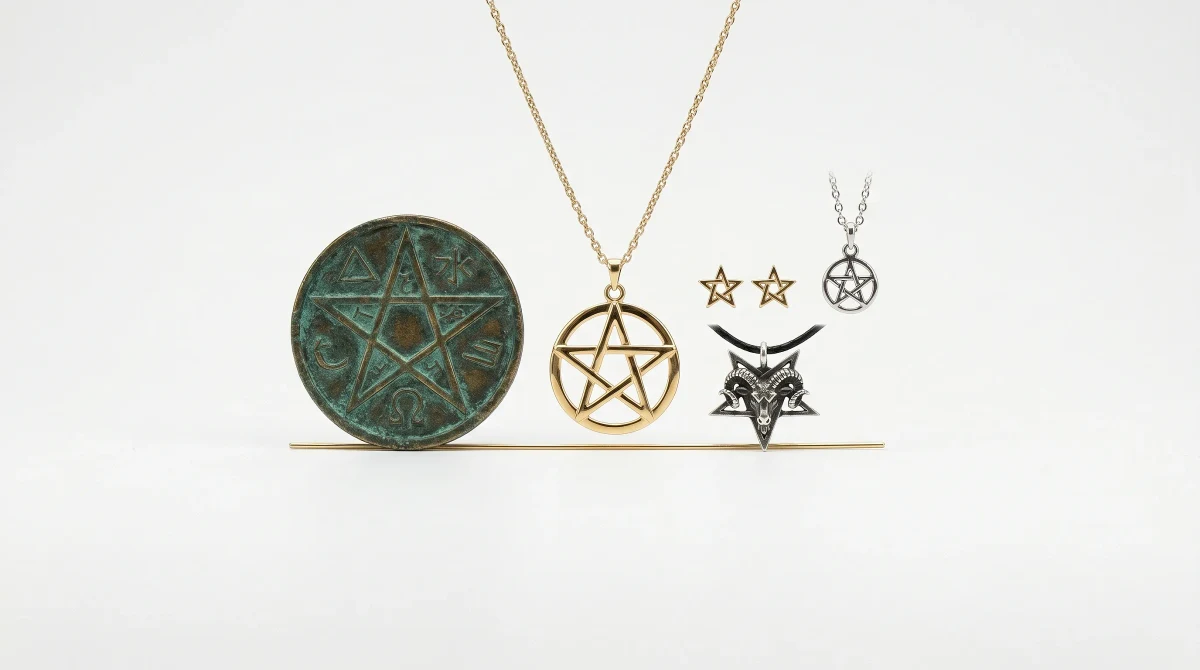
Pentagram Pendant
The principal form.
- Small minimalist pendant, 2-3 cm thin linear pentagram, accessible to mid-range price point.
- Pentagram in a circle (pentacle) the most classical Wiccan form, mid-range.
- Large pendant, 5-7 cm gothic, striking, mid to premium price point.
- Pentagram with gemstones amethyst or moonstone at each point, premium.
- Oxidised silver with engraving antique character, mid-range.
Pentagram Ring
- Signet ring with engraved pentagram minimalist, not overtly esoteric, mid-range.
- Circle ring with pentagram pentacle on the top, mid to premium.
- Statement ring with large pentagram gothic style, mid to premium.
Pentagram Earrings
- Small stud pentagrams paired, mid-range.
- Drop pentagram earrings more mystical in character, mid-range.
- Asymmetric pentagrams one star, one rune, contemporary trend.
Pentagram Bracelet
- Bracelet with pentagram charm one of several mystical charms, mid-range.
- Rigid bracelet with pentagram accent minimalist Wicca aesthetic, mid-range.
As an Alternative to a Tattoo
The pentagram is one of the most popular tattoo motifs. A jewellery piece works either as an alternative or as a companion to existing ink.
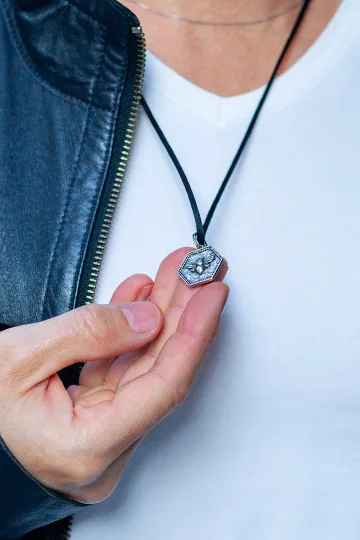
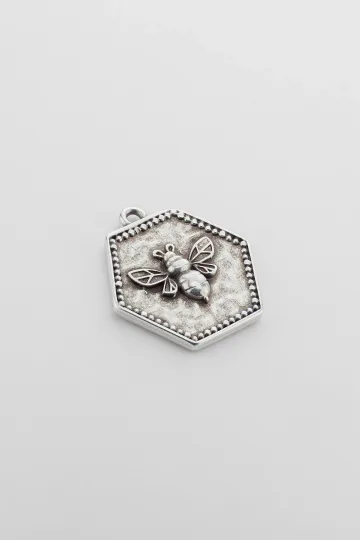
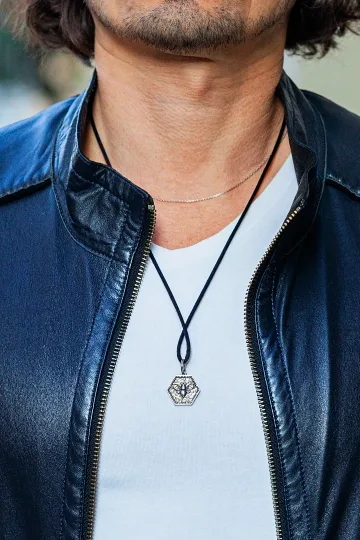
Wear the symbol, don't just read about it. These are in stock:
Types of Pentagram
By Orientation
Classical (point up). Five-pointed star, traditionally positive, representing the five elements with spirit at the apex.
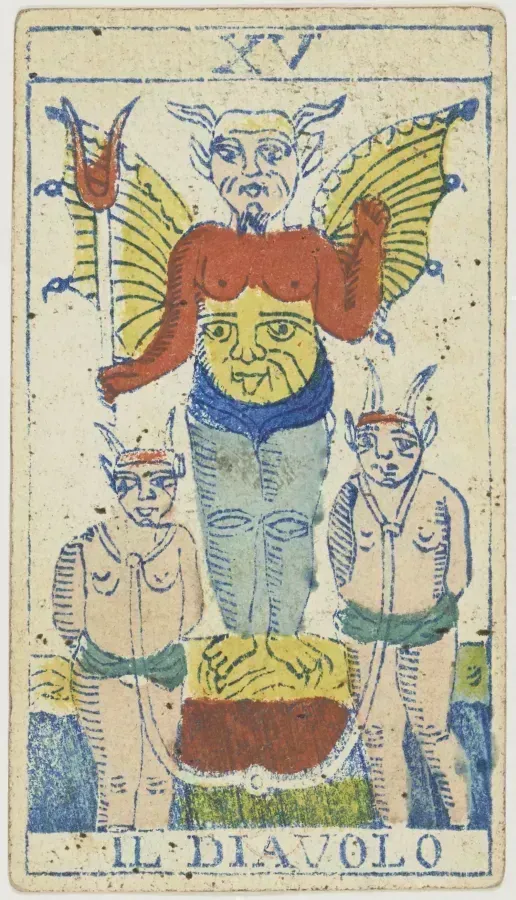
Inverted (point down). Two points at the top. Associated with Satanism from the twentieth century onward. Historically used without negative connotation, including in Eliphas Levi's illustration of Baphomet where the upper two points serve as "horns."
Pentacle (pentagram in a circle). Enclosed by an outer ring. Standard in Wiccan tradition and ceremonial magic.
Decorative. A five-pointed star with no ritual significance, purely geometric.
By Style
Minimalist linear. Fine lines, contemporary geometric look.
Gothic. Oxidised, patinated, deliberately aged.
With runes. Runic inscriptions along each ray.
Wiccan triple goddess. Pentagram in a circle beside the triple-goddess crescent symbol.
Celtic pentagram. Interlaced lines in Celtic knotwork style.
What the Pentagram Symbolises
Five Elements (Wiccan Reading)
Each point represents one element:
- Top: Spirit (Aether)
- Upper left: Water
- Upper right: Fire
- Lower left: Earth
- Lower right: Air
The star within a circle unites all five. This assignment of elements to points is largely a twentieth-century Wiccan convention: Gerald Gardner's published work and Doreen Valiente's later elaborations standardised it for modern practice. Earlier ceremonial magic used slightly different correspondences depending on the system, but the underlying idea of the pentagram as a map of the five principles is consistent across traditions going back several centuries.
Five Wounds of Christ (Christian Tradition)
Early Christians used the pentagram as a symbol of the Five Wounds of Christ received at the Crucifixion (hands, feet, side). It served as a Christian emblem well into the medieval period before its meaning was gradually inverted. The symbol appears in manuscripts and church carvings of the eleventh and twelfth centuries in this reading, often accompanied by the number five in its broader devotional significance. The fact that this same figure is now widely perceived as anti-Christian is a dramatic illustration of how completely the cultural meaning of a symbol can shift over a few centuries.
Pythagorean Geometry
The Pythagoreans of the fifth century BCE regarded the pentagram as "sacred geometry." The golden ratio appears repeatedly in its proportions: every segment of the pentagram's internal lines divides every other in that same proportion. It was a mathematical symbol of harmony and cosmic order, and also the identifying mark of the Pythagorean brotherhood, one of the earliest documented uses of a symbol as the password of a secret society.
For the Pythagoreans the mathematical fact was not a secondary detail. They called the golden ratio the "extreme and mean ratio" and believed it was the key to understanding the structure of nature. The pentagram was, in their view, geometry as visible proof of universal harmony. Members scratched it on door posts, wore it as an amulet, used it as a silent greeting. When you draw the intersecting lines inside a pentagram, every segment divides every other at the same ratio. That consistency, built into a figure you can draw with one unbroken line, was the kind of thing that struck the ancient Greek mind as cosmically significant.
The Star of Ishtar: Sumerian Origins
Long before Pythagoras, Sumerian scribes used the five-pointed star as a cuneiform sign associated with the goddess Ishtar (Inanna) and heavenly dominion. Tablets from the third millennium BCE place the star beside titles meaning "great heavenly lady." In cuneiform the sign "UB" (a five-pointed star) could indicate heavenly regions, angular zones, and quarters of the known world. This makes the pentagram one of the oldest human symbols with a documented meaning still recoverable today. The association with a goddess of power, love, and war is as far from Satanism as it is possible to travel.
The Sumerian use is particularly significant because it shows the pentagram operating as a functional written sign, not merely a decorative motif. The scribes who pressed the five-point form into wet clay were not creating art: they were writing. The sign had a defined phonetic and semantic value within the cuneiform system. When the Babylonians inherited Sumerian writing, they retained the sign with its celestial and imperial resonances. The trajectory from Sumerian clay tablet to Pythagorean amulet to Christian manuscript to Wiccan altar tool is one of the longest continuous symbolic histories in human culture.
The Vitruvian Body
The pentagram mirrors the proportions of the human body with limbs extended. Pythagoras called this the "microcosm," the human form as reflection of universal structure. Leonardo da Vinci's famous Vitruvian Man drawing makes the same point in a different geometric idiom: the human body fits both a circle and a square. The pentagram version of the same intuition is older and, in some traditions, considered more revealing because it shows five distinct proportional relationships rather than two.
The connection between the five-pointed figure and the human body was not an analogy or a metaphor for the Pythagoreans: it was a mathematical observation. Extend your arms and legs and you create five terminal points (head, hands, feet) that correspond precisely to the five points of the star. Agrippa made this explicit in the sixteenth century with his famous illustration of the human figure inscribed within a pentagram, showing that the body and the star share structural proportions. This is what he meant by an "anthropocosmic diagram."
Protection: The Drudenfuss
In German-speaking lands the pentagram was known as the Drudenfuss or Alpdruckfuss, literally "the footprint of the Drude," a night demon believed to press on sleepers. It was carved into barn doors, thresholds, and stable frames to ward off supernatural harm. Goethe used this folk tradition directly in Faust: Mephistopheles explains to Faust that a poorly drawn pentagram at the threshold kept him from leaving the room. The scene makes the logic explicit: the devil fears the pentagram. It is his opponent, not his symbol. This tradition was widespread in Central Europe from at least the fourteenth century and remained in folk practice well into the eighteenth.
The folk-protective use of the pentagram in German-speaking territories is one of the clearest historical counter-arguments to the "satanic symbol" claim. In this tradition, the pentagram was specifically the thing that prevented demonic entry. A household that carved a Drudenfuss into its doorframe was doing the exact opposite of inviting evil. The parallel with iron horseshoes nailed above doors, or hawthorn branches hung at windows, places the pentagram in the mainstream of European folk-protective practice.
Protection (Wiccan)
The pentacle is the primary protective symbol in Wicca, drawn on doors, worn as a pendant, used in ritual. The circle is understood to seal and focus the five forces within.
Five Senses
Sight, hearing, smell, taste, touch. Another reading of the five points, entirely secular.
Medicine (Hygieia)
In antiquity the pentagram was the symbol of Hygieia, goddess of health and cleanliness, from whose name the word "hygiene" derives. A medical symbol long before the caduceus.
Military Star
Many nations use the five-pointed star in military insignia: the United States, the Soviet Union, Vietnam. The same geometry, an entirely different context.
Inverted: Satanism
From the nineteenth century (Eliphas Levi, Baphomet) and definitively from 1966 (Anton LaVey, Church of Satan), the inverted pentagram became associated with Satanism. This is one specific interpretation of one orientation of the symbol, not the general meaning of the pentagram.
Customer reviews
Zevira is a real jewellery shop. Genuine payments, deliveries and customer thank-yous.
🥰🥰🥰 gracias
Ok, ¡gracias! 🙂
History of the Pentagram
Sumer and Babylon
The oldest known pentagrams appear on Sumerian tablets dated to around 3500 BCE. The symbol was used to represent "imperial power" and "the four corners of the earth plus heaven." In cuneiform the five-pointed star functioned as a written sign, not merely a decoration. Scholars read the sign UB as denoting regions, angular zones, or celestial areas. The consistent association with Ishtar and with governance gives this early usage a firmly positive, authoritative character.
The tablets from the city of Nippur, one of the great Sumerian religious centres, show the pentagram used in administrative and ritual contexts alongside names of deities and titles of authority. Nippur was the city of Enlil, the chief god of the Sumerian pantheon, and its scribal tradition was conservative and precise. When the five-pointed star appears in these records, it is not decorative filler: it carries specific semantic weight within a writing system that evolved over centuries into one of the most sophisticated ancient scripts.
Ancient Egypt
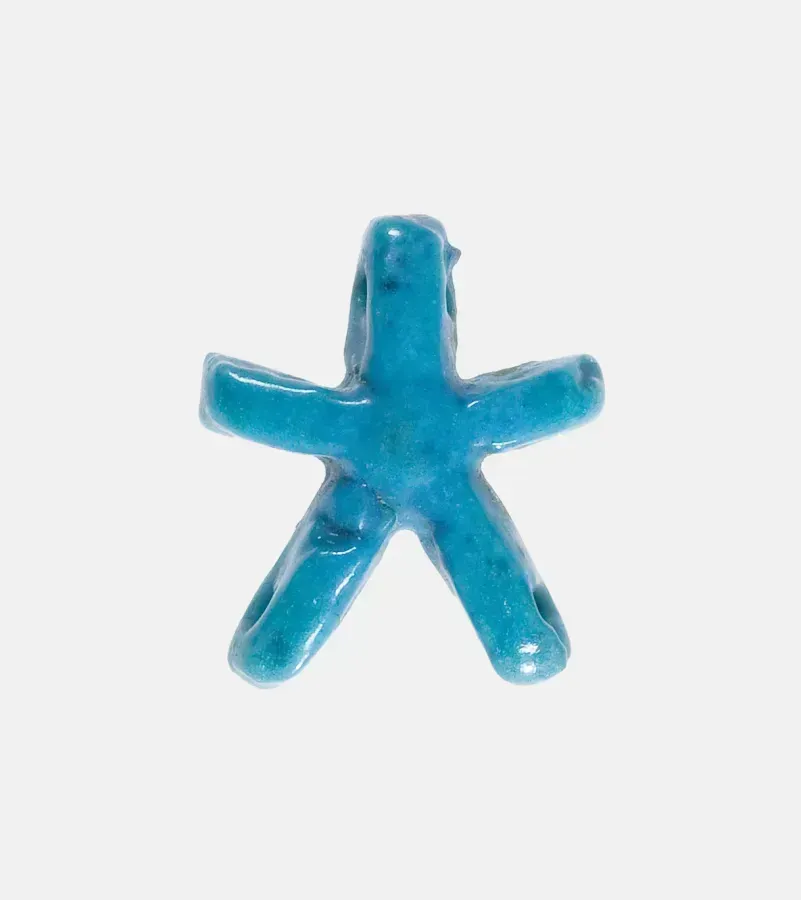
The pentagram appeared in Egyptian temples, associated with the mother goddess and fertility. Egyptian five-pointed stars drawn with two points upward appear in tomb paintings and temple reliefs, often in stellar contexts, as stars in the sky above divine scenes. The orientation difference between this Egyptian usage and the later Western positive reading illustrates that the significance of orientation is not constant across cultures: it shifted with the specific tradition and period.
The Pythagoreans, Fifth Century BCE
Pythagoras and his school adopted the pentagram as their secret emblem. Members recognised one another by it. The golden ratio appears in every proportion of the figure, and for the Pythagoreans that mathematical fact was not incidental: the pentagram was geometry made visible proof of universal harmony. It identified members of the brotherhood, one of the earliest recorded uses of a symbol as a mark of a secret society.
The Pythagorean community at Croton in southern Italy was structured as a philosophical and religious brotherhood with strict rules of secrecy. When members travelled they could identify fellow Pythagoreans by the pentagram without speaking. The symbol served simultaneously as a philosophical statement and a social password.
The Pythagorean discovery that the golden ratio is embedded in the pentagram's proportions was not accidental. The golden ratio, approximately 1.618, appears in the growth patterns of nautilus shells, in the branching of trees, in the proportions of the human face, and in the structure of galaxies. That a simple five-pointed star drawn with one unbroken line should contain this ratio at every intersection struck the Pythagoreans as evidence of a hidden mathematical order underlying visible reality. They were not wrong to be impressed.
Early Christianity
The first Christians used the pentagram to represent the Five Wounds of Christ. The association persisted through the early medieval period. It appears in devotional manuscripts alongside other counting symbols of Christian piety, and the number five had strong devotional resonance: five wounds, five joys of the Virgin, five senses oriented toward God. The pentagram was a compact visual summary of this arithmetic of faith.
Medieval Christian use of the pentagram is documented in illuminated manuscripts from Ireland, England, Germany, and France. The symbol appears in devotional contexts, often alongside the cross and the fish. The shift from Christian emblem to feared occult sign was not sudden: it occurred gradually across the fifteenth through seventeenth centuries, driven partly by the Reformation's suspicion of visual symbolism and partly by folk-magic associations that accumulated over centuries of popular use.
The Middle Ages: Sir Gawain's Pentangle
The pentagram circulated as the "Seal of Solomon," a protective symbol against demons. The irony is notable: what many people today regard as satanic was then explicitly anti-demonic.
The fourteenth-century English poem Sir Gawain and the Green Knight is the most detailed medieval account of the pentagram's meaning. The poet devotes a full passage to Gawain's golden shield, explaining that the endless knot represents five fivefold virtues: the five senses, the five fingers, the Five Wounds of Christ, the five joys of the Virgin Mary, and five knightly qualities (generosity, fellowship, purity, courtesy, and compassion). The pentagram here is a symbol of interlocking perfection, each group of five reinforcing every other.
The poet calls it the "endless knot" because the line that forms it never breaks and returns to its starting point. This property, one unbroken line forming five connections, was understood as an image of completeness and perfect moral integration. No other medieval text analyses the pentagram in this depth; it is one of the most developed symbolic readings in all of medieval literature.
The Arthurian context is significant. By placing the pentagram on Gawain's shield, the anonymous poet was encoding it as a specifically Christian chivalric symbol. Gawain, one of the purest knights of the Round Table, carries the figure as a statement of moral completeness. The medieval reader would have understood immediately that the poet was constructing a positive Christian symbolism out of a five-pointed geometric figure. The symbol on the shield has nothing demonic about it: it is a systematic theology of knightly virtue in geometric form.
Renaissance: Pico, Ficino, and Agrippa
Pico della Mirandola (1463-1494) and Marsilio Ficino at the Platonic Academy in Florence studied sacred geometry as a key to understanding divine order. The pentagram, in which the golden ratio appears in every proportion, served as visual evidence of mathematical structure in nature.
Heinrich Cornelius Agrippa von Nettesheim, Paracelsus, and Johannes Trithemius integrated the pentagram into Western ceremonial magic, not as evil, but as a neutral geometric form believed to carry concentrated force. Agrippa's De Occulta Philosophia (1531) treated the pentagram as the symbol of the five places of the human body projected onto the cosmos: head, two arms, two legs. For him it was an anthropocosmic diagram, a map of the relationship between the human and the universal, not a tool of dark invocation.
Agrippa's famous illustration shows a human figure inscribed within a pentagram, each point of the star aligned with a body extremity. This image became one of the most reproduced diagrams in Western esoteric literature. It was not a satanic image: it was a statement about the structural correspondence between human anatomy and geometric harmony. Agrippa was arguing that the same proportional relationships that govern the human body also govern the cosmos, and that the pentagram makes this relationship visible.
Giordano Bruno (1548-1600), the Neapolitan philosopher who taught in Paris, London, and Prague before his condemnation by the Church, used the pentagram and star geometry in his systems of artificial memory, described in De Umbris Idearum and Ars Memoriae. For Bruno geometric forms were mnemonic tools that mirrored the structure of the cosmic mind. A use as far from Satanism as the geometry of architecture.
Nineteenth Century: Eliphas Levi and Modern Occultism
Eliphas Levi, the French occultist, published Dogme et Rituel de la Haute Magie in 1856, distinguishing clearly between:
- The pentagram point upward (positive, white magic)
- The pentagram point downward with the goat's head (negative, demonic)
Before Levi, the distinction between the two orientations was not codified. His formulation became the foundation for all subsequent Western occult interpretation of the symbol.
The second image became firmly associated with Baphomet. It is worth noting that Levi himself described Baphomet as a symbol of "universal balance," not as an endorsement of evil. The image was dialectical: two opposite readings of the same figure. Later readers, including eventually Anton LaVey, collapsed the dialectic and treated the inverted form as a simple emblem of opposition to Christianity. That simplification is what generated the popular equation, not Levi's original text.
Levi's contribution to the symbol's history is immense and complex. He did not invent the inverted pentagram as evil: he codified the positive/negative distinction for the first time. But because his Baphomet illustration is so visually striking and was so widely reproduced, the inverted form became fixed in the Western imagination as something sinister. Levi himself would have been surprised by this outcome: his intention was to create a complete symbolic system, not to generate a simple good/evil binary.
Aleister Crowley and British Ceremonial Magic
Aleister Crowley (1875-1947) systematised the use of the pentagram in his Thelemic system, producing what he called the Lesser Ritual of the Pentagram, a practice that became standard in British and American ceremonial magic through the twentieth century. Crowley worked within a British esoteric tradition that stretched from the Hermetic Order of the Golden Dawn through his own Abbey of Thelema, treating the pentagram as a formula of the five elements rather than as a symbol of dark or light magic in themselves.
The Hermetic Order of the Golden Dawn, founded in London in 1888, had already developed elaborate pentagram rituals before Crowley joined it. Members used the Lesser Banishing Ritual of the Pentagram as a daily practice of psychic hygiene: drawing the figure in the air while facing each compass direction. The intention was the opposite of Satanism: clearing the space of hostile influences.
Twentieth Century: Satanism and Horror Cinema
Anton LaVey founded the Church of Satan in 1966 and adopted the inverted pentagram with the goat as the central emblem.
Horror cinema (Rosemary's Baby, The Exorcist, and many others) embedded the association between the pentagram and the devil in mass culture. These films drew on LaVey's iconography and generalised it: audiences who had never read a word of Levi or LaVey came away associating the five-pointed star with Satanism. The association is real in popular culture. It simply has no historical depth behind it.
The speed at which this cultural shift occurred is remarkable. Between 1966 and approximately 1980, the pentagram went from a specialist occult symbol used in esoteric circles to a mainstream horror image recognisable to audiences worldwide. Film production designers who wanted a quick visual shorthand for Satanism reached for the inverted pentagram. Within two decades it had become as legible as a skull-and-crossbones. The historical record, stretching back fifty-five centuries, had been buried under roughly fifteen years of genre cinema.
Wiccan Revival: Gerald Gardner, 1954
Parallel to the Satanist movement, Gerald Gardner established modern Wicca in Britain and adopted the properly oriented pentacle as the tradition's primary symbol. The pentacle in Wicca represents the balance of the five elements and the union of all things within the protective circle. Scott Cunningham later expanded Gardner's work and brought Wiccan practice to a mainstream readership.
Doreen Valiente, who worked closely with Gardner and contributed significantly to the development of Wiccan ritual, helped establish the pentacle as the standard altar tool for earth, grounding the five-element reading in liturgical practice. Her influence on modern Wicca is considerable and often underacknowledged.
2010s to 2026: Online Witch Communities and Spiritual Revival
Social media made Wicca, witch culture, and spiritual practice into mainstream phenomena. The pentagram entered mass jewellery production.
Designers began working with the pentagram while consciously detaching it from Satanist associations, returning it to its older, broader history. For the generation that grew up with these online communities, the pentagram reads as nature spirituality, elemental connection, and personal power rather than as any form of devil worship. The visual rehabilitation is essentially complete within that demographic.
Inverted vs. Classical
The distinction matters in contemporary culture.
Classical (Point Up)
- Wicca
- Early Christian symbol (Five Wounds)
- Military star
- Levi's "absolute magical symbol" in positive reading
- The Drudenfuss of German folk magic
Inverted (Point Down)
- Church of Satan (from 1966)
- Horror cinema and dark aesthetics
- In Wicca: associated with the second degree of initiation, not inherently evil but symbolising descent into mystery
The Baphomet Nuance
Levi's 1856 Baphomet image places a goat's head over the inverted pentagram, with the two horns occupying the upper points. Levi himself framed this as a symbol of "universal balance," not satanic worship. The Church of Satan later adopted the imagery, which is what generated the popular equation "pentagram equals Satanism."
The historical timeline matters here. Levi published in 1856. LaVey founded his church in 1966. The popular equation is therefore 60 years old. The pentagram itself is approximately 5,500 years old. The Satanist association represents roughly 1% of the symbol's documented life.
Silver, gold, commitment rings, symbolic jewellery, matching sets.
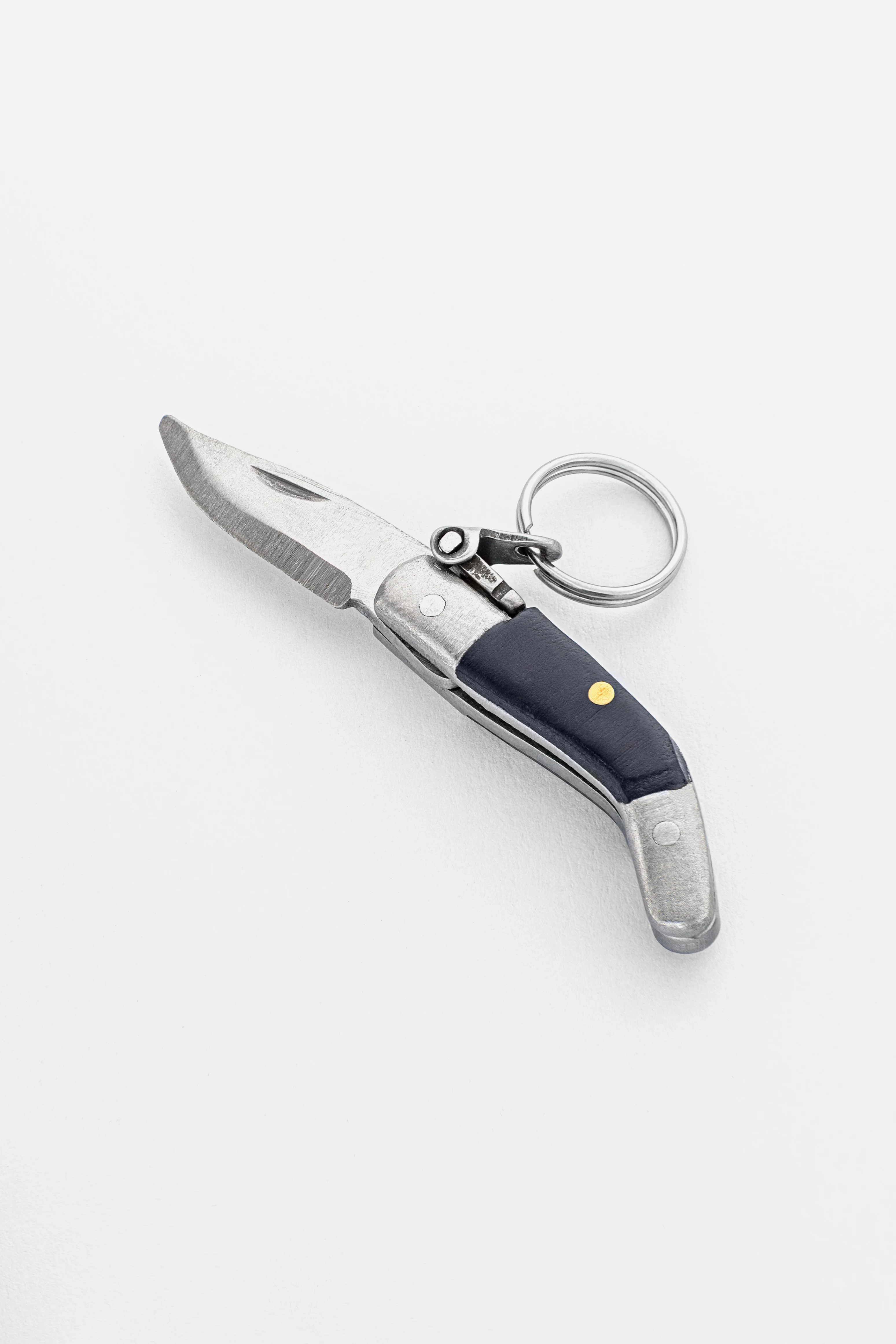
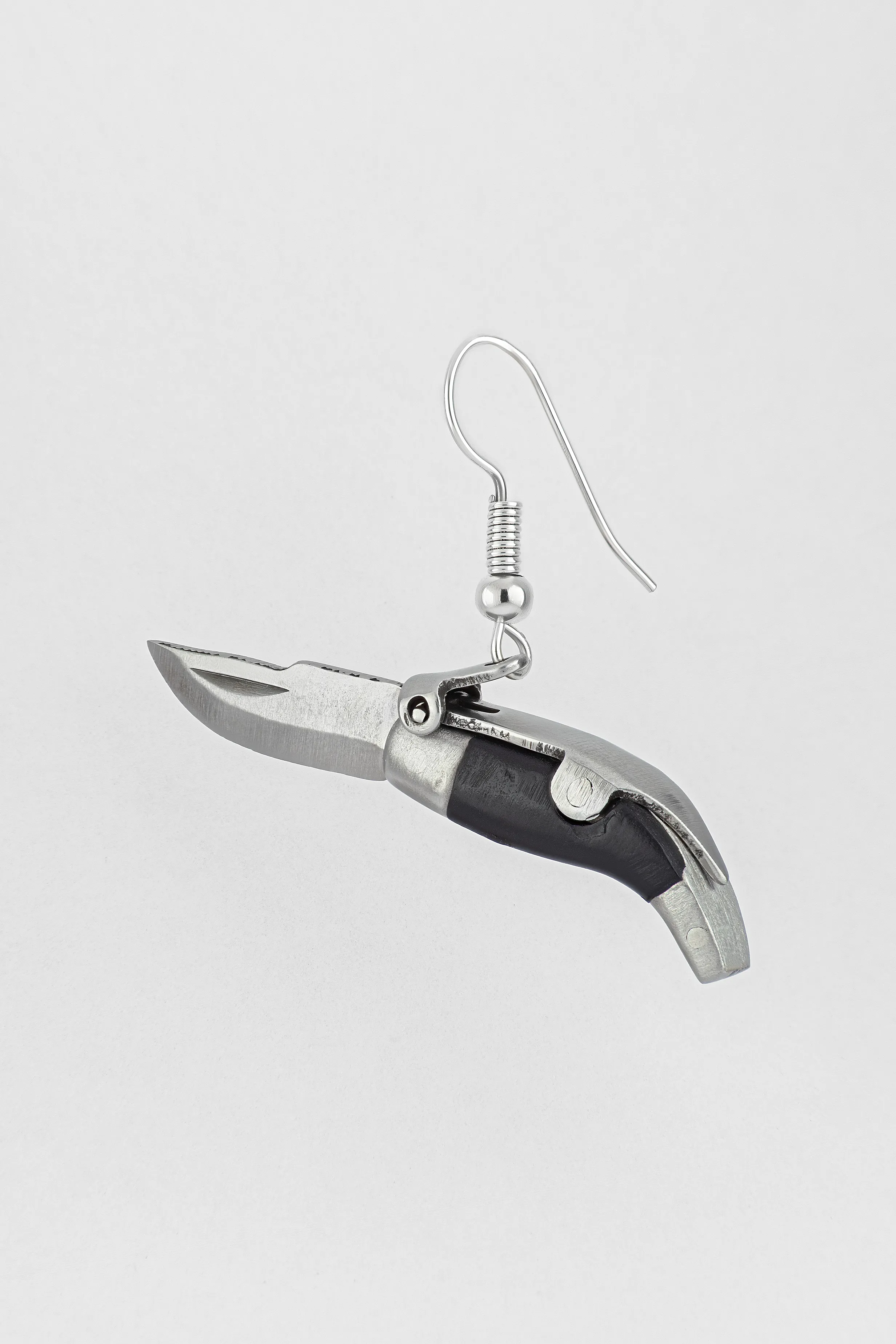
Artisan-crafted CAPAORA navaja pendant
A 40 mm stainless-steel navaja with a real folding mechanism and Palanquilla lock. An affordable gift to remember.
A code for blog readers:
10% off your first order
Authentic · Maker's guarantee · Ships from Spain
Pentagram vs. Pentacle: What Is the Difference
The two terms are often used interchangeably, but they have distinct technical meanings.
A pentagram is the five-pointed star figure itself, created by five intersecting lines. It can be point up or point down, plain or elaborate, with or without a surrounding circle.
A pentacle is a pentagram enclosed within a circle. The circle transforms the meaning: it creates a boundary, unifies the five elements, and converts the radiating star into a contained symbol. In Wicca the pentacle is specifically the name for the altar tool, often a flat disc of wood, stone, or metal with the pentagram-in-circle inscribed on it.
In jewellery, a pendant with an outer ring enclosing the pentagram is technically a pentacle. Many pieces sold as "pentagram pendants" are in fact pentacles. The distinction matters more in Wiccan practice than in everyday usage, but it is worth knowing if you are choosing a piece with intentional meaning.
The pentacle's circle also changes the visual weight: the enclosed version reads as more contained and formal, while the bare star reads as more open and dynamic. Both have strong traditions in jewellery.
In older ceremonial magic, the word "pentacle" was used more broadly for any consecrated disc or plate inscribed with symbols, not necessarily a pentagram. The modern equation of pentacle with pentagram-in-circle is a Wiccan convention that has become dominant in popular usage. When you see the term on a piece of jewellery, it almost always refers to the star-in-circle form.
The Five Elements in Depth
The assignment of five natural forces to the five points of the star is one of the most persistent ideas in the symbol's history, though the specific elements assigned have varied between traditions.
Western/Wiccan system: Earth, Water, Fire, Air, and Spirit (Aether). Spirit occupies the top point, making the upright pentagram a symbol of spirit presiding over matter. This is the standard system in contemporary Wicca and most Western magical practice.
Classical Greek system: Earth, Water, Fire, Air, and Aether, corresponding roughly but with different ritual resonances.
Chinese five-element system (Wu Xing): Wood, Fire, Earth, Metal, Water. The five-pointed star appears in Chinese cosmology in a different but parallel tradition of five-fold natural classification. The geometric coincidence has occasionally led to cross-cultural comparisons, though the two traditions developed independently.
Ayurvedic system: Earth, Water, Fire, Air, and Ether (Akasha). Again five elements, again an independent tradition that arrives at the same number.
The recurrence of five-element systems across unrelated cultures is striking enough that historians of science have discussed it. The five visible planets known to ancient observers (Mercury, Venus, Mars, Jupiter, Saturn), the five fingers of the hand, the five senses: the number five has long served as a natural grouping for phenomena that resist being reduced to four.
In jewellery, each of the five points can be assigned a specific gemstone: amethyst or clear quartz for Spirit, aquamarine or blue topaz for Water, carnelian or garnet for Fire, peridot or malachite for Earth, citrine or yellow topite for Air. A pentagram pendant set with five different stones, each at a specific point, becomes a miniature cosmological diagram as well as a piece of wearable jewellery.
The choice of stone also affects the weight and visual balance of the piece. If you want a pentagram that reads clearly as a pentagram, smaller stones at each point work better than large ones: large stones can visually break the star's geometry. Round cabochons sit cleanly in the angles; faceted stones catch more light and add movement.
Leave your email, we'll send your discount code. No spam, unsubscribe anytime.
The code arrives by email, valid on your first order.
In Jewellery: Style and Combinations
The Pendant
The most common form. A diameter of 1.5-3 cm works for daily wear without drawing excessive attention. A larger pendant of 5-7 cm suits a gothic or Wiccan statement. The pentacle (pentagram in a circle) is the most immediately recognisable form in a Wiccan context.
The choice between a bare star and a circle-enclosed pentacle is partly aesthetic and partly cultural signal. Among people familiar with Wicca, the pentacle reads as a religious symbol; the bare star reads as more ambiguous. In gothic contexts, the bare star or the inverted form tend to dominate. In fine jewellery contexts, a minimalist linear star in silver or gold reads primarily as geometric.
Chain length affects how a pentagram pendant reads. At 40-45 cm the pendant sits at the collarbone and is clearly visible. At 50-60 cm it falls lower, partially concealed by a shirt's open collar. At 70 cm or longer, combined with a layered look, it becomes part of a deliberate stacking aesthetic. The chain weight should match the pendant: a heavy pendant on a fine chain looks awkward and puts strain on the link at the bail.
The Signet Ring
An engraved pentagram on a flat seal surface. Less visually prominent than a pendant, functions in a professional context. A shallow relief reads as more understated than a raised three-dimensional star. The signet ring format also connects to the historical use of the symbol as a seal: Pythagorean members used the pentagram as a mark of recognition, and ceremonial rings with the pentagram were common in occult practice from the Renaissance onward.
Earrings
Paired stud earrings with a pentagram of 1-1.5 cm read as a geometric motif in most contexts. Both pieces worn point up. Drop earrings with a pentagram carry a more explicitly mystical register.
Asymmetric pairs are a current trend: one ear carries the pentagram stud, the other a crescent moon or a small rune. This works because neither piece is competing for attention, and the combination creates a visual language without requiring an explanation.
Bracelet Charm
A pentagram as a charm on a chain bracelet. Combines well with other mystical pendants: moon phases, crystal, feather, small bottle charm.
Stylistic Variants
- Minimalist linear fine outline with no fill, contemporary geometric look
- Enamel-filled Wiccan tradition, solid colour (black, deep blue, forest green)
- Engraved and oxidised gothic, aged look, vintage-mystical character
- With gemstones amethyst (spirituality), moonstone (lunar, intuition), obsidian (protection)
Combinations
- Pentagram and moon phases classic witch aesthetic, lunar and stellar symbolism
- Pentagram and feather nature magic, kitchen-witch register
- Pentagram and small bottle pendant alchemical aesthetic
- Pentagram and crystal working with intention, practical magic
Craftsmanship: What Makes a Good Pentagram Piece
The pentagram is a geometrically demanding motif to execute well in metal. The five intersecting lines must be precisely proportioned: if any one of the ten interior angles deviates, the star looks irregular. In mass-produced cast pieces, this is often visible as a slightly lopsided star or uneven point lengths. In a hand-cut or hand-engraved piece, each line is drawn individually, which requires skill but produces a more consistent result.
Cast pieces are made by pouring molten metal into a mould. Quality varies enormously depending on the mould precision and the finish work. A well-finished cast pentagram in sterling silver can be excellent; a poorly finished one shows pitting, rough surfaces, and imprecise geometry.
Die-struck pieces are stamped from sheet metal under high pressure. This produces very sharp edges and consistent geometry. Die-striking is more expensive than casting but gives crisper results for fine linear designs.
Hand-engraved pieces are cut individually into the metal surface. The lines are not identical in depth or width across the piece, which gives hand-engraved pentagram signet rings their characteristic warmth. The small variations in line are a sign of human craft, not a flaw.
Oxidised silver requires deliberate treatment: the metalsmith applies a liver-of-sulphur solution to the surface, which darkens it, then polishes back the high points to create contrast between the dark recesses and bright ridges. On a pentagram with its many intersecting recessed lines, this treatment creates strong visual contrast and a genuinely antique look.
When a pentagram is set with gemstones at the five points, the setting type matters. Prong settings hold the stone in place with small claws and let in maximum light, but the prongs at the angles of a pentagram can snag. Bezel settings wrap the stone in a rim of metal, which protects the stone and reduces snagging but blocks more light. For daily-wear pieces, bezel settings at the points of a pentagram are more practical.
Who Wears a Pentagram
Wiccans and neopagans. The primary religious symbol of their practice.
Those interested in esotericism. A general occult symbol without commitment to any one tradition.
Gothic aesthetic enthusiasts. A defining motif of gothic style.
Tattoo culture fans. The pentagram is among the most common tattoo designs; jewellery works as companion or alternative.
Online witch-community followers. A mainstream spiritual symbol of the 2020s.
Christians with historical awareness. The pentagram was a traditional emblem of the Five Wounds for centuries; some wear it consciously in that reading.
Mathematicians and scientists. The geometric beauty is its own justification.
Medieval literature enthusiasts. Sir Gawain's symbol of the five knightly virtues.
Occultists in the British tradition. From the Pythagorean roots through the Golden Dawn and Aleister Crowley's ceremonial work before 1947, the pentagram has a documented place in British esoteric practice.
Those with an academic interest in symbolism. Few symbols have as long and as well-documented a history of layered interpretation.
Fans of German folk culture. The Drudenfuss is a legitimate piece of German cultural heritage, referenced in Goethe and rooted in centuries of folk practice.
People who grew up with the symbol. For a generation raised on online witch communities, fantasy literature, and games like Dungeons and Dragons, the pentagram is simply part of a visual vocabulary, as familiar and as neutral as a compass rose. For this group, the symbol requires no justification: it has always been geometric and interesting.
Addressing Common Misconceptions
"The pentagram is a satanic symbol." Point upward, it never was. Point downward, it became associated with the Church of Satan specifically in 1966, and with Eliphas Levi's Baphomet illustration from 1856, which Levi himself described as a symbol of balance rather than evil. Before 1856, the orientation distinction did not carry any systematised meaning.
"Wearing a pentagram means you worship the devil." The assumption collapses under any historical examination. Pythagorean mathematicians wore it as a proof of mathematical order. Medieval Christians wore it as a symbol of Christ's wounds. Wiccan practitioners wear it as a symbol of nature and the five elements. Gothic enthusiasts wear it for aesthetic reasons. None of these is devil worship.
"The pentagram was never used in Christianity." It was, extensively, from the early medieval period onward, including in church architecture and manuscript illumination. The shift from positive Christian symbol to feared occult sign occurred gradually across the fifteenth through eighteenth centuries, driven partly by the Reformation's suspicion of visual symbolism and partly by folk-magic associations that accumulated over time.
"Inverted means the same as upright, just rotated." In contemporary culture they carry very different associations, specifically because of Levi's 1856 codification and LaVey's 1966 adoption of the inverted form. Outside those specific contexts, the orientation difference is less loaded.
"You must be in a specific tradition to wear a pentagram." The symbol's history predates every living tradition by millennia. The Sumerians did not belong to Wicca. The Pythagoreans did not belong to the Golden Dawn. Medieval Christians who used the pentagram were not occultists. The symbol belongs to human history, not to any one group.
Materials and Care
Materials
- 925 sterling silver the most authentic choice for both Wiccan and gothic aesthetics. Takes oxidation treatment well.
- Gold-plated silver warmer tone, contemporary interpretation of the symbol.
- Oxidised silver deliberately darkened surface, aged look, the classic gothic choice.
- Blackened steel industrial roughness, suited to heavy gothic pieces.
- 14-18K gold luxurious reading of the symbol, neutral in relation to any specific tradition.
Care
Jewellery with a pentagram, especially pieces with thin intersecting lines, collects dust and cosmetic residue in the angles. A soft toothbrush with mild soapy water cleans hard-to-reach areas easily. For oxidised pieces, avoid ultrasonic cleaning: it strips the patina. Polish only the raised outer surfaces; the recessed areas are best kept dark for contrast.
If a piece has set gemstones at the five points, check the settings periodically: the star geometry means the prongs or bezels are at angles that can catch on fabric and loosen over time. A jeweller can re-tighten settings easily.
Sterling silver will tarnish with time, especially in humid environments or with frequent contact with skin. Light tarnish on a plain silver pentagram polishes off easily with a silver cloth. On an oxidised piece, polishing should be restricted to the raised surfaces only: rubbing a cloth over the entire surface removes the patina from the recesses.
For gold-plated pieces, avoid abrasive polishing entirely: it wears through the plating layer. Clean with a damp cloth only.
Point up, always. Wear it inverted only if you fancy explaining yourself all night.
How to Wear a Pentagram
Dozens of looks with the star have passed through my hands, from nearly invisible to openly gothic. Here is what actually works, by occasion.
How do I wear a pentagram every day? For daily wear I recommend a fine linear pendant of 1.5-2 cm on a 45-50 cm chain over a plain tee, a roll-neck or a linen shirt. Silver settles quietly on grey, olive, burgundy and black. Under a V-neck the star lands right in the open triangle at the collarbone, its best position. Under a round neckline I suggest a slightly longer chain so the pendant rests on the fabric instead of fighting the collar.
Is a pentagram appropriate at the office? It is, if you turn the mysticism into pure geometry. I recommend an engraved signet ring or tiny studs around 1 cm: the symbol reads as a clean motif rather than a statement. If you want a pendant, choose a thin unfilled star and keep it under a shirt or in a shallow neckline. A large gothic piece I would leave at home for meetings.
How do I build an evening look? For the evening I choose a larger pendant of 4-6 cm or a stone-set pentacle over a black dress or a silk blouse with an open neckline. Oxidised silver adds drama to dark fabrics, polished gold plays on velvet and satin. On a long 60-70 cm chain the star drops beautifully into a layered set of fine chains of different lengths.
How do I wear a pentagram for a gothic or witch look? This is where the symbol comes into its own. I build a stack: pentagram plus a moon phase plus a crystal or a feather. I mix metals only at one temperature, all cool silver or all warm gold. Drop earrings with a star raise the register, but I keep one bold accent and let the rest stay in the background.
Who suits a pentagram at all? Anyone who likes objects with meaning rather than a pile of shine. Two rules that never fail. First, choose the length to fit the neckline, not the other way round, the star should land in the open zone. Second, hang a heavy star on a solid chain and a fine linear one on a delicate chain. One strong symbol always reads truer than five pendants in a heap.

Turn on your camera, pick earrings, a pendant or a ring, and see the piece on yourself in real time.
Switch items in one tap.
Everything runs in your browser: no photo or video is ever uploaded.
Send a friend a discount code, they save on their first order.
FAQ
Is the pentagram a satanic symbol?
Only the inverted form, and only in modern popular culture from the 1960s onward. The classical pentagram, point upward, is Pythagorean geometry, a Wiccan symbol, and an early Christian emblem of the Five Wounds. Five thousand years of history against roughly fifty years of Satanist association.
Why do people react negatively?
Horror films and media coverage of the "culture wars" of the late twentieth century cemented the satanic association in popular consciousness. It does not reflect the broader historical record.
Can a Christian wear a pentagram?
It is a genuinely complex theological question. Historically, yes: the pentagram was used as a Christian symbol for centuries. Today it depends on community and denomination. Catholic and Orthodox parishes are generally opposed. Protestant positions vary widely.
What is a pentacle?
A pentagram enclosed within a circle. The defining Wiccan symbol. The circle represents unity and the protective boundary of ritual space. In a jewellery context, the pentacle is the most recognisable form for Wiccan practitioners.
What is the difference between a pentagram and a pentacle?
The pentagram is the star. The pentacle is the star inside a circle. Technically distinct; often used interchangeably in everyday speech and commercial jewellery.
Is the meaning the same in jewellery as in a tattoo?
The symbolism is identical. A tattoo is permanent; jewellery is removable. Many people wear both.
How do you respond if someone associates your pentagram with darkness?
Briefly and without apology: "It is a Sumerian symbol five thousand years old. The Satanist connection dates to 1966." Most people will not pursue the conversation further. You are not obliged to justify your jewellery.
Can you wear a pentagram in a Catholic context?
In an openly visible form, questions may arise. A small piece worn under clothing is essentially invisible. Historically the pentagram was used as a Christian symbol, but that observation does not always persuade in contemporary parish settings.
What size works for daily wear?
For a pendant, 1.5-2.5 cm. Larger pieces attract more attention; smaller ones are less legible at a distance. For stud earrings, 1-1.5 cm.
What material suits a gothic look best?
Oxidised silver with natural patina. Blackened steel for an industrial edge. Plain polished silver belongs more to Wicca than to gothic.
What is an appropriate price range?
A small silver pendant sits in the accessible segment. A statement piece with gemstones moves into mid-premium. An artisan piece with significant stonework reaches premium.
Is a pentagram suitable for a teenager?
It depends on family context and school environment. In a conservative setting, a small piece worn under clothing avoids conflict. Where the social context is accepting, wearing it openly is straightforward.
Is an inverted pentagram always satanic?
In the specific context of the Church of Satan, yes. Outside that context it may be purely decorative or carry another historical meaning entirely. The broader guide to jewellery symbols places the pentagram alongside other widely worn motifs.
Why does the pentagram use five points specifically?
Five is both geometrically special and culturally resonant. It is the smallest number of points that allows a star figure to be drawn with one unbroken line that returns to its starting point. Mathematically the figure encodes the golden ratio in every segment. Culturally, five maps onto the senses, the elements in multiple ancient systems, the fingers of one hand, and numerous other fundamental categories. The coincidence of the mathematical property and the cultural resonance contributed to its adoption across so many unrelated traditions.
How do you explain the pentagram to others?
Briefly: "It is an ancient symbol of the five elements" or "Pythagorean geometry." Most people do not pursue the conversation further. Lengthy explanations are rarely necessary.
Does the size of the star matter symbolically?
No. Size affects visibility and statement-level, not symbolic content. A 1.5 cm pendant and a 6 cm pendant carry the same historical meaning; they differ in how loudly they announce it.
Can you mix a pentagram with non-esoteric jewellery?
There is no rule against it. A pentagram pendant alongside plain gold hoops, or a pentagram ring with a simple band, works in contemporary jewellery styling. The esoteric meaning is yours to assign or ignore; the geometric form reads as attractive regardless.
What chain length works best with a pentagram pendant?
A standard 45 cm chain places the pendant at the collarbone, which is the most visible position. A 50-55 cm chain drops it to the upper chest, which reads as more casual. Longer chains work in layered looks. The chain weight should be proportional to the pendant: a heavy star on a fine chain is both visually awkward and structurally risky.
Conclusion
The pentagram is one of the most contested symbols in contemporary culture. Its rehabilitation is gradual: those raised on online witch communities read it as Wiccan; an older generation reads it as satanic; the historically informed read it as Pythagorean geometry, a chivalric emblem from medieval English poetry, a cornerstone of British esoteric tradition, and an anthropocosmic diagram from the European Renaissance.
In jewellery the pentagram works on several registers. A minimalist pendant suits those drawn to the spiritual without wanting to announce it. A large statement piece suits an openly gothic or Wiccan wearer. With amethyst or moonstone at the points it speaks to elemental work. With a circle enclosing it, it becomes the pentacle and the language shifts to Wiccan.
Whatever your neighbours think, the pentagram is a symmetrical geometric figure with a five-thousand-year history. The interpretation is yours.
About Zevira
Zevira is based in Albacete, Spain. The pentagram is part of our mystical and gothic collection, where it sits alongside other symbols of elemental and esoteric traditions.
What you can find at Zevira with the pentagram motif:
- Wiccan pentacles (pentagram in a circle)
- Gothic pentagrams in oxidised silver for dark aesthetics
- Minimalist geometric five-pointed stars
- Pentagrams with a gemstone at each point (five elements)
- Pentagram pieces with amethyst or moonstone
- Pentagram rings in silver with oxidised finish
Each piece is made by hand, with the option of personal engraving. We work in 925 sterling silver and 14-18K gold.