Aegishjalmur: The Helm of Awe and the Dragon Who Wore It
A symbol that started with a dragon and ended up on your forehead
There's a symbol that shows up in Norse mythology before almost any other magical stave. Not in a 19th-century manuscript. Not in a folk collection. In the sagas themselves, spoken by a dragon lying on a pile of cursed gold.
Fafnir, the great wyrm of the Volsunga Saga, declares that he wore the Aegishjalmur, the "Helm of Awe," and that no living thing could stand against him while he bore it. This isn't a later addition or a scholar's footnote. It's embedded in one of the oldest and most important narrative cycles in Norse literature.
That makes the Aegishjalmur unusual among Icelandic magical staves. Most of them, including the popular Vegvisir, appear only in post-medieval manuscripts. The Aegishjalmur has roots that reach back into the Eddas and the heroic sagas. It belongs to the deep layer of Norse belief, the layer where gods and monsters use magic as naturally as warriors use swords.
But here's what makes the symbol genuinely interesting: it wasn't just mythological. Norse warriors adopted it as practical battle magic. They painted it on their foreheads. They carved it into helmets. They believed it could make enemies freeze with terror. And centuries later, Icelandic magicians wrote down instructions for how to use it, preserving a tradition that may stretch from the Viking Age into the early modern period without a clean break.
This article traces that full arc. From Fafnir's hoard to the Galdrabok grimoire, from battlefield foreheads to modern pendants. What the Aegishjalmur actually meant, how it differs from the Vegvisir (they are NOT the same thing), and what it means to wear a symbol of terror as a statement of inner strength.
What the Aegishjalmur Actually Is
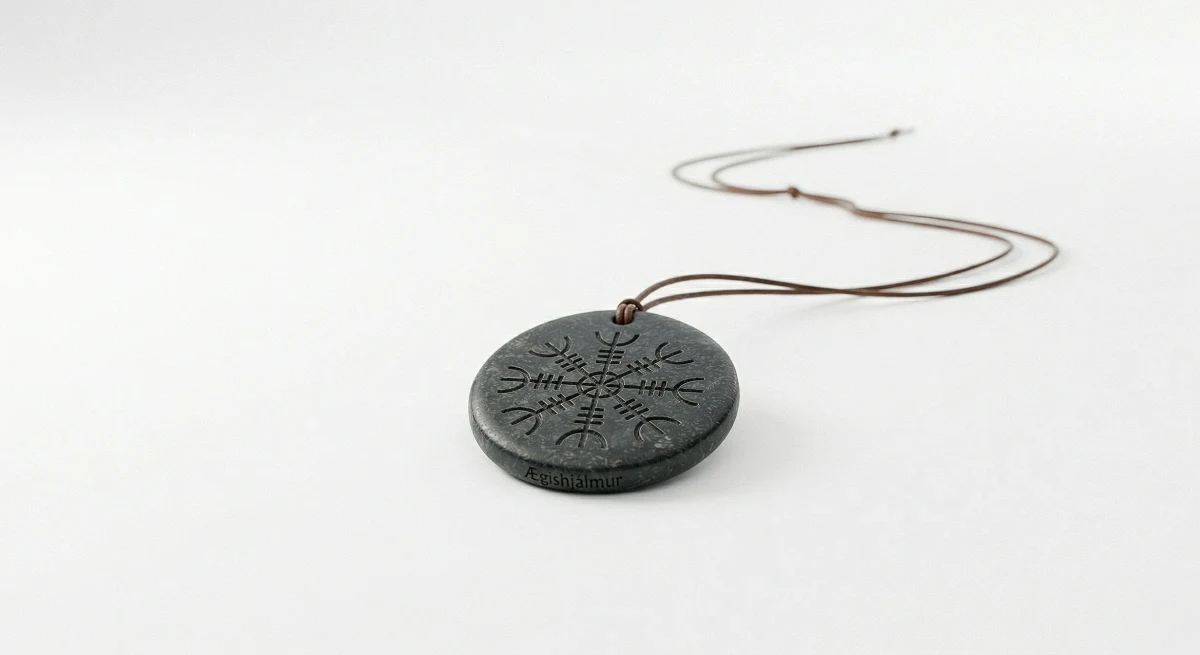
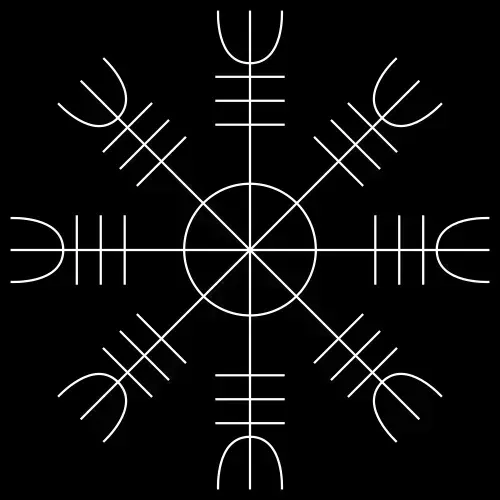
The Aegishjalmur (pronounced roughly "EYE-gis-HYOWL-mur," though even Icelanders debate the exact stress) is a magical stave consisting of eight identical arms radiating from a central point. Each arm ends in the same trident-like fork, often with additional perpendicular lines crossing the arms near the centre.
The visual key: Eight IDENTICAL arms. This is the critical difference from the Vegvisir, which has eight DIFFERENT arms. The Aegishjalmur's perfect symmetry is central to its meaning. It radiates outward equally in all directions, creating a field of influence that covers everything around the bearer. There is no front or back, no stronger side or weaker side. The protection is total.
What it is:
- A magical stave from Icelandic Galdrastafir tradition
- Referenced in the Poetic Edda and the Volsunga Saga (medieval sources, not just post-medieval)
- Present in the Galdrabok (c. 1600 CE), one of Iceland's most important grimoires
- A symbol of invincibility, terror projection, and protection
What it is not:
- It is not a rune. No runic characters are used in its construction.
- It is not a physical helmet. The "helm" is metaphorical: a covering of magical protection.
- It is not the same as the Vegvisir. Similar family, completely different function.
- It is not primarily about navigation. It's about power.
The eight-armed radial design places it firmly in the Icelandic stave tradition, alongside dozens of other galdrastafir. But unlike most of its cousins, the Aegishjalmur has a pedigree that stretches back into the saga age. That matters, because it gives the symbol a weight and authenticity that few magical staves can claim.
Wear the symbol, don't just read about it. These are in stock:
Fafnir and the Volsunga Saga: Where It All Begins
The dragon's claim
The Volsunga Saga is one of the central texts of Norse heroic literature, telling the story of the Volsung dynasty through generations of glory, betrayal, and doom. It's the source material for Wagner's Ring Cycle, for Tolkien's dragon Smaug, and for much of the popular imagination about Norse heroes.
In this saga, Fafnir is a dwarf who murders his father Hreidmar to seize a hoard of cursed gold (originally extorted from the gods as compensation for the killing of Fafnir's brother Otr). Consumed by greed and paranoia, Fafnir transforms into a dragon and lies upon his treasure in a desolate heath, guarding it against all comers.
When the hero Sigurd (Siegfried in the German tradition) approaches to slay him, Fafnir speaks. Among the things he says is this: "I wore the Aegishjalmur against all men, after I lay upon my brother's inheritance. And I blew poison in every direction around me, so that no one dared come near me."
The Aegishjalmur, in Fafnir's telling, is not a symbol drawn on parchment. It's something he "wore," something that made him untouchable. The combination of the helm and his venomous breath created a zone of absolute terror. No one approached. No one dared.
Sigurd and the stolen helm
Sigurd kills Fafnir by hiding in a pit along the dragon's path and stabbing upward into its belly. After the dragon dies, Sigurd takes the treasure, and the Aegishjalmur is specifically listed among the items he claims.
This detail matters. The Aegishjalmur is treated as a physical object in the saga, something that can be taken from one bearer and used by another. It's part of the dragon's hoard, alongside gold, weapons, and other precious things. Whether the saga's audience understood it as a literal helmet, an amulet, or a magical pattern is debated by scholars. But the point is clear: the Aegishjalmur is a thing of power, transferable, and worth keeping.
Sigurd later gives the Aegishjalmur to his wife Gudrun's mother, Grimhild, which ties the symbol into the broader web of cursed treasures that drives the saga's tragic second half. Everything Fafnir touched carries doom.
What the saga tells us about the symbol
The Volsunga Saga establishes several things about the Aegishjalmur that persist through all later traditions:
It is about terror. Fafnir doesn't say it made him stronger or faster. He says no one dared come near him. The helm works on the mind of the enemy, not the body of the wearer.
It is associated with dragons. The most famous bearer of the Aegishjalmur is a dragon, not a god or a human hero. This gives the symbol a reptilian, hoarding, guarding quality.
It can be transferred. It's not an innate power. It's an object or technique that can be learned, taken, and used by others.
It belongs to the cursed treasure cycle. The Aegishjalmur is part of Andvari's cursed gold, which means it carries a narrative warning: power comes with a price.
These themes show up in every later use of the symbol, from Viking battlefield practice to modern tattoo culture.
Customer reviews
Zevira is a real jewellery shop. Genuine payments, deliveries and customer thank-yous.
🥰🥰🥰 gracias
Ok, ¡gracias! 🙂
The Word Itself: Aegis, Hjalmur, and What They Mean
Aegis: terror and awe
The first element, "aegis" (Old Norse "aegir" or "oegir"), relates to concepts of awe, terror, and overwhelming power. It shares a root with the word "agi" (terror) and is connected to the name Aegir, the Norse god/giant of the sea, whose very name suggests something awe-inspiring and dangerous.
The English word "awe" descends from the same Germanic root. Originally, awe didn't mean "wonder" or "admiration" the way it often does today. It meant fear. Reverential fear. The kind of fear you feel before something so much larger and more powerful than yourself that your body's first response is to freeze.
This is exactly what the Aegishjalmur is supposed to produce: not admiration, but the freezing, paralysing kind of awe that stops an enemy in their tracks.
Hjalmur: helm, covering, concealment
"Hjalmur" means helm or helmet in Old Norse. But the Norse concept of "helm" is broader than a piece of metal you put on your head. It carries connotations of covering, concealment, and protection. A helm hides you. It creates a boundary between you and the world.
In magical context, the "helm" of the Aegishjalmur is understood as an invisible covering, a field of magical influence that surrounds the bearer. It's not physical armour. It's the magical equivalent of an aura, a projection of power that others can feel before they can see.
This is why the symbol was painted on the forehead rather than worn as a helmet. The "helm" IS the painted symbol. Your forehead becomes the seat of your projected power, and the Aegishjalmur radiating outward from the spot between your eyes sends its influence in all directions.
A helm you wear on your mind
Putting these elements together: the Aegishjalmur is the "helm of terror," a covering of awe, a magical projection that makes the bearer terrifying and untouchable.
It's worth noting how psychological this is. The Aegishjalmur doesn't claim to make your sword sharper or your armour harder. It works on perception. It changes how others see you. In modern psychological terms, we might call it a confidence amplifier, something that shifts the power dynamic in a confrontation by projecting absolute certainty.
Norse warriors understood something that modern psychology has confirmed: confrontation outcomes are often determined before the first blow. The fighter who believes they will lose has already lost. The Aegishjalmur was a tool for winning that pre-fight psychological battle.
The Historical Record: Viking Age Symbol or Early-Modern Stave?
This is the question that honest discussion of the Aegishjalmur requires, because the answer is more complicated than popular culture suggests.
What the literary sources actually say
The Aegishjalmur's mention in the Volsunga Saga and the Poetic Edda is real, and it is genuinely old. These texts were written down in Iceland during the 13th century, drawing on oral traditions that are older still. The Volsunga Saga is generally dated to around 1270 CE. The Poetic Edda, compiled in the 13th century, contains the "Fafnismal" poem in which Fafnir speaks of the helm.
This means the Aegishjalmur is attested in medieval literary sources as a concept, a type of magical protection associated with dragons and battlefield invincibility. That part is legitimate.
What we do not have
What does not exist is an actual archaeological artefact showing the Aegishjalmur's geometric form from the Viking Age. The specific eight-armed stave design that people recognise today, with its radial trident forks, is not found carved on Viking-era runestones, helmet fragments, or metalwork recovered by archaeologists.
The earliest visual representation of the stave in its recognisable form appears in the Galdrabok, an Icelandic grimoire dated to approximately 1600 CE. That is roughly 600 years after the end of the Viking Age (conventionally set at 1066 CE). The Galdrabok itself is a product of post-Reformation Iceland, a time of complex religious tensions between official Christianity and persistent folk magic traditions.
The broader Icelandic stave manuscript tradition
The Galdrabok is the best-known source, but it is not the only one. Several other 17th-century Icelandic manuscripts contain versions of the Aegishjalmur, including the Lbs 4375 8vo manuscript and various collections now held in the Royal Library in Copenhagen. These multiple independent attestations confirm that by 1600 the stave was a recognised and circulating magical diagram, not a one-off inscription in a single curious text.
What the manuscripts show, when compared against each other, is that the design was reproduced with recognisable consistency across different hands and sources. The eight identical arms, the trident terminals, the proportional geometry: these appear across multiple manuscripts, which suggests the stave had a stable visual tradition behind it, however old that tradition actually was.
Scholars of Icelandic magic, including Stephen Mitchell and Terry Gunnell, have pointed out that the transition from oral and practical magical knowledge to written grimoire was gradual, and that written codification does not necessarily mark the origin of a practice. What the Galdrabok records in ink may reflect a working tradition that had existed in practical use for generations. We simply cannot document how long.
Why this matters without diminishing the symbol
Acknowledging this gap is not a reason to dismiss the Aegishjalmur. The medieval literary tradition clearly preserves a concept of powerful protective magic associated with terror projection. The Galdrabok tradition represents the written codification of practices that may genuinely have older roots, even if we cannot document the exact visual form.
Many deeply significant cultural symbols went through similar processes: the symbol is referenced in ancient sources, the specific visual form crystallises later in manuscript tradition, and both the ancient concept and the later form carry authentic cultural weight.
What changes with this knowledge is how you understand what you are wearing. The Aegishjalmur pendant represents a 13th-century saga concept made tangible through 17th-century Icelandic magical tradition. That is still a remarkably deep lineage for any symbol, and it is an honest one.

Turn on your camera, pick earrings, a pendant or a ring, and see the piece on yourself in real time.
Switch items in one tap.
Everything runs in your browser: no photo or video is ever uploaded.
The Geometry of the Stave
Understanding the Aegishjalmur's visual structure explains why it works as a symbol of total protection.
The eight-fold radial form
Eight is not an arbitrary number. In Norse cosmology, the world tree Yggdrasil connects nine worlds, and the cardinal and intercardinal directions structure much of Norse spatial thinking. An eight-armed stave covers every compass direction simultaneously: north, south, east, west, and the four diagonals. There are no gaps in the coverage. No direction from which something can approach without encountering the symbol's influence.
This completeness is what separates the Aegishjalmur from a simple protective charm. It is not a talisman that protects you from one threat or one direction. It is a system of total coverage.
The trident terminals
Each arm of the Aegishjalmur ends in a trident-fork pattern, three lines diverging from the arm's terminal point. Some versions add additional perpendicular cross-lines closer to the centre, creating a more complex radiating structure.
The trident terminals serve two purposes visually. First, they create the impression of radiating force rather than static lines. The eye follows the arms outward to their tips and perceives them reaching further, extending beyond the physical drawing into the surrounding space. Second, the three-part terminal can be read as stabilising each arm in three planes, creating a three-dimensional effect even in a two-dimensional drawing.
Proportional construction
In traditional Galdrabok stave construction, the arms of the Aegishjalmur are equal in length and spacing. The eight arms divide the circle perfectly into equal sectors of 45 degrees. This geometric precision is not decorative; it is functional. Any inequality in arm length or spacing would break the visual logic of total coverage. The symbol communicates through its structure, and the structure only communicates correctly when it is geometrically exact.
This is why quality of execution matters for an Aegishjalmur pendant or ring. A poorly cast piece with arms of unequal length loses the core meaning of the symbol. The precision is the point.
Variations in the manuscript tradition
Across the Icelandic manuscripts, the Aegishjalmur appears in slightly different forms. Some versions show arms with only the basic trident fork at the tip. Others add additional branches closer to the hub, creating a more elaborate radial pattern. Some manuscript versions include a circle drawn around the entire stave; others do not.
These variations are not corruptions. They reflect a living tradition in which practitioners adapted the design to their needs and abilities. What remains constant in every version is the eight-fold symmetry and the radial outward projection. Those two elements, equal arms and centrifugal direction, are the symbol's non-negotiable core.
Artisan-crafted CAPAORA navaja pendant
A 40 mm stainless-steel navaja with a real folding mechanism and Palanquilla lock. An affordable gift to remember.
A code for blog readers:
10% off your first order
Authentic · Maker's guarantee · Ships from Spain
Norse Warriors and the Helm of Awe
Painted on foreheads before battle
The most commonly reported use of the Aegishjalmur among Norse warriors was painting or pressing it onto the forehead before battle. The forehead was chosen deliberately: it's the most visible part of a face approaching you in combat, and in Norse magical thinking, the area between the eyes was considered the seat of projected will.
Sources describe warriors using charcoal, blood, or lead to mark the symbol on their skin. Some accounts mention pressing a small carved amulet against the forehead with the symbol facing outward, leaving an impression. The goal was the same in every case: project the Aegishjalmur toward the enemy so they would feel its effects before combat began.
This practice connects to the broader Norse concept of "sjonhverfing," the magical art of altering what others see. A warrior with the Aegishjalmur on their forehead wasn't just wearing a symbol. They were performing an act of magic, attempting to alter the enemy's perception and drain their courage.
Carved into helmets and shields
Beyond skin application, the Aegishjalmur was carved or scratched into physical objects associated with combat. Helmets were an obvious choice given the name, but shields, sword pommels, and even ships' prows are mentioned in various sources.
The logic follows the same pattern: the symbol radiates outward, and any surface facing the enemy becomes a potential carrier. A shield with the Aegishjalmur carved into its face projects terror while also protecting the bearer. A ship's prow carrying the symbol would, in theory, terrify approaching vessels.
This overlaps with the well-documented Viking practice of mounting dragon heads on ship prows, which served the same dual purpose: intimidation and magical protection. Icelandic law actually required ships to remove their dragon heads when approaching friendly ports, to avoid frightening the land spirits. The Aegishjalmur operates on the same principle: your appearance IS your weapon.
The psychology of warrior magic
Modern readers might dismiss this as superstition, but consider the context. In an era before standardised armies, professional training, and reliable equipment, the psychological dimension of combat was everything. Viking-age battles often involved small groups of men who knew each other, fighting at close quarters with hand weapons. In that context, anything that gave you a psychological edge was a genuine tactical advantage.
A warrior who believed the Aegishjalmur made him invincible fought differently. More aggressively. More confidently. With less hesitation. And an enemy who saw the symbol and believed in its power fought more cautiously, more fearfully, more defensively. The belief on both sides created the reality.
This isn't unique to Norse culture. Roman soldiers painted their shields with terrifying imagery. Samurai wore demon-faced helmets. Maori warriors performed the haka. The Aegishjalmur belongs to a universal human tradition of weaponising appearance and belief in combat.
The Galdrabok: Where the Aegishjalmur Lives on Paper
The grimoire and its contents
The Galdrabok (Book of Magic) is the single most important Icelandic grimoire, dating to approximately 1600 CE. It's a collection of 47 spells and magical staves, written in a mix of Icelandic, Latin, and runic characters. The manuscript is now held in the Arni Magnusson Institute in Reykjavik.
What makes the Galdrabok significant for the Aegishjalmur story is that the symbol APPEARS in this text. This is a crucial distinction from the Vegvisir, which does NOT appear in the Galdrabok. The Vegvisir's earliest known appearance is the Huld Manuscript of 1860. The Aegishjalmur predates that by roughly 260 years in written magical tradition, and by several more centuries in literary tradition (the Volsunga Saga).
The Galdrabok contains spells for a wide range of purposes: attracting women, defeating enemies, protecting livestock, causing illness, and gaining the favour of powerful people. It mixes Christian invocations with pagan elements, reflecting the complex religious landscape of post-Reformation Iceland, where Christianity was official but folk magic retained deep pagan roots.
The Aegishjalmur instructions
The Galdrabok's version of the Aegishjalmur comes with actual instructions for use, unlike the Volsunga Saga's more narrative presentation. The text describes making the symbol using lead, pressing it against the forehead, and speaking specific words (a combination of runic invocations and Christian prayers, reflecting the syncretic nature of the grimoire).
The instructions specify that the symbol should be worn when meeting an enemy or when facing someone you need to intimidate. It's not exclusively military. The Galdrabok's audience was farmers, traders, and ordinary Icelanders, not professional warriors. By 1600, the Viking Age was long over, but the need to project authority and overcome opponents hadn't gone away. It had just moved from the battlefield to the courtroom, the marketplace, and the neighbour's fence line.
This evolution is important. The Aegishjalmur went from dragon magic to warrior magic to everyday magic. The core function never changed: make others fear you, make yourself untouchable. But the context widened from mortal combat to any confrontation where you needed the upper hand.
The Galdrabok in context: what kind of document it actually is
It's worth understanding the Galdrabok not just as a list of magic spells but as a historical document about how folk belief actually functioned in early-modern Iceland. The manuscript was compiled by at least three different hands, suggesting it was a collaborative or copied document rather than a single practitioner's private notebook. It was designed to be consulted and used.
The mix of Christian prayer and pagan stave in a single instruction is not contradiction or confusion. It is pragmatic syncretism: the people who used this book lived in a Christian society and probably attended church, but they also believed that the older magical techniques had practical value. The Aegishjalmur in the Galdrabok is embedded in this everyday compromise between official religion and practical folk magic, which tells us something important about how ordinary Icelanders actually related to these symbols.
Icelandic stave tradition and persecution
The Galdrabok and its cousin manuscripts exist because Icelandic magical practice was widespread enough to be written down, shared, and copied. But this very visibility made it dangerous.
During the Icelandic witch trials of the 17th century (1654-1690), at least 20 people were burned at the stake for practicing galdur (magic). Unusually for European witch trials, most of the Icelandic victims were men. Possession of grimoire pages, knowledge of magical staves, or simply a reputation for knowing galdur could get you killed.
The Aegishjalmur and symbols like it weren't quaint cultural artefacts. They were evidence in murder trials. The Icelandic church and Danish colonial authorities viewed them as genuine threats to Christian order. People died for drawing these symbols, carrying these symbols, and teaching others how to use them.
This persecution is part of the Aegishjalmur's story. The symbol survived because people valued it enough to risk their lives to preserve it. That tells you something about how seriously they took its power.
Leave your email, we'll send your discount code. No spam, unsubscribe anytime.
The code arrives by email, valid on your first order.
Aegishjalmur vs Vegvisir: Same Family, Different Purpose

These two symbols get confused constantly. They shouldn't. They look similar at first glance, both being eight-armed radial designs from the Icelandic magical stave tradition. But they differ in nearly every way that matters.
Visual difference: The Aegishjalmur has eight IDENTICAL arms, each ending in the same trident-fork pattern. The Vegvisir has eight DIFFERENT arms, each with a unique terminal design. If all the arms look the same, it's an Aegishjalmur. If they're all different, it's a Vegvisir.
Historical depth: The Aegishjalmur appears in the Eddas and sagas (medieval literary sources), in the Galdrabok (c. 1600), and in the Huld Manuscript (1860). The Vegvisir appears only in the Huld Manuscript (1860). The Aegishjalmur has dramatically older and deeper attestation.
Purpose: The Aegishjalmur is about POWER. Terror. Invincibility. Making enemies freeze. The Vegvisir is about GUIDANCE. Finding your way. Not getting lost. One is a weapon. The other is a compass (metaphorically speaking).
How it was used: The Aegishjalmur was painted on the forehead or carved into combat equipment. The Vegvisir was carried on the person (in a pocket, on a piece of paper, as an amulet). The Aegishjalmur faces outward toward the enemy. The Vegvisir works inward, on the bearer.
Mythological roots: The Aegishjalmur is claimed by a dragon in one of the most important Norse sagas. The Vegvisir has no mythological associations at all.
What they share: Both belong to the Icelandic Galdrastafir tradition. Both are eight-armed radial designs. Both were taken seriously enough that people risked death to use them. Both have become massively popular in modern tattoo and jewellery culture.
Knowing the difference matters. If you want a symbol of finding your way, that's the Vegvisir. If you want a symbol of standing your ground and being unconquerable, that's the Aegishjalmur. They're siblings, not twins.
For a deep dive into the Vegvisir's story, history, and the Huld Manuscript that contains it, read our complete Vegvisir guide.
Modern Interpretation: From Battle Magic to Inner Strength
Overcoming fear
The Aegishjalmur's original purpose was to project terror outward. But modern wearers have largely flipped the direction. Today, the symbol is more often interpreted as protection against one's own fears than as a weapon against external enemies.
This shift makes psychological sense. Most people in 2026 don't face literal combat. But they face job interviews that feel like battles. Medical diagnoses that freeze them with terror. Social situations where they feel overwhelmed. The internal experience of fear is the same whether you're facing a Viking with an axe or an MRI machine. The Aegishjalmur's promise, that you can become untouchable, that nothing can get through your defences, resonates in both contexts.
The eight identical arms radiating outward become a visual metaphor for equanimity: equal strength in all directions, no blind spots, no weak sides. It's a mandala of resilience.
The symbol in tattoo and jewellery culture
The Aegishjalmur's geometric perfection makes it one of the most visually striking Norse symbols. Its eight-fold symmetry reads clearly at any scale, from a full chest piece to a small pendant. Tattoo artists appreciate its clean lines and the opportunities for customisation (adding runes around the circumference, integrating it into larger Norse compositions, varying the arm terminals).
In jewellery, the Aegishjalmur works particularly well as a round pendant or medallion, where the radial symmetry can be fully expressed. Unlike asymmetric symbols that have a "right way up," the Aegishjalmur looks correct from any angle. This makes it ideal for pendants that rotate on a chain.
The symbol's popularity has grown alongside the broader Norse revival driven by TV shows like Vikings, games like God of War, and the enduring appeal of Norse mythology in metal music, fantasy literature, and tattoo culture. The Aegishjalmur has gone from an obscure Icelandic stave to a globally recognised emblem of strength.
Who wears it and why
People facing difficult situations. The Aegishjalmur's core promise is that nothing can touch you. People going through hard times, health challenges, legal battles, personal crises, often choose it as a talisman of invulnerability.
Strength and fitness enthusiasts. The warrior association is strong. People who train, compete, or push their physical limits connect with the idea of a symbol that makes you unstoppable.
Norse culture devotees. For people serious about Norse mythology and history, the Aegishjalmur's deep roots in the sagas give it a credibility that newer symbols lack. It's "the real thing" in a way that many other popular Norse symbols aren't.
Introverts and quiet people. There's a particular appeal for people who don't project power naturally but want to feel protected. The Aegishjalmur isn't about aggression. It's about creating a boundary that nothing can cross. That resonates strongly with people who feel overwhelmed by the world.
People who pair it with the Vegvisir. Some wear both: the Aegishjalmur for protection and the Vegvisir for guidance. Together, they represent a complete magical toolkit: I am safe, and I will find my way.
Materials, Craft, and What to Look for in a Pendant
The Aegishjalmur's geometric logic has direct implications for how it should be made. The eight identical arms radiating at precisely 45-degree intervals, each with exactly proportioned trident terminals, require crisp execution. The symbol can survive reduction to small sizes, but it cannot survive sloppy casting.
Metal choices
Sterling silver is the traditional choice and the best fit for a symbol with Icelandic roots. Silver carries historical associations with protective magic across many northern European traditions, and its bright finish emphasises the geometric precision of the stave's lines.
Stainless steel and surgical steel are excellent practical choices. They are harder than silver, hold fine engraved lines very well, and resist the darkening that silver develops over time. For someone who wears jewellery constantly and does not want maintenance, steel is the more durable option.
Oxidised silver (deliberately darkened) suits the Aegishjalmur's character particularly well. The dark recesses between the arms throw the radiating structure into sharp relief. The contrast between dark background and bright raised lines reads as visual force.
Brass and bronze carry a warmer, older quality. They work well for pieces that reference the weapon-and-armour context of Norse warrior culture. Over time they develop a patina that some wearers find expressive.
Gold is the least expected material for the Aegishjalmur given its warrior origins, but a gold version has its own logic: Fafnir's hoard was gold, the Aegishjalmur was part of that hoard, and gold carries the curse as much as the protection. For someone who finds meaning in the full story of the symbol, including its dark associations, gold is a legitimate choice.
Surface finish and depth
Beyond the choice of metal, the surface treatment of an Aegishjalmur piece affects how the symbol reads. A flat-engraved piece on a smooth background has a different visual weight than a piece where the arms are cast in raised relief above a recessed field.
Raised relief works better for the Aegishjalmur specifically, because the three-dimensional structure reinforces the radial movement of the design. The arms appear to project outward not just in the plane of the drawing but toward the viewer. The recessed background catches shadow and makes the radiating arms sharper and more assertive.
A flat-engraved piece on a mirror-polished background loses this directional energy. The lines read as incised decoration rather than projecting force. If you're choosing between two otherwise comparable pieces, the relief-cast version will carry the symbol's meaning more effectively.
Size and proportion
The Aegishjalmur reads best when given enough diameter for the trident terminals to be distinct from the central hub. A pendant below roughly 18mm risks losing the detail that makes the symbol visually coherent. Between 22mm and 35mm is the sweet spot for most wearers: large enough to show the structure clearly, small enough to wear without the piece feeling like armour.
Flat pendants work. Slightly raised relief work (where the arms stand above a recessed background) works better, because the shadow adds dimension to the radial structure.
Care
Metal takes care of itself in most cases. Sterling silver will darken at the points where it meets skin regularly. This isn't damage; it's normal oxidation. A soft polishing cloth returns the brightness. Avoid prolonged contact with chlorine (pool water) and harsh cleaning products. The geometric engraving on smaller pieces can trap soap residue; rinse well after bathing.
For pieces that intentionally use oxidised or patinated finishes, keep them away from polishing cloths. The darkness is part of the design.
Send a friend a discount code, they save on their first order.
Wearing the Aegishjalmur: Styling and Gifting
How to style it
The Aegishjalmur's radial symmetry makes it exceptionally versatile:
- Round pendant on chain. The natural format. The eight-fold symmetry works perfectly in a circular frame. Medium to large sizes show the detail best. A compass rose pendant in a Norse-inspired design carries similar energy.
- Layered with other symbolic pieces. The Aegishjalmur pairs naturally with anchor pendants (standing firm), compass pieces (navigation + protection together), and other meaningful men's jewellery.
- Ring. Engraved or cast on a flat signet-style face. The Aegishjalmur works as a ring because its symmetry reads well even at small sizes.
- Combined with the Vegvisir. Wearing both symbols creates a dialogue between protection (Aegishjalmur) and guidance (Vegvisir). Different pieces on different chains, or a single piece incorporating both.
The gift guide
For someone facing a challenge. New job, health issue, legal matter, big exam. The message: "Nothing can touch you. You are untouchable." The Aegishjalmur is the most powerful protective symbol in Norse tradition.
For a warrior type. Someone who trains, competes, or puts themselves on the line physically or professionally. The dragon Fafnir's symbol for someone with a dragon's determination.
For a Norse mythology enthusiast. This is the deep-cut gift. Not the easy-to-google Mjolnir or the trendy Vegvisir, but the symbol with the oldest, richest story. Include a note about Fafnir and the Volsunga Saga.
For someone who needs to feel invincible. Not aggressive. Invincible. The Aegishjalmur's power is defensive, not offensive. It's about becoming untouchable, which is exactly what some people need during the hardest periods of their lives.
Frequently Asked Questions
What does Aegishjalmur mean? "Aegis" relates to awe/terror (sharing a root with the English word "awe"). "Hjalmur" means helm or covering. Together: "Helm of Awe" or "Helm of Terror." It's a magical covering that projects fear and creates invincibility.
Is the Aegishjalmur a Viking symbol? The concept is genuinely old: it appears in the Poetic Edda and the Volsunga Saga, both 13th-century texts drawing on Viking Age oral tradition. However, the specific geometric stave design we recognise today first appears in the Galdrabok around 1600 CE. So: the symbol as a concept is medieval; the visual form we know is early-modern Icelandic. Both layers are authentic, and both are historically interesting.
What's the difference between Aegishjalmur and Vegvisir? Aegishjalmur has eight identical arms and is about power/protection/terror. Vegvisir has eight different arms and is about guidance/wayfinding. The Aegishjalmur has older attestation (Eddas, sagas, Galdrabok). The Vegvisir only appears in the 1860 Huld Manuscript. They look similar but serve completely different purposes. Read our Vegvisir guide for the full comparison.
Did Norse warriors really paint it on their foreheads? Historical and literary sources describe this practice. The Galdrabok (c. 1600) gives specific instructions for pressing the symbol onto the forehead using lead. Saga literature references warriors wearing the symbol into battle. Whether this was widespread common practice or reserved for specific occasions is debated, but the association between the Aegishjalmur and the forehead is well-established.
Is the Aegishjalmur in the Galdrabok? Yes. Unlike the Vegvisir, which does NOT appear in the Galdrabok, the Aegishjalmur is present in this c. 1600 grimoire with specific instructions for use. This is one of the key historical differences between the two symbols.
Are there other manuscripts besides the Galdrabok that contain it? Yes. Several other Icelandic manuscripts from the 17th century contain versions of the Aegishjalmur. Multiple independent attestations in different manuscripts confirm it was a widely circulating design, not a single isolated entry. The Galdrabok is the most famous and accessible source, but not the only one.
Can anyone wear the Aegishjalmur? The Icelandic stave tradition is not a closed cultural practice. There are no restrictions based on heritage, gender, or background. Both men and women were involved in Icelandic magical practice historically. The symbol is widely sold in Iceland and used globally.
What's the best material for an Aegishjalmur pendant? The design's geometric precision requires materials that hold clean lines. Cast metal (steel, silver-toned alloys, brass, sterling silver) works well. The eight identical arms need to be truly identical for the symbol to read correctly, so quality of casting matters. Avoid very small sizes where the trident-fork details might blur.
Should I wear Aegishjalmur or Vegvisir? If you want protection, strength, and the feeling of being unconquerable, choose Aegishjalmur. If you want guidance, navigation through uncertainty, and trust in the journey, choose Vegvisir. Many people eventually own both, wearing each for different situations or moods.
Is the Aegishjalmur a rune? No. The Aegishjalmur belongs to the Galdrastafir tradition, which is distinct from the runic alphabet. Runes are individual characters used for writing and for magic. Galdrastafir are complex composed symbols, often involving multiple lines and geometric structures, that function as unified magical diagrams rather than alphabetic characters.
Why does the Aegishjalmur have exactly eight arms? Eight arms cover all eight compass directions simultaneously: the four cardinals (north, south, east, west) and the four intercardinals (northeast, southeast, southwest, northwest). This means no direction is unprotected. The eight-fold completeness is the geometric expression of total coverage.
Does the design vary between manuscripts? Yes, slightly. Some versions show more complex branching near the hub; others are more spare. A circumscribing circle appears in some versions but not others. What remains constant across all versions is the eight-fold symmetry and the outward-radiating structure. Those two elements are the symbol's non-negotiable core.
Silver and gold jewellery, wedding bands, symbolic pendants, paired sets.
The dragon's inheritance
The Aegishjalmur has been on a long journey. From a dragon's hoard in a saga written when Europe was still medieval, through centuries of warrior practice, into the pages of grimoires that people died for possessing, and finally into the modern world as a pendant on a chain or a tattoo on someone's skin.
Its meaning has evolved, but the core has remained constant: you can become untouchable. Not through armour or weapons or physical force, but through a shift in how you carry yourself and how others perceive you. The dragon Fafnir was untouchable because he projected absolute terror. A modern person wearing the Aegishjalmur isn't projecting terror. They're projecting resolve. The refusal to be broken.
Eight identical arms, radiating outward, covering every direction equally. No blind spots. No weak points. The Helm of Awe isn't a physical object. It never was. It's a state of mind made visible.
Fafnir told Sigurd: "I wore the Aegishjalmur against all men."
Against all men. Not against some men, not against the easy opponents. All of them. That's the promise the symbol carries, not that nothing difficult will happen, but that nothing difficult will break through.
Wear the symbol, don't just read about it. These are in stock:
About Zevira
Zevira makes jewellery by hand in Albacete, Spain. Norse symbols like the Aegishjalmur aren't a trendy print to us. They're geometry with meaning: eight identical arms have to be genuinely identical, and we treat that precision as part of what the symbol says.
What you'll find with us around protective and Norse symbols:
- Pendants with radial staves where the symmetry holds and reads correctly from any angle
- Pieces in oxidised silver, where the dark recesses bring out the relief of the arms
- Hard-wearing steel versions for anyone who keeps a piece on day and night
- Signet rings with the symbol engraved on a flat face
- Paired sets, including the protection-and-guidance combination of two staves worn together
- Silver and gold for those who want a piece built to last for decades
Every piece is handcrafted by a single maker, with the option of personal engraving. Sterling 925 silver and 14-18K gold.