Punta de Espada: The Knife with a Sword's Soul
The sword they could not take away
In 1563, a Spanish blacksmith in Albacete received an order. The customer wanted a folding knife. But not just any knife. He wanted one with the tip of a rapier. The law said commoners could not carry swords. The law said nothing about a knife that looked like one.
That knife was the punta de espada. Four hundred and sixty years later, it still makes the same statement: quiet defiance, wrapped in steel.
What it is: form between knife and sword
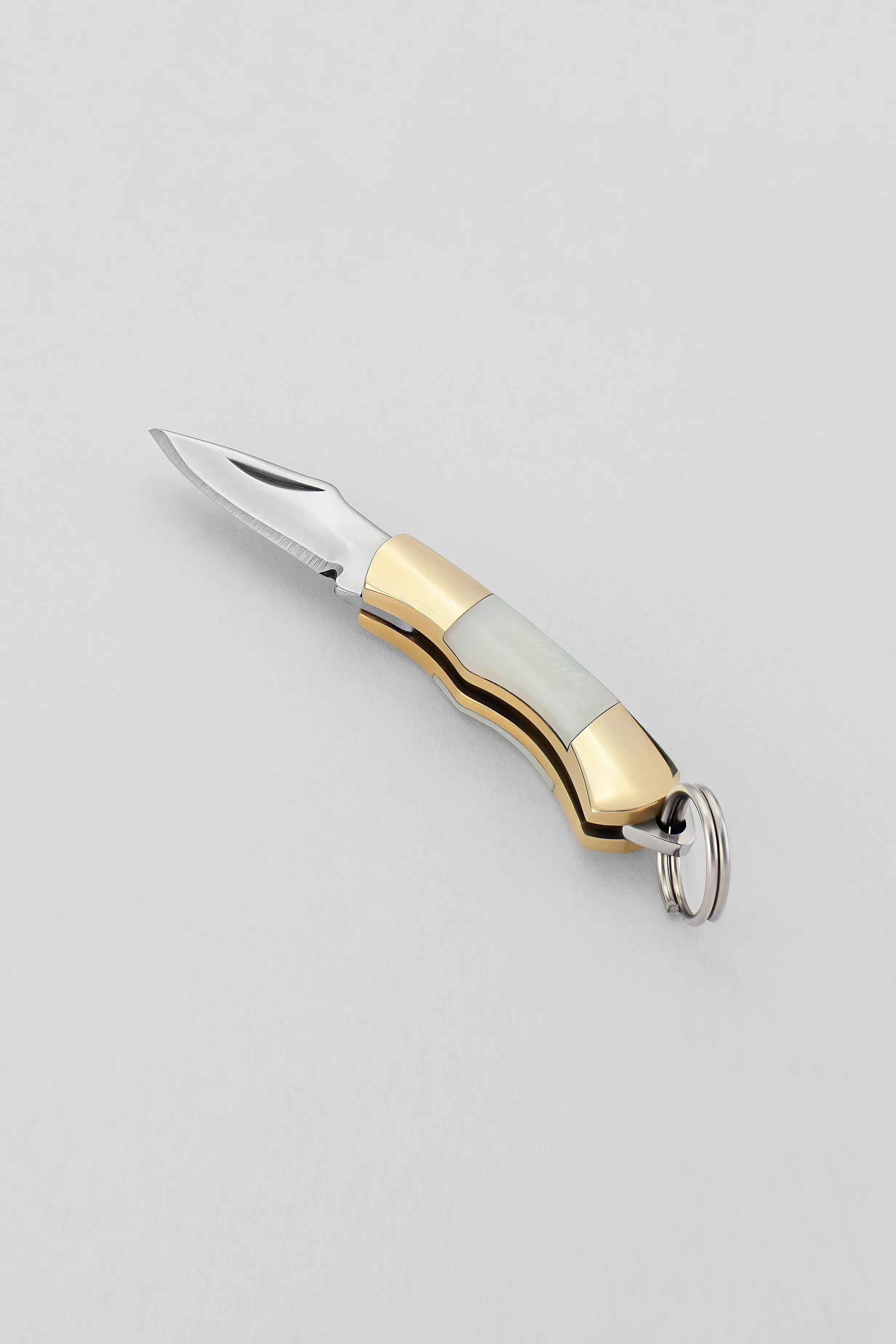
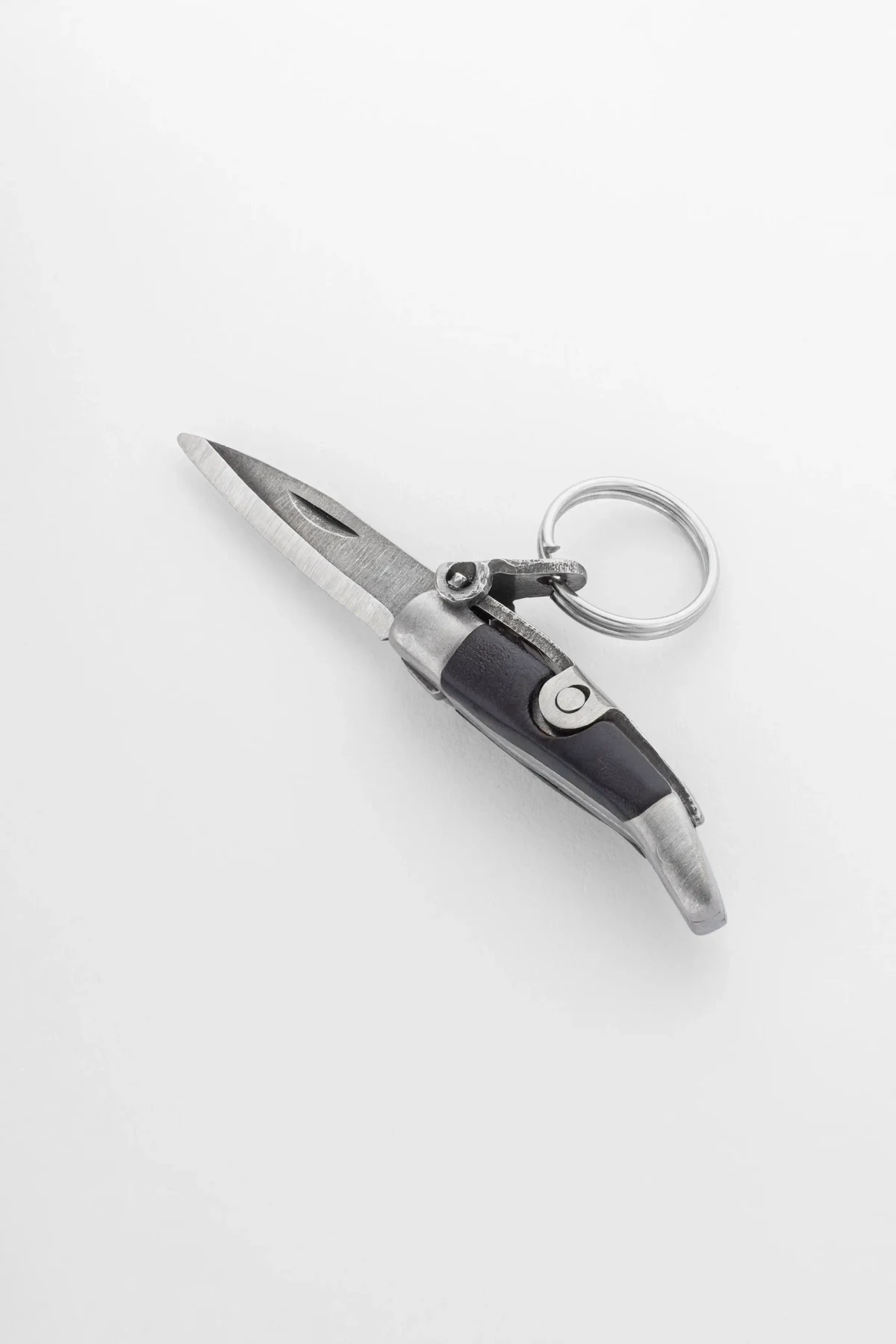
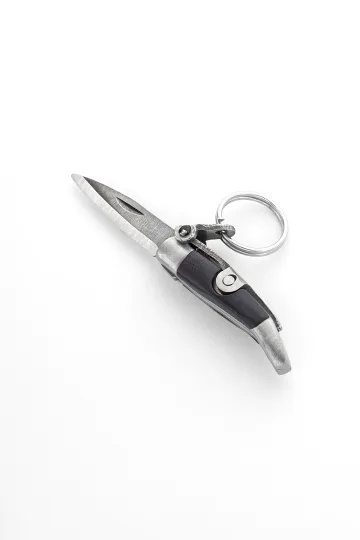
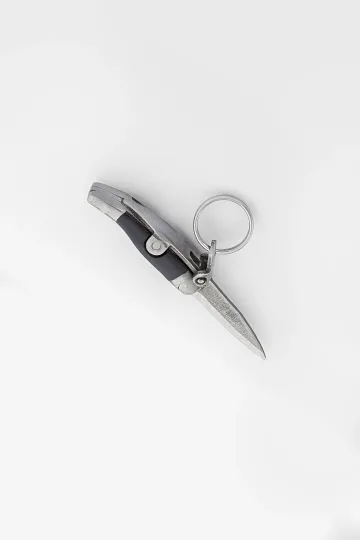
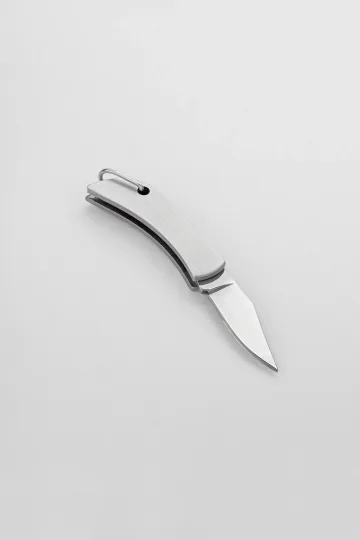
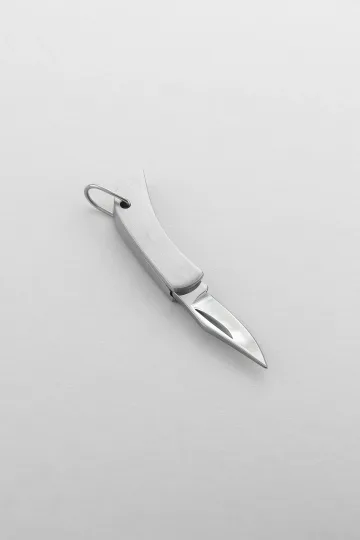
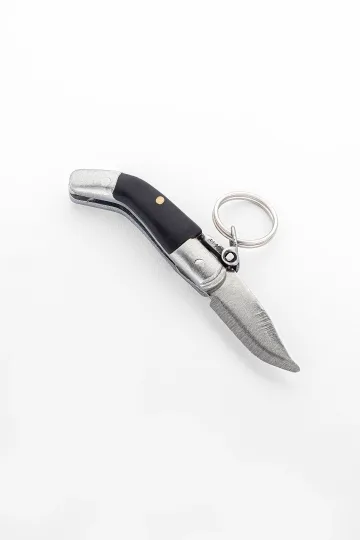
The punta de espada is distinguished from other navajas by one detail: the blade tip. Where the jerezana has a clip point and the capaora a wide chopping blade, the punta de espada extends forward symmetrically, like a rapier. No slope, no curve. A straight line ending in a point.
The blade is long and narrow, with even bevels on both sides. The cross-section is diamond-shaped, like a real rapier: not a flat strip of steel but a three-dimensional form that catches light on two facets simultaneously. Historical blade length ran from 15 to 35 centimetres. The longest specimens were essentially folding swords: a 35 cm blade hiding in a handle of equal length. Open: 70 centimetres of steel. Technically a knife. Practically a sword.
One quality criterion passed down from the old masters: lay the blade flat on an even surface, and it must touch that surface along its full length, no gaps, no warping. Sounds simple. In hand forging, achieving it consistently takes decades.
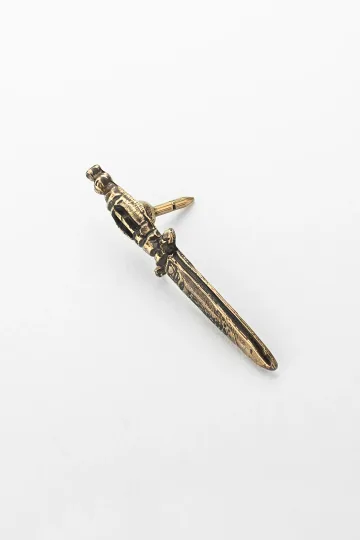
The handle is usually simple, without excessive decoration. Brass inserts, polished horn, minimal ornament. Like a good suit: quality shows in the cut, not the embroidery. On finer specimens, brass inserts along the handle formed a small guard-shaped fitting, a deliberate echo of the rapier's crossguard. No functional necessity, but the symbolic weight was clear: a knife that wanted to be a sword.
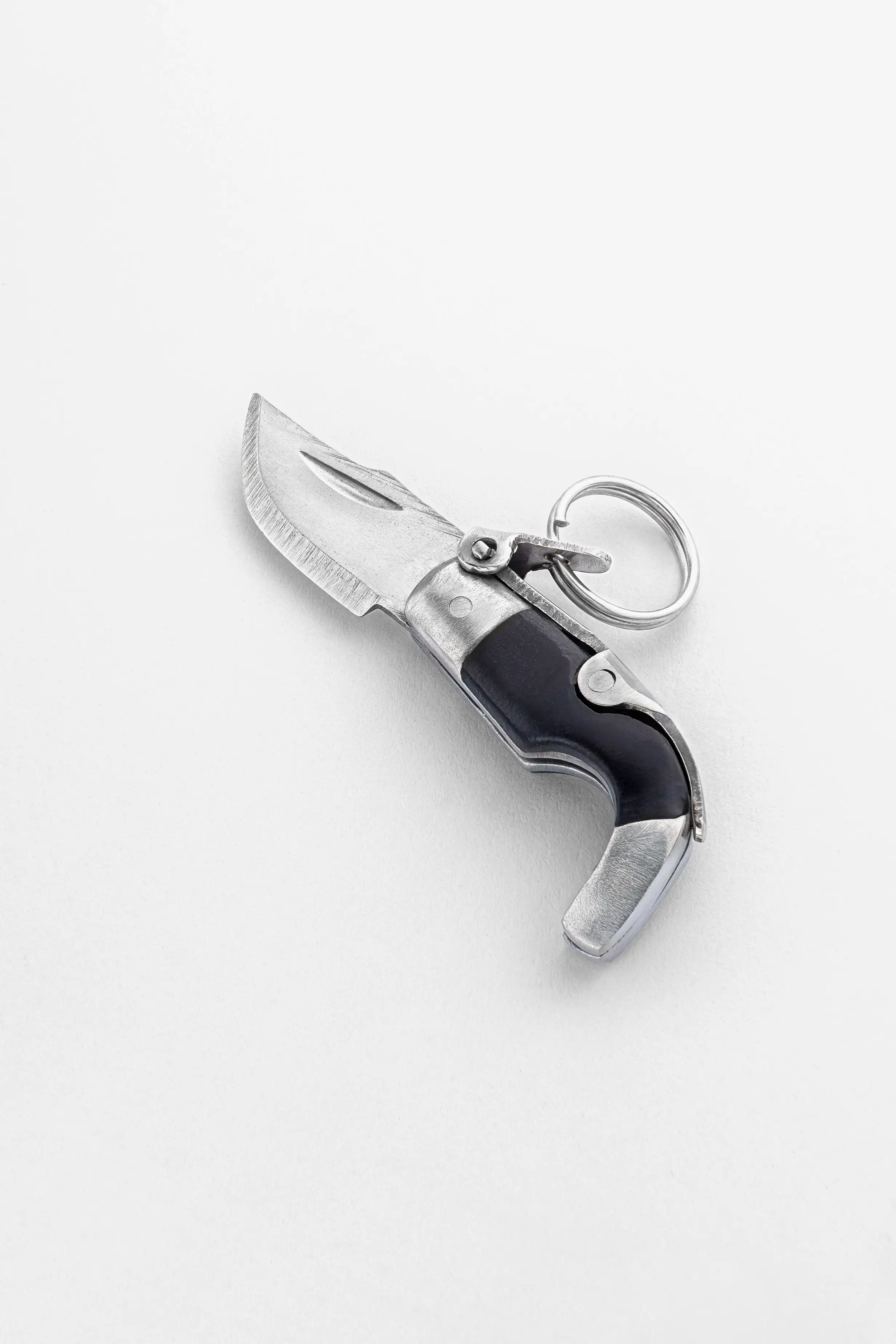
The lock mechanism (carraca) is a spring-loaded ratchet that locks the blade open. You hear it click as the blade passes through each notch. On a well-made punta de espada, the carraca engages with a clean, decisive snap. A loose or rattling mechanism was considered a mark against the maker at the Albacete fair, where collectors and craftsmen knew every sound the mechanism should make.
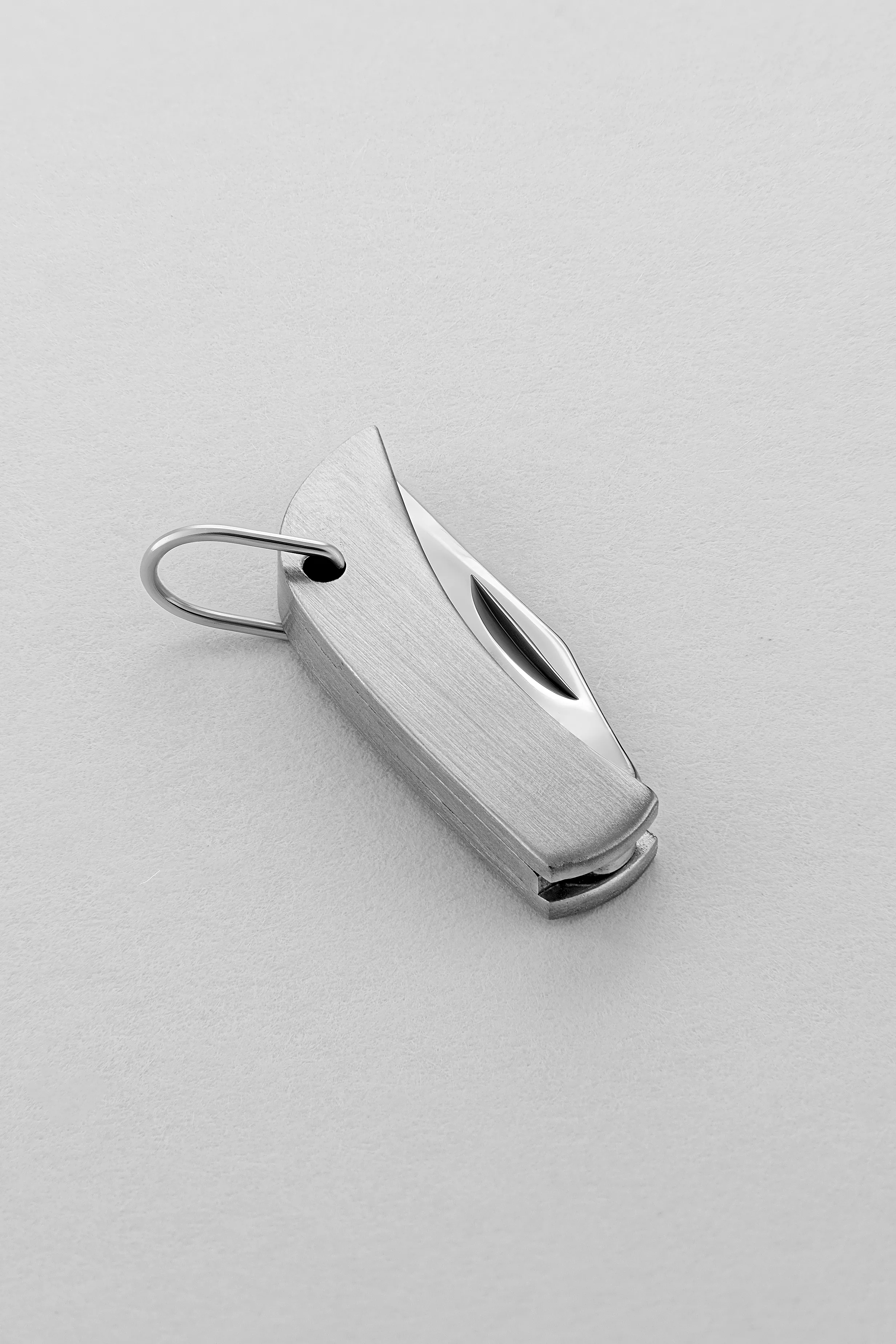
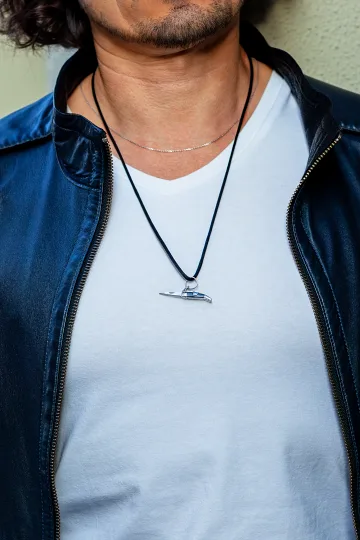
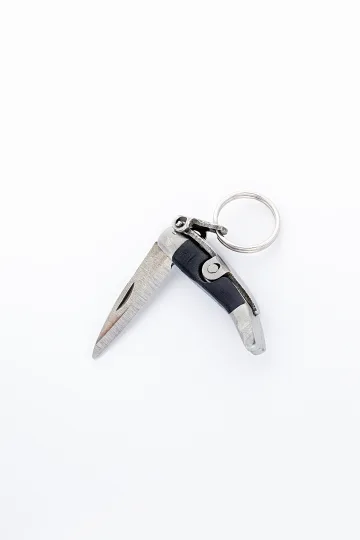
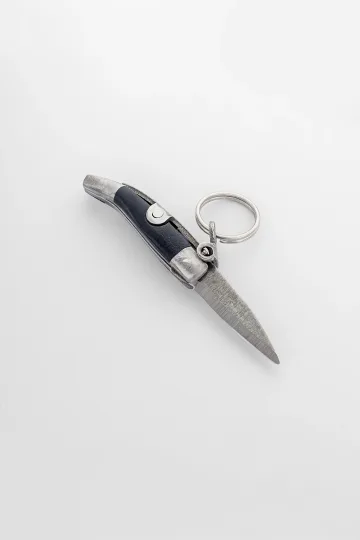
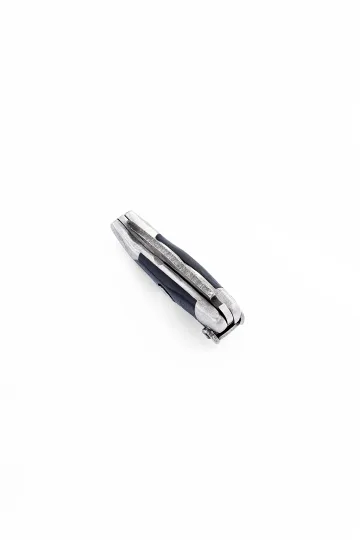
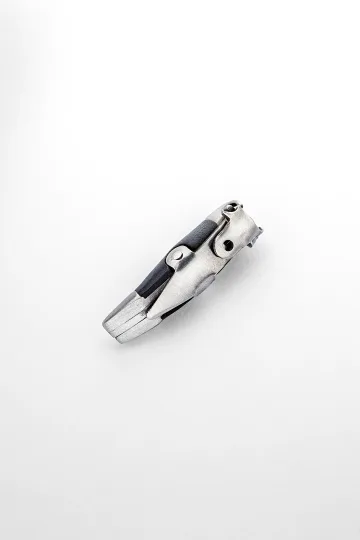
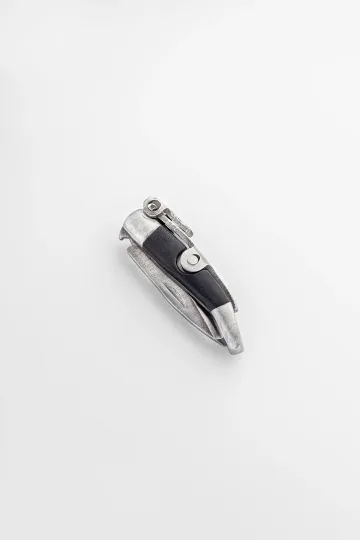
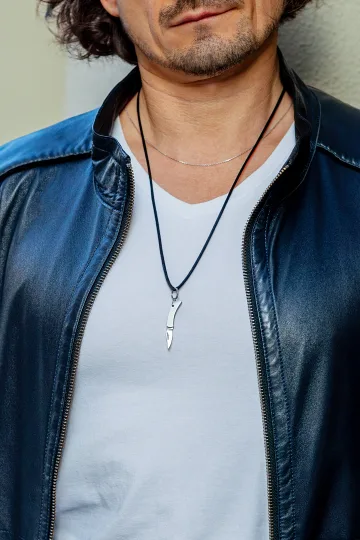
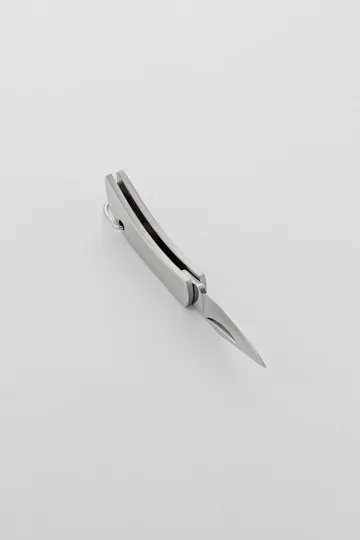
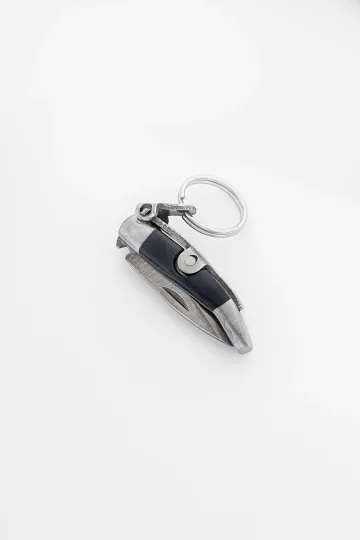
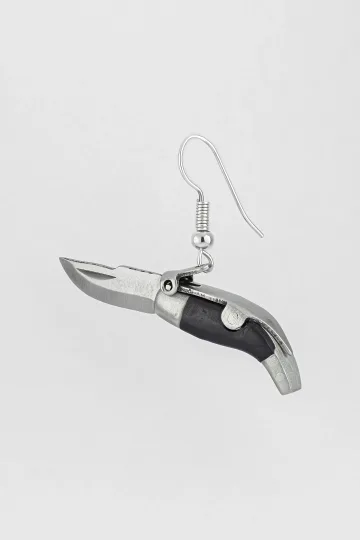
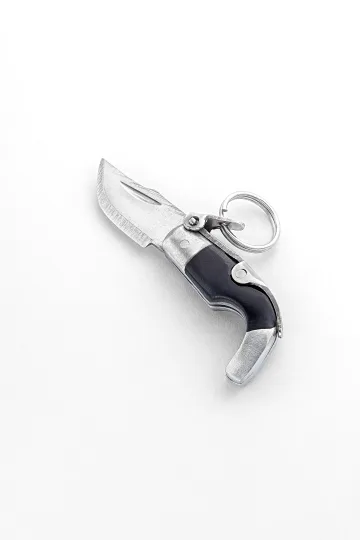
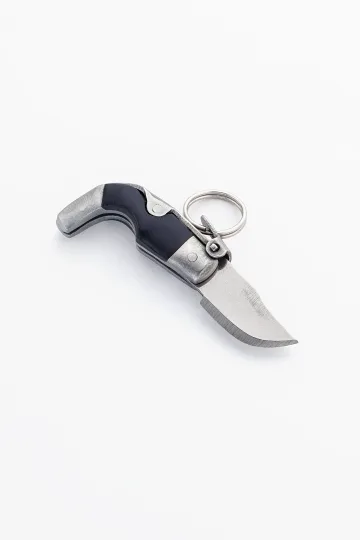
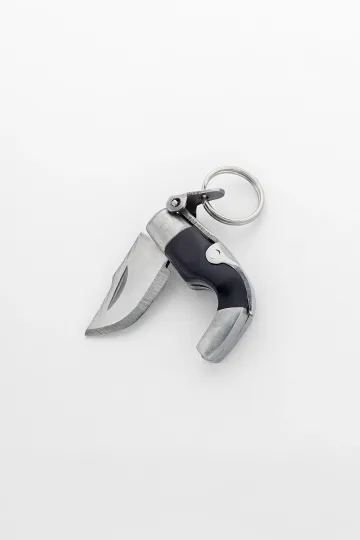
The silhouette in unfolded form genuinely resembles a miniature rapier. Long, thin, purposeful. As a jewellery miniature, about the size of your little finger, this silhouette works especially well: the pendant looks like a small blade suspended by its handle. Even from across the room, you can tell it apart from other navaja types by that forward-reaching point.
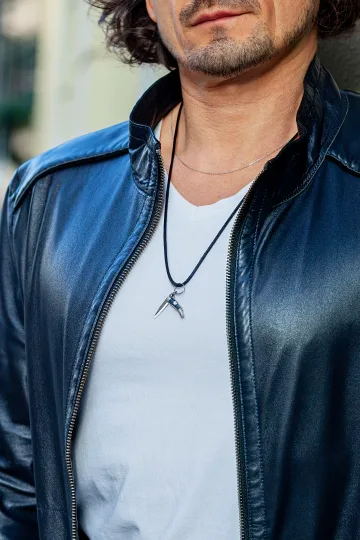
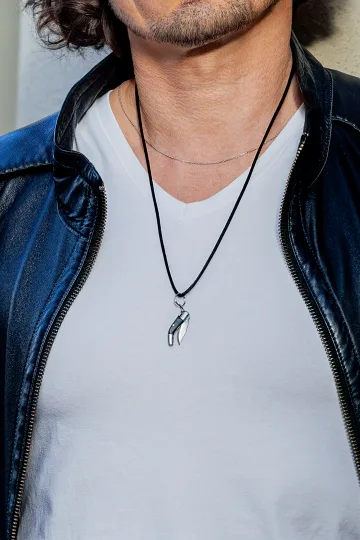
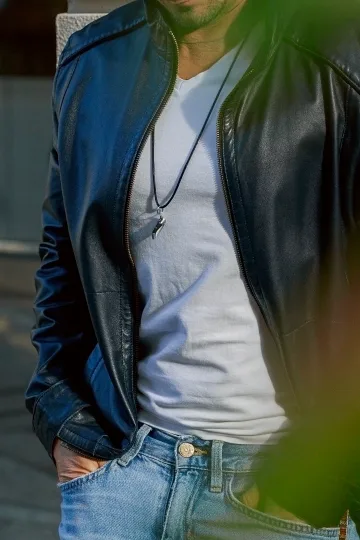
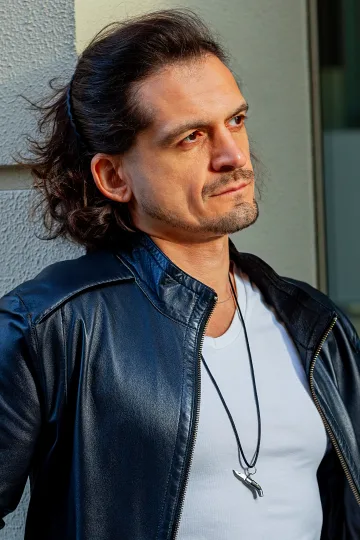
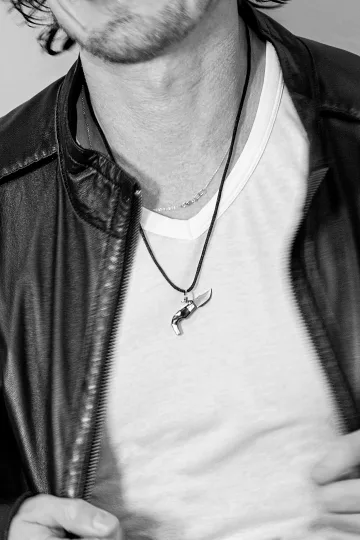
Visualise it on the neck. On a chain, the punta de espada rests against the sternum, its blade pointing down. In the open collar of a white shirt, only the handle peeks out. Walk closer, and the diamond cross-section catches the light. It reads as abstract geometry until someone asks, "What is that?" Then the story begins.
Silver and gold jewellery, wedding bands, symbolic pendants, paired sets.
Who it suits
Minimalists. The cleanest navaja by line. No carving, no flourish. If you own three things and each earns its place, this is your pendant.
Men who do not wear jewellery. Precisely because it does not feel like jewellery. The straight, austere silhouette sits closer to a military medal than a mall pendant. It may be the first thing on a chain that some men agree to wear.
History lovers. This pendant carries a specific story: the 1563 sword ban, resistance through craft, dignity through form. Not an abstract symbol but an artefact with a biography.
Professionals. Lawyers, architects, surgeons. The punta de espada was the knife of urban professionals in 19th-century Spain. That lineage did not break.
Spain lovers. Not the Spain of beaches and paella. The other Spain: La Mancha, Albacete, dusty roads and steel characters.
Couples. Punta de espada and Curva Helada as paired pendants: straight and curved, Castilian and Moorish, austere and flowing.
History: the sword ban and the birth of the navaja
In 1563, Philip II banned commoners from carrying swords. In 16th-century Spain, a sword was a class marker, far more than a blade. With a sword you were a caballero. Without one, a peasant. The law stripped millions of their symbol of dignity.
Smiths answered with the navaja. A folding knife did not fall under the ban. But smiths began making these knives ever longer, ever more refined, ever closer to a sword in form. The punta de espada is the most brazen example of this resistance. The smith literally made a knife that looks like a sword.
This matters for understanding why navajas became jewellery. They were always more than tools. They were statements. And when the navaja shrank to pendant size, it did not lose that function. It simply moved from pocket to neck.
The law and its loopholes
The ban of 1563 was not Philip II's only attempt at control. In the 17th century, authorities tried to limit blade length. In the 18th, certain locking mechanisms were restricted. Each restriction generated a new cycle of craftsman ingenuity. Some punta de espada specimens were made with deliberately shortened blades to pass inspection length limits, while retaining the full diamond cross-section and flawless edge. Shorter, no less formidable.
Social function: the knife as speech
A man who ordered a punta de espada did not just want a knife. He wanted to tell those around him: I deserve a sword, even if the law says otherwise. Execution quality was critical. A crude navaja is a knife. A flawless punta de espada with diamond cross-section and brass "guard" is a declaration of class.
Evolution: 16th to 19th century
Early specimens (16th-17th century) were simpler, prioritising function as weapons. By the 18th century, as the navaja became a status object, specimens appeared with refined geometry: even bevels, clean centre line, perfect symmetry. Smiths competed not on blade length but on precision.
By the 19th century, the punta de espada became the knife of urban professionals: lawyers, doctors, notaries. Too austere for Andalusian flamboyance, too refined for rural roughness. For them it was ideal.
You can see historical specimens at the Museo de la Cuchilleria in Albacete, some executed with such precision they seem machine-made. They are not. Each blade was individually forged.
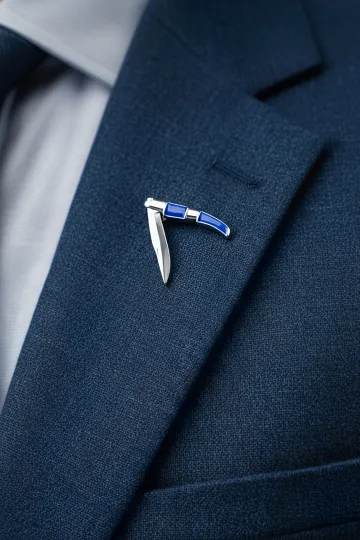
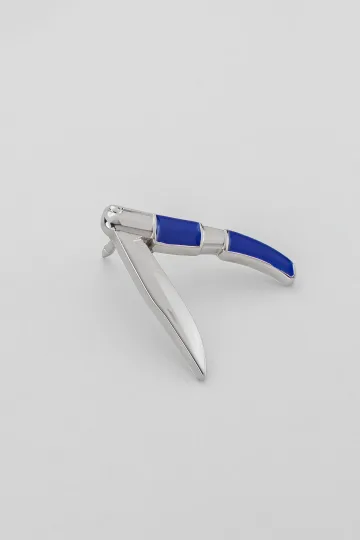
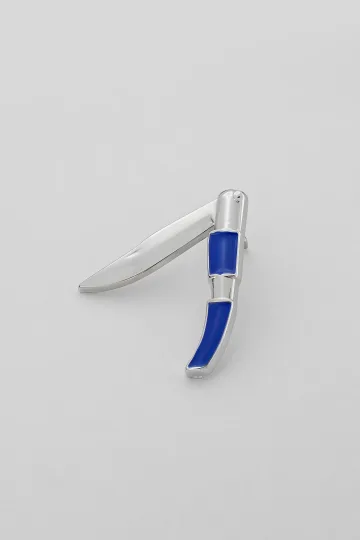
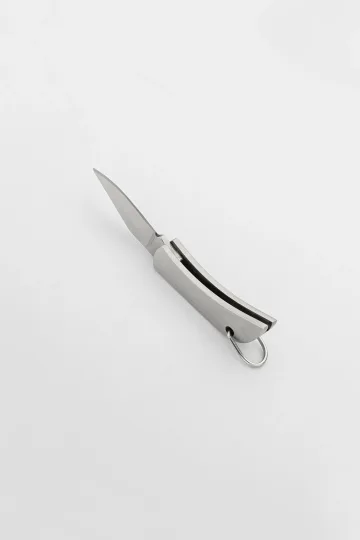
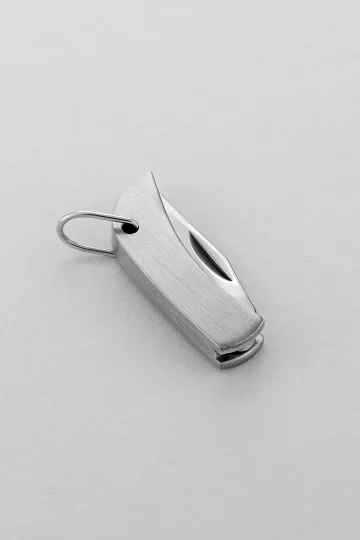
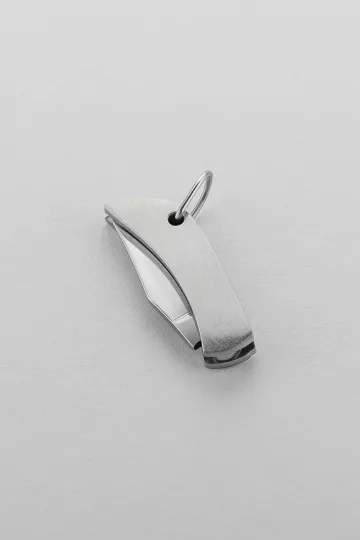
Wear the symbol, don't just read about it. These are in stock:
In film, music and culture
"Captain Alatriste" (2006) with Viggo Mortensen shows 17th-century Spain, when navajas and swords coexisted on the streets of Madrid. The film depicts exactly the world where the punta de espada was born.
Fantasy storytelling has given this principle a familiar modern shape: the thin, straight, precise blade made for the thrust rather than crude hacking. The same approach as the smiths who forged the punta de espada.
Modern action cinema has turned precise, clean weapons into an aesthetic of their own, where symmetry and restraint read as competence rather than brute force.
Musketeer cinema, from classic versions to recent adaptations, lives on the rapier aesthetic. Every thrust, every parry. The punta de espada tried to capture that in folding-knife format.
On TikTok and Instagram, knife pendants find audiences among people who would never buy "regular" jewellery. The hashtag #knifependant unites collectors, stylists and people for whom a pendant is not decoration but a statement.
An illustrative scenario
Imagine someone who works in a formal setting, wearing the punta de espada under a shirt. Nobody sees it, but the wearer knows it is there. Before a demanding day, a touch through the fabric becomes a small private ritual, less superstition than habit, like checking your notes one last time. It is the kind of quiet, personal detail that suits this pendant.
What to pair it with
With a compass: direction plus steel, two symbols for someone who knows where they are headed. With an anchor: maritime severity. But honestly, the punta de espada works best solo. Its clean silhouette needs no support. One chain, one pendant, nothing extra.
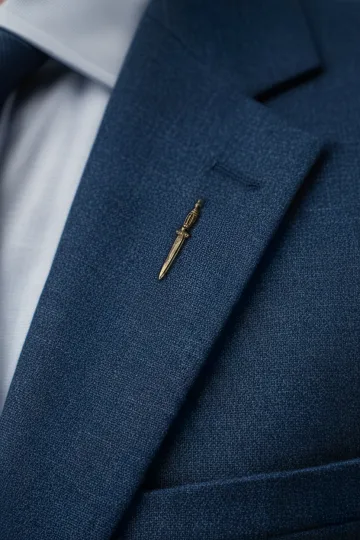
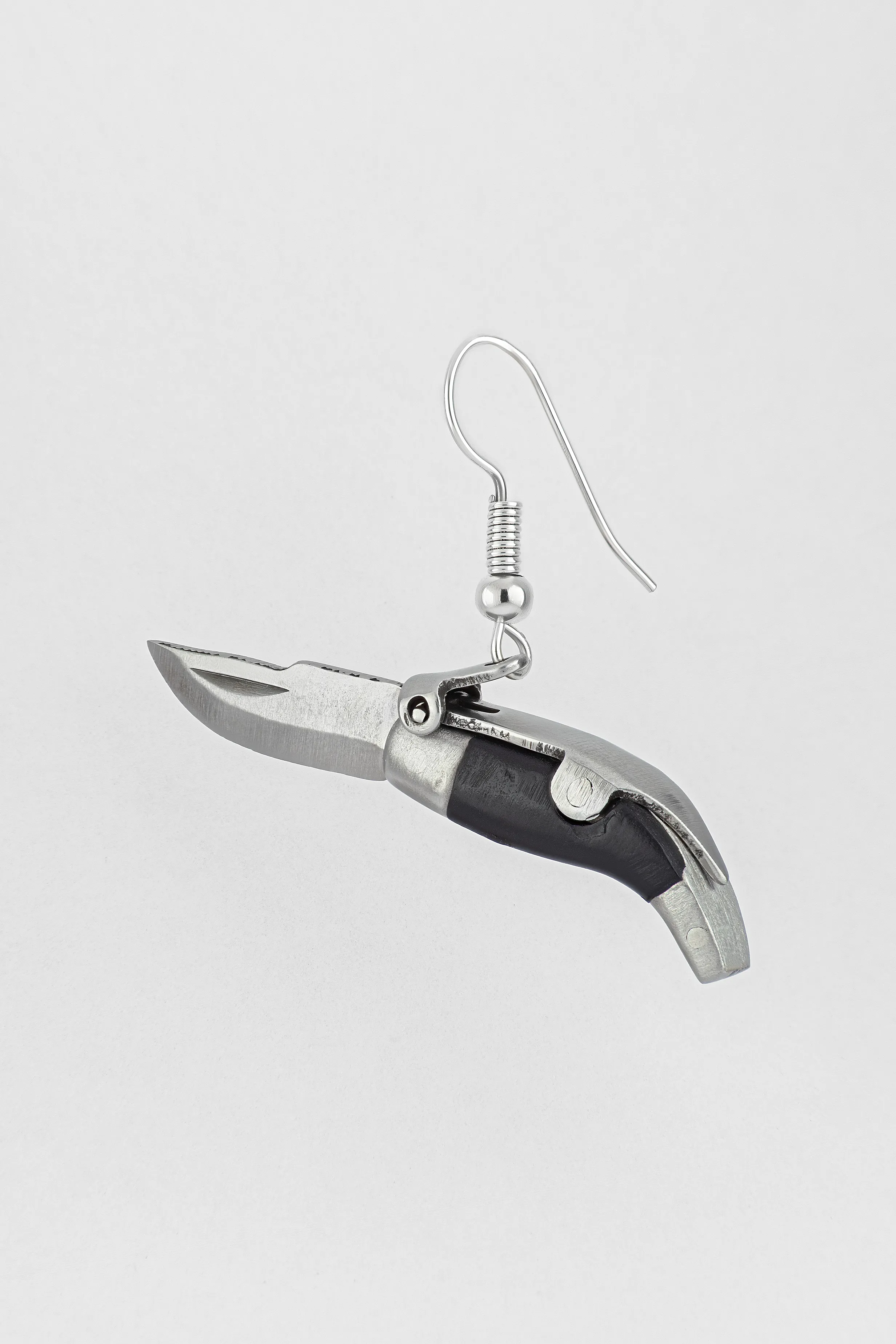
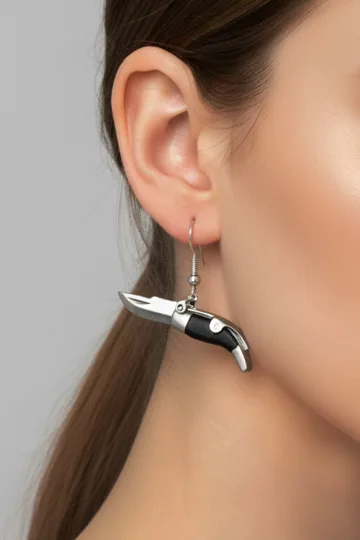
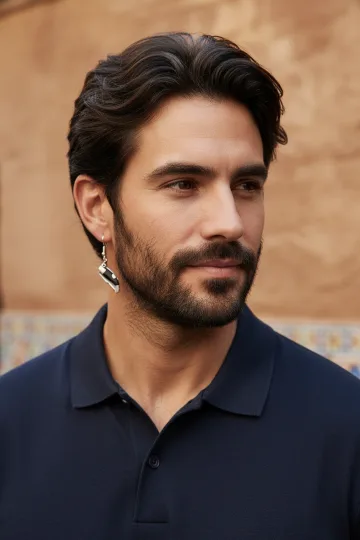
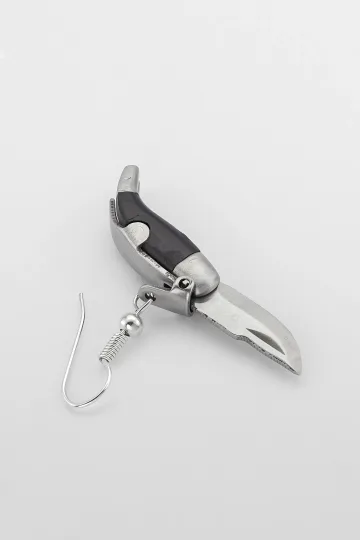
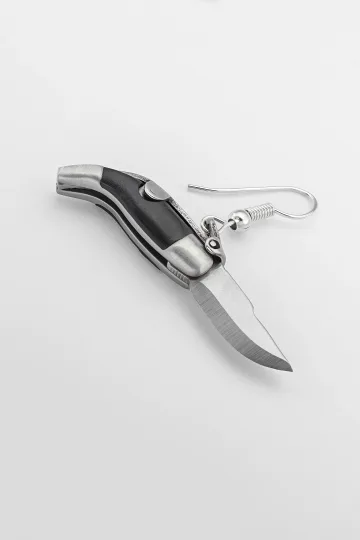
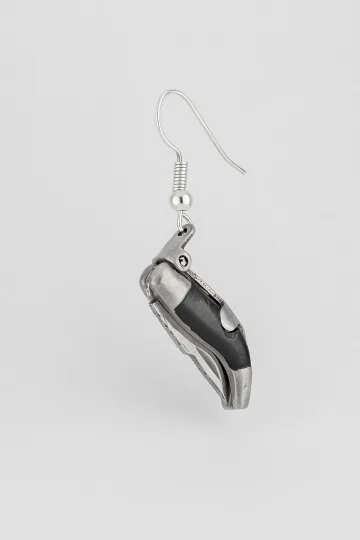
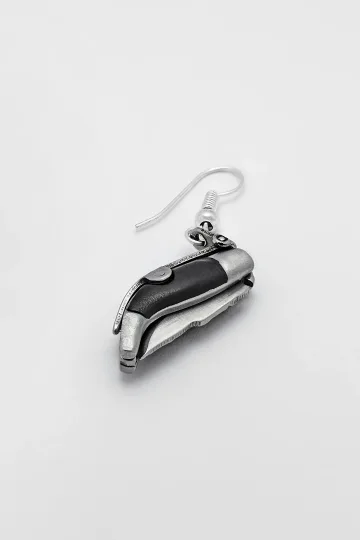
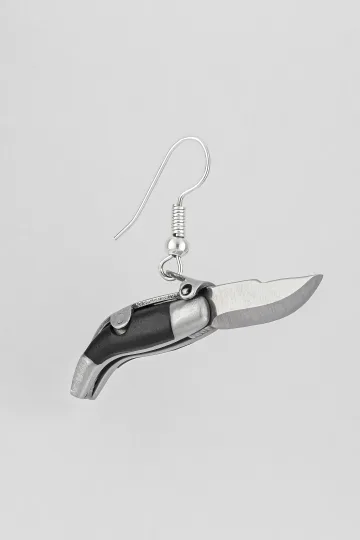
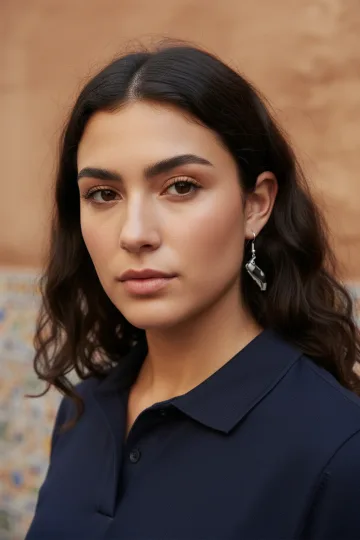
If you want a pair, choose something with contrasting character: Curva Helada on a second chain (straight and curved, Castile versus the Moorish world) or jerezana (austerity versus Andalusian chic). As an earring, the vertical blade creates an arrow effect, pointing down from the ear. One earring, not a pair, is the classic choice.
As a gift
For a minimalist. Three pieces of furniture, all in their place. One watch for ten years. The punta de espada lands in that world without a ripple.
For someone who values history. A lawyer, a teacher, someone who reads biographies instead of novels. The punta de espada carries a specific story, and that story is worth more than the box.
For a man who does not wear jewellery. Precisely because this is not "jewellery" in the usual sense. Closer to a military medal than a mall pendant.
For a professional. Lawyer, architect, surgeon. Precision workers. The punta de espada was the knife of urban professionals in the 19th century. That line continues.
For a graduation. A gift that says: you earned this precision. The blade speaks for itself.
For Father's Day. Not a tie. Not socks. A pendant with 460 years of backstory. Costs about the same as two good dinners out, but it will still be around decades from now.
For a retirement. A career built on precision, on doing things right, on the long game. The punta de espada is the pendant that says: the discipline was noticed. The precision was respected. This blade was earned.
For someone starting a new chapter. A new job, a new city, a new life. The punta de espada carries a story of transformation: a sword became a knife, a knife became jewellery, function became form. Transitions are not losses. They are evolutions.
What to write on the card? Nothing. The blade speaks for itself.
Customer reviews
Zevira is a real jewellery shop. Genuine payments, deliveries and customer thank-yous.
🥰🥰🥰 gracias
Ok, ¡gracias! 🙂
The geometry of the thrust: what the diamond cross-section actually does
A flat blade cuts. A blade with a diamond cross-section does something else.
The rapier, and by extension the punta de espada, was designed primarily for the thrust. When a triangular or diamond-shaped blade enters a surface, it does not cut a clean line: it displaces material in four directions simultaneously. The result is a wound that does not close easily and a penetrating force that bypasses edge resistance entirely. You do not need to be sharp to achieve this; you need to be pointed and rigid.
This is why the diamond cross-section requires additional forging work. A flat blade is straightforward to produce. Grinding a faceted diamond profile demands careful attention to both sides simultaneously, keeping the central ridge line exactly centred. If the ridge migrates even slightly to one side, the blade's balance changes, its light-catching behaviour changes, and its visual identity changes. The punta de espada's entire aesthetic depends on that ridge being precisely where it belongs.
In the pendant miniature, this cross-section is what separates a genuine translation from a generic pointed shape. On a well-executed miniature, the two facets catch light at different angles as you rotate the piece. One catches a reflection while the other falls into shadow, then they reverse. This optical behaviour is impossible on a flat blank; it requires the three-dimensional form. It also means the miniature reads differently in different lighting conditions, which is part of why the piece holds visual interest over time.
The punta de espada and the sword ban: deeper context
The story of the 1563 sword ban deserves more detail because it illuminates why the punta de espada matters as more than a pretty pendant.
Philip II did not ban swords because he feared violence. He banned them because the sword was a class marker. In 16th-century Spain, carrying a sword meant you were a caballero, a gentleman. Without a sword, you were a commoner. The law was not about safety. It was about social control. Keeping the lower classes in their place by stripping them of the symbol of dignity.
The smiths who responded with the navaja were not just making tools. They were making statements. "You can take our swords, but you cannot take our craft." The punta de espada is the most audacious version of that statement: a knife deliberately shaped to look like the very weapon that was forbidden. It was quiet defiance. Civil disobedience in steel.
This context gives the pendant a weight beyond aesthetics. When you wear a punta de espada, you wear the memory of people who found dignity through craft when the law tried to take it away. That is a principle, beyond a mere story. And principles do not go out of style.
The rapier in European history
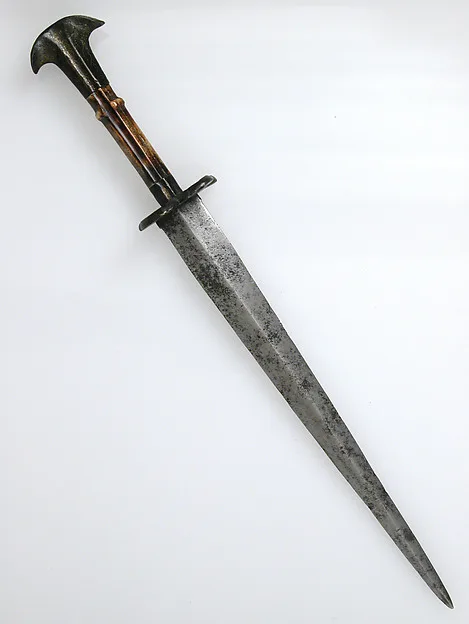
The punta de espada references the rapier in its very name, and it is worth looking at this sword more closely to understand the pendant better.
The rapier emerged in the 15th century in Spain (espada ropera, "dress sword"). It was lighter and longer than medieval swords, designed for the thrust rather than the cut. The Spanish fencing schools (Destreza) turned the rapier into a science: geometry, angles, distance.
Jerónimo Sánchez de Carranza published in 1569 "De la Filosofia de las Armas," the foundational text of the Destreza. His student Luis Pacheco de Narváez refined the system. The idea: the fencer stands at the centre of an imaginary circle. Every movement, every thrust, every parry follows geometric principles. The angle determines everything.
This philosophy is embedded in the punta de espada. The symmetrical point, the diamond cross-section, the straight lines. Nothing is accidental. Every measurement serves a purpose. The same discipline a fencer requires, a smith must also embody when forging this blade.
From Spain, the rapier spread to Italy, France, Germany and England. In every culture it was adapted. The German version was sturdier. The Italian more elegant. The Spanish the longest and the most geometry-based.
What this means for the pendant: when you wear a punta de espada, you wear an echo of a European tradition that reached from Madrid through Toledo to Sheffield and Nuremberg. A tradition that understood blade form as language.

Turn on your camera, pick earrings, a pendant or a ring, and see the piece on yourself in real time.
Switch items in one tap.
Everything runs in your browser: no photo or video is ever uploaded.
Punta de espada and Toledo
Toledo, the city of swords, lies roughly 250 kilometres northwest of Albacete. Since the Roman Empire, Toledo has been famous for its blades. Toledo steel was a quality mark across medieval Europe.
The punta de espada connects these two blade cities. The sword form comes from the Toledo tradition. The navaja technique comes from Albacete. The result is an object that unites two Spanish blade traditions in a single form.
For travellers who visit both cities: in Toledo you see the swords the punta de espada was dreaming of. In Albacete you see the knife that put that dream in someone's pocket. Two cities, one story.
The punta de espada and the philosophy of the straight line
There is a design principle this knife embodies: the power of the straight line. In a world that celebrates curves, ornaments, and complexity, the straight line makes a radical statement. It says: I need nothing additional. The form is enough.
This principle shows up throughout design history. The Bauhaus (1919-1933) made the straight line a programme. "Less is more" (Ludwig Mies van der Rohe) became the motto of an entire design philosophy. Dieter Rams's Braun products, USM Haller office furniture, Swiss typography: everywhere the straight line, everywhere the absence of the superfluous. The punta de espada fits this tradition. Not because it shares the same origin, but because it follows the same principle. An object that draws its beauty from the perfection of its basic form, not from decoration.
For the minimalist buyer, this is a relevant point. The punta de espada does not compete with opulent jewellery. It competes with the empty wall, the white shelf, the black T-shirt. It is for people who understand that the absence of decoration can also be a form of decoration, and that a single piece that is perfect says more than ten pieces that are merely pretty.
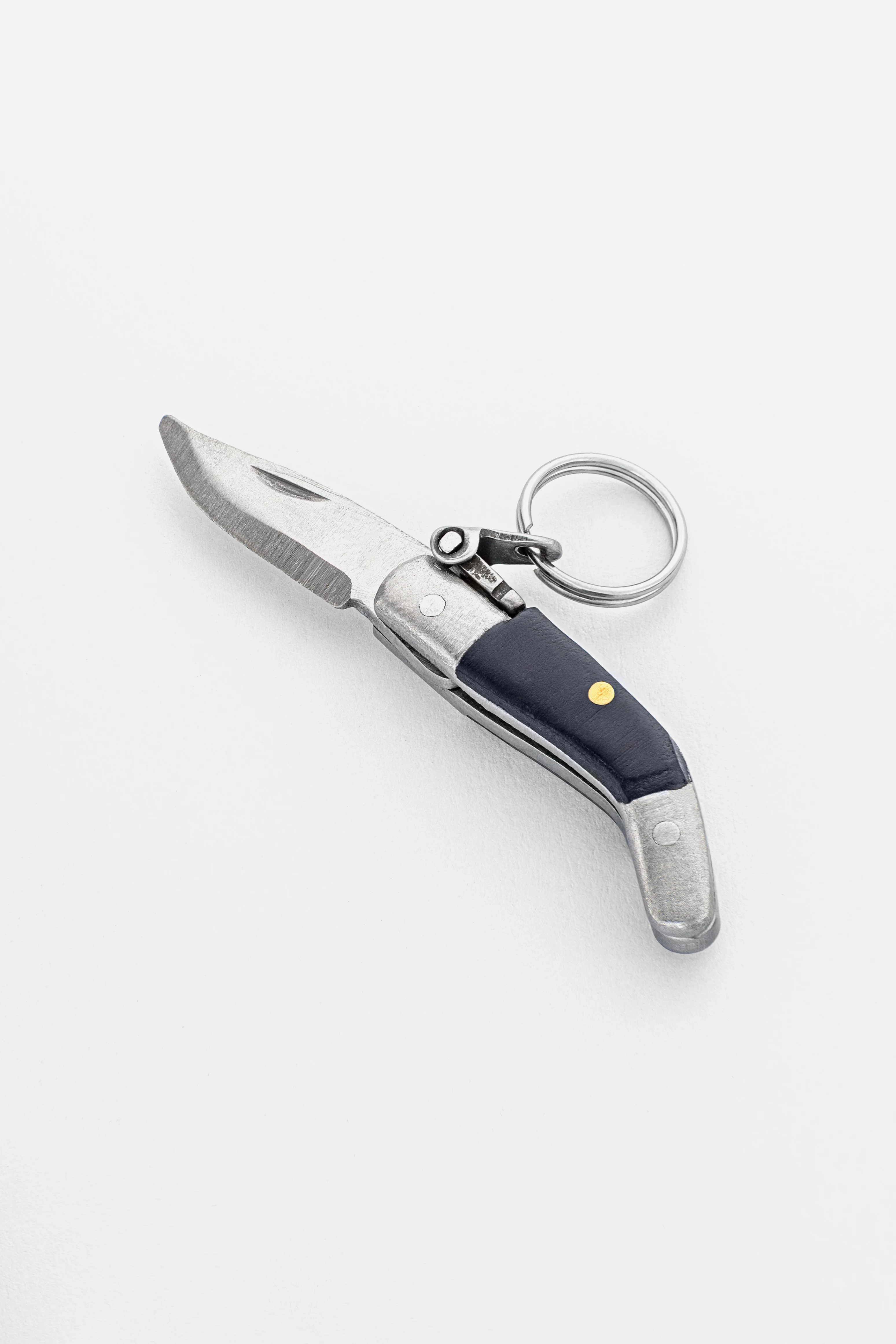
Artisan-crafted CAPAORA navaja pendant
A 40 mm stainless-steel navaja with a real folding mechanism and Palanquilla lock. An affordable gift to remember.
A code for blog readers:
10% off your first order
Authentic · Maker's guarantee · Ships from Spain
The carraca: the voice of the navaja
A full-size punta de espada announces itself. As the blade swings open, the carraca engages, notch by notch, with a sequence of clicks that are as much a part of the knife's identity as its silhouette. The carraca is a spring-loaded ratchet: a toothed rack on the blade's spine, a leaf spring in the handle that rides each tooth. Each notch held the blade at a fixed angle. To close, you pressed the spring aside with your thumb.
This mechanism was not just engineering. At the Albacete fair, where collectors and smiths gathered every September, a man would open a punta de espada by sound as much as sight. The clicks told him about spring tension, tooth geometry, and the smith's precision. A sloppy carraca with uneven spacing rattled. A fine one clicked with consistent weight and rhythm, each notch indistinguishable from the last. That consistency required patience that modern manufacturing rarely offers.
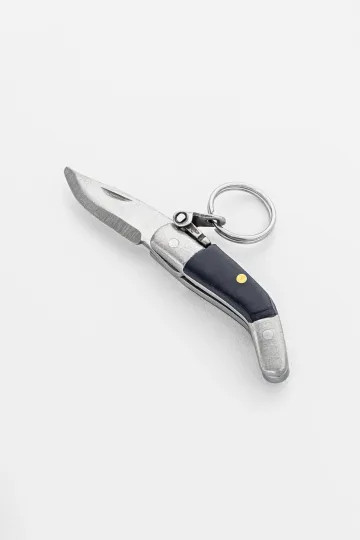
On the pendant miniature, the carraca is represented as a visual reference on the handle spine, not a working mechanism. But for anyone who has handled a historical punta de espada, the detail is immediately legible. It places the miniature in the correct category: not generic knife, but this specific knife, with this specific tradition.
Materials: what the blade is made of
Historical punta de espada blades were forged from high-carbon steel, typically sourced from the metalworking centres of the Basque Country and Catalonia. Carbon steel takes a sharper edge than stainless but requires more maintenance. The choice of steel was itself a statement: a blade that demanded attention from its owner was not a casual object.
The handles combined several materials in deliberate contrast. Horn (from cattle, deer, or ibex) was the most common grip material. Each horn is unique in its patterning, which meant no two handles were identical. The grain of the horn ran along the handle's length, giving the grip a subtle visual rhythm. Bone was used for less expensive specimens, often dyed black to resemble horn. Hardwoods (oak, olive, rosewood) provided a denser feel. On finer pieces, mother of pearl appeared as accent panels, catching light differently from the polished metal of the fittings.
Brass served multiple roles. The bolsters at the handle's ends protected the wood or horn from splitting when the blade was opened and closed thousands of times. Brass liners ran along the handle's inner surfaces, housing the spring mechanism. The "guard" fitting on premium specimens was built from the same material: a functional component elevated to symbolic purpose.
The interaction between these materials creates a visual counterpoint. The blade is all geometry and precision. The handle is warm, organic, varied. Together they balance the austere and the comfortable, which is exactly the balance the historical punta de espada occupied in Spanish society: something hard, exact, and unapologetic, worn by a man who also appreciated comfort and refinement.
Behind the scenes: how the miniature is born
Translating the punta de espada from full-size knife to a pendant the size of a lighter is deceptively hard. The silhouette is clean, no complex carving to lose at small scale. But that cleanness forgives nothing. A slight asymmetry invisible on a 30 cm blade screams on a 3 cm pendant. The master works to tenths of a millimetre: the diamond cross-section of the blade, the transition from handle to edge, the proportion of the sword tip.
In the Zevira workshop in Albacete, this process runs start to finish under one roof. Sketch, prototype, final form, polish. The master who makes the miniature has walked five minutes to the museum to study the originals. He knows what a proper punta de espada looks like because he has seen hundreds, both antique in glass cases and new at the September fair. That proximity to the original is not a marketing detail. It is what separates craft from factory stamping.
The specific moment that separates makers: forming the sword tip itself, the punta de espada. It must be perfectly symmetrical, not approximately so, exactly so. Remove the symmetry and it is no longer a punta de espada. It is just a navaja with a long blade. The name describes a standard, beyond a mere shape.
Leave your email, we'll send your discount code. No spam, unsubscribe anytime.
The code arrives by email, valid on your first order.
Albacete, the workshop and the tradition
Knife-making in Albacete is not a tourist brand. It is a living tradition with an unbroken line of master-to-apprentice transmission stretching over five hundred years. In 2017, this tradition received BIC status (Bien de Interes Cultural), state recognition of cultural heritage. The craft that produces these knives is protected at the same level as the Alhambra or the Santiago cathedral.
Every September at the Feria de Albacete, knife-makers display their best work. The fair has run since 1375. Six hundred and fifty years, every September. The punta de espada is always judged especially closely at these fairs: its clean silhouette allows no hiding. There is nothing to distract from an uneven line.
The Zevira workshop operates in this city. Full production cycle in the workshop, two hundred metres from the museum where the full-size originals stand behind glass.
The feria de Albacete: where the punta de espada is judged
Every September since 1375, craftsmen have gathered in Albacete for the fair. Six hundred and fifty years of uninterrupted continuation, through wars, plague, political upheaval, and industrialisation. The knife tradition never stopped.
At the fair, the punta de espada is displayed and evaluated differently from other types. With a jerezana, a skilled carver can draw the eye to a decorated handle and away from blade irregularities. With a capaora, the robust working form accommodates minor imperfections. But the punta de espada has nowhere to hide. Collectors pick it up, extend it, and lay the blade flat on a flat surface right there at the display table. If it touches completely, the smith passes the test. If there is daylight under any portion, the conversation ends.
This accountability shaped the tradition. Smiths who made punta de espada could not coast on decorative skill. The blade geometry was the entire argument. This is why the type attracted the most technically precise makers, and why historical punta de espada from the 18th and 19th centuries often show a quality of metalwork that seems at odds with the hand forging methods used to produce them.
The September feria continues today. The Museo de la Cuchilleria, opened in 1987, stands in the city centre. It holds one of Europe's most complete collections of Spanish cutting instruments, including examples of every navaja type across five centuries. The punta de espada specimens span from crude early examples to 19th-century masterworks where the symmetry is measurable with instruments, not just visible to the eye.
How to spot quality
Proportions: the punta de espada blade is longer and narrower than other types. If the miniature looks like any generic navaja, the maker did not know the difference.
Weight: a quality pendant has noticeable heft. Hollow stampings feel weightless and do not convey the character of a knife built for serious intent.
Details: the sword tip, diamond cross-section, handle-to-blade transition should all be readable. If what you see is just a pointed stick, it is not a punta de espada.
Finish: even coating, no burrs, smooth edges. The bail (loop for the chain) should be neat and proportional, not a massive ring that disrupts the austere silhouette.
Care
Wipe with soft cloth after wearing. Store separately from other jewellery to avoid scratches. Avoid contact with perfume, creams, chlorine. Brass toning over time is normal, it develops patina. Baking soda restores shine if wanted. Open and close navaja earrings periodically to keep the mechanism smooth.
Punta de espada vs other navajas
| Type | Blade shape | Character | World analogue |
|---|---|---|---|
| Punta de Espada | Straight, symmetrical, sword-like | Austerity, dignity | Rapier |
| Jerezana | Clip point, elegant | Grace, Andalusian chic | Stiletto |
| Capaora | Wide, working | Brute force, practicality | Cleaver |
| Curva Helada | Curved, crescent | Moorish grace | Yataghan |
| Lunar knife | Sickle-shaped | Mystique, night | Sickle |
Send a friend a discount code, they save on their first order.
The punta de espada and minimalism
The punta de espada is the most minimalist pendant in the navaja collection. No carving, no decor, no narrative handle design. Just a straight line ending in a point.
In a world that has read Marie Kondo and celebrates "less is more" as a life principle, the punta de espada is the perfect jewellery. It sparks joy not through opulence but through precision. Through the absence of everything superfluous.
This principle echoes through design history. The Bauhaus (1919-1933) made the straight line a programme. "Less is more" (Ludwig Mies van der Rohe) became the motto of an entire design philosophy. Dieter Rams's Braun products, USM Haller office furniture, Swiss typography: everywhere the straight line, everywhere the absence of the superfluous.
The punta de espada fits this tradition. Not because it is German (it is Spanish), but because it follows the same principle. An object that draws its beauty from the perfection of its basic form, not from decoration. Whoever understands Bauhaus understands the punta de espada. Whoever understands Rams understands why less ornamentation means more impact.
Why the punta de espada makes the best first navaja
If someone is buying a navaja pendant for the first time and cannot decide between the types, the punta de espada is usually the recommendation.
The silhouette is the most universal. The straight, symmetrical form adapts to any style from streetwear to business. No other navaja type is as versatile.
The history is the easiest to tell. "The law banned swords. Smiths made knives that looked like swords." Thirty seconds. Everyone understands. With the capaora you have to explain a butchering knife, which does not fit every conversation.
The punta de espada provokes the least. The jerezana with its aggressive clip point can seem threatening to people unfamiliar with navaja forms. The capaora is deliberately blunt. The punta de espada reads as abstract geometry until someone gets close and sees the details.
The pendant works solo. While other navaja types gain from combination, the punta de espada stands alone. One chain, one pendant. Minimalism. Completeness.
The punta de espada in daily life: concrete scenarios
At the office. Under the shirt on a 55 cm chain: invisible. The personal ritual nobody sees. When you open the collar at the end of the day, the sword point becomes visible. For lawyers, architects, and professionals in structured environments, this is the perfect balance: personal meaning without workplace questions.
At a meeting. In business-casual context: visible at 50 cm in the open collar. The clean silhouette does not provoke questions about "knives." It reads more as abstract geometry. Colleagues who notice it will ask, but the question will be curious, not concerned.
At a conference. The conversation starter. "What is that pendant?" and the answer opens a conversation about 500 years of history, the Spanish sword ban, Albacete, and why craft traditions matter. Better than a business card for making yourself memorable.
At the gym. Remove it. A metal silhouette with a point and weight while running: impractical. Exception: on a short rubber cord tight against the body, then it works. For yoga or pilates, no issue.
Travelling. The punta de espada is the ideal travel pendant. It carries a specific story (the sword ban, Albacete, resistance through craft) that connects to wherever you go. In Spain, it is a nod to local tradition. In a museum, it is a conversation about blade history. At dinner, it is the piece that someone across the table notices and asks about.
The punta de espada as a heirloom
In the era of fast fashion and seasonal trends, the punta de espada represents the opposite approach: an object meant to outlast its first owner.
Historical specimens in the Albacete museum are three hundred years old and still impressive. The craftsmanship reads clearly. The geometry holds. The miniature pendant carries the same ambition: materials and form chosen to age well rather than look new.
Stainless steel and brass are durable materials. Brass develops patina that gives character rather than suggesting neglect. The form does not date because it is not fashionable, it is historical. In twenty years, the pendant will look the same, with more story behind it.
A father wears the punta de espada for ten years, then passes it to a son. The son chooses a different piece and puts this one in a drawer. Twenty years later he opens the drawer and finds the pendant, slightly darker, slightly rougher, but with the same straight line. He puts it on and remembers. That is what happens when objects are made well enough to survive.
The punta de espada and the law
A common question: "Am I allowed to wear a knife pendant?" Generally speaking, a jewellery pendant in knife form is a decorative miniature, not a functional knife. It is not sharp, not usable as a weapon, and is designed purely as an ornament. That said, rules vary from country to country and by context, so if you have any doubt, check the local regulations that apply where you are.
At the airport: small jewellery miniatures are unlikely to draw attention, and security will usually treat them as ordinary jewellery. Because procedures differ between airports and jurisdictions, use your own judgement about what to wear or pack when travelling.
Wear the symbol, don't just read about it. These are in stock:
Not for everyone
The punta de espada is not for everyone, and that is the point. If you want something raw, heavy, unapologetic, the capaora is your knife. The punta de espada is for restraint, not force. For the thrust, not the chop. If you pick it up and wish it were wider, louder, more aggressive, put it down. The capaora is waiting.
Frequently asked questions
What does "punta de espada" mean? Literally "sword point." A type of Spanish navaja with a straight blade whose tip resembles a rapier.
How does it differ from the jerezana? The main difference is the blade tip. The jerezana has a clip point (sloped spine), creating a predatory profile. The punta de espada has a symmetrical sword tip, more austere and straight. The jerezana handle is typically more decorated.
Why were navajas made to look like swords? Because in 1563, commoners were banned from carrying swords. Smiths made folding knives with sword-like forms as social resistance.
Is the pendant a real knife? No. It is a jewellery miniature in stainless steel and brass with coating. Decorative, not functional.
Is it legal to wear a knife pendant? In most everyday situations, a jewellery miniature in knife form is treated as an ornament rather than a knife, since it is not sharp, not functional, and not usable as a weapon. Rules differ by country and by setting, however, so check the local regulations that apply to you if you are unsure. At airports, small jewellery miniatures are usually treated as ordinary jewellery, but procedures vary, so use your own judgement when travelling.
Does it suit women? Yes. The clean, austere silhouette works well in minimalist style. On a thin chain it reads as elegant, not aggressive. For a more curved, flowing form, look at Curva Helada or the lunar knife.
Where are Zevira pendants made? In Albacete, Spain, a city with 500 years of continuous knife-making tradition, recognised as national cultural heritage (BIC since 2017). Full production cycle in the workshop.
Can I see the original punta de espada? Yes. The Museo de la Cuchilleria in Albacete holds a collection of all navaja types, including historical punta de espada from the 16th through 19th centuries.
What chain length works best? 50-55 cm for most people. At this length, the pendant sits at the sternum in the opening of a shirt. Under a buttoned collar, it is hidden. With an open collar, the sword tip catches light. For women, 45 cm keeps it higher, at the collarbone. Shorter than 42 cm crowds the neckline. Longer than 60 cm drops it too low and loses the connection to the face. The sweet spot is where the pendant sits in the frame of an open collar, visible but not dangling.
What makes the punta de espada different from a generic knife pendant? Three things. First, the symmetrical sword tip. Other navajas have clip points, curves, or rounded tips. The punta de espada ends in a straight, symmetrical point like a rapier. Second, the diamond cross-section. The blade is not flat but three-dimensional, catching light on two facets. Third, the austerity. No handle decoration, no curves, no flourish. Just a straight line ending in a point. A generic knife pendant has none of these distinguishing features. It looks like a knife. The punta de espada looks like a sword that learned to fold.
What is the carraca mechanism? The carraca is the spring-loaded ratchet lock that holds the blade open. On historical navajas, its distinctive clicking sound as the blade engaged each notch was part of the knife's identity. On the pendant miniature, the mechanism is represented as a visual detail, not a functional one, but the form references the original construction.
Why does the diamond cross-section matter on a pendant? The diamond cross-section is not just historical accuracy. It creates a three-dimensional blade that catches light on two separate facets simultaneously. As you move or the light shifts, one facet brightens while the other darkens, then they reverse. A flat blade pressed from sheet metal has one static reflective surface. The diamond cross-section gives the miniature visual behaviour that flat pendants cannot replicate.
What does "Bien de Interes Cultural" mean for the craft? BIC is Spain's highest level of cultural heritage protection, the same classification applied to the Alhambra and the Santiago de Compostela cathedral. For the Albacete knife-making tradition, receiving BIC status in 2017 means the transmission of the craft is officially recognised and supported by the state. It affects workshop standards, apprenticeship structures, and the cultural legitimacy of the tradition. A pendant produced within this tradition carries that institutional weight.
How should I care for the pendant? Wipe with soft cloth after wearing. Store separately. Avoid perfume, creams, chlorine. Brass develops patina over time, which is normal. Baking soda restores shine if wanted. If the pendant has a folding mechanism (earring version), open and close it periodically to keep the mechanism smooth. Full care details in the water and shower guide.
About Zevira
Zevira makes jewellery by hand in Albacete, Spain, the same city where the punta de espada was born as an answer to the 1563 sword ban. Our workshop sits two hundred metres from the cutlery museum, where the full-size originals stand behind glass, and we translate those historical forms into wearable miniatures.
What you will find with us on the navaja-pendant theme:
- Punta de espada with its symmetrical sword tip and diamond cross-section blade
- Other navaja types: jerezana, capaora, Curva Helada, lunar knife
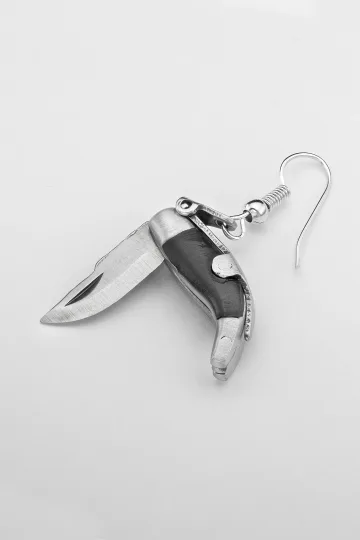
- Navaja earrings with a folding mechanism, for anyone who wants the vertical line of the blade beside the face
- Paired sets of the straight and curved forms, a quiet narrative about Spain's two traditions
- Chains in a range of lengths and weights to match the pendant, from 42 to 55 cm
Every piece is made by hand, with the option of personal engraving. Sterling silver 925 and gold 14-18K.