Cuff Bracelet: The Open Bangle Without a Clasp
A cuff has no clasp. That means you cannot forget to close it, you cannot lose it through a broken fastening, and its strength comes from the fact that you squeeze it onto your wrist every morning. It is the most tactile bracelet of all.
An open bangle with a gap between the ends behaves like neither a chain nor a rigid closed bangle. It lives on the wrist differently. It sits tight through the pressure of metal rather than through a fastening, and it comes off with the same motion you use to put it on. Every time you wear it becomes a small ritual, because every time you feel the metal first resist, then give way.
This guide is built as a complete map of the cuff. From Roman armillae to modern minimalism, from sizing it to your wrist to why an overly rigid cuff is impossible to wear. If you are choosing your first cuff, or working out how to stack it with a watch, everything is here.
History of the Cuff: From Roman Legionaries to Modern Collections
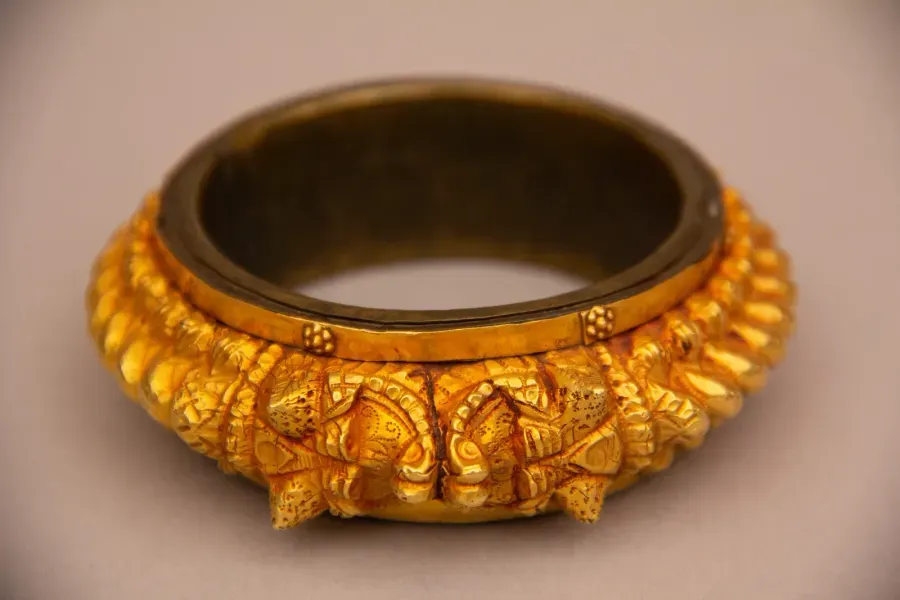
The history of the open bangle runs longer than that of most bracelets with clasps. The clasp as we know it entered common use only in the late Middle Ages. Before that, a bracelet was worn one of three ways: pushed over the hand like a closed bangle, squeezed on like a cuff, or wound on like a ribbon. The open gap turned out to be the most practical solution for warriors and for cultures where jewellery was at once a status sign and a working tool.
Antiquity: The Roman Legionary's Armilla
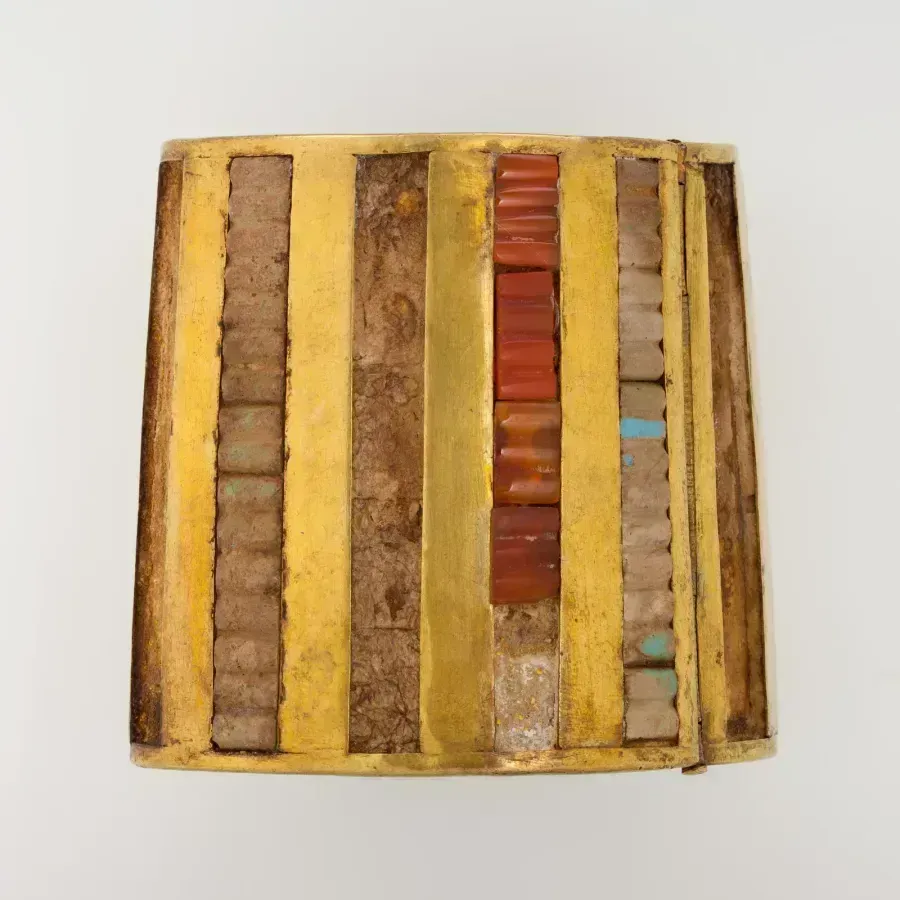
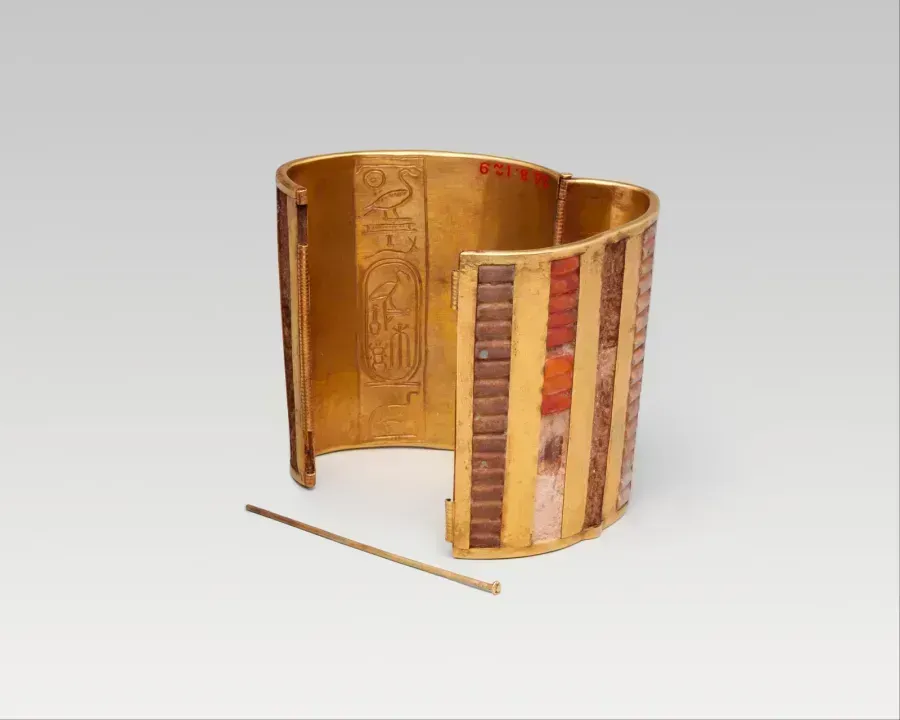
The word "armilla" is Latin and refers to any rigid bracelet worn on the wrist or upper arm. During the Roman Republic and early Empire, the armilla was one of the standard combat decorations (dona militaria), awarded to a legionary for a feat in battle. The recipient earned the right to wear two armillae at once, one on each arm, visible from a distance. Finds from Pompeii, Herculaneum, and the Roman camps along the Rhine show the typical form: a gold or bronze open bangle 15 to 30 mm wide, sometimes engraved, sometimes finished with small animal figures at the ends.
The armilla was worn on the forearm over a tunic sleeve, or on the wrist itself. Because there was no clasp, a military armilla was fitted to one person: first bent to a cast of the arm, then presented. That made it a named object, and Romans recognised one another by these pieces. Each armilla carried its own character, the trace of the smith's tools, a quirk of the pattern, a particular patina. When a legionary died, the armilla passed to his family or returned to a temple as an offering.
Alongside the military version there was a civilian one. Women of Roman households wore gold open bangles on the forearm and wrist as ornament, often in pairs, sometimes shaped as a stylised serpent with garnet eyes. The serpent motif was especially popular in the Hellenistic provinces, in Alexandria, Syria, and Asia Minor, and from there moved into Rome. Archaeologists find such serpent armillae in women's burials of the first to fourth centuries across nearly every corner of the former empire.
Byzantine and Medieval Period: Protection and Ritual
After the fall of the Western Roman Empire, the tradition of rigid bracelets survived in the East. Byzantine craftsmen developed the style, drawing on Roman and Sassanid experience. Bracelets of the sixth to tenth centuries from Constantinople combined engraved decoration with cloisonné enamel and precious stones. The open gap stayed a practical choice, because clasps demanded thin wire and delicate technique that proved fragile on large pieces.
In medieval Europe another relative of the cuff appeared: the knight's vambrace. This was a protective plate covering the wrist and lower forearm over chainmail or a padded garment. The manica of late antiquity and the medieval bracer served a defensive purpose, yet looked closely related to the cuff: a rigid metal plate, bent to the shape of the arm, open on the inner side for easy wearing.
The curious part is that decorative bracelets and combat bracers began to converge in the late Middle Ages. Noble knights ordered bracers with engraving and gilding, while women wore cuff bracelets that imitated the warrior style. By the fourteenth and fifteenth centuries, workshops in Italy and Burgundy specialised in parade bracers worn not in battle but at tournaments and ceremonies.
Tribal Traditions: Native American Silver and Turquoise
Parallel to the European story, a powerful tribal tradition grew up in North and South America. When sixteenth century Spanish colonists brought silverworking skills to the New World, Native craftsmen of the Navajo, Zuni, Hopi, and Zapotec peoples reworked the technique through their own aesthetic. By the mid nineteenth century, an independent tribal cuff style had taken shape in the southwestern United States, and today it counts as a world classic.
The Navajo began working with silver in earnest in the 1850s and 1860s. Their cuffs were made from near pure 999 silver or coin silver (90 percent silver, 10 percent copper), hand forged from melted coins or silver ingots. The signature stone was turquoise from the local mines of Arizona and New Mexico. Each mine gave its own colour, from the bright blue of Sleeping Beauty to the deep green of Carico Lake. The maker chose stones for a specific cuff, reading their veins and texture.
The Zuni specialised in fine stonework: their cuffs often carried mosaics of dozens of small turquoise plates set into a pattern. The Hopi developed the overlay technique, a double silver layer where the top sheet was pierced with a design and the bottom stayed smooth. Each people kept its own handwriting, and collectors still distinguish tribal cuffs at a glance.
In Latin America, Zapotec and Mixtec makers worked in parallel in present day Mexico. Their cuffs of silver inlaid with malachite, lapis lazuli, and obsidian keep a pre Columbian feeling to this day. The town of Taxco in Guerrero state remains one of the world centres of silverwork, and most of the mass silver sold in Mexican tourist zones is made there.
Paris Workshops of the 1920s: The Art Deco Era
The twenties turned jewellery on its head. After the First World War, the whole way of life of well off women changed. Short haircuts, bare shoulders, sleeves to the elbow or no sleeves at all, all of it called for new jewellery. Long strands of pearls, drop earrings, and wide cuffs became the calling card of the decade.
Paris workshops pushed the cuff toward geometry and graphic line. Black enamel on platinum, sharp pairings of onyx and rock crystal, the rays and zigzags of skyscraper architecture, all of it landed on wrists. The cuff went flat and wide, sometimes with a hinged centre for easier wearing. Watch movements were often set inside, turning the bracelet into a hybrid.
These makers used cloisonné in a new way: thin walls of gold or platinum wire divided the enamel field into geometric sectors, then filled each with coloured compound. Every sector was fired on its own, because different colours needed different kiln temperatures. The finished cuff came together from dozens of such plates joined by hinges. This was engineering work on the border between watchmaking and jewellery.
Art Deco spread quickly from Paris around the world. London, New York, Buenos Aires, Shanghai, every jewellery capital produced its own reading. By the early 1930s the Art Deco cuff sat on the wrists of actresses, dancers, and the wives of industrialists. The Great Depression hit the market, yet the style carried on in humbler materials: silver instead of platinum, coloured glass instead of precious stones, stamping instead of handwork.
The Sixties: Boho, Hippies, and the Return of Tribal
In the 1960s a wave of interest in tribal cultures, Eastern religions, and nonconformism lifted the cuff to new heights. Young Americans and Europeans travelled in numbers to the American Southwest, to Mexico, India, and Morocco, bringing silver home. Turquoise and silver Navajo cuffs became a recognisable part of boho style.
Designers of the era rediscovered old motifs. Greek meanders, Egyptian hieroglyphs, Celtic weaving, Indian lotuses, all appeared on wide silver cuffs. The look was deliberately eclectic: one wrist might carry a thin bangle from Rajasthan, a Navajo silver cuff, and a leather strap with a single tourmaline bead.
Another current ran alongside it, the art cuffs of European sculptors and metal artists. They made cuffs as small sculptures: bronze, forged copper, cast brass. Not for daily wear, but as part of an artistic look. That tradition is alive today, and many modern cuff lines come from sculptors rather than classical jewellers.
Eastern Tradition: India, Iran, Tibet
In India the cuff belonged to the wedding and festive wardrobe of women from wealthy families. Rajasthani workshops produced wide silver and gold cuffs from the sixteenth and seventeenth centuries, set with rubies, emeralds, and pearls. The Indian cuff was marked by intricate engraving across the whole outer surface: floral patterns, peacocks, scenes from the gods. Cuffs were often worn in pairs, one on each arm, as part of a wedding gift set. The bride received them from the groom's family and wore them for life, sometimes passing them to daughters and daughters in law.
The Persian tradition stands apart. Iranian masters of the Sassanid era (third to seventh century) made cuffs with cloisonné enamel and granulation, tiny gold spheres soldered to the surface. The Sassanid cuff is heavy, dense, deeply worked. After the Arab conquest, Persian technique did not vanish but merged with Islamic calligraphic tradition. By the fourteenth century, cuffs in Iran and Central Asia often carried Quranic lines on the outside and the owner's personal texts on the inside.
Tibetan tradition used the cuff as part of the ritual dress of monks and aristocracy. Tibetan cuffs were made of silver inlaid with coral, turquoise, and amber, stones held protective in Himalayan culture. They were often worn with long chains hung with small reliquary boxes holding prayer scrolls. The cuff was less ornament than protective object, tied to daily meditation and the recitation of mantras.
Minimalism of the 2010s and Today
In the 2010s the cuff swung the other way, toward clean lines and restrained taste. Scandinavian designers set the tone for narrow flat cuffs 5 to 10 mm wide, undecorated, in matte silver or white gold. A cuff like this reads as an almost invisible line on the wrist and pairs with watches, rings, and thin chains.
By the late 2010s the double cuff trend arrived: two narrow parallel bands joined by a cross bar. It goes on as a single piece yet gives the visual effect of two bracelets. Very handy for people who like a stacked look but do not want the fuss.
Today the cuff lives in three parallel worlds. Minimalist (narrow band, basic metal, for everyday dressing). Tribal and ethnic (wide silver cuffs with inlay, for boho and art looks). Classical jewellery (gold, enamel, sometimes stones, for evenings and occasions). Each has its own audience and its own price range.
Anatomy of a Cuff: What to Measure and Why
A cuff is not a "one size fits all" piece. Unlike a chain with adjustable length or a watch strap with a buckle, a cuff has a fixed diameter and a fixed gap. If those do not match your wrist, the cuff either will not go on or it will spin and slide off. So the first step in choosing one is accurate measurement.
Inner Diameter
This is the main figure. Most makers quote it in millimetres, set to the narrowest part of the wrist plus a small margin. The standard range runs 50 to 65 mm of inner diameter, which covers almost all women's and most men's wrists. Thin women's wrists sit at 50 to 55 mm. Average wrists at 55 to 60 mm. Large men's wrists at 60 to 65 mm. Cuffs wider than 65 mm are rare and usually custom.
To measure your wrist, take a flexible tape or a length of string and lay it around the narrowest part, just behind the bone on the hand side. Do not pull tight; the tape should rest without pressure. Note the circumference, then divide by 3.14 (pi) to get the diameter. A circumference of 17 cm gives a diameter of roughly 54 mm. Add 5 to 7 mm of clearance to that figure, the room a cuff needs to sit comfortably rather than press.
Most sizing mistakes come from measuring at the vein, where the bone shows, rather than where the cuff actually sits. The right spot is a little above the hand, where the wrist becomes the forearm. There the circumference usually runs 1 to 2 cm larger than the tight reading taken over the vein.
Band Width
Width drives the whole effect. A narrow cuff (5 to 10 mm) is almost a bangle, barely there, good for daily wear and for stacking with other bracelets. A medium cuff (10 to 20 mm) is versatile, visible without dominating. A wide cuff (20 to 30 mm) is a statement, the centre of the look, and wants a free wrist with nothing else on it. A very wide cuff (30 to 50 mm) is art level: right for an evening, the runway, or a photo shoot, but impractical for daily life, since it scrapes tables and gets in the way of the hand.
Width relates to wrist proportion. A thin wrist takes a wide cuff badly, the band visually eats the arm. A large wrist, by contrast, wants at least 15 to 20 mm of width, or the narrow band gets lost and looks accidental. A simple rule: the cuff's height should not exceed a third of the wrist length from the bone to the elbow bend.
Metal Thickness
Thickness sets rigidity and the feel in the hand. Thin metal (1 to 1.5 mm) bends easily, which helps fitting but hurts longevity, since such a cuff deforms under hard squeezing and the gap drifts over time. Medium thickness (1.5 to 2.5 mm) is the sweet spot: it adjusts by hand yet holds its shape. Thick metal (2.5 to 4 mm) barely bends in the hand, so fitting needs workshop tools, but a cuff like this survives decades with no loss of form.
Thin cuffs are usually gold and silver. Thick ones tend to be brass, bronze, or stainless steel. The reason is ductility: precious metals are soft, so a thin silver band already gives the rigidity you want, while steel and brass need more thickness for the same stiffness.
Open Gap
The gap between the cuff's ends sets how easily it goes on and how securely it stays. The standard range is 15 to 30 mm. A narrow gap (10 to 15 mm) is harder to put on, but the cuff grips tighter and spins less. A wide gap (25 to 35 mm) goes on easily yet can slip off a thin wrist.
Putting it on, the cuff opens at the gap, passes the hand, then closes back onto the wrist. If the gap is too narrow for your hand, you cannot get it on without forcing it open, and every forced opening speeds up metal fatigue. If it is too wide, it slides on easily and slides off just as easily.
Position matters too. Most cuffs are worn with the gap on the inner side of the wrist, toward the body. There it shows less and does not catch on cuffs, tables, or door handles. You can rotate the cuff to move the gap, but never wear it at the top, where it reads as a break in the piece rather than an intended shape.
Cross-Section Profile
Cuffs come in different cross sections. Round (classic wire, purely decorative, narrow). Flat (a ribbon that lies even on the wrist, the most common profile). D shaped (flat inside, rounded outside, comfortable for long wear, kind to the vein). Half round (a deeper take on the D profile, adding visual mass at the same width). Square (angular, bold, sometimes engraved along each face).
Profile changes how it feels. Round and square sections press on one point, because skin contact is minimal. Flat and D shaped sections spread the pressure across the whole area, so you can wear them all day without leaving marks on the skin.
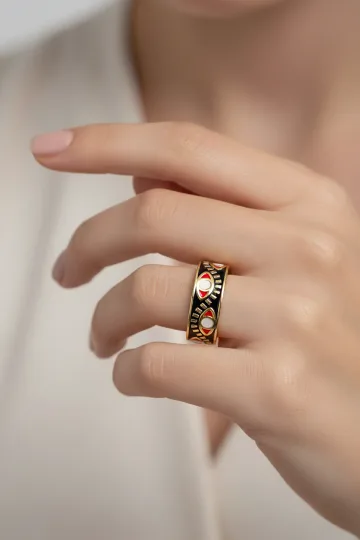
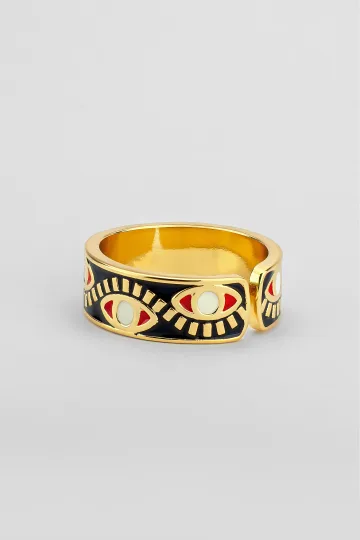
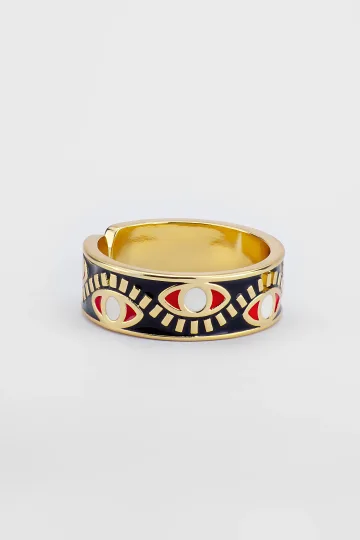
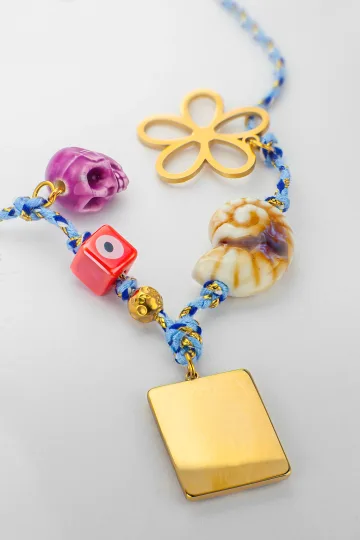
Wear the symbol, don't just read about it. These are in stock:
Materials for a Cuff: What to Choose for Daily Wear
A cuff touches the wrist every day, takes the squeeze of putting on and the bend of taking off. The material decides its look, its durability, its price, and how it feels against the skin.
Silver 925
The classic jewellery standard. Sterling 925 is an alloy of 92.5 percent pure silver and 7.5 percent copper (or another metal, usually copper or zinc). Pure silver (999 grade) is too soft for a cuff and deforms under any load. The copper gives the rigidity you need while keeping the colour and shine.
Silver 925 takes squeezing well. You can bend a silver cuff slightly by hand, though heavier adjustment is better left to a jeweller. Over time silver darkens from contact with air, sweat, and cosmetics, forming a dark sulphide tarnish. It cleans off easily with a soft cloth and silver paste or a treated wipe. There is more in the guide on how to clean gold and silver jewellery at home.
Who it suits. Anyone without a copper allergy. Silver 925 is universal in style, budget, and wear, the basic choice for a first cuff.
Gold 14K and 18K
585 gold (14 karat) and 750 gold (18 karat) are the two main standards for jewellery gold. 14K holds 58.5 percent pure gold, the rest an alloy of copper, silver, nickel, or palladium for rigidity. 18K holds 75 percent gold. The 18K is richer in colour and density but softer than 14K, and since rigidity matters most for a cuff, 14K is often the more practical pick.
A gold cuff sits in a different value category. It does not tarnish, needs no cleaning, and outlives its owner. It is also more prone to denting than silver: 18K is very plastic, and a hard squeeze leaves marks. Always have a gold cuff adjusted by a jeweller.
Who it suits. Those buying a piece for keeps, for decades and for inheritance. Those allergic to silver or copper (rare, but real). Those who wear gold watches, rings, and chains and want a matched set.
Brass
An alloy of copper and zinc with a golden colour. Brass costs less than precious metals yet often looks indistinguishable from gold. The downside: it oxidises in air and can leave a greenish mark on the skin (harmless to health but unappealing). You can seal the surface with lacquer, clear enamel, or rhodium, though any coating wears thin over time.
Brass cuffs are a good call for boho, a festival, a photo shoot, or a costumed event. Not for year round daily wear.
Copper
Pure copper has its own reddish colour and darkens over time toward brownish green as patina builds. On some people, copper leaves a green mark where it meets the skin, from the oxidation of skin chlorides. It does no harm but wants daily cleaning. There is more in the article on why jewellery turns skin green and how to fix it.
A copper cuff suits a rustic mood: boho, eco, vintage, festival. With age it earns a noble patina and often looks better than it did new. Some traditions hold that copper helps the joints. There is no scientific backing, but the psychological effect is real.
Bronze
An alloy of copper and tin, sometimes with a little aluminium or zinc. It is darker and denser than brass, the colour running from brown to deep gold. A bronze cuff is heavy and substantial, with a texture that looks as if it came straight from a dig. It is ideal for Viking, Celtic, and ancient styles.
Bronze patinates over time. That is normal, and many collectors leave bronze cuffs uncleaned on purpose, letting the patina deepen over years. If you want a fresh shine, seal it with lacquer after polishing.
Stainless Steel 316L
Surgical steel: hypoallergenic, does not tarnish, does not scratch easily. Heavy, strong, and far cheaper than gold. The downside is rigidity, so deep adjustment is possible only in a workshop with a press. A steel cuff either fits you from the start or it does not.
Who it suits. Men with large wrists. People who work with their hands and worry about damaging a soft metal. Anyone allergic to copper, nickel, or low grade alloys.
Titanium Grade 5
A high tech metal, about half again lighter than steel and stronger in tension. The colour is grey and matte. It is almost perfectly hypoallergenic, with reactions to pure titanium running at one case in millions. Titanium cuffs are often anodised, an electrochemical treatment that brings out colour from gold to blue and violet.
Titanium barely yields to adjustment, so buy your size right the first time. This is the most high tech cuff of all.
Stabilized Wood
Wood soaked with resin under pressure, becoming a tough material that shrugs off water and does not crack. Cuffs of stabilised wood are cut from ebony, cocobolo, and rosewood. The colour is deep, the texture natural, and the feel warm, since wood does not chill the wrist the way metal does.
The one drawback: wood does not bend. If the cuff does not fit, nothing can be done. So wooden cuffs are built with a generous gap to suit a wide range of wrists, which means they often spin.
Mixed Materials: Metal and Leather
A half cuff where a metal arc covers the upper wrist and a leather strap runs along the inside. A hybrid build: rigid metal outside, soft leather within. The leather soaks up sweat and the metal never touches the vein. Very comfortable in a warm climate and for anyone who dislikes metal on the skin.
The one drawback: leather wears out. A cuff like this lasts 3 to 5 years before the strap needs replacing. Good workshops take such cuffs in for service and fit fresh leather while keeping the metal part.
Cuff Styles: Directions and Their Characters
The same open bangle can be a minimalist accessory, a tribal ornament, or an art object. The style of a cuff decides what you wear it with and where you take it.
Minimalist Cuff
Flat, narrow (5 to 15 mm), undecorated. A smooth surface, matte or gloss. One material, no stones, no enamel, no engraving. The most versatile style, matching any clothing, any watch, any ring.
The minimalist cuff is armour without ornament. It suits the office, daily life, and travel. You can wear it with a t shirt and jeans or with an evening dress, and in both it stays out of the way of the rest of the look. It is the best entry point into cuffs for anyone who has not worn one before.
Metal colours for minimalist: silver, white gold, rhodium, matte steel. Yellow gold reads worse here because it adds character, and the minimalist look wants quiet.
Tribal Cuff (Boho, Native American, Latin American)
Wide, silver, set with turquoise, lapis lazuli, or coral. It may carry a complex geometric pattern drawn from folk tradition. Often hand forged, with visible hammer marks on the metal.
This style is historically tied to the cultures of the American Southwest, Mexico, and Guatemala. Today it is worn well beyond those regions as part of boho dressing. It looks good with denim, suede, leather, and linen dresses.
A tribal cuff wants a free wrist. Do not pair it with a watch on the same arm, which overloads the look. It works well with rings in the same vein and with fringed drop earrings.
Art Deco Cuff
Geometric patterns, black enamel on silver or gold, symmetry. Often wide, sometimes with a hinged centre. The idea is 1920s skyscraper architecture moved onto the wrist: zigzags, rays, triangles, diamonds.
Art Deco is an evening style, for a dress, a dinner, a premiere. It works poorly with everyday clothes because it is simply too strong. If you want Art Deco for daytime, choose a narrow version with minimal decoration.
Gothic Cuff
A dark palette, sometimes with skulls, crosses, spikes, or an ornament of branches and ivy. Silver with blackening, oxidised metal, sometimes matte black. The stones tend to be dark: onyx, hematite, black tourmaline, deep garnet.
The gothic cuff belongs to subcultural dressing, though in recent years it has crossed into wider fashion through renewed interest in dark aesthetics. It pairs with a leather jacket, dark colours, and silver chains. There is more in the article on gothic jewellery.
Ethnic Cuff (Moroccan, Indian, Celtic and Scandinavian)
Every cultural tradition produced its own subtype of cuff.
The Moroccan cuff is filigree and chasing in silver: fine openwork, an ornament of intertwined vines and flowers, sometimes with coloured enamel or mother of pearl. It is light for its size, because the work is openwork.
The Indian cuff is massive, engraved and inlaid. Silver or yellow gold with rubies, emeralds, and moonstone. Often hung with small drops along the edge or tiny bells. A very distinctive piece that asks for confidence in style.
The Celtic cuff continues the tradition of rigid armrings worn across the British Isles and continental Europe. Gold, silver, or bronze, engraved with the interlaced knotwork that has no beginning or end. There is more in the guide on Celtic knots and their meaning.
The Scandinavian cuff grows from the Viking armring, worn as a token of loyalty. Cast silver with deep relief, runes, plaited knots, and animal motifs, sometimes with enamel set into the recesses. There is more in the guide on Viking jewellery.
Classical Jewellery Cuff
Gold plus a single stone. A clean form with no excess. The stone sits at one point of the cuff, usually near the centre: diamond, sapphire, ruby, or emerald. This is the wedding cuff, jewellery for special occasions, gifts, and heirlooms.
The classical jewellery cuff is rarely worn daily. It lives in a box and comes out for the occasion. It suits anyone who values jewellery as an asset rather than a daily accessory.
Sculptural Art Cuff
A category of its own, where the cuff is not jewellery but a small sculpture. Made by sculptors and metal artists, often as a single piece or a small run. The form can be asymmetrical, the texture deliberately rough, marked by hammer and torch. Metal finishes run oxidised, patinated, sometimes with coloured anodising.
A sculptural cuff is not for a neutral wardrobe. It works against unprinted clothing with little other jewellery, or it turns into noise. It looks right in places with their own sense of style: at an exhibition, in a studio, at a premiere, among people who can tell jewellery from an art object.
Wedding and Paired Cuff
A special subtype. One cuff for the bride, one for the groom, usually engraved with names, a date, or the coordinates of where they met. Paired cuffs are made to each person's size and joined by a shared motif: the same pattern, a single stone split in two, matching initials.
Unlike wedding rings, paired cuffs need not be worn daily. They come out for anniversaries, milestones, holidays, and special events. The format suits couples who already have rings and want a second layer of paired pieces. There is more in the guide on matching engraved bracelets for couples.
Customer reviews
Zevira is a real jewellery shop. Genuine payments, deliveries and customer thank-yous.
🥰🥰🥰 gracias
Ok, ¡gracias! 🙂
Cases: Which Cuff Works for Whom
To keep style from staying abstract, here are some real situations. Each case is about the cuff itself and about the logic of choosing one for a person.
The Young Architect, for Himself
Twenty eight, works in a design studio, wears black turtlenecks and technical clothing, keeps accessories to a minimum. He wants something on the wrist that will not compete with his outward austerity but will add a little weight.
The choice: a silver minimalist cuff 8 mm wide, matte finish, no decoration. Metal thickness 2 mm, enough to hold its shape without visually thickening the wrist. He wears it on the left arm with a mechanical watch on a steel bracelet. Watch and cuff read as one set, both matte, both restrained.
Why it works. An architect lives in a system of lines and planes, and a minimalist cuff slots into that system as one more element. It does not turn him into "a man in jewellery"; he stays an architect who happens to have something on his wrist.
A Wife at a Milestone Birthday, from Her Husband
A woman turning forty five, with the basics already in place: a wedding ring, diamond studs, a chain with a pendant. He wants a gift that adds to her wardrobe rather than repeating what she owns.
The choice: a wide Art Deco cuff in yellow gold with black enamel. A geometric pattern of stylised rays spreading from the centre. Width 25 mm, the diameter taken from a measurement gathered quietly in advance, the husband borrowed her favourite bangle from her sister and measured it.
Why it works. Forty five is an age when a woman knows what suits her and is not keen to gamble on experiments. Art Deco is a classic that never dates, and black enamel with gold is a permanent pairing. A wide cuff brings density where a minimalist piece would fall short. The gift will be worn for years, then move into a daughter's jewellery box as an heirloom.
A Teenage Daughter
Sixteen, into rock music, lives in jeans and vintage t shirts. She wants real jewellery, nothing plastic or childish, but not too grown up either.
The choice: a silver boho cuff with a fine turquoise inlay across the centre. Width 15 mm, medium size. Silver without blackening, a natural shine. The cuff reads young enough yet is made of real 925 silver and will outlast her student years.
Why it works. A teenager is sensitive to how peers read her jewellery. A boho cuff with turquoise is a universally youthful code that looks neither childish nor borrowed from a parent. The silver gives it the status of a real thing. In ten years she will pull it from the box and wear it again.
A Biker
Forty five, twenty years on a motorcycle, physically solid, wears leather and denim. He wants a piece that looks like part of his own code and survives life on the road.
The choice: a heavy 316L stainless steel cuff 25 mm wide. No enamel, no stones, just a steel plate engraved with runes around the rim or a skull on a central medallion. Metal thickness 3 mm, so the cuff shrugs off a dropped bike, a day with tools, or a ride across the country.
Why it works. Steel is a technical, masculine metal with no whiff of expensive jewellery. A heavy cuff reads as part of the silhouette on a large wrist. The hypoallergenic nature of 316L matters for someone who wears a piece in any weather and sweats on the road.
A Collector of Cultural Artefacts
A woman of fifty to sixty, a long time traveller who brings one piece home from every trip. She loves things with a story, handwork, and a clear provenance.
The choice: a Moroccan filigree cuff brought back from Fez. Silver 925, openwork, 60 mm in diameter, made by a craftsman whose workshop opens onto the street. It was not bought from a tourist stall but ordered to size, and she returned for it three days later.
Why it works. For a collector the biography of a piece matters as much as its beauty. A Moroccan cuff made by a named maker, on a known day, to her wrist, carries a story no mass produced piece can. It becomes part of her map of the world and her account of Morocco.
A Programmer, a Team Gift
Thirty five, a lead developer, lives in plain t shirts and hoodies, has never worn jewellery. The team wants to mark five years with something he will actually use rather than drop in a drawer.
The choice: a titanium cuff of medium width (12 mm), anodised matte grey, laser engraved on the inside with the date, his colleagues' names, and a short line of code. The outer surface stays smooth and plain. Titanium is hypoallergenic, does not tarnish, does not scratch, and survives daily contact with a keyboard and a desk.
Why it works. For someone who has never worn jewellery, it matters that a first cuff draws no attention and prompts no questions. Matte grey titanium does not read as jewellery so much as a technical accessory, a cousin of a watch. The engraving from the team gives it emotional weight, so he wants to wear it. In a few years it becomes part of his daily kit.
An Artist, for an Exhibition
Forty, a sculptor, preparing for her own show. She wants a piece that holds up on camera during the opening and the interviews but does not pull attention from the work.
The choice: a wide hand forged copper cuff with visible hammer marks, patinated to dark brown. Width 30 mm, no stones, no inlay, pure work with the material. It was made by a smith she knows, and she can name the story behind every dent.
Why it works. For someone who makes visual work, it matters that the piece is "hers", made by hand, with a history, not off a shelf. A hand forged copper cuff reads as an extension of her own style and supports her sculptures rather than competing with them. In photographs from the show it works as a small accent, never stealing focus from the pieces on the wall.
A Grandmother at Seventy, from Her Grandchildren
A woman of seventy who wears classic jewellery, used to gold and pearls, has never owned a wide bracelet. Her grandchildren want a gift that surprises her without looking wrong for her age.
The choice: a 14K gold cuff of medium width (15 mm) with deep engraving, an old plant ornament in the early twentieth century style. Inside, an engraving with the date of her seventieth and the names of three grandchildren. The form is classic enough to fit her wardrobe yet unusual enough to be a new thing in her box.
Why it works. She recognises the engraving style as something her own mother wore in the 1920s and 1930s, and that builds an emotional bridge. The narrow width lets her wear it with other bracelets or a watch. The engraved names turn the cuff from ornament into a family piece that, in twenty or thirty years, will pass to the next generation.

Turn on your camera, pick earrings, a pendant or a ring, and see the piece on yourself in real time.
Switch items in one tap.
Everything runs in your browser: no photo or video is ever uploaded.
How to Wear a Cuff: Styling Scenarios
A cuff is versatile, but not for every look. To avoid missteps, here are working scenarios.
One Cuff as Accent
The strongest and simplest scenario. One bold piece on the wrist and nothing else, no watch, no other bracelets, no thin chains. All the attention goes here. It works with any style of clothing, from an evening dress to a t shirt.
The key condition: the cuff has to be expressive enough to carry the lead. A narrow minimalist cuff fails this role, leaving the wrist looking bare beside it. For this scenario reach for a cuff from 15 mm wide, with texture or a colour accent.
Wear it on your dominant hand (the right for right handed people, the left for left handed), where it catches the gestures more often and does more for the look. On the other hand it appears less and the effect fades.
Cuff plus Charm Bracelet
The cuff plays the calm element on one arm, a charm bracelet the lively one on the other. That gives a balance: one wrist with firm geometry, the other with movement and sound. Good for anyone who likes to play with jewellery but fears overloading the look.
When pairing this way, match the metals: both silver or both gold. Mixing metals works only as a deliberate choice, never by accident. There is more in the guide on mixing metals in jewellery.
A Stack of 3 to 5
A harder but striking scenario. Several cuffs of different widths on one arm, built from thin to thick or alternating. The main rule of a stack: one material and one style. Five silver minimalist cuffs, five bronze boho cuffs, five forged tribal ones. A mix of styles in a stack works only for experienced stylists.
A stack reshapes the wrist visually. It suits summer looks with short sleeves, boho dressing, and the art scene. For the office it is out of place, and for sport even more so.
Line up the stack by gap: if every gap sits on the same side, the stack looks ordered. If the gaps scatter, it looks chaotic.
Under and Over the Sleeve
A separate strategy for cold weather, when the arms are covered. A narrow minimalist cuff can be worn under the sleeve, showing only when a gesture shifts the fabric. This is the secret piece for anyone who does not want to display jewellery but wants to feel it. It works well in an office with a dress code or at serious meetings.
A wide cuff, by contrast, goes over the sleeve of a blouse or thin sweater. Here it works like a Roman armilla worn over cloth rather than on skin. The one condition: the fabric must be thin, or the cuff presses and crumples the sleeve. Chunky knits and double cuffed shirts are out. Thin cotton, silk, fine wool, and light cashmere work best.
Cuff plus Watch on Different Hands
The classic combination for anyone who wears a watch daily. Watch on one arm, cuff on the other. The watch stays a working tool, the cuff stays ornament. The look is balanced, symmetrical, both arms in play.
Match the metals of watch and cuff. A watch on a steel bracelet, a silver or steel cuff. A watch on a gold bracelet, a gold cuff. A watch on a leather strap, any cuff, ideally with a minimalist metal.
Cuff with Rings and Earrings of One Style
A cuff rarely works alone. To pull a look together, the rings and earrings beside it should share its style. Minimalist cuff, thin rings, and studs. Boho cuff, large turquoise rings, and fringed drops. Art Deco cuff, geometric rings, and enamel earrings.
Do not pair a cuff with jewellery from the opposite style. A boho cuff plus a classic gold solitaire ring is a clash of two aesthetics, and one of them ends up looking accidental.
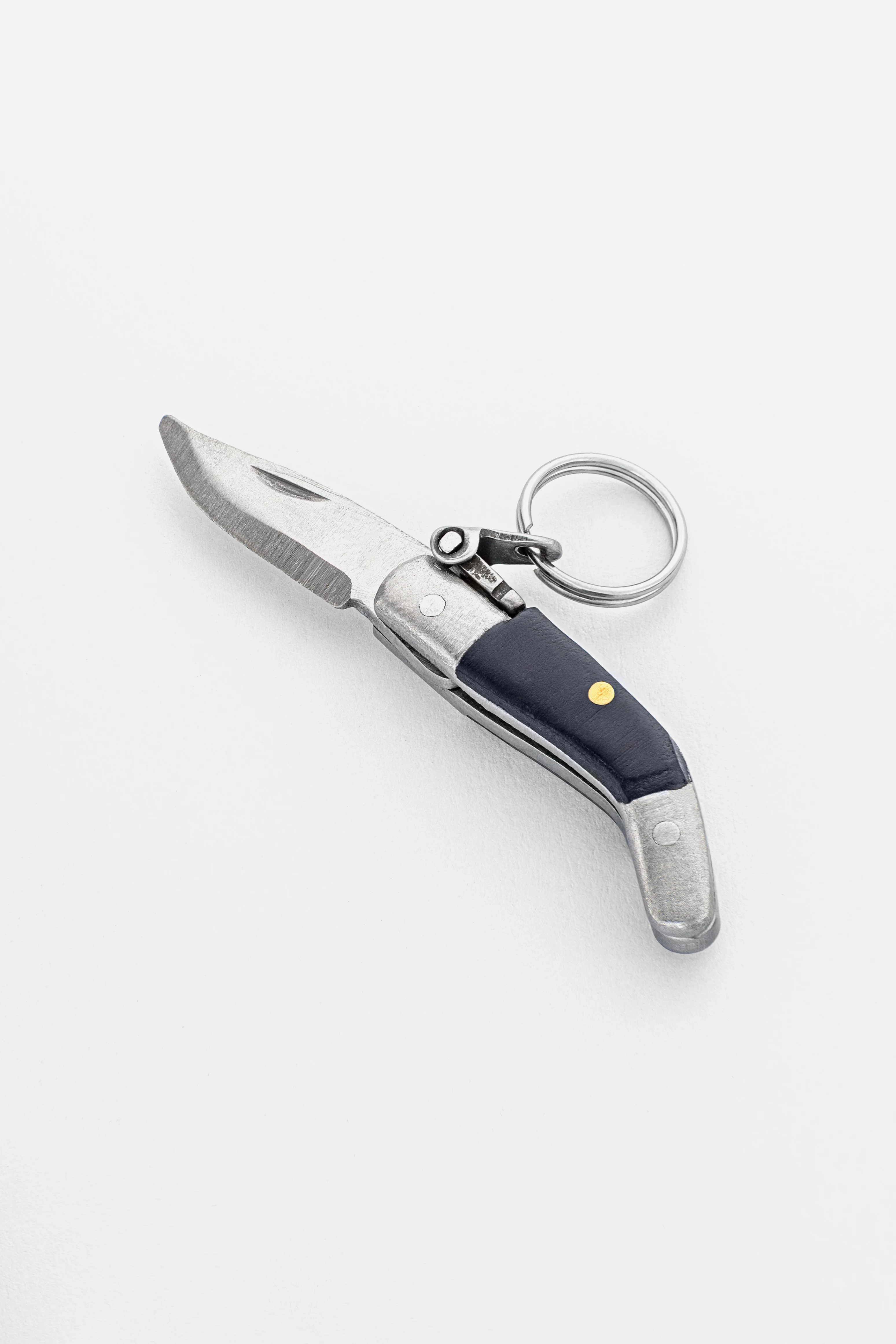
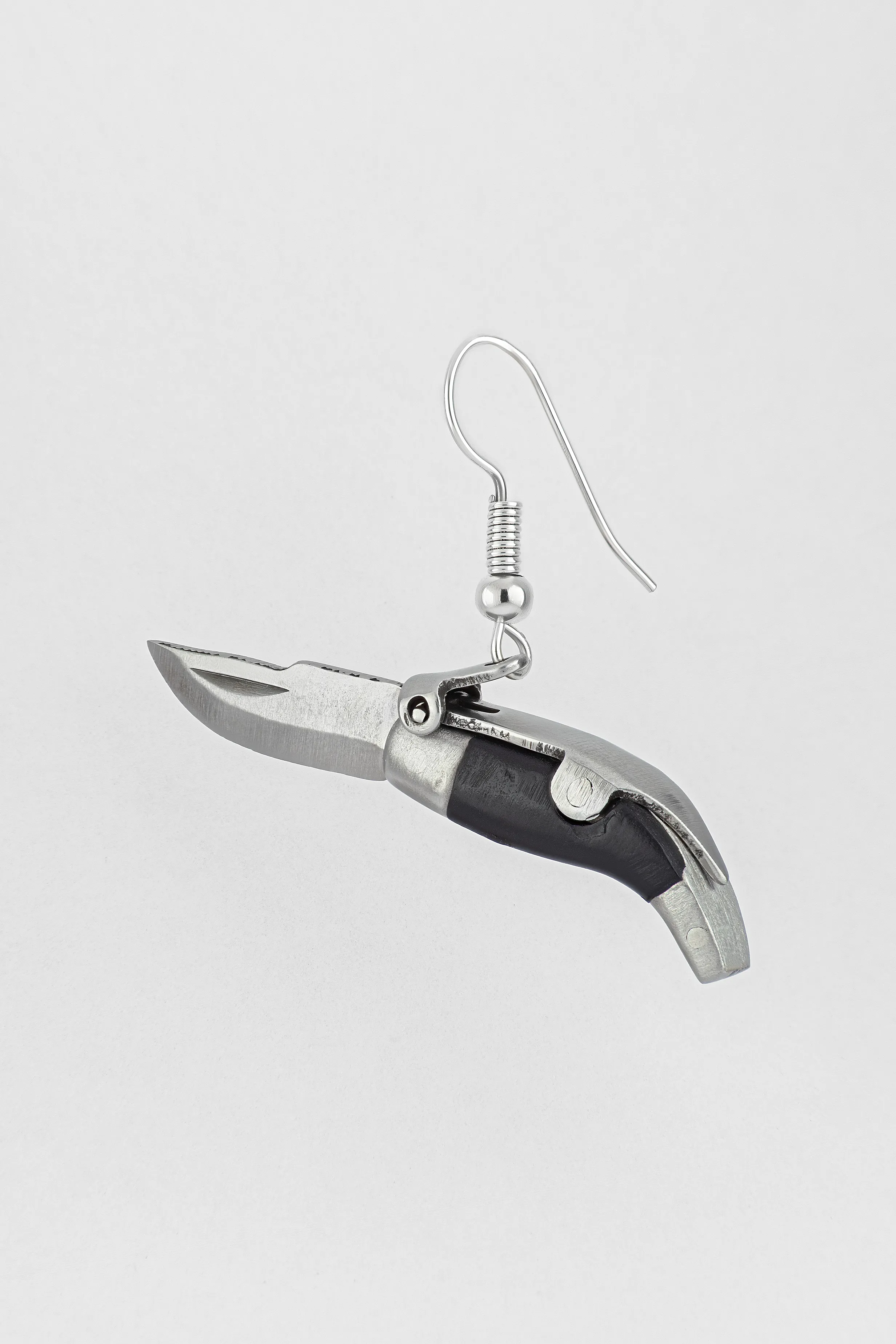
Artisan-crafted CAPAORA navaja pendant
A 40 mm stainless-steel navaja with a real folding mechanism and Palanquilla lock. An affordable gift to remember.
A code for blog readers:
10% off your first order
Authentic · Maker's guarantee · Ships from Spain
Antipatterns: Mistakes in Cuff Selection
Most disappointment with a cuff comes not from the piece but from a wrong choice. Here are the most common mistakes and how to avoid them.
Too Rigid
A thick steel or titanium cuff that will not open by hand for wearing. The buyer sees a good photo, orders it, receives it, and cannot get it on. The hand will not pass through the gap, and there is not enough strength to open it.
The fix. Before buying, ask the seller about metal thickness and how the piece flexes. A steel cuff 3 mm or thicker barely bends in the hand. If you have a broad hand, choose silver, gold, brass, or bronze, all of which are ductile and take fitting. If you truly want steel or titanium, order a larger size from the start, with a gap the hand passes through without forcing.
Too Thin Metal
A silver cuff 1 mm thick starts to bend at the first active wear, the gap widening then narrowing. The cuff loses its shape and turns into an oval within half a year. Cuffs this thin are often made of cheap silver plate that cannot take repeated squeezing.
The fix. For a cuff, the idea that thinner is better simply does not hold. Aim for at least 1.5 mm in silver and at least 2 mm in brass and bronze. Go thinner only if the cuff is a decorative piece for a single outing rather than a daily one.
Sharp Edges
Burrs, rough spots, and sharp corners on the ends of the cuff. They catch the skin while wearing, scratch the arm, and leave red marks. Sometimes such a cuff tears a blouse cuff or scratches a laptop screen.
The fix. Before buying, run a finger over the ends. They should be rounded and feel smooth, with no resistance. If you feel roughness, ask for extra polishing. At home you can use a fine nail file and polishing paste. Silver and gold take this work easily; steel and titanium only in a workshop.
Wrong Size
Too large and it slides over the hand and gets lost. Too small and it presses on the vein, leaves a mark, and starts to hurt after a few hours. This is the most common complaint when a cuff is bought without measuring.
The fix. Measure the wrist before buying, not after. Do not trust a "universal size", which does not exist. Good makers offer cuffs in at least three sizes, S, M, and L (with a 50 to 65 mm inner diameter range). Premium workshops make to the client's exact measurement.
Conflicting Material
A brass or copper cuff on someone with sensitive wrist skin. A green mark after a day, irritation after a week, an allergic reaction after a month. Sometimes the buyer has no warning, having never worn these metals before.
The fix. If you have never worn brass or copper in close contact with skin, start with a short trial. Wear the cuff for half a day and check the skin. At the slightest irritation, stop wearing it. For sensitive skin the best choices are silver 925, gold from 14K, stainless steel 316L, and titanium. There is more in the article on nickel free jewellery and allergies.
Leave your email, we'll send your discount code. No spam, unsubscribe anytime.
The code arrives by email, valid on your first order.
Care and Adjustment: How to Keep a Cuff for Decades
A cuff takes more mechanical strain than most bracelets. Every time you put it on or take it off is a tiny bend of the metal. To make it last, a few rules help.
How to Squeeze a Cuff
Adjustment is rare, needed only at first wear or if the cuff has loosened. Squeeze it by technique, or the metal fatigues and cracks.
Hold the cuff in both hands, the gap facing up and away from you. Put your thumbs on the inside, the rest of the fingers on the outside. Gently press the ends together by 2 to 3 mm. Not straight to the target, but step by step. Between squeezes, try the cuff on the wrist and check the fit. If it is still loose, press another 2 to 3 mm. Repeat until it sits firmly without pain.
Never squeeze a cuff around a hard object. Do not wind it onto a door handle, a rod, or a bottle, which all bend it at one point and deform the metal unevenly. Always squeeze by hand, symmetrically from both sides.
How to Open a Cuff
The reverse, needed if the cuff has grown too tight. The same grip and finger positions, but now you ease the ends apart. Again step by step, 2 to 3 mm at a time.
Opening fatigues the metal faster than squeezing. Do not open a cuff more than five to seven times over its whole life; after that the metal accumulates fatigue and can crack at any moment. If you sense a major adjustment is needed, take it to a workshop. A jeweller does it on a tool that spreads the load evenly.
Adjusting Through Cloth
A professional trick. Before squeezing or opening, wrap the cuff in a soft cloth (a thin towel, suede, or flannel). The fingers leave no prints on a polished surface and the metal scratches less. The cloth also spreads the pressure from your fingers, making the squeeze more even.
Periodic Gap Check
Twice a year, check the gap. If it has widened from when you bought it, the cuff has loosened, so press it 1 to 2 mm. If it has narrowed, you may have sat on it or crushed it in a bag, so ease it open a little.
Polishing
Silver and gold cuffs polish up with a treated wipe, which lifts surface oxidation and brings back the shine. Do this monthly or as needed.
Deep polishing belongs in a workshop. A badly scratched cuff can be sent out and brought back to near new. Keep in mind that deep polishing removes a thin top layer of metal, so do it no more than three or four times over the life of the piece. Polish engraved cuffs with extra care, since heavy work can wear away the design.
Cleaning Tarnish
Silver darkens from air, sweat, cosmetics, and the sulphur in water. Light tarnish lifts with a soft cloth and silver paste or simply a polishing wipe. Heavy tarnish comes off by dipping in a dedicated silver cleaning solution for 1 to 3 minutes, then rinsing in water and drying fully.
Gold is simpler: warm water with a drop of dish soap, a soft brush (a child's toothbrush), then dry it off. There is more in the general guide on how to clean gold and silver jewellery at home.
What Not to Do
Do not squeeze a cuff while it is wet, since water raises the risk of spots and micro corrosion. Do not squeeze it around hard objects. Do not open it more than five to seven times in its life. Do not wear it in a chlorinated pool, since chlorine attacks silver. Do not leave it in a jeans pocket, where it takes the shape of the pocket. Do not let children play with it, since they can crush it into an oval in half a minute.
Storage
Keep each cuff in its own cloth pouch or a slot in a jewellery box. Do not stack cuffs on top of one another, especially stone set ones, since they scratch each other. For silver, a sealed bag with an anti tarnish strip is ideal, and jewellery shops sell them.
The Cuff in Different Cultures
The cuff is a rare format that exists in almost every jewellery tradition on earth. Each culture gave the open bangle its own character, and knowing these regional traits helps you choose a cuff for your own taste.
Mediterranean
The Greek and Roman tradition of the cuff means gold, engraving with plant or mythological motifs, and a clean form with no stones or a single large stone at the centre. Workshops in Athens, Rome, and Barcelona still follow this line, making 18K gold cuffs engraved with a meander, laurel branches, or the heads of mythological creatures. The style is strict and noble, built for decades of wear. Such cuffs are often made in pairs, one for a mother, one for a daughter in the same design.
The Spanish tradition stands apart. After centuries of contact with Arab culture, the Spanish cuff absorbed the ornament of the Emirate of Granada and of Toledo. Damascene, the technique of inlaying fine gold wire into dark iron, is still practised in Toledo today, and a damascene cuff of dark iron with a golden plant ornament is made exactly as it was four hundred years ago. There is more in the guide on Toledo damascene Spanish jewellery.
Northern and Viking
The Scandinavian and Viking tradition of the cuff means silver engraved with runes, plaited knots, and animal motifs. Vikings wore rigid armrings as a sign of oath to a chief: a warrior received a silver ring from the hand of a king and wore it as proof of loyalty. Some such rings survive in hoards of the tenth and eleventh centuries, found across territory from Scandinavia to the British Isles and Eastern Europe.
The modern Viking cuff is one of the most popular men's formats. Cast silver with deep relief, motifs from the Poetic Edda and the sagas, sometimes with enamel set into the recesses. There is more in the guide on Viking jewellery.
Celtic
The Celts of the British Isles and continental Europe made rigid armrings and cuffs of gold, silver, and bronze. Pieces of the first to third centuries found in the peat bogs of Ireland and Scotland show a sophisticated interlace: ribbons that weave into an endless pattern with no beginning and no end. The Celtic knot became a decorative system in its own right and still appears on cuffs from Celtic workshops in Ireland, Wales, and Brittany.
A Celtic cuff reads as a piece with a symbolic charge. Each knot carries its own meaning, from protection of the family to eternity of love. It suits anyone who values jewellery with a history and a symbol. There is more in the guide on Celtic knots.
African
The African tradition of the cuff is among the most varied in the world, with each region offering its own style. The Ethiopian silver cuff with filigree and granulation. The Berber silver cuff set with amber and coral. The Zulu copper or brass cuff with wire wrapping. The Tuareg silver cuff with engraved geometric ornament. The Swazi copper cuff with patina.
African cuffs are often massive, wide, and richly textured. Both men and women wear them. Many tribal cuffs are at once currency and ornament: in nomadic societies, silver on the arm was a way to carry wealth, and the cuff was the most convenient format for it.
Asian
Beyond the Indian, Persian, and Tibetan traditions already noted, China and Japan deserve their own line. The Chinese cuff (around the Tang dynasty, seventh to ninth century) was made of jade and silver, sometimes from a single piece of jade. Paired cuffs were worn alongside hairpins and earrings. The Japanese tradition leans toward a spare aesthetic: silver cuffs with light engraving of characters or nature motifs (a wave, a pine, a crane), without excess. The wabi sabi spirit, the beauty of imperfection, shows in cuffs with a deliberately uneven surface, patina, and the marks of the maker's hammer.
Sizes and Proportions: Choosing by Build
A cuff works not at one point of the wrist but across the whole line of the arm. To make it flatter your build rather than break your proportions, here are the principles by body type.
Thin Wrist
A narrow wrist wants a narrow cuff. A wide band (25 mm and up) visually eats the arm, making it look thinner and more fragile. If you are slight of build, your comfortable maximum is 15 to 20 mm. Better still is a 5 to 12 mm minimalist cuff in matte silver or white gold, with no heavy decoration.
Thickness matters too. A thin band (1 to 1.5 mm) suits a slight wrist better than a heavy casting. A stack of several narrow cuffs works better on a delicate wrist than one wide one, adding visual layers while each layer stays light.
Average Build
The universal range. Almost any width from 5 to 30 mm works, any style, any metal thickness. The main rule: choose by lifestyle, not by build. If you gesture a lot and work with your hands, a narrow or medium cuff is more comfortable. If you want an evening piece, you can go toward 25 to 30 mm.
Large Build
A broad wrist wants visual mass. A narrow 5 to 8 mm minimalist cuff gets lost on a large arm and reads as a child's piece. The minimum width for a broad wrist is 15 mm, the sweet spot 20 to 30 mm. Metal thickness from 2 mm, or the cuff looks disproportionately thin for its width.
A stack on a broad wrist works differently: not one above another, but as a single block of three or four cuffs aligned in height. That creates the effect of an ancient bracer and looks excellent on men's arms.
Tall
Tall builds can carry larger cuffs without breaking proportion, because the overall silhouette reads the arm as part of a long line. Shorter builds with the same cuff width can look weighted at the wrist. If you are tall (from 175 cm for women, from 185 cm for men), go confidently toward 25 to 40 mm.
Ratio with Other Bracelets
If anything else shares the arm, the cuff has to leave room. Keep at least 1.5 to 2 cm of bare wrist between the cuff and a watch, or between the cuff and another bracelet. Otherwise the pieces compete and scratch each other. A stack of cuffs is the exception: a stack sits close, with no gaps.
What to Wear a Cuff With
A cuff loves a bare wrist, so the first rule is simple: the sleeve is either short or moves easily. Anything that leaves the arm above the elbow bare, or covers it in thin fabric, plays to the cuff's advantage.
For an everyday look, a narrow or medium minimalist cuff in silver or matte steel sits well with a white t shirt, a linen shirt with rolled sleeves, and jeans. Here the cuff works as a quiet detail, noticed on a second glance, which is exactly right for daytime. It pairs well with cool tones, grey, blue, white, and olive.
For the office, a thin band under the sleeve of a blouse or jacket shows only on a gesture and breaks no dress code. Reach for smooth silver or white gold, without stones. Warm yellow gold works too, but better as a single narrow piece, with no stack.
For an evening out, the cuff becomes the lead. A dress with bare shoulders or a short sleeve, a clean neckline, and a wide Art Deco cuff with black enamel or a classic gold cuff with one stone takes the role of the main piece. Black, wine, and emerald fabrics deepen the metal's shine. Studs or small drops, and nothing else on the hands.
For a special occasion, a wedding, an anniversary, or a graduation, this is the moment for a paired or engraved cuff. Silk, satin, and fine wool make the best background, since on smooth fabric the cuff reads clearly without visual noise.
For pairing with other jewellery, hold to one style and, where you can, one metal. Minimalist cuff, thin rings, and studs. Boho turquoise cuff, large rings, and drop earrings, with suede, denim, and linen. Mixing gold and silver is fine, but as a deliberate decision rather than chance.
A cuff suits anyone who talks with their hands and does not mind the piece being noticed. If the wrist is thin, choose a narrow band and a stack of two or three over one wide piece. For daytime, take a width up to 15 mm in a cool metal; for the evening, from 20 mm with texture or a stone, and match the cuff metal to the rest of the jewellery on the arm.
FAQ
Cuff or bangle, which to choose?
If you have a broad hand, a cuff is easier. A bangle has to go on by squeezing the hand, which hurts for large hands, while a cuff simply opens at the gap. If the hand is slim, a bangle suits better: it sits evenly, with no gap, and needs no fitting. By style, a bangle is the more classic answer and a cuff the more distinctive one. For the office a bangle is more versatile; for the evening a cuff is more expressive.
Can I wear a cuff with a watch?
You can, but ideally on different arms. A cuff and watch on the same arm overload each other: the cuff spins, scratches the watch case, and the strap catches the cuff's ends. Put one on the left, the other on the right. The exception is a very narrow minimalist cuff (5 mm), which can sit beside a watch on the same arm if there is room between the base of the hand and the lower edge of the watch. That calls for a precise fit.
How do I work out my cuff size?
Measure the wrist with a flexible tape at the narrowest part, divide the circumference by 3.14, and you get the diameter. Add 5 to 7 mm. For example, a wrist circumference of 17 cm divided by 3.14 gives 5.4 cm, or 54 mm. Add 7 mm and you reach 61 mm. That is your inner diameter.
My cuff keeps slipping off, what do I do?
Squeeze it 3 to 5 mm by the technique above. If it still spins and slides after that, it was simply too large for your wrist to begin with. Buy a smaller size, or take it to a workshop for shortening, where a jeweller removes 5 to 10 mm of metal and rejoins it.
Can the size of a cuff be adjusted?
Yes, within limits. Silver and gold take hand fitting of 5 to 10 mm of diameter. Steel and titanium cuffs only in a workshop. Repeated opening and squeezing wears the metal, so adjustment should be rare, ideally a single fitting at purchase.
Is a cuff fine for men, or is it a women's piece?
The cuff began as a men's piece. Roman armillae were worn by legionaries, Viking armrings by warriors, and tribal Navajo cuffs are traditionally worn by men. Only in the twentieth century did the cuff lean toward women's jewellery, and that is a passing shift of fashion. More men are returning to the cuff as part of a male jewellery wardrobe. For a men's cuff, choose 15 to 25 mm width, silver or steel, minimal decoration. There is more in the guide on meaningful jewellery gifts for men.
I get a reaction from a cuff, what should I do?
Take it off. If the skin turns green or red, the material does not suit you. The usual culprit is brass or a cheap nickel alloy. Switch to silver 925, gold from 14K, stainless steel 316L, or titanium. There is more in the article on nickel free jewellery and allergies.
Can I order a cuff in a custom size?
Yes, many workshops do this. Measure the wrist, give the maker the figures, and choose metal and style. Production runs from 2 to 8 weeks. The cost sits 30 to 50 percent above a stock piece, but the cuff fits perfectly.
My cuff cracked, can it be repaired?
It depends on the metal and the crack. Silver and gold can be soldered, so a jeweller fills the crack and polishes the spot. Steel and titanium do not take ordinary solder and need argon welding, which not every workshop offers. Bronze can be soldered, though the join shows because of the colour. Wood cannot be mended, only replaced.
Send a friend a discount code, they save on their first order.
A Cuff as a Gift: Choosing for Someone Else's Wrist
Gifting a cuff is harder than a chain or earrings. With a chain the length adjusts or fits most people. With a cuff the size is critical: if it does not fit, it cannot be worn. So a cuff gift takes a little reconnaissance.
The simplest way to learn a wrist size is to ask a mutual contact. A sister, a mother, a best friend, one of them has surely seen the recipient wearing a bracelet and can either name her usual jewellery size or borrow her bangle to "try on" and pass you the figures. A second route is a measurement taken at a meeting, under the cover of trying on something neutral (a watch, a scarf, a fitness band). A third is to look at her usual bracelets in her social media and gauge the width against her wrist.
If you cannot work out the size, there are backups. First, choose a cuff with a large gap (25 to 30 mm), which fits a wide range of wrists and can be adjusted if needed. Second, buy from a workshop that guarantees fitting or a size exchange within a month. Third, give a gift certificate for the value of a cuff and let the recipient choose the size in person.
When choosing the style of a cuff to give, take your cue from her existing jewellery. If she wears classic gold, give a classic gold cuff. If she wears boho and silver, give a boho cuff. Do not try to "update" her style through a gift. That works once in a hundred times and usually ends with the cuff in a drawer. A gift should add to her wardrobe, not argue with it.
Conclusion
A cuff bracelet is a rare blend of simple construction and complex character. No clasp, no fastening, no clever opening mechanism, and yet a history two thousand years long, with cultural layers from Roman legionaries to Navajo tribal makers, from Paris Art Deco to Scandinavian minimalism.
Choosing a cuff is, first of all, choosing a relationship. To the metal, to the wrist, to the daily ritual of putting it on. To whether the jewellery sees you or you see the jewellery. To whether you wear it as part of yourself or as a decoration.
A good cuff sits so well that you forget it, and you remember it only when someone pays a compliment. In that moment you understand the choice was right.
About Zevira
Zevira is a Spanish brand from Albacete with a handcraft workshop and our own 925 silver production. We make bracelets, rings, pendants, and earrings across the Mistico, Arcana, and Knife collections, plus matching lines for couples. We take custom orders and reforge family metal into new pieces. Every item goes through alloy control and comes with a passport and certificate. We ship worldwide with insurance.