The Great Jewel Heists: Stolen Crowns and Legendary Stones
When a gemstone is worth more than the crown
On 9 May 1671 a man dressed as a clergyman knocked out the keeper of the Tower of London with a wooden mallet, then used that same mallet to flatten the English imperial crown so he could hide it under his clothes. He was seized at the gate. The king pardoned him and handed him land and a pension.
Stories like this have circled crowns and famous stones for centuries, and they share one logic across the gap of time. A gemstone is power, money, and risk packed into a single object that fits in the palm of your hand. It needs no signature, no bank, no border control. Steal it and you hold a fortune that weighs nothing; lose it and it can vanish into a stranger's pocket forever. That is why a handful of crystals has cost more guards, sentences, and reputations than most acts of war. The twelve stories below run from a Restoration adventurer to a Berlin clan tunnelling into a Saxon treasury, and at the end we come back from the museum cases to a stone you can actually wear without breaking the law.
Colonel Blood and the Crown of England, 1671
Thomas Blood, an Irish adventurer whose biography reads as part officer, part con man, spent months laying the ground for the theft. He arrived at the Tower in the robes of a parson, with a woman posing as his wife, and struck up a friendship with the seventy-seven-year-old keeper of the jewel house, Talbot Edwards. Over repeated visits he became almost family: he proposed a match between a fictitious wealthy nephew and Edwards's daughter and used the betrothal as a reason to call again and again. The point of all of it was access. The regalia sat behind a metal grille in the basement of the Martin Tower, and Blood needed the old keeper to let him in without suspicion.
On the morning of 9 May 1671 he returned with three accomplices, supposedly to let his "nephew" see the collection before the wedding. As Edwards lifted the grille, the men threw a cloak over his head, beat him with a wooden mallet, and stabbed him when he struggled. Then they set to work on the regalia itself. They flattened St Edward's Crown with the mallet so it would fit under a cloak, filed the sceptre in two because it was too long to carry whole, and stuffed the orb down a pair of breeches. They almost made it out. Edwards's son returned home unexpectedly, the alarm went up, and the gang was run down inside the Tower precincts. Blood dropped the crown as he ran and was taken with it almost in his hands.
Then comes the strange part. Charles II did not execute Blood. He summoned him for a private audience, then pardoned him outright and granted him Irish lands worth several hundred pounds a year. Historians have argued ever since over why a king would forgive a man who had assaulted his crown, with theories ranging from Blood's sheer nerve and charm to the idea that he was already a useful informer for the crown and too dangerous to make a martyr of. The crown jewels survived the episode dented but intact, and they have never since left the Tower.
The Queen's necklace that ruined a reputation, 1785
The piece at the centre of the affair was a monster: a diamond rivière of 647 stones weighing some 2,800 carats, originally designed by the Paris jewellers Boehmer and Bassenge for Madame du Barry, mistress of Louis XV. The king died before he paid for it, and the jewellers were left holding an unsellable fortune. Into that opening stepped Jeanne de La Motte, a charming swindler who claimed descent from a royal bastard line. She convinced the ambitious Cardinal de Rohan, desperate to win back the favour of Marie Antoinette, that the queen secretly wished to buy the necklace and needed him to act as her go-between.
La Motte forged letters in the queen's hand, even staged a moonlit meeting in the gardens of Versailles with a prostitute dressed as Marie Antoinette to seal Rohan's belief. The cardinal agreed to guarantee the purchase in instalments and took delivery of the necklace, which he passed to a man he thought was the queen's servant. The stones promptly vanished: La Motte's husband carried them to London, where the necklace was broken up and the diamonds sold piecemeal. The queen had never been involved in the deal at all.
When the scheme collapsed and the unpaid jewellers went to the palace, the scandal exploded into a public trial. Rohan was acquitted, which read as a humiliation for the crown, and La Motte was branded and imprisoned before escaping to England. Marie Antoinette emerged technically innocent and thoroughly damaged: the public, already primed to believe the worst of her, was now certain she squandered fortunes on jewels while France starved. Napoleon later said the queen's death dated from the necklace trial, and historians still count the affair among the cracks along which the monarchy split a few years before the revolution.
Customer reviews
Zevira is a real jewellery shop. Genuine payments, deliveries and customer thank-yous.
🥰🥰🥰 gracias

Ok, ¡gracias! 🙂

The French crown and the diamond that became the Heart of the Ocean, 1792
By September 1792 revolutionary Paris had let the guard over the royal storehouse, the Garde-Meuble on the Place de la Concorde, fall apart. The treasures of the crown were on public display with almost no security, and a loose band of thieves simply climbed the colonnade at night, lowered themselves in, and helped themselves. They came back five nights running, growing bolder each time, drinking and feasting between trips, until dozens of accomplices were filing through the building. Among the loot were the Regent and Sancy diamonds, the order of the Golden Fleece, and a large deep-blue diamond of around 69 carats known as the French Blue.
The fallout was tangled in politics. The theft happened just as France went to war, and there were lasting suspicions that someone in the new government had let it happen to free the gems for bribes abroad. The Regent proved too famous to fence: a year later it was recovered, hidden in the rafter of a Paris attic, and it survives in the Louvre to this day. The blue diamond was less lucky for the investigation and far luckier for the legend. It vanished, then resurfaced decades later in London, recut into the smaller stone now called the Hope Diamond. That the Hope and the missing French Blue were one and the same crystal was only proven in 2005, more than two centuries later, when a surviving lead cast of the original stone was matched to it by computer model.
It was the Hope that gave screenwriters the idea for the fictional "Heart of the Ocean" in the film about the Titanic. The real blue diamond outlived any plot and now sits in the Smithsonian in Washington. For why the colour blue in a stone is prized so highly and how it forms, there is a separate piece on sapphire colours.
The Irish regalia that vanished forever, 1907
The jewels of the Order of St Patrick, the so-called Irish Crown Jewels, were kept in a safe at Dublin Castle, in the office of the Ulster King of Arms, Sir Arthur Vicars. Their disappearance was discovered on 6 July 1907, just four days before a state visit by Edward VII, in the worst possible week for the men responsible. The safe stood undamaged and had been opened with a key, and the door of the strongroom showed no forced entry. There were only a handful of keys, and that fact pointed straight at someone with legitimate access.
What vanished was the grand master's diamond star of the order, set with a shamrock of emeralds and a cross of rubies on Brazilian white diamonds and blue enamel, a diamond badge, and five gold collars of the knights. The investigation quickly turned messy. The chief suspect named in the press was Francis Shackleton, brother of the polar explorer Ernest Shackleton and an associate of Vicars's household, but the inquiry was steered away from anyone too well connected. A commission cleared Vicars of personal theft yet found him negligent, and he lost his post; he never accepted the verdict and accused Shackleton to the end. The case was closed without a single criminal charge over the jewels themselves. The regalia have never been found. It remains the largest unsolved jewel theft in Irish history, and every few years the newspapers return to fresh theories about where the stones might have ended up.
Wear the symbol, don't just read about it. These are in stock:






The Florentine Diamond that vanished with an empire, 1918
A yellow diamond of almost 137 carats, cut in an elaborate double rose with many facets, the Florentine travelled through the loudest treasuries of Europe. Its legend ties it to the Medici of Florence, and by tradition it once belonged to Charles the Bold of Burgundy, lost on a battlefield in the fifteenth century. By the modern era it had settled firmly in the crown jewels of the Austrian Habsburgs, worn as a brooch and a hat ornament by the imperial family. It was one of the great named diamonds of the world, recorded, drawn, and weighed.
After defeat in the First World War and the collapse of Austria-Hungary, the last emperor, Charles I, went into exile, and the imperial family carried part of the jewels with them into Switzerland for safekeeping. There the trail of the Florentine breaks off. By the most widely repeated account the stone was stolen by someone close to the family, smuggled to South America or the United States, and recut so the famous crystal could never be identified again. No version of the story carries hard proof. For more than a century the Florentine Diamond has been listed as lost, and it is a rare case where what disappeared was not merely an expensive stone but one of the visible symbols of a fallen dynasty. Periodic claims that it survives, recut and unrecognised in a private collection, have never been confirmed.
The Star of India: a night raid on the museum, 1964
On the night of 29 October 1964, three men led by Jack Murphy, a champion surfer and small-time criminal nicknamed Murph the Surf, climbed the fence of the American Museum of Natural History in New York. They had cased the building for days. They went up a fire escape, found an open window into the Hall of Gems left ajar for ventilation, and lowered themselves in. With a glass cutter and tape they opened the cases and gathered roughly two dozen stones in a matter of minutes, then left the way they came.
The haul was extraordinary. It included the Star of India, a star sapphire of 563 carats the size of a golf ball and one of the largest in the world, along with the DeLong Star Ruby, the Midnight Star black sapphire, and the Eagle Diamond. What made the raid notorious was how ordinary the failure of security had been: the alarm on the Star's case had been broken for a long time, the museum had not fixed it, and the window stood open on the night. The investigation moved fast. Murphy and his accomplices were arrested within days, and most of the stones, the Star of India among them, were recovered from a locker at a Miami bus terminal after the gang tried to ransom them. Murphy cut a deal, helped return the loot, and served only a couple of years for the theft. The Eagle Diamond was never seen again and is presumed to have been cut up. The episode spread through books and films as the textbook museum robbery and made Murphy briefly famous, though he was later convicted of murder in an unrelated case.
Artisan-crafted CAPAORA navaja pendant
A 40 mm stainless-steel navaja with a real folding mechanism and Palanquilla lock. An affordable gift to remember.
A code for blog readers:
10% off your first order
Authentic · Maker's guarantee · Ships from Spain
The Millennium Dome raid: the heist that failed, 2000
On 7 November 2000 a gang set out to pull off what could have been the most audacious robbery in London's history. The plan read like a screenplay: ram the wall of the De Beers diamond exhibition inside the Millennium Dome with the bucket of a JCB digger, smash the display case with a nail gun and sledgehammers, cover the escape with smoke grenades, and get away down the Thames on a waiting speedboat. The target was a single case of diamonds, and at its centre lay the flawless 203-carat Millennium Star and eleven rare blue diamonds, a collection valued at around £200 million.
What the gang did not know was that the police had been watching them for months. The Flying Squad had tracked their earlier failed attempts, and by the day of the raid the real stones had been quietly swapped for replicas. More than a hundred officers, many disguised as cleaners and Dome staff, were waiting inside and around the hall, with marksmen in position. When the digger crashed through the perimeter and the robbers rushed the case, they were seized on the spot, holding worthless fakes. The boat crew on the river was arrested too. It was the heist of the century run in reverse: enough nerve and planning for a whole legend, and a haul of precisely nothing. The men were convicted and given long sentences for conspiracy to rob.
The Antwerp Diamond Centre, 2003
The vault beneath the Antwerp Diamond Centre, in the world's largest diamond trading district, was reckoned among the most secure on earth. It sat two floors underground behind a steel door, protected by a combination lock, magnetic sensors on the door, a seismic sensor, infrared heat detectors, motion sensors, light detectors, and a private guard, with the contents of 189 safe deposit boxes inside. Over the weekend of 15 to 16 February 2003 a team of Italian thieves emptied 123 of those boxes of diamonds, gold, and securities, in a theft later valued at more than 100 million dollars, possibly far more.
The group was led by Leonardo Notarbartolo, who had rented an office in the building for years posing as a diamond dealer, which gave him a tenant's access and a key to study the vault at leisure. The crew, nicknamed the School of Turin, defeated every layer of the system: they disabled the magnetic alarm, taped over the heat and motion sensors, covered the light detector, and worked through the night with the security systems blind. They never had to crack the door's combination lock; investigators concluded it had been recorded in advance. Notarbartolo was caught largely by chance, when a discarded bag of rubbish along a motorway, holding receipts, a half-eaten sandwich, and traces of the loot, was traced back to him. He and several accomplices were convicted, but almost none of the diamonds were ever recovered, and exactly how the job was pulled off in full has never been settled.
Schiphol: the diamonds that vanished off the tarmac, 2005
On 25 February 2005 two men in the uniforms of airline ground staff drove a stolen KLM service van out onto the guarded apron of Amsterdam's Schiphol Airport. They had inside knowledge of the cargo schedule and the layout of the restricted zone. They intercepted an armoured truck that was transferring a shipment of uncut and polished diamonds to a cargo aircraft bound for Antwerp, forced the drivers at gunpoint, took the cases, and drove off the way they had come. The whole operation took only minutes and unfolded entirely behind the airport's security perimeter, where the public could never reach.
The haul was valued at somewhere between 75 million and well over 100 million dollars, ranking it among the largest diamond robberies on record. Neither the thieves nor the stones were ever recovered, and the strong suspicion of an inside job was never resolved with a conviction over the diamonds themselves. The case became a standing lesson for the trade: the weak point of even the strictest security is the place where no one is looking, on the airside of the airport, among the staff and the service vehicles that move freely past the checkpoints everyone else has to clear.
Leave your email, we'll send your discount code. No spam, unsubscribe anytime.
The code arrives by email, valid on your first order.
The display case in Cannes, 2013
In broad daylight on 28 July 2013 a lone man walked into the Carlton Hotel on the French Riviera, where the jeweller Leviev was running a temporary exhibition during the summer season. He was armed with a pistol, his face hidden, and he was inside for barely a minute. He swept jewels off the display cases into a bag and walked out through a side door onto the Croisette, melting into the crowds before the alarm meant anything. The haul was valued at around 136 million dollars, which made it one of the largest jewellery robberies in European history.
Security at the show was strikingly thin for such a sum on display, and the thief exploited it with cold simplicity rather than any technical feat. He was never caught, and the stones never resurfaced. The method, a fast snatch by a lone operator at a luxury venue, was linked by investigators to the loose international network of jewel thieves known to police across Europe as the Pink Panthers, blamed for a long string of similar raids on the Riviera and beyond. Cannes that summer became the symbol of how exposed the glamour circuit can be when the jewels travel to the buyers.
Hatton Garden: the pensioners' tunnel, 2015
Over the Easter weekend of 2015, when London's Hatton Garden jewellery quarter sat empty for four days, a gang of veteran criminals carried out the largest burglary in English legal history. Most of them were well past sixty, several in their seventies, with bad backs and hearing aids and lifetimes of form behind them. They entered the building through a communal door, disabled the lift on the second floor and climbed down the shaft, then bored through the half-metre-thick concrete wall of the underground vault with an industrial diamond-tipped drill. The first drilling left a hole too small and an obstacle behind the wall forced them to abandon the job and return the next night to finish it.
Inside, they emptied 73 safe deposit boxes of jewellery, gold, diamonds, and cash, a haul estimated at up to 14 million pounds. For a few weeks it looked like the perfect crime by men too old to suspect. What undid them was ordinary police work: detectives identified the gang's cars on traffic cameras and bugged their conversations, in which the old men bickered about the split and boasted about the job. Most of the gang was arrested within two months and convicted. A large part of the loot, including a great many of the diamonds, was never recovered, and the case passed instantly into folklore as the heist pulled off by pensioners.
Dresden's Green Vault, 2019
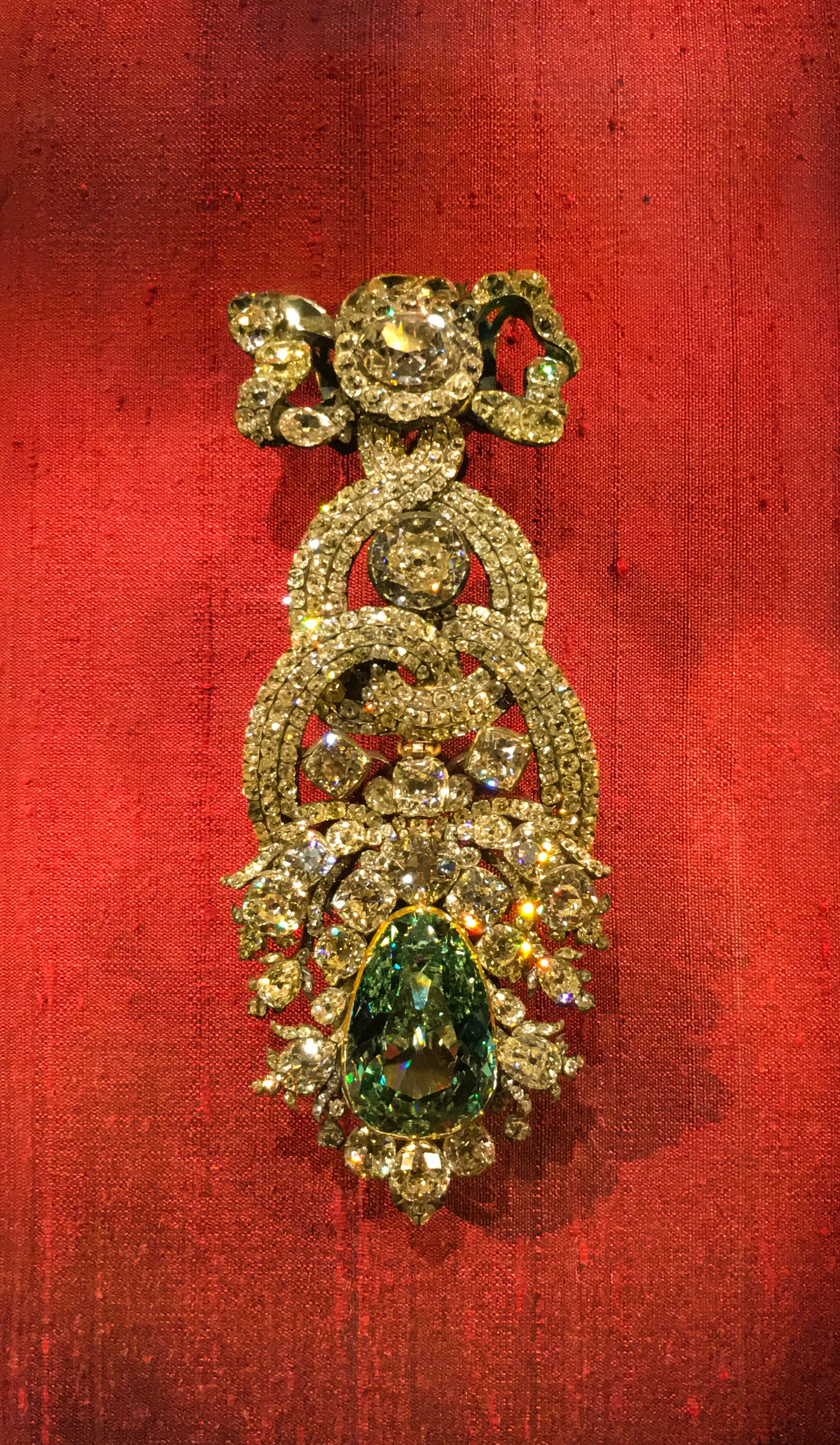
In the small hours of 25 November 2019, around four in the morning, thieves set fire to an electrical distribution box near the Augustus Bridge in Dresden. The blaze cut the power to the street lamps along the river and knocked out part of the alarm system covering the Grünes Gewölbe, the Green Vault, one of the oldest museums in Europe and the historic treasure chamber of the Saxon kings. Two men then forced a window grille that had been quietly cut beforehand, climbed inside, and went straight for the jewel room.
With a small axe they smashed the glass of the cases and, within minutes, swept up several eighteenth-century Saxon parure sets of August the Strong and his successors, studded with diamonds, rubies, emeralds, and sapphires, including pieces holding some of the most famous historic diamonds in the collection. They fled to a waiting getaway car, which was found burned out, and the gang torched a second vehicle to destroy evidence. The estimated value of the haul ran well past 100 million euros, and it was immediately called one of the largest art thefts in postwar Europe. The perpetrators, members of the Berlin Remmo clan well known to German police, were convicted in 2023. After negotiations involving the defence, 31 of the stolen pieces were handed back in late 2022 and restored, though some were damaged. A number of items were still listed as missing at the time of the verdict.
The stones people call cursed
The loudest stones almost always come trailing a legend of a curse. The Hope Diamond is the textbook case: it is said to ruin everyone who owns it, and storytellers list a long chain of bankruptcies, illnesses, suicides, and violent deaths among its former keepers as proof. The pattern repeats with other famous gems, from the Koh-i-Noor, said to bring disaster to any man who wears it, to the Black Orlov and the Delhi Purple Sapphire.
It is worth holding on to a duller truth. Most of these stories were invented or inflated by the very people selling the stones and the journalists writing about them. A grim legend lifts the price and the column inches better than any advertisement, and the dealer Pierre Cartier, for one, is widely thought to have polished up the Hope's curse to help close a sale. Coincidences cluster around any famous object because such an object passes through many hands over centuries, and no one's life is free of misfortune. A curse is not a property of the mineral; it is a convenient storyline laid over an ordinary string of chance events. It makes the stone no more dangerous, only more interesting, and there is nothing supernatural in that.
Send a friend a discount code, they save on their first order.
From legend to the jewellery box: stones with a history you can wear
All these stories share one thing: legend gives a stone a weight far out of proportion to its size. The good news is that wearing a stone with a history does not mean stealing one. The very types of gem that drove thieves and kings to the mallet, the tunnel, and the forgery live quite happily in an ordinary jewellery box, and you can choose them for the same qualities that made them famous without any of the danger.
The blue Hope Diamond is, at heart, a love of deep blue, which is easier and far more honest to satisfy with a sapphire. Behind the Regent and Sancy diamonds stands the whole culture of cutting, the way form and proportion decide how a stone catches light, covered in the guide to diamond colour and clarity. The Irish star set an emerald shamrock against a ruby cross, the classic pairing of green and red that still reads as regal centuries later. And for how a red stone was mistaken for ruby for centuries, and how much that confusion cost the crowns that prized it, there is a separate story about red spinel.
Frequently asked questions
Which of the stolen stones was the most valuable?
There is no single answer, because the estimates vary widely and much of the loot never went to public auction. Measured by historical importance and by sheer legend, the front-runners are usually the blue diamond of the French crown that became the Hope Diamond, and the Saxon parure sets from the Dresden Green Vault. By raw cash value of a single robbery, the Antwerp, Schiphol, and Cannes hauls all ran past 100 million dollars.
Were the Irish Crown Jewels ever found?
No. Since 1907 they have officially been listed as missing. The inquiry closed without a single criminal charge over the theft, and across more than a century many theories have come and gone, but none has been confirmed. It remains the most famous unsolved jewel theft in Ireland.
Is it true that the Hope Diamond is cursed?
It is a belief, not a fact. The legend of the curse was inflated by dealers and the press because a grim story raises interest in the stone, and the dealer who sold it to its most famous owner is thought to have embellished the tale himself. There is no real evidence behind it, and coincidences cluster around any famous object that has passed through many hands.
Was there a heist that failed?
Yes, and the most famous is the raid on London's Millennium Dome in 2000. The gang meant to ram the diamond exhibition with the bucket of a digger and escape down the Thames by speedboat, but the police had watched them for months, swapped the real stones for replicas in advance, and waited inside disguised as staff. The robbers were arrested holding worthless fakes.
Which famous stones disappeared without a trace?
The two that have stayed furthest from recovery are the Irish Crown Jewels, lost in 1907, and the Florentine Diamond, gone after the collapse of Austria-Hungary in 1918. Both have been listed as missing for more than a century, and not one account of their fate has ever been confirmed. The Eagle Diamond from the 1964 New York robbery and most of the Antwerp diamonds also vanished for good.
Which of these heists inspired films?
The 1964 theft of the Star of India has been retold many times in books and on screen as the textbook museum robbery, and it made its ringleader briefly famous. The blue Hope Diamond gave screenwriters the idea for the fictional "Heart of the Ocean" in the film about the Titanic, and both the Antwerp and Hatton Garden jobs have since been dramatised on film.
Can you see the recovered Dresden stones today?
Yes. Most of the stolen sets were handed back and returned to the museum in late 2022, and the Grünes Gewölbe is open to visitors again. Some pieces were still missing at the time of the 2023 verdict, and a few of the recovered items were damaged, so the collection is not shown entirely as it was before the theft.
Conclusion
All these stories share one hero, and it is neither the thief nor the king but the stone itself. It outlives owners, investigations, and film plots, passing from a treasury to a getaway car to a museum case and back again over centuries. Legend adds more value to a famous gem than its carats ever could, and that is exactly why people faced the mallet, the tunnel, the arson, and the forgery for a handful of crystals. The quiet lesson under all the drama is simple: a stone with a history is something you can choose and wear, which is far calmer than spending a lifetime guarding it.
Silver, gold, wedding rings, symbolic pieces, matching sets.
About Zevira
Zevira is a jewellery workshop in Albacete, Spain. We love stones with character and history: sapphire and its deep blue, diamond cuts, emerald and ruby, garnet with the wine-dark depth of its colour. Handwork, engraving to order, transparent sourcing of materials. What makes a stone legendary is not theft but attention to how it is cut and set, and that is the part of the story you can wear every day.