Jewellery by face shape: how to choose earrings, necklace and hairstyle
Introduction: the mirror in the changing room
Anna stood in front of the mirror in a department store in London. She was wearing the long drop earrings she had seen in a magazine and quietly wanted for six months. On the model they looked like a thin line extending the neck. On Anna they were fighting with her face, pulling everything down, adding years. The shop assistant said the line every customer hears at some point: "Not for you, try a different pair."
The earrings were not the problem. The model had an oblong face. Anna has a round one. Long drops emphasised the round curve of her cheeks and made them visually wider. If Anna had picked the same drops in a shorter length with an angular bottom, the effect would have flipped: her face would have looked slimmer.
Matching jewellery to face shape is not magic and it is not a strict code. It is a set of proportional rules used by Renaissance portrait painters, by Hollywood stylists in the 1940s, and by modern makeup artists. The rules are simple. Jewellery works as lines, and lines either echo the shape of the face or correct it.
This guide goes through the six main face shapes, explains what lengthens, what softens, what highlights the cheekbones or the chin. Inside we work through earrings, necklaces, hairstyle, and even spectacle frames. If you want to start with material basics, see our guides to metal by skin tone, to earring types, and to chain length. When you are ready, try combinations through our jewellery layering guide.
Why match jewellery to face shape
The face is the first thing people see. Jewellery sits right in that focal area. Earrings frame the cheekbones, a necklace lies on the collarbones, the hairstyle frames the silhouette of the head. All of it enters the same frame, and the viewer reads the proportions at once.
When jewellery conflicts with face shape, the effect is not catastrophic but it is visible. The face looks heavier than it actually is. The chin pushes forward or disappears. The cheekbones become too sharp or, on the contrary, blur out. A long neck shortens. A small face gets lost under oversized earrings.
Well chosen jewellery does the opposite. It balances asymmetry. It lengthens a short face or softens a square one. It highlights the eyes or the cheekbones, by choice. It creates the feeling that the jewellery and the face were made for each other, even though the viewer cannot say why.
The goal of this guide is not to lock anyone in a box. There are no universal bans. Any woman can wear any earring, and any choice will be personal. But if you want jewellery to work for you rather than against you, knowing your face shape shortens a two hour fitting session to five minutes.
How to identify your face shape in three minutes
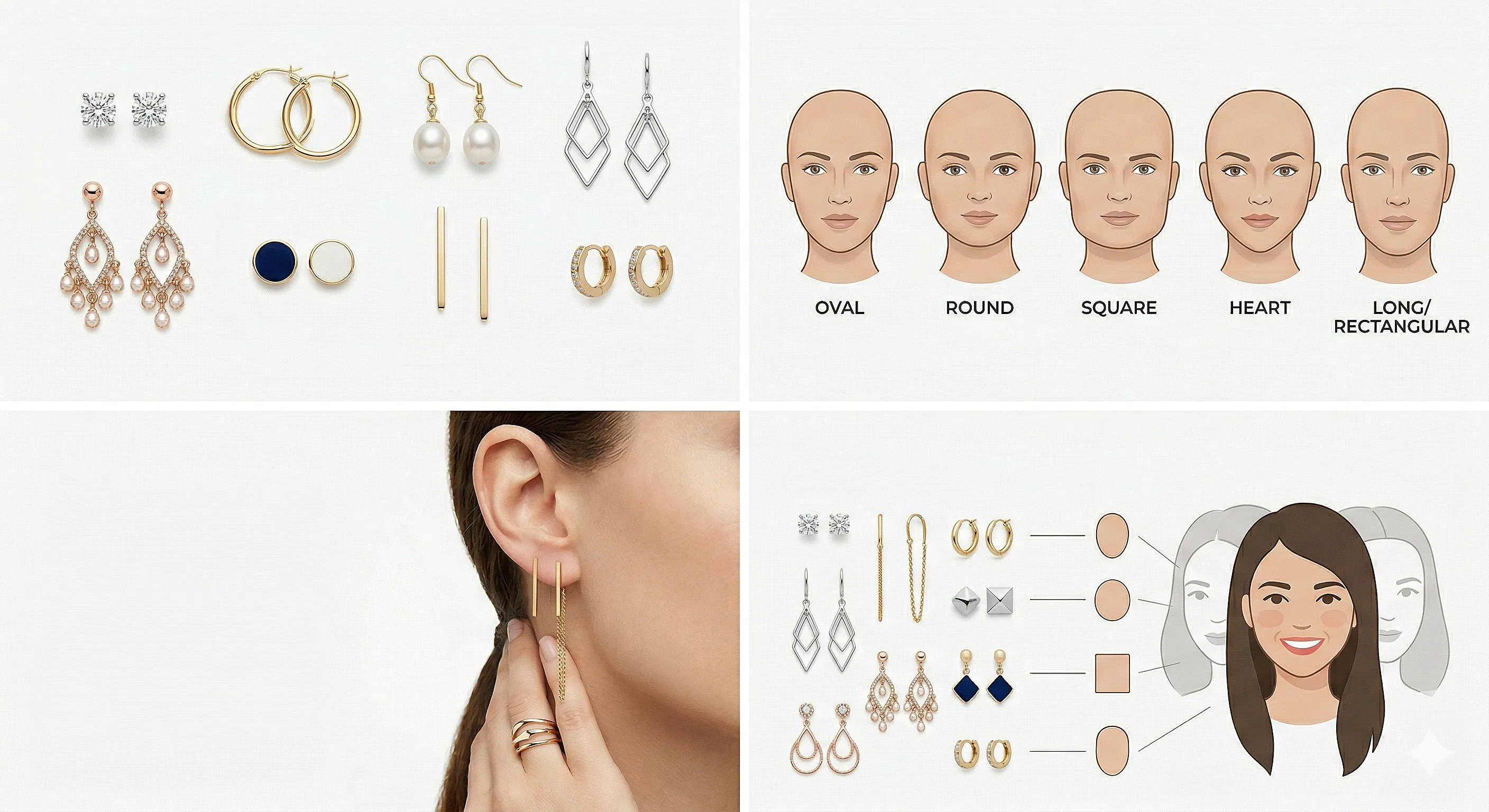
There are seven recognised shapes: oval, round, square, heart (triangular), oblong (long), diamond, and pear (inverted triangle). The pear is rarer and often grouped under the heart. We work through the six main ones here.
The mirror test takes three minutes. You need a mirror, a soft pencil or eyebrow marker, and a tape measure or ruler.
Step one. Pull your hair back off your forehead, open up your whole face. Stand at arm's length from the mirror, look straight ahead. Or take a selfie in flat light, no smile.
Step two. Measure four lengths. Forehead (from temple to temple at the widest point). Cheekbones (from the point under the outer corner of one eye to the symmetric point on the other side). Jaw (from one corner of the jawline to the other). Face length (from the hairline at the top to the tip of the chin).
Step three. Compare the numbers.
- If face length is 1.5 times or more the width of the cheekbones, and forehead and jaw are roughly equal width: oblong.
- If face length is roughly equal to cheekbone width, forehead and jaw are roughly equal, jaw corners are sharp: square.
- If face length is roughly equal to cheekbone width but the jaw corners are soft and cheeks are round: round.
- If forehead is wider than jaw, chin is narrow, cheekbones are medium: heart.
- If cheekbones are wider than both forehead and jaw, both forehead and chin are narrow: diamond.
- If everything is proportional, forehead slightly wider than jaw, length slightly more than width: oval.
A fast alternative. Look at your chin. Sharp and narrow points to heart or diamond. Round and soft points to round. Straight and wide points to square. Long and gentle points to oval or oblong.
Six main shapes: the overall map
Remember a simple principle behind all of the recommendations. Jewellery should add what the face lacks, and not emphasise what is already there in abundance.
Round face looks for verticals (lengthening). Oval is universal (almost anything works). Square looks for curves (softening). Heart looks for volume below (balance). Oblong looks for horizontals (widening). Diamond looks for width at forehead and chin (so cheekbones do not dominate).
That is the base logic. Then come the nuances: earring length, the shape of the bottom, the distance from earlobe to shoulder, necklace length, neckline type, and hairstyle. Every detail works for you or against you.
The good news is that none of these recommendations are strict. They are directions, not bans. Grace Kelly, who had a square jaw, wore round diamond earrings and looked superb. Jacqueline Kennedy, who had an oblong face, wore long thin strands of pearls (classically "not recommended") and looked superb too. Knowing the rules gives you choice. You can follow them or consciously break them.
Oval face: the flexible all rounder
The oval has been treated as the proportional ideal since Greek sculpture. Length slightly greater than width. Forehead slightly wider than chin. Jaw corners gently rounded. Cheekbones present but not dominant.
What works. Almost everything. Studs, drops, long pendants, hoops of any size all suit the oval face. Necklaces from choker to opera. Hairstyles with or without a fringe.
What to watch out for. The oval does not need lengthening, softening, or extra volume. The stylist's job for the oval is not to correct the shape but to highlight strong features: eyes, cheekbones, mouth, neck.
Earrings. To highlight the eyes, pick earrings at mid ear or earlobe height, in the colour of your iris. To highlight cheekbones, pick earrings that reach chin level, with the accent in the middle. To highlight a long beautiful neck, pick long drop earrings that reach the shoulders.
Necklace. Princess (45 cm) sits on the chest and works with most necklines. Choker (35 to 38 cm) highlights the neck. Matinee (55 to 60 cm) sits well over button up blouses.
The main rule for the oval. Do not overload. The oval is strong on its own. One central piece works better than three medium ones.
Customer reviews
Zevira is a real jewellery shop. Genuine payments, deliveries and customer thank-yous.
🥰🥰🥰 gracias
Ok, ¡gracias! 🙂
Round face: the task is to lengthen
A round face has roughly equal length and width. Cheekbones and cheeks are round. Jaw corners are soft, chin is gentle. Forehead is medium or low.
The face looks young and approachable. But visually it can read as short and wide, especially if the chin is soft. The job of jewellery is to stretch the vertical.
What to choose.
- Earrings. Long drops, teardrops, elongated pendants, threader chains. Sharp shapes at the bottom (downward triangle, rhombus). Minimum width, maximum length.
- Necklaces. Vertical pendants, a long chain with a single teardrop or vertical bar pendant. A Y necklace (with a central hanging element) is ideal. Length matinee 55 to 65 cm.
- Length direction. Anything that points down and lengthens the line of the neck.
What to avoid.
- Small round studs (they echo the roundness of the face).
- Big round hoops (they add width).
- A tight choker close on the neck (it shortens the neck even more).
- Heavy pendants where width is greater than length.
Hair. Long hair, pulled down, especially straight. Fringe avoided, or strongly side swept. Volume on top (a high pony, a tight bun on the crown) extends the silhouette.
Sample look. Vertical threader earrings in silver 8 to 10 cm long, a long chain 60 cm with a teardrop pendant, straight loose hair. The face reads slimmer instantly.
More for the round face. Pieces with a strong vertical element (a bar, a long shaft) work harder than soft drops. For maximum lengthening, choose earrings with open geometry rather than dense closed forms. Thin lines beat wide plates. Layered necklaces in one long stack lengthen more than a single medium piece. The key is keeping the ratio of length to width higher than 1:2 across the whole ensemble.
Square face: the task is to soften
The square face has roughly equal length and width like the round, but jaw corners are sharp, the forehead is wide and relatively straight, and the chin is not pointed. The lines of the face are angular.
This is a strong, sculptural face. It works for actresses in dramatic roles. But when the angles are emphasised, the look can read as severe.
What to choose.
- Earrings. Medium round hoops, round pendants, drop earrings with soft curves, oval stones. Any curve softens the square.
- Necklaces. Round pendants, U shaped necklaces (princess or matinee), pearl strands. Avoid V shaped and angular forms.
- Placement. Earrings that frame the cheekbones (not the ears) soften the jawline. Length at earlobe or slightly below, not at the shoulders.
What to avoid.
- Geometric earrings (squares, rectangles, triangles, rhombus) which echo the angles.
- Thin flat studs (they vanish on a strong jaw).
- Heavy wide chokers with straight edges.
Hair. Waves and curls soften the square beautifully. Layered cuts with face framing. Medium length or below the shoulders. Long side swept or textured fringe, not a heavy blunt one.
Stones. A round or oval solitaire in a pendant works better than a princess cut diamond. A princess cut on a strong jaw can fight; an emerald cut can too.
Sample look. Medium gold hoops 4 to 5 cm, an oval pendant on a 50 cm chain, light waves. The face reads more feminine, and the angles drop back into the cheekbones as an asset.
Note. A square face takes asymmetry well. One big drop earring on one side and a small stud on the other can work better than a symmetric pair. If you wear a stack on one ear (a helix cuff plus a lobe stud), keep the other ear at one soft earring. Twisted cable chains also soften the square: their wave pattern adds organic flow to the look.
Heart face: the task is to add volume below
The heart face has a wide forehead, pronounced cheekbones, and a narrow pointed chin. The outline goes from a wide top to a sharp point at the bottom, like an inverted triangle.
This is the face of classic Hollywood beauties of the 1940s and 1950s: high foreheads, cat like cheekbones, small chins. Almost everything suits it, but with the wrong choice the chin can read as too sharp.
What to choose.
- Earrings. Wider at the bottom, narrow at the top. Drops, pears, upward pointing triangles, chandelier with downward widening. They balance the narrow chin by adding visual mass at the jawline.
- Necklaces. U shaped, princess length to the collarbones, pendants that sit below the throat. They create a rounded curve that continues the narrowing of the face.
- Earring length. From the earlobe to chin level or slightly below.
What to avoid.
- Earrings that point downward (they echo the chin).
- Narrow long threaders (they pull the already narrow chin further down).
- Tight chokers (they cut the narrow part of the face off the neck too high).
Hair. Volume at chin level and below works as earrings do. A medium length bob with light texture, long waves to the shoulders. A centre parting highlights face symmetry.
Fringe. A light side swept or longer fringe visually narrows a wide forehead. A heavy straight fringe makes the forehead even wider and the chin even sharper.
Sample look. Teardrop pearl earrings wider at the bottom than the top, a princess necklace of small pearls. The heart face reads at its most harmonious in this look, which is why pearls have historically been tied to this type of beauty.
Oblong face: the task is to add width
The oblong face is longer than it is wide by 1.5 times or more. Forehead, cheekbones and jaw are roughly equal width. The face reads as stretched vertically.
This face is elegant and aristocratic. It works in front view and in profile. Without the right jewellery, it can read as too thin or too serious.
What to choose.
- Earrings. Wide and short. Large button studs, round hoops, cluster earrings, statement studs with a large stone. The key: width greater than length.
- Necklaces. Chokers, short dense necklaces (35 to 42 cm), wide collars, layered short chains. They break the vertical at collarbone level.
- Pendants. Prefer horizontal bars over vertical ones.
What to avoid.
- Long drop earrings (they extend the face further).
- Linear earrings (vertical lines).
- Long opera or matinee necklaces, especially with a vertical pendant.
- Y necklaces.
Hair. Medium length hair with side volume, waves and curls add width. A chin length bob with outward styling. Layered cuts.
Fringe. A heavy straight fringe is one of the best strategies for an oblong face. It shortens the forehead visually and brings the proportions closer to ideal.
Sample look. Large round hoops 5 cm, a dense choker of two or three gold chains, a straight fringe and medium length hair. The face gains balance between length and width.
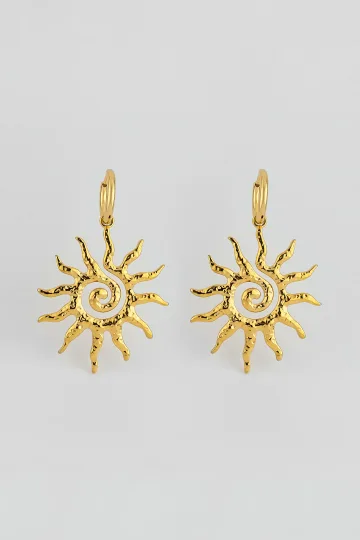
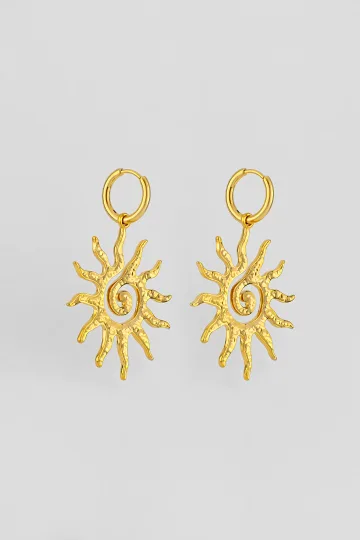
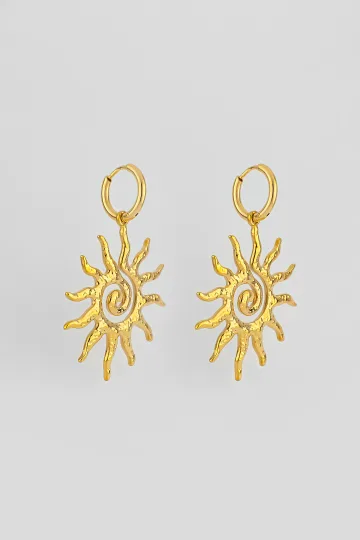
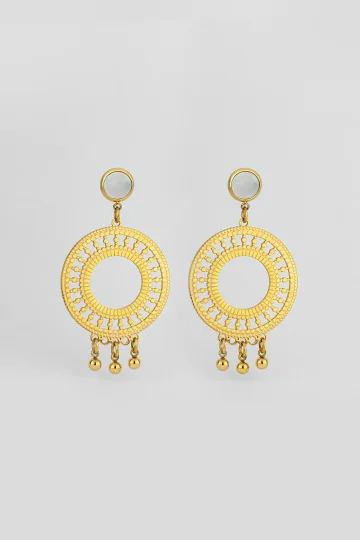
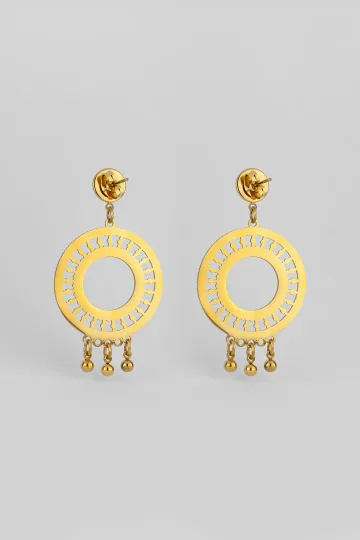
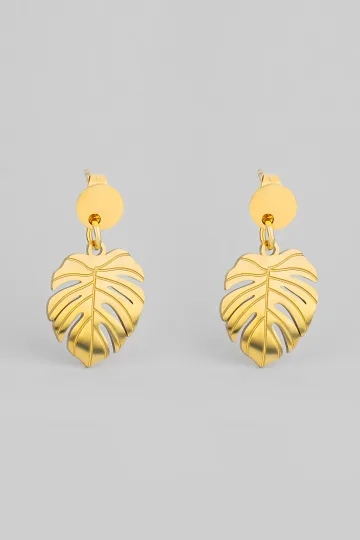
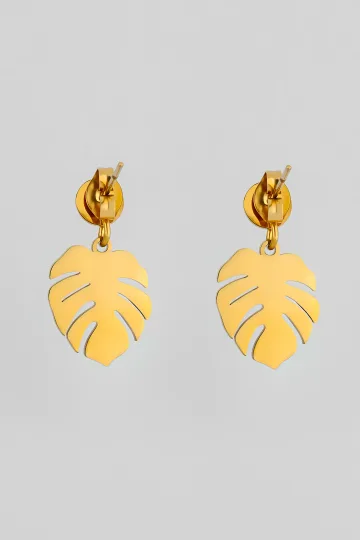
Wear the symbol, don't just read about it. These are in stock:
Diamond face: the task is to soften the cheekbones
The diamond face has its widest point at the cheekbones. Forehead is narrow, chin is narrow, cheekbones dominate. The face resembles a marquise cut diamond.
This is a very photogenic face. Cheekbones cast shadow, eyes look more expressive. But in real life with the wrong jewellery the cheekbones can read as too sharp, and the forehead and chin can read as too narrow.
What to choose.
- Earrings. Earrings with width at the top and at the bottom. Chandelier earrings with a tiered structure. Earrings with detail at brow level and a second section below. Wide flat shapes at the lobe paired with a long drop.
- Necklaces. Princess or a medium height choker that widens the narrow jaw and chin. V shaped necklaces work because they echo the narrow chin without emphasising it.
- Idea. The widest part of your jewellery should sit at forehead level or chin level, not at cheekbone level.
What to avoid.
- Earrings that widen exactly at cheekbone level (they double the widest part of the face).
- Button studs sitting right on the lobe and adding width horizontally at the cheekbones.
- Heavy geometric pieces at cheekbone level.
Hair. Volume on the crown and at chin level. A fringe adds width to a narrow forehead. A bob with bottom volume is ideal. A high bun is not, because it lays the cheekbones bare.
Sample look. Ear cuff on the upper ear plus a small stud at the lobe, V necklace princess to the chest, soft waves with volume at chin level. The cheekbones stay beautiful but no longer dominate.
Note. A diamond face is often mistaken for a heart face at a glance. The key difference is the forehead. The diamond has a narrow one, the heart has a wide one. If you keep getting heart recommendations that do not work, check forehead width against cheekbones. If forehead is narrower, you are a diamond. Then instead of necklaces that widen the lower face, look for volume at forehead level (a decorative headband, ear climbers).
A diamond face is very photogenic in profile thanks to the cheekbones. For photo shoots and video calls you can wear bolder earrings than in daily life. The camera will smooth the intensity.
Earrings: length and shape
Earrings are the jewellery closest to the face. They act as a frame, and the viewer reads proportions through them.
Length rule.
- At the earlobe (studs, small huggies) suits any shape. Minimum risk.
- At cheekbone level (short drops 2 to 3 cm) emphasises cheekbones. Good for oval and round. Not ideal for diamond.
- At chin level (drops 4 to 6 cm) lengthens the face. Good for round. Not ideal for oblong.
- At jaw line (drops 7 to 9 cm) strongly lengthens. Reserved for round and square.
- At the shoulders and below (long linear, chandelier) strong lengthening. Suits the round face. For others, risk.
Shape rule.
- Round shapes (circles, ovals, hoops) soften.
- Sharp shapes (triangles, rhombus, marquise) lengthen and emphasise angles.
- Geometric (squares, rectangles) add structure.
- Organic (drops, leaves, feathers) add motion.
Colour rule. Earring metal colour should match warm or cool skin undertone (see metal and skin). Stone colour can echo the iris colour to intensify the gaze.
A deeper look at all earring types and how they work with different face shapes lives in our earring types guide.
Hoops by diameter.
- 1.5 to 2 cm huggies (close to the lobe): universal.
- 3 to 4 cm small hoops: oval, round with care.
- 5 to 6 cm medium hoops: square, oblong, oval.
- 7 cm and above large hoops: oblong, oval, heart.
- 10 cm and above oversized: a confident look. The oblong face carries them best.
Weight. Heavy earrings stretch the earlobe over the years. If you plan to wear big drops every day, choose lighter versions (hollow metal, acrylic with plating, light pearl) instead of solid cast pieces. This is not a style question, it is a long term question about the shape of your ear.
Necklaces and necklines: working together
A necklace reads in two ways. By its own shape (U, V, straight) and by how it works with the neckline of your clothing. The pairing affects facial proportions just as much as the earrings.
Base rule. Necklace shape should either echo the neckline or contrast with it cleanly, without crossing it.
- V neckline plus V necklace lengthens the face. Good for round, bad for oblong.
- Round neckline plus U necklace softens the face. Good for square, bad for oblong.
- Boat neck plus collar to the collarbones widens the top. Good for oblong, bad for round.
- V neckline plus a short round necklace creates a line conflict. Usually best avoided.
Lengths.
- Choker (35 to 38 cm) suits round necklines and oblong faces.
- Princess (43 to 48 cm) universal, sits on the upper chest.
- Matinee (50 to 60 cm) works with button up blouses. Not ideal for oblong.
- Opera (70 to 90 cm) and rope (90 cm and up) are dramatic lengths that need a matching outfit. They lengthen the face.
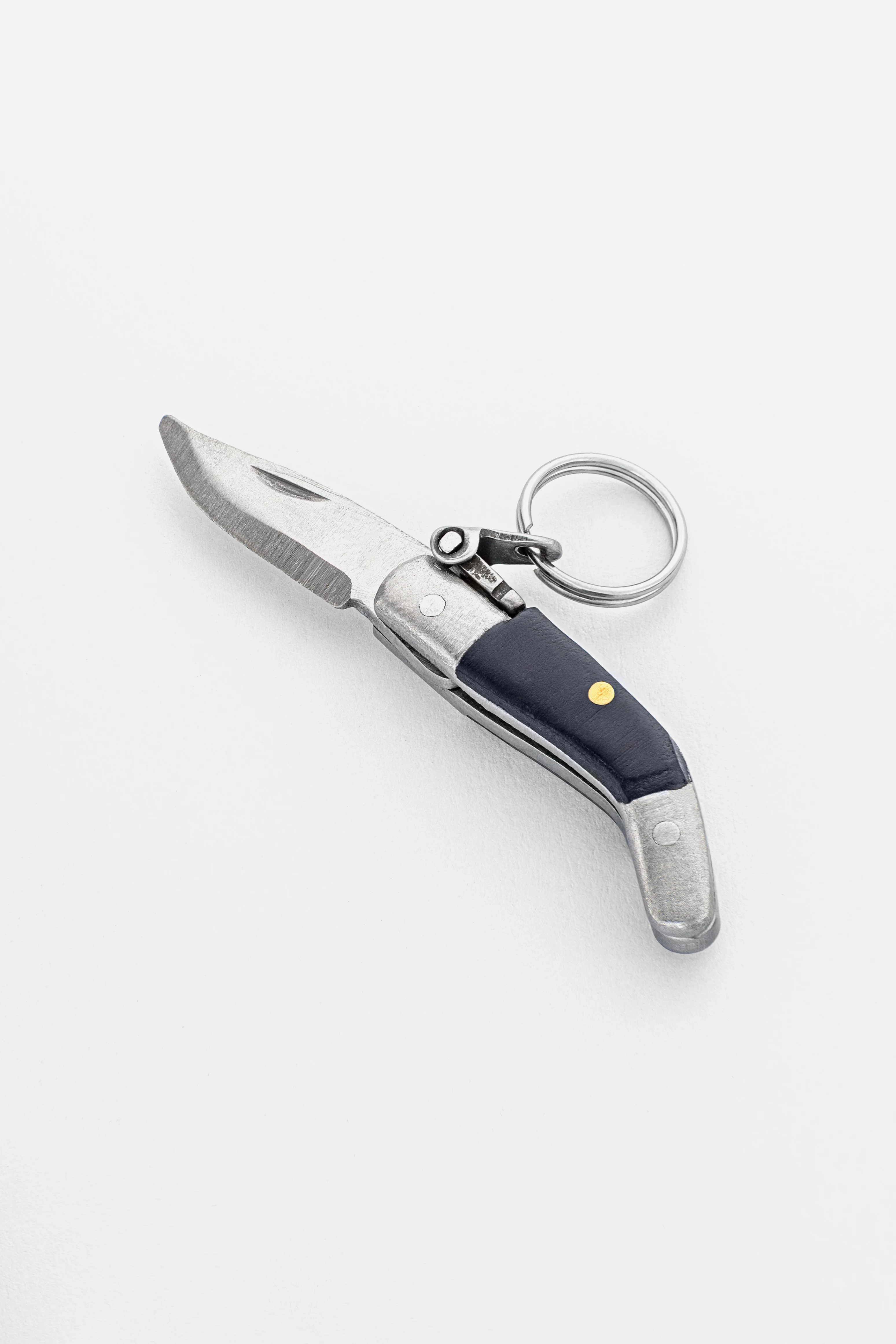
Artisan-crafted CAPAORA navaja pendant
A 40 mm stainless-steel navaja with a real folding mechanism and Palanquilla lock. An affordable gift to remember.
A code for blog readers:
10% off your first order
Authentic · Maker's guarantee · Ships from Spain
Choker, princess, matinee, opera: lengths for the oval
Each length has a name and a function. Knowing the names speeds up the shop visit. You can say "matinee 55" and get the right piece.
Collar (30 to 35 cm). Snug at the throat. Very dramatic. Suits oblong and square. Choker (35 to 38 cm) is slightly looser at the base of the neck. Universal for oblong, careful for round.
Princess (43 to 48 cm). Classic length, sits on the collarbones. Suits almost everyone. The most frequent choice for daily wear.
Matinee (50 to 60 cm). Sits between collarbones and bust. Ideal for blouse looks. Not for round faces (vertical line).
Opera (70 to 90 cm). A long strand to the solar plexus or below. Dramatic. Ideal for oval and oblong. Can be worn in one or two loops.
Rope (90 cm and up). Lariat, long chain. Can be knotted, wrapped. Universal but needs a thought through outfit.
A full guide to lengths is in our chain length guide.
Rings and bracelets: how face shape carries to hand proportions
There is no direct link between face shape and finger shape. But overall body proportions usually align. A person with a round face often has shorter fingers and fuller hands; a person with an oblong face often has long fingers and slim wrists.
So the rules carry across indirectly. The round face often suits narrow lengthening rings (long oval signet, marquise). The oblong face often suits wider rings with a horizontal accent (cushion, princess). The square face takes everything with softened corners.
Bracelets follow the same logic. Thin lengthening pieces for round wrists, wider ones for thin wrists, soft round forms for angular wrists. More in our bracelet types guide and ring stacking guide.
Hair and jewellery: a single ensemble
Hair on the face is the second piece of jewellery after earrings. Length, volume, fringe, parting work on the same principles.
Base rule. Hair should correct the same disproportion as the earrings. If you have a round face and wear long drops for lengthening, keep the hair straight and long below the shoulders. If you choose a tight bun on top, you do not need the drops; the hairstyle is doing the lengthening.
Hair plus earring conflict. If the hair strongly lengthens (high pony, straight long hair) and the earrings also lengthen (long linear), the result is over stretched. The face starts to look too thin and tired.
Universal rule. One of the two elements corrects expressively, the other stays neutral.
The fringe matters most. A heavy straight fringe shortens the forehead (good for oblong, bad for round). A side swept fringe hides a wide forehead (good for heart). No fringe opens the whole forehead (universal but emphasises square and round).
Leave your email, we'll send your discount code. No spam, unsubscribe anytime.
The code arrives by email, valid on your first order.
Glasses and earrings: avoiding conflict
If you wear glasses, the frame joins the face frame alongside earrings. Often the two compete, and you have to choose a priority.
Principle. The frame and the earrings should either echo each other or one dominates and the other stays minimal.
- Heavy frame plus large earrings is too much, the face drowns in jewellery.
- Thin frame plus large earrings works, accent on earrings.
- Heavy frame plus small studs works, accent on glasses.
- Rimless plus any earrings works freely.
Colour. Frame and earring metal go well coordinated. Black frames pair with silver, white gold, platinum. Tortoiseshell pairs with gold, bronze. Clear plastic is neutral.
Shape. A round frame on a round face is doubling up. If you wear glasses, the frame should correct the face shape. Round face wants rectangular glasses. Square face wants oval. Heart face wants cat eye or aviators.
Metal colour and skin tone near the face
Earrings and pendants sit directly on the skin of the neck and below the ears. If the metal tone does not suit your skin, the contrast is felt even without conscious analysis.
Warm skin undertone (golden, peach, olive, warm bronze tan): yellow gold, rose gold, copper, brass.
Cool undertone (pink, blue tinted, porcelain, silvery tan): silver, white gold, platinum, rhodium.
Neutral undertone (most people): both warm and cool metals work. You can mix freely.
Quick test for warm vs cool. Look at the veins on your wrist in daylight. Greenish veins mean warm. Bluish or purple veins mean cool. A mix of both means neutral.
More on matching metal to skin.
Stones near the face: how to choose the centre
A coloured stone in an earring or pendant works as an accent. Sitting close to the face, its colour should highlight your strong features.
Eye colour. A stone of the same colour intensifies the iris. Blue eyes plus blue topaz or aquamarine. Green eyes plus emerald or peridot. Brown eyes plus smoky quartz or garnet. Grey eyes plus pearl or moonstone.
Hair colour.
- Blonde: pastels, aquamarine, morganite, light citrine.
- Brunette: deep stones, ruby, sapphire, emerald.
- Red: warm stones, citrine, garnet, amber.
- Grey hair: pearl, black onyx, black pearl, deep blue sapphire.
Skin tone.
- Fair skin: pastels and bright stones. Too dark and the stone "eats" the face.
- Medium: almost anything works.
- Dark: contrasting bright stones look superb, light pastels can fade.
More on stone meanings in our jewellery symbols guide.
Makeup and the direction of lines
Makeup sets facial lines as much as jewellery does. Eye liner extends the eye, blush highlights cheekbones, contouring darkens forehead and jaw.
Coordination of makeup and jewellery.
- To emphasise the eyes, pick earrings with a stone in iris colour and keep the lips neutral.
- To emphasise the lips (bold lipstick), keep the earrings minimal.
- With strong contouring, do not add a heavy necklace. The face will look overloaded.
Eyebrows. Brows are the horizontal line above the eyes. Thin high arched brows lengthen the face. Straight low brows widen it. Earrings at brow level (reaching them in length) intensify this line.
Lipstick and metal. Warm lipstick (coral, brick, burgundy) goes with gold. Cool lipstick (fuchsia, wine, berry) goes with silver. When the mouth is bold and the metal is in the wrong register, the look reads as disconnected. If you wear a particular lipstick shade daily, check that your earrings stay in the same warm or cool family.
Eye shadow. A deep smoky eye asks for minimal earrings, or the upper face gets overloaded. A naked face with strong lashes lets bigger earrings work. This is about distributing weight across the face. If the eyes shout, the ears whisper, and vice versa.
Age and how to adapt
Face shape changes with age. By 40 to 50 the contours can soften (square becomes closer to oval), the jawline can carry slight fullness, the cheekbones can flatten.
What this changes for jewellery.
- Earrings that worked at 20 to 25 may not work at 45. Especially if a once strongly square face is now closer to oval with soft chin fullness.
- Long drops lengthen the neck visually and help when the chin area carries slight extra weight.
- Chokers tend to get less comfortable over time, both stylistically and physically.
- Pearls and matte gold sit softer on older skin than bright mirror finish stones.
This does not mean that after 45 a woman should "settle into pearls". Grace Kelly, Jacqueline Kennedy and Audrey Hepburn wore bold pieces at every age. The principle is adaptation: if something stops working, try a slightly different shape or length, without changing the whole register.
Selfies and video calls: what works on camera
A camera does not see the face the way a mirror does. The lens distorts. A wide angle front camera makes the nose larger and the forehead wider. That means jewellery reads slightly differently on video than in person.
For selfies and video calls.
- Medium earrings read better than small studs, which vanish on camera.
- A pendant below the throat is visible; a choker often falls outside the frame.
- Shiny stones and mirror finish metals work with the right lighting, but they catch glare under strong overhead lighting.
- Matte finishes (matte gold, pearl) read well in any light.
More on this in our jewellery for video calls guide.
Wedding looks: jewellery by the bride's face shape
Wedding photography is full of close ups. The bride's face shape drives jewellery choices more strictly than daily wear.
Under a veil.
- A long veil plus long drops is too much, the length cascades downward.
- A short birdcage veil plus large earrings works beautifully, especially on a square or oblong face.
With a high updo.
- Neck open, ears open. Any earrings are visible. Choose by face shape as usual.
With loose hair.
- Ears partially covered. Earrings should be either longer than the hair or shorter than it. "In line with the hair" reads poorly.
Pearls as the universal wedding stone. They suit almost every face shape thanks to a soft sheen and neutral form. More in our bridal wedding jewellery guide.
Send a friend a discount code, they save on their first order.
Office looks: jewellery for the workplace
For work and negotiations the rules tighten. Jewellery should not distract from the face. People should listen to you, not stare at your hoops.
Office earring baseline. A stud or a small drop up to 3 cm. Face shape rules apply but on a smaller scale.
Office necklace. A fine princess or matinee chain with a small pendant. No large V necklaces or statement pieces.
Colour. Classic gold or silver. No bright enamel or large coloured stones. Pearls are universal and entirely office friendly.
For people who work in front of a camera (presenters, on screen sales, talk show hosts), the rules shift. Strong lighting and camera ask for slightly bolder jewellery.
Round hoops on a round face only underline what nature already rounded off. Draw a line down, not a circle around. Trust me on this.
How to wear jewellery for your face shape
After years on shoots I pick earrings and chains for the face in front of the mirror, not for the trend. Here is what actually works, by occasion.
What works for every day? For daily wear I recommend one quiet accent for your face shape: a short drop or a stud plus a fine chain at the collarbone. It sits best under a crew neck or a roll neck, where an open throat gives the earrings room. Keep to one metal and calm colours. This set keeps the face fresh and never looks thrown together.
Is it right for the office? For work I suggest keeping the scale down: a stud or a drop up to three centimetres for your shape, and a fine chain that matches your watch and buckle. It reads cleanest under a V-neck shirt or a blazer, where the neckline holds the earrings up. Save the big hoops and bright stones for the evening.
How do I build an evening look? In the evening I choose the piece that corrects the face shape and push that one further. For a round face I recommend long linear earrings with the hair up; for an oblong face, bold studs or hoops under a high collar. A deep neckline asks for a long pendant, a boat neck for a short necklace. Dark, dense fabric gives metal and stones more depth.
What works on camera? For photos and video calls I suggest mid-size earrings: the lens swallows tiny studs. A pendant below the throat shows, while a choker often gets cropped by the frame. Matte gold and pearl read evenly in any light, mirror-bright stones catch glare from overhead lamps.
Where do I start if I do not know my shape? Start with one rule: jewellery adds what the face lacks and never traces what it already has. A round face wants a vertical, a square one a curve, an oblong one width. Then hold the rhythm: one loud piece, the rest a whisper. If the earrings shout, the necklace stays quiet.
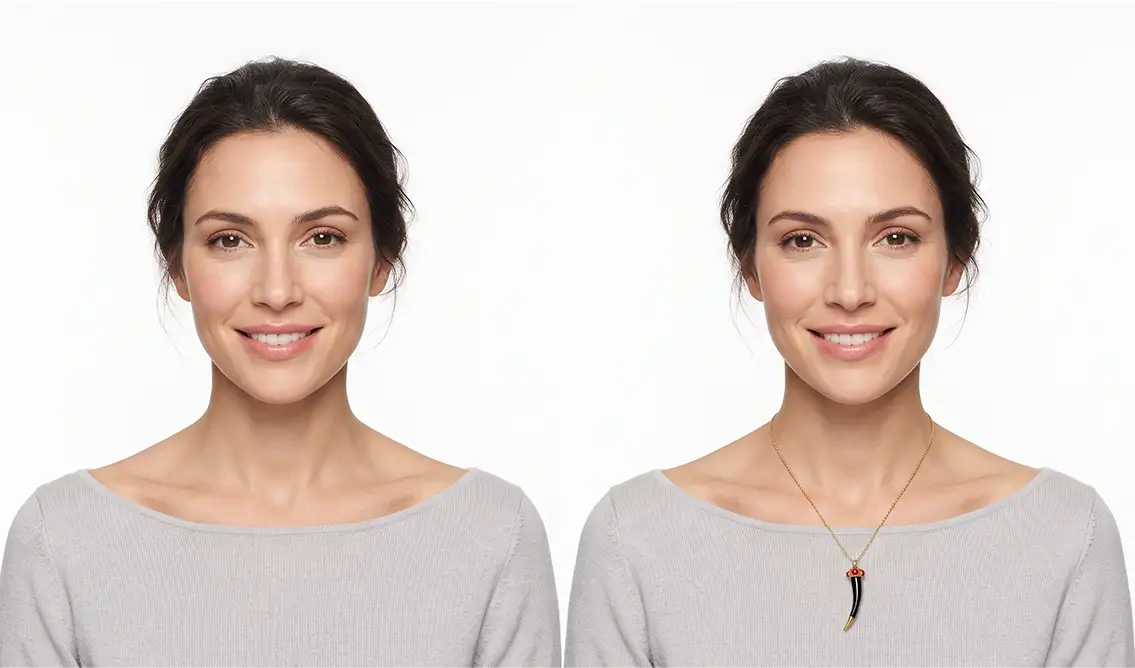
Turn on your camera, pick earrings, a pendant or a ring, and see the piece on yourself in real time.
Switch items in one tap.
Everything runs in your browser: no photo or video is ever uploaded.
Common mistakes when choosing by face
Mistake 1. Echoing the face shape. Round face plus round earrings, square face plus square ones, heart plus triangle. This is the first intuitive move, and it works against you.
Mistake 2. Following the rules blindly. Sometimes the "correct" earrings do not suit your personal style. If you love geometry and have a square face, wear medium sized geometric earrings. Nothing terrible will happen.
Mistake 3. One rule for every occasion. Earrings for the office, for a wedding, for a date, and for a video call are four different earrings.
Mistake 4. Ignoring the hair. Earrings work as a package with the hairstyle. If you change a haircut, check whether you need to change the earring set.
Mistake 5. A perfectly symmetric set. Earrings plus necklace plus ring from the same collection often look over coordinated and add years. The modern approach is one central element with quieter pieces around it.
Mistake 6. Choosing only by trend. If your face shape does not suit the trend piece, skip it. Massive hoops are in fashion now, but they do not suit every face.
Ready made recipes for each face shape
Oval. Medium drop earrings 4 to 5 cm, round or teardrop shape, princess necklace 45 cm with a collarbone pendant, oval cut solitaire ring.
Round. Long threader or drop earrings 6 to 8 cm with a sharp bottom, long matinee chain 60 cm with a vertical bar, narrow marquise ring.
Square. Medium round hoops 4 cm or pearl drops, princess pearls or a round pendant, ring with an oval or round centre stone.
Heart. Teardrop earrings widening downward 4 cm, U shaped princess to the collarbones, soft round rings.
Oblong. Large studs 1.5 cm or short drops up to 3 cm, choker 35 cm or several short layered chains, cushion cut ring with a horizontal accent.
Diamond. Two tier chandelier earrings (top plus drop), V necklace princess, ring with an oval centre stone.
Frequently asked questions
How do I identify my face shape when it sits between oval and round?
Most faces are hybrid. If you are stuck between two shapes, go with the more pronounced one and use its rules. If face length roughly equals width but jaw corners are soft, you are a round with an oval lean. Treat it as round.
Can I wear hoops with a round face?
Yes, with care. Not the largest, not perfectly circular. Slightly elongated oval hoops or small huggies up to 2 cm work well. Large classical round hoops widen a round face.
Are there earrings I should never wear, no matter the face shape?
No. The rules are recommendations, not bans. Any stylist can name actresses who wore "wrong" earrings for their face and looked stunning.
Two faces in one family want a single gift set. What works for both?
Pearl drops 3 to 4 cm work for most face shapes. The most universal genre for a family gift set.
Do the rules apply to men who wear earrings?
Yes. The same principles. A round male face suits small lengthening studs. A square one suits round hoops. And so on.
Can makeup or hair change my face shape enough to switch the earring rules?
Yes. Strong contouring can visually turn a round face into an oval, and a high bun can lengthen any face. In such a look you can wear "oval" jewellery even if your bare face is round.
A family heirloom does not suit my face shape. What now?
Wear it on special occasions, not every day. A family piece has emotional value that outweighs the rules. Or ask a jeweller to redo the setting (change a chain length, swap an ear wire for a more comfortable one) without changing the stone.
Does face shape affect the choice of engagement ring?
Indirectly. Finger proportions usually correlate with overall body proportions, which correlate with face. But the ring is not on the face, so the rule is much softer. See our engagement ring guides on the site.
Should I invest in different sets by face shape, or is one universal kit enough?
If you wear jewellery occasionally, one good pearl set (princess plus drops) lasts a lifetime and works on almost any face shape. If you wear jewellery daily, two or three different sets for different looks make sense.
How do face shape rules combine with prescription glasses?
Glasses and earrings should be in the same family of shapes or contrast consciously. See the glasses section above. The rule of thumb: do not duplicate the shape. Round glasses plus round earrings plus round face is a triple that suits no one.
Does face shape change with weight gain or loss?
Yes. With weight gain the face rounds first at the cheeks and under the chin. With weight loss the cheekbones come forward and the face moves toward oval. Adapt your jewellery to your current shape.
What matters more: face shape rules or overall outfit style?
Outfit style matters more for cohesion. But face shape decides which length and shape of earring suits you. Within one face shape you can choose minimalist, classic, vintage or avant garde by style.
Does the length of earrings depend on height?
A secondary factor, yes. Tall people can carry longer earrings without looking overloaded. Shorter people get lost under massive pendants. But face shape is primary.
Where should I check whether earrings work: mirror or photo?
Both. The mirror shows you "live", the photo shows what others see. If the earrings "eat" your face in a front photo, the effect is the same in person; you have just got used to it.
Conclusion
Choosing jewellery by face shape is not a strict code, it is a tool. Knowing the principles gives you freedom. You can follow them so the face looks harmonious with no effort, or break them deliberately when you want a particular effect.
The six main shapes (oval, round, square, heart, oblong, diamond) each have a direction of correction: lengthening, softening, widening, adding volume below or above, softening cheekbones. Earrings, necklaces, hair length, even the frame of glasses, all work as lines that correct those proportions.
The key rule is one strong accent per look. If you choose bold earrings, the necklace stays minimal. If the necklace is the centrepiece, the earrings stay quiet. The face should remain the main subject in the frame. Jewellery is support.
For a deeper dive, see metal by skin tone, earring types, bracelet types, chain length, and ring stacking. For date or special occasion looks, see our jewellery layering guide.
Silver, gold, engagement rings, symbolic jewellery, paired sets.
About Zevira
Zevira makes jewellery by hand in Albacete, Spain. Matching jewellery to face shape is not abstract theory for us. We make earrings and pendants in a range of lengths, shapes and proportions, so that whatever your face shape, there is a piece that works for you and not against you.
What you can find with us by face shape:
- Long drop earrings and threader chains that lengthen a round face
- Rounded hoops and teardrop earrings that soften a square jaw
- Teardrop earrings widening toward the bottom for a heart shaped face
- Large studs and short earrings that add width to an oblong face
- Chains in lengths from choker to the longest strands for any neckline
- Pendants with a centre stone chosen to match eye colour and skin undertone
Every piece is made by hand by a craftsperson, with personal engraving available. Sterling silver 925 and 14 to 18K gold.